Photo by Scott Arenstein
The Los Angeles Philharmonic’s current season, the final one for outgoing Music & Artistic Director Gustavo Dudamel, affectionately called “Gracias Gustavo,” offers a wealth of performances, so much so that even mid-week, single-concert events deliver an extraordinary experience at the impressive Walt Disney Concert Hall. These concerts also draw a broader audience than typical weekend shows, highlighting the LA Phil’s role as a key cultural institution in Downtown LA.
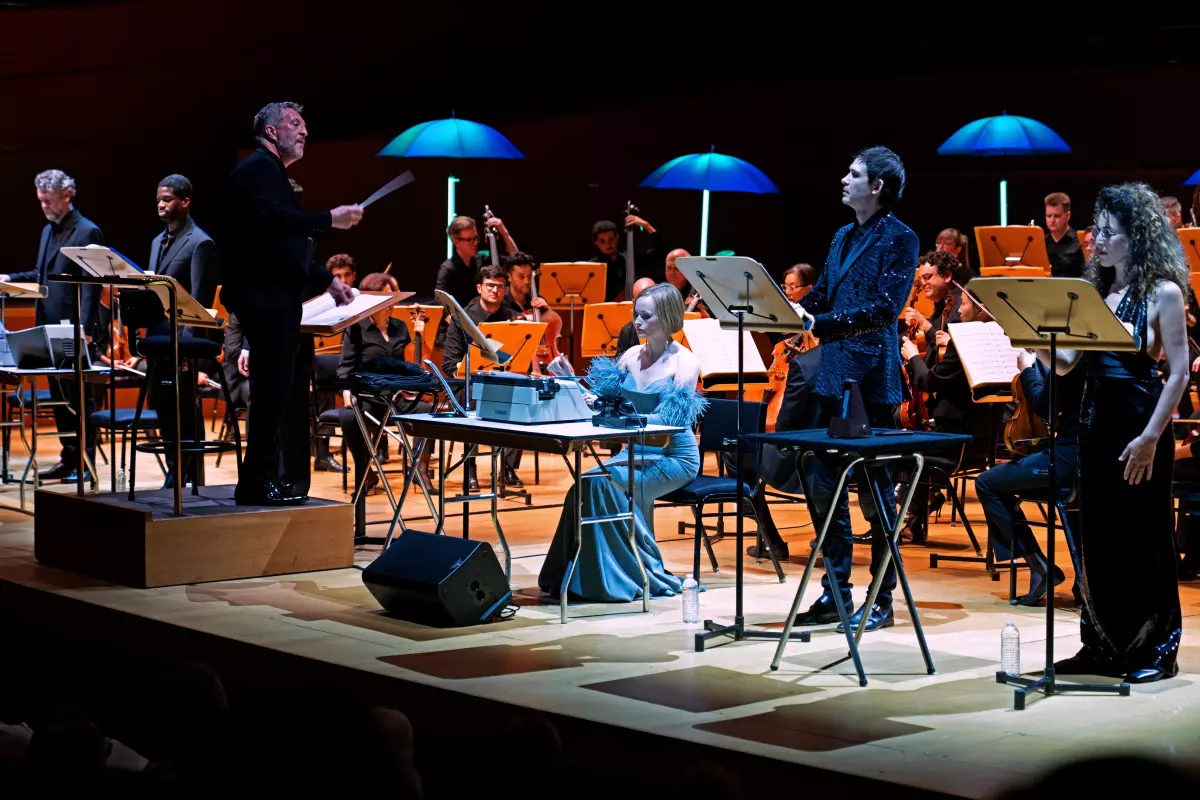
On Tuesday, March 24, the LA Phil presented the U.S. premiere of Irish composer Gerald Barry’s seventh opera, Salome, conducted by his frequent collaborator and fellow composer, Thomas Adès. Since debuting Barry’s second opera, The Triumph of Beauty and Deceit, in 2006, the LA Phil has commissioned and premiered two other operas based on classic literature: The Importance of Being Earnest (2011) and Alice’s Adventures Under Ground (2016), all conducted by Adès. Salome, another LA Phil commission, was scheduled to have its world premiere in April 2021 under Barbara Hannigan’s direction, but the global pandemic prevented those plans. Salome eventually premiered in a 2025 stage production at Theater Magdeburg, directed by Julien Chavaz and conducted by Jerome Kuhn, with Alison Scherzer, who also sang here, in the lead role.
With a libretto by Barry himself, Salome is based on Oscar Wilde’s play, the same source as Richard Strauss’s famous 1905 opera. It features brilliant, wacky deviations from the original that only Barry’s mind could produce. In this version, Salome doesn’t dance, but types instead, and Herod dictates to her Wilde’s own letter De Profundis, written during Wilde’s imprisonment. Barry removes all the names except Salome; Jokanaan is simply addressed as The Prisoner, and he speaks only in French. The opera ends with a “I have kissed your mouth” chorale, mirroring Salome’s own words in Wilde’s play. Most importantly, the piece’s mood shifts from tragic to almost comic (or maybe tragicomic). In Barry’s own words, “Salome is an opera of voyeurism, the moon, French, God, punishment of sin, misunderstanding, sex, the metronome, suicide, hysteria, hunger, blood, typing, speaking correctly, sterility, “The Blue Danube”, the wind, fever, art, Wilde, dreaming, beheading, Frankenstein, kissing.”
Musically speaking, Barry’s Salome couldn’t be further from the opulent sound of Strauss’s creation. I attended The Importance of Being Earnest during the New York Philharmonic’s Biennial a decade ago and was struck by the accessibility of his music (made memorable by the breaking of 40 dishes as percussion). If anything, Salome’s score was even more accessible. The declamatory style of the singing made many short, repeatable phrases easy to discern, and they were very funny. To my ears, the emphasis on brass and lower strings, coupled with numerous musical quotes (including an interpolation of “The Blue Danube”), gave the score an almost Americana, particularly Ivesian, feel. The brilliance of the score didn’t stop there. Barry developed distinct singing techniques for almost every character; Salome’s phrases stretched the limits of the soprano’s voice with its high-flying octave jumps, while The Prisoner spoke his lines rather than singing. Both the music and the texts pushed the piece’s black comedy to the forefront, making Salome a rarity in the contemporary opera world.
Barry found a perfect interpreter in Adès, so much so that in an interview, he admitted that they have always “been on the same page, the same wavelength.” Adès’ contribution to the night’s success couldn’t be understated; he coaxed a sparkling, chamber-like quality from the LA Phil New Music Group, bringing clarity and vigor, while clearly having fun with the score.
LA Phil assembled an exceptional cast for this premiere, including three from the world premiere, namely Scherzer, tenor Timur Bekbosunov (who goes by simply TIMUR) as The King, and Vincent Casagrande as The Prisoner. It wasn’t hard to see why Scherzer was cast in the title role ever since the planned 2021 premiere, as she fully embodied Salome with her presence and voice. Her bright, shimmering tone effortlessly soared over the many coloratura passages and octave jumps, and she brought an intense Lolita persona to the stage, even in this semi-staged presentation. Similarly, TIMUR sang his extreme phrases with ease, juggling a range of emotions from lust to fear, pairing well with Sara Hershkowitz as his cunning wife.
Casagrande’s performance as The Prisoner was exemplary. Singing and speaking entirely in French, Casagrande didn’t just portray a confused, angry person but also provided comic relief at times. He brought this duality by varying the delivery of his lines, giving many nuances and colors to his presentation. Justin Hopkins and Karl Huml, respectively, completed the cast as The Young Syrian and The Soldier, both lusting after Salome and even The Prisoner.
Barry insisted that “Tragedy and humor, they’re pretty much the same thing.” With Salome, he successfully blended the two into a convincing work of art that, in a way, represents the world we live in. While many contemporary operas try to be socially aware in their seriousness, I truly appreciate that Salome did so in a fun, humorous manner. Judging from the audience’s reaction, I know I wasn’t the only one.
Exactly one week later, I returned to the Walt Disney Concert Hall for a very different yet equally mesmerizing performance, Katia and Marielle Labèque performing Philip Glass’ Cocteau Trilogy, suites for two keyboards from the three Glass’ operas inspired by the films of Jean Cocteau, namely Orphée (1993), La Belle et la Bête (1994), and Les Enfants terribles (1996), arranged by Michael Riesman. This performance was also part of LA Phil’s ongoing Body and Sound festival, which began with Prometheus with Esa-Pekka Salonen in January.
The three Glass Cocteau operas are essentially French in nature, though they manifest differently. Orphée is a chamber opera influenced by Gluck’s Orfeo ed Euridice. For La Belle et la Bête, he replaced the film’s soundtrack, set the words to music, and synchronized the scenes with the opera, effectively transforming the film into an opera. Les Enfants terribles is a dance opera, scored for voices, three pianos, and dancers. Collectively, the trilogy marks the peak of Glass’s “middle period” and contains some of Glass’s loveliest music.
The Labèque Sisters have a longstanding relationship with Glass. In 2015, they premiered Glass’ Double Concerto for Two Pianos with the LA Phil and Dudamel. In 2020, they recorded the Les Enfants terribles Suite and later toured with the piece the following year. The success of that recording and those concerts prompted them to work with Glass and Riesman to complete the trilogy, which they recorded in February 2024.
This presentation was a Philharmonie de Paris production, in conjunction with various art centers in the UK and France. It was also designed to stimulate the senses of sight and smell as the Labèque Sisters performed beneath a sleek, custom-designed chandelier conceived by Nina Chalot and Cyril Teste and lit by Mehdi Toutain-Lopez. Perfumer Francis Kurkdjian created three unique fragrances to accompany each suite. In previous concerts in Europe, the fragrances were blasted into the air. Here, the audience was given a leaflet with three scent strips, similar to those found in shopping malls.
The Labèque Sisters gave a very committed, even ferocious, performance of the Suites, exploring the intricacies of Glass’s repetitions and modulations. It was amazing to see how completely synchronized they were, barely making eye contact with each other. I was initially taken aback to hear that the grand pianos sounded rather thin and muddled from my seats in the second-to-last rows on the Terrace level, particularly during the opening number “La Chamber d’Orphée,” where each sister took turns playing the melody with a lot of pedaling. Nevertheless, by the time “Le Voyage aux Enfers” arrived, the virtuosity and ferocity bowled me over. The sound was even better in the second half (after intermission), when they played the Les Enfants terribles Suite. For this concert, the Sisters dropped “Le Café” (a pity, because it’s my favorite!) and rearranged the order of the first few numbers from the Orphée Suite. They also ditched “She Slapped Me” from the Les Enfants terribles Suite, while keeping all numbers of the La Belle et la Bête Suite intact.
Personally, I was rather indifferent to the non-musical aspects of the production. While the chandelier looked great, during the first half, it mostly displayed white strips of light, which didn’t add any meaningful sensory experience to the pieces. It was different in the second half, where the lights began in bright red and gradually faded to white to signify the loss of the characters’ reality. Kurkdjian concocted evocative scents for each suite, including incense for Orphée Suite (very masculine); rose for La Belle et la Bête Suite (no doubt influenced by the animated Beauty and the Beast); and sweet cotton candy for the final suite. Unfortunately, I barely saw anyone peruse those scent strips during the performance, as the audience was utterly captivated by the Labèque Sisters’ playing.
It was absolutely wonderful to see the Labèque Sisters perform those Suites with such conviction, and the audience showered them with a lengthy standing ovation. More to come in this wonder of a Season.


