Photo by Richard Termine
Purely for convenience, Hercules —like its better-known sister Semele — is always grouped with Handel’s oratorios, though its characters are involved with gods rather than God. It is likely that its secular subject disconcerted the composer’s London audiences when Hercules arrived in 1745, as it was deemed a failure after just two performances. However, it has come to be embraced as one of Handel’s most compelling works. He labeled it a “musical drama” that was presented un-staged “after the manner of an oratorio,” which is how The English Concert performed the work’s Carnegie Hall premiere on Sunday, the fourth and final stop of the group’s latest U.S. tour.
Hercules may strike some as rare, but it’s been done a few notable times. Its New York premiere had to wait until the American Opera Society performed it in 1960 starring Elisabeth Schwarzkopf, Christa Ludwig, Richard Verreau and Walter Berry. Remarkably a pirate recording of that performance exists and can be heard here. Some may know the broadcast of its staged La Scala predecessor in which Schwarzkopf was joined by a mind-boggling cast featuring Fedora Barbieri, Franco Corelli, Ettore Bastianini, and Jerome Hines, which shouts Verdi rather than Handel!
In 1998 San Francisco’s Philharmonia Baroque brought a Handel oratorio double-bill to the Brooklyn Academy of Music where Hercules followed Saul; once again, the women shone brightest: English soprano Julia Gooding was a radiant Iole, and her thrilling Dejanira was the much-underrated Canadian mezzo Catherine Robbin.
Many readers may have caught the return of Hercules to BAM in 2007 when Les Arts Florissants brought Luc Bondy’s biting contemporary staging, which highlighted then-rising-star Joyce Di Donato whose ferocious theatrical intensity often caused her to make (for me) too many ugly sounds.
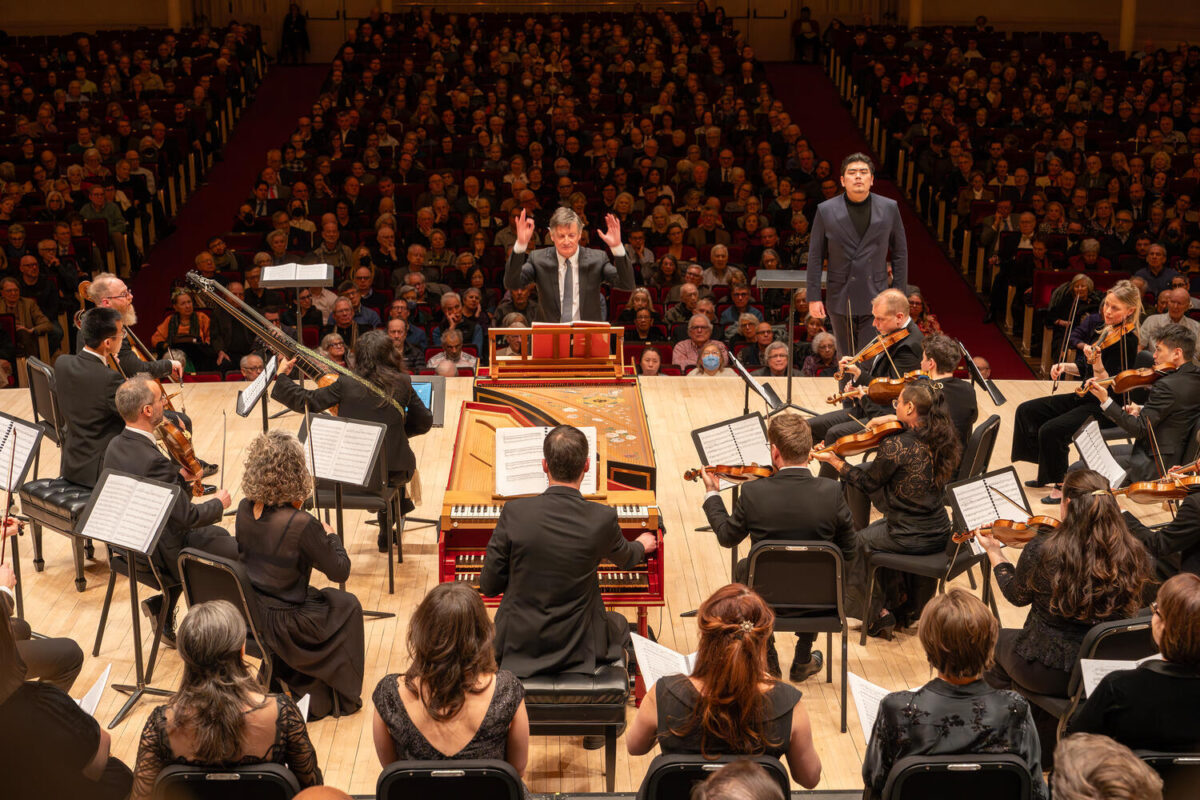
Photo by Richard Termine
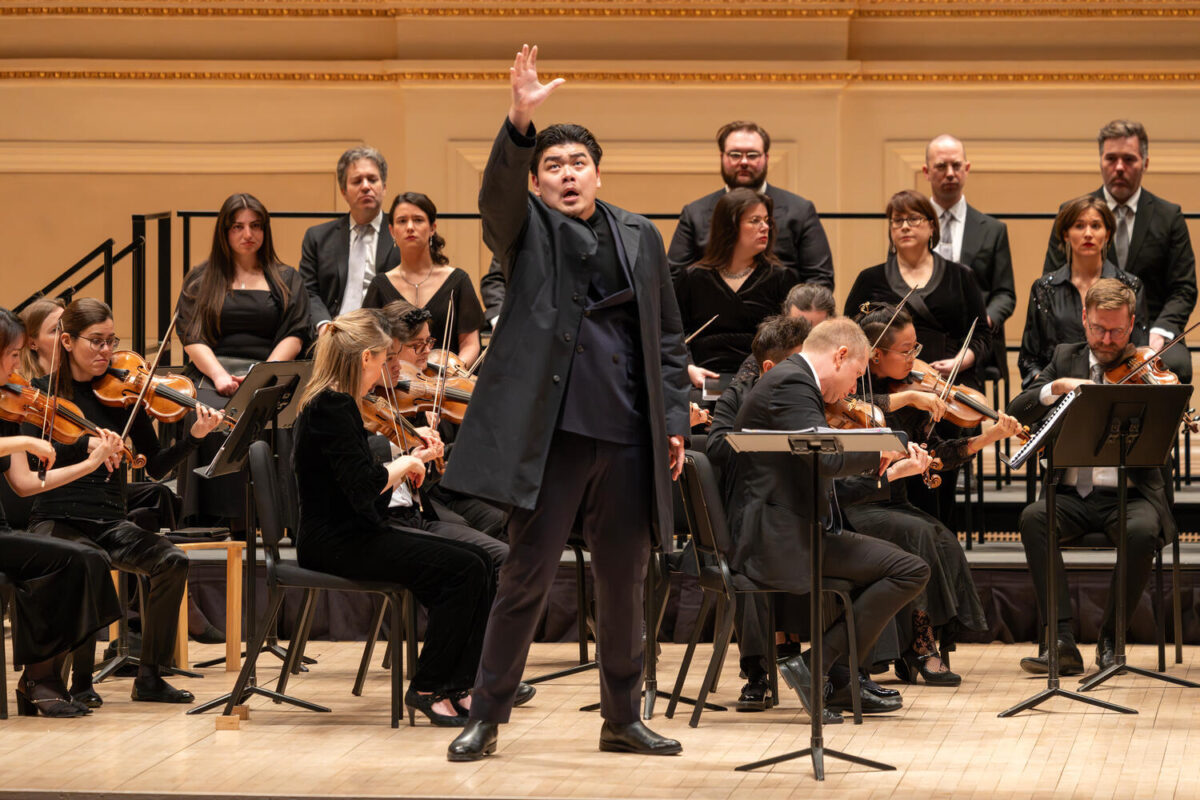
This year’s period-instrument ensemble under the direction of Harry Bicket has been visiting Carnegie Hall annually since 2011 to offer Handel’s best-known operas and oratorios. Sometimes these performances, while outstanding musically, have suffered from a scattershot dramatic presentation. Happily, though no director was credited, Hercules’s singers embraced the work’s high-stakes “operatic” conflicts and gave effective, committed portrayals of their characters, particularly William Guanbo Su and Ann Hallenberg as the boastful title character and Dejanira, his “complicated” wife.
The libretto by the Reverend Thomas Broughton doesn’t conjure up the admirable hero remembered from movies with Steve Reeves or the television series starring Kevin Sorbo. In Handel’s version, he proves to be a minor character in his own drama, as the “oratorio” focuses primarily on the women in his life: Dejanira and Iole. The former initially fears that her husband has died in battle. After learning of his survival, she rejoices, anticipating their reunion, until she learns he has returned with the beautiful, vanquished princess Iole as his captive. Dejanira’s all-consuming jealousy of Iole inadvertently results in her husband’s death, a result none of his many enemies could achieve.
Handel predictably lavished some of his most rewarding music on the pair. I first heard Hallenberg, one of the composer’s most avid champions, as Dejanira at Berlin’s Konzerthaus in 2002, a year before her “big break” replacing an ill Cecilia Bartoli as Piacere in Handel’s Il Trionfo del Tempo e del Disinganno at the Zurich Opera. If Hallenberg’s voice at Carnegie Hall wasn’t as robust as it had been twenty-four years ago, her striking interpretation of Dejanira has deepened considerably and is now filled with cherish-able subtleties that demonstrated once again her ideal command of Handelian style.
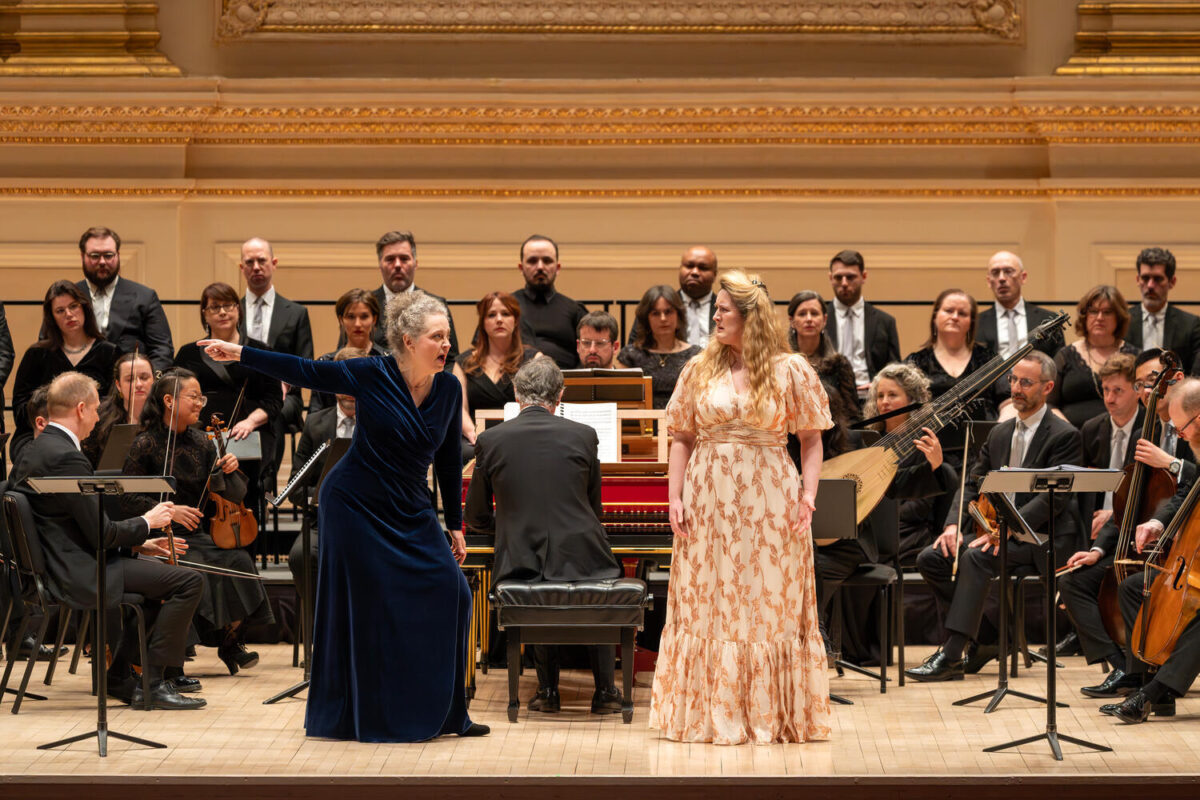
Photo by Richard Termine
Hallenberg dug deeply into Dejanira’s complex arc of six arias and an accompanied recitative. Her stinging “Resign thy club” was quickly followed by a ravishingly spun “Cease, ruler of the day,” both demonstrating her mastery of the da capo structure in which she not only decorated the A repeat but also imbued it with deepening dramatic intent. After Dejanira sends the cloak of Nessus to Hercules in an attempt to recapture his love, she discovers that the garment was instead cursed and has killed her husband. A crazed Hallenberg returned, hair undone, to spit out a fearsome “Where shall I fly?”— one of Handel’s most imaginative and riveting scenes.
By contrast, the displaced princess is endowed with some of the composer’s loveliest, most touching music. Her entrance “My father! Ah! methinks I see” recounts witnessing the brutal murder of her parent by Hercules and transitions into a moving prayer for his eternal rest. The exquisite Hilary Cronin, last heard at Carnegie Hall when the Monteverdi Choir offered Handel’s L’Allegro, Il Penseroso ed il Moderato, brought her pure and golden soprano to the role. She then fired volleys of extravagant coloratura at Dejanira after she accuses her of captivating the gullible Hercules. Though Bicket’s edition omitted two of Iole’s arias as well as a piquant duet with Dejanira, Cronin crowned the afternoon with a sublime rendition of “My breast with tender beating swells,” a stunning example of Handel’s compassionate insight into human suffering and forgiveness.
Lichas’s music was originally expanded as a vehicle for Susannah Cibber; however, Handel later recognized the character is mostly superfluous and even cut some of his music himself. The remainder was performed with winning earnestness by countertenor Alexander Chance whose immaculate voice resembled only slightly that of Michael Chance, his famous father. David Portillo as Dejanira and Hercules’s son, Hyllus, who, of course, marries Iole at the finale excelled in his more forthright music. But his somewhat tight tenor lacked the seductive repose needed for the beguiling “From celestial seats descending.”
Entering with strutting braggadocio, Su brought vigorous life to Hercules, a hero so wrapped up in his ego that he fails to notice when his wife’s welcome quickly turns into deadly suspicion. He boldly tackled his character’s fierce coloratura, which made its gloating mark, though it lacked Hallenberg and Cronin’s stylish florid élan.
The twenty-six member Clarion Choir, The English Concert’s American choral partner, again brought dynamic vigor and enviable agility to its Hercules duties which unfortunately lacked the second-act closer “Love and Hymen, hand in hand.” If 2023’s Solomon tossed audiences more splendid choral numbers, the sterling Clarion crew brought thrilling bite to the work’s highpoint “Jealousy! Infernal pest” which was set as dance solo by Mark Morris in 1985.
The English Concert’s polished excellence has long been the ensemble’s expected hallmark since it was founded by Trevor Pinnock in 1972. Bicket can always be depended upon to lead the orchestra, chorus and soloists with a brisk and tasteful hand. Ornamentation tends to be excessively modest, but with each succeeding year, the English Concert’s offerings have evolved into an essential event in a city where Handel’s big works aren’t performed so often.
Juilliard did however offer a fine Jephtha this past fall, and in May, the Oratorio Society of New York will present a rare performance of Alexander’s Feast, another non-oratorio. Next season, Bicket finally dips his toe into less familiar operatic waters when, for a few hours, Christophe Dumaux, Joélle Harvey and Xenia Puskarz Thomas become Senesino, Cuzzoni and Bordoni in diva-dueling Alessandro.
Hallenberg’s Iole in Berlin was the superb Canadian soprano Karina Gauvin. Unfortunately, she’s not recorded the role in its entirety but has included excerpts on several CDs, so I can’t resist including “Ah! think what ills the jealous prove,” her bravura retort to Dejanira in the second act. Lorraine Hunt Lieberson, another astonishing Dejanira, can be heard in extensive live excerpts from her single 1999 Boston Hercules.
I have made no secret of my long admiration for Hallenberg (this Hercules was my seventh live encounter with the Swedish mezzo): I was pleased to profile her for the New York Times six years ago.
Live recordings featuring Hallenberg been featured here over the years including, among many others, an over-the-top all-Handel Ann-thology; Penelope in Monteverdi’s Il Ritorno d’Ulisse in Patria; and Fernando Cortez in Vivaldi’s Motezuma, a zippy Paris performance I attended.