Songs and snowbirds
Will Liverman and Kiera Duffy brought an eclectic program to their jovial post-blizzard recital at Rhode Island College.
 By
Harry Rose
By
Harry Rose
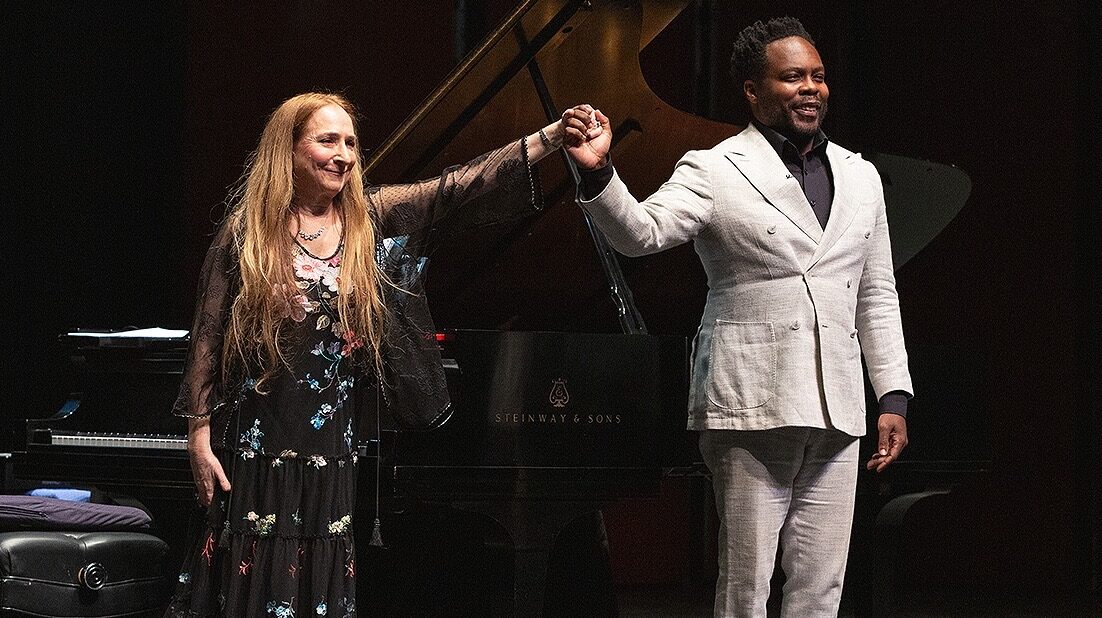
Judith Lynn Stillman and Will Liverman / Photo: Cat Laine
We don’t get a lot of classical voice around here in Rhode Island. Nor, until a few days ago, did we seem to get a lot of snow. But less than a week after the already legendary blizzard of ’26 unloaded 37.9 inches of heavy, wet powder on the Ocean State, the Portraits in Song series at Rhode Island College (RIC), organized by the ebullient Judith Lynn Stillman, presented Will Liverman and Kiera Duffy in an afternoon of assorted songs and arias in the College’s Nazarian Center for the Performing Arts.
The Juilliard-trained Stillman, who is both an Artist-in-Residence and Professor of Music at RIC, is a force. A composer and impresario in addition to being a collaborative pianist, at Saturday’s concert — where she accompanied the singers, affably provided explainers before each piece, and managed a slideshow with translations and some evocative pictures — she was fittingly billed as not “accompanist,” but “Host.” Perhaps the presence of the city’s Mayor, Brett Smiley, and our RI-1 congressman, Gabe Amo, both of whom provided remarks before the concert, did something to highlight Stillman as the hardest working person in the room.
Stillman’s involvement with Will Liverman goes back to a 2020 pandemic-era collaboration. Since, they have performed together numerous times including his Rhode Island debut in 2024. Sunday’s performance was also the Rhode Island debut for Kiera Duffy.
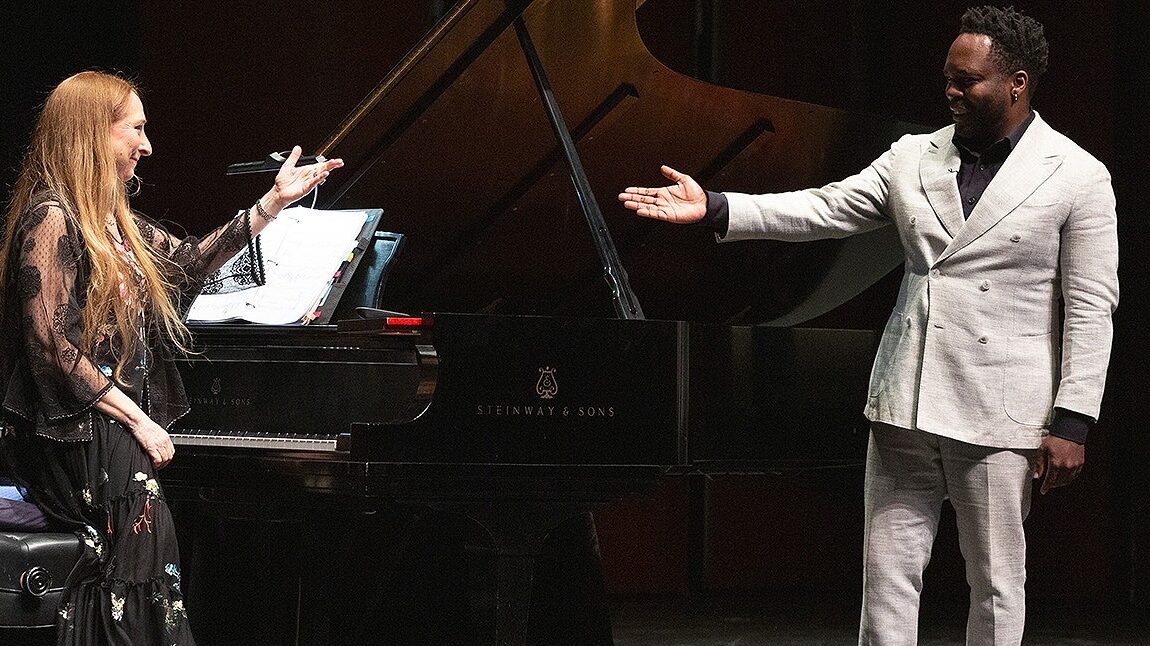
Judith Lynn Stillman and Will Liverman / Photo: Cat Laine
The pair started with several Mozart selections, including an “Ein Mädchen oder Weibchen” from Liverman that had Stillman accompanying him from both the piano and an electronic celesta. Duffy brought personality to “In uomini, in Soldati,” though the set ended with a “La ci darem” that had all the charm and frisson of a child abduction.
“Now, Harry,” you might be saying, “But that scene is a child abduction,” to which I say, “maybe for you, sourpuss, but on a Sunday afternoon in a college recital hall after three feet of snow, I want to be wooed.” Duffy can’t take the flack for this one; she’s got a glassy, somewhat monochromatic voice that constricts toward the top, but she’s fun onstage. It’s Liverman who seems quite unable to fully relax. And while his vowels can bloom with beguiling shadings, consonants seem to unsettle him to the point that his default setting for delivering text seems to consistently be overly serious or mad. I left thinking ,“I’d like to hear him do either vocalises or Wagner.”
His undeniable highlight was two songs by H. Leslie Adams, his firm, marbled baritone and uncanny sense of pitch characterizing Adams’s setting of Langston Hughes’s “Prayer while he brought a haunting mixte followed by a sudden veering into a near cry in a setting of James Weldon Johnson’s “Sence You Went Away.” Ken Medema’s “Moses,” which I heard him perform in an eerie pandemic-era recital at the Kennedy Center in 2020, with its gospel inflections and hokey text, came off well enough though Liverman still seemed a little stiff for Medema’s stuttering prophet.
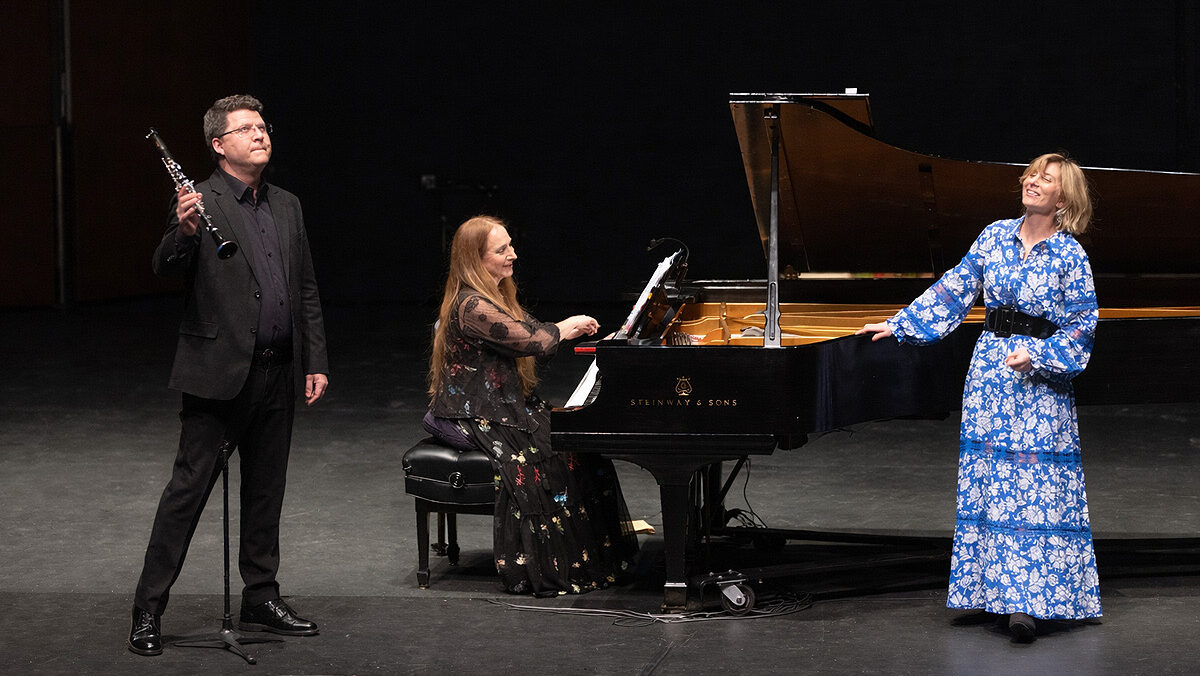
Alexander Fiterstein, Judith Lynn Stillman, and Keira Duffy / Photo: Cat Laine
Duffy’s highlight was Schubert’s Der Hirt auf dem Felsen, performed in a gracious duet with clarinetist Alexander Fiterstein. The two had an easy correspondence between the shepherd’s sung passages and the clarinet’s doubling of them and Duffy attacked the piece’s yodel-y grace notes with precision. In three Fauré songs earlier on, she was less descript, but his setting of “Clair de lune” showed some handy dynamic controls.
While a pair of musical theater duets – “Anything you can do, I can do better,” in a key too low for non-belter Duffy, and “People will say we’re in love” – felt a bit wooden, the concluding piece, “‘Tis you that are the music,” a thoughtful short duet composed for the occasion by Stillman to poetry by Amy Lowell, had Duffy and Liverman overlapping arching phrases and was the strongest ensemble work of the afternoon. It was a lovely afternoon and I hope that Stillman’s moxie can bring some classical voice back to Roger Williams’s city, hopefully sooner rather than later.
Harry Rose
Harry Rose, based in Providence, Rhode Island, is currently pursuing a PhD in Italian Studies at Brown University. Starting out blogging independently as Opera Teen in 2013, he holds the auspicious distinction of being the youngest writer to ever contribute to parterre box (at age 14) and has had the pleasure and challenge of writing for the rigorously discerning cher public since 2012. Increasingly niche hobbies and interests include opera, ballet, theatrical goings-on of the fin-de-siècle, and gatekeeping Camp.
-
Topics: keira duffy, Review, will liverman
-
People: Judith Lynn Stillman, Keira Duffy, Kiera Duffy, Mozart, Will Liverman
-
Works: Der Hirt auf dem Felsen, Don Giovanni
-
Places & Organizations: Rhode Island College