Photo by Virginia Harold
Could it be that The Magic Flute has become an opera about putting on an opera? The piece has always invited spectacle – monsters, tempests, temples, and tests – but a particular fashion has emerged of turning the spectacle “inside-out,” treating the stagecraft not as a vehicle for an interpretation so much as the interpretation itself. The live hand-drawing and onstage foley of Simon McBurney’s minimalist Met staging are case in point, but even Julie Taymor’s diaphanous puppet theatre and Kosky and Andrade’s opera-as-silent-film staging in San Francisco seem to gravitate towards the new philosophy: Let illusion be on full view, let process be product, so that the audience may marvel as much at the practical magic that conjures up the world as at the world of the story itself.
This approach has a kind of democratic charm. When the trick is in full view, everyone wants in on the fun. Performers do double duty, crossing boundaries that conventionally structure the production of operatic illusion – between pit and stage, “character” and “company,” and, of course, between performers and audience. When, in McBurney’s production, Papageno steps in for a glockenspiel player who has apparently disappeared, the transgression of operatic protocol offers a small shock to the system that summons a new theatrical spell – not the old-fashioned suspension of disbelief where the listener unconsciously surrenders to the logic of the story world, but rather a wide-awake, knowing sort of complicity. The more we sit up and pay attention to “exactly how it’s done,” these productions promise, the greater our enjoyment will be.
But there is a version of this approach that goes further: one that substitutes complicity for enchantment altogether, coaching the audience not only into awareness of the apparatus but into a posture of comfortable detachment, as if the visibility of artifice gives permission not to feel. Enchantment is not ignorance of the trick, but consent to be acted upon by it – an act of willing susceptibility which, like hypnosis, can unlock meanings not available at the conscious surface. The St. Louis Symphony’s Magic Flute raised the question of which version it really wanted to be.
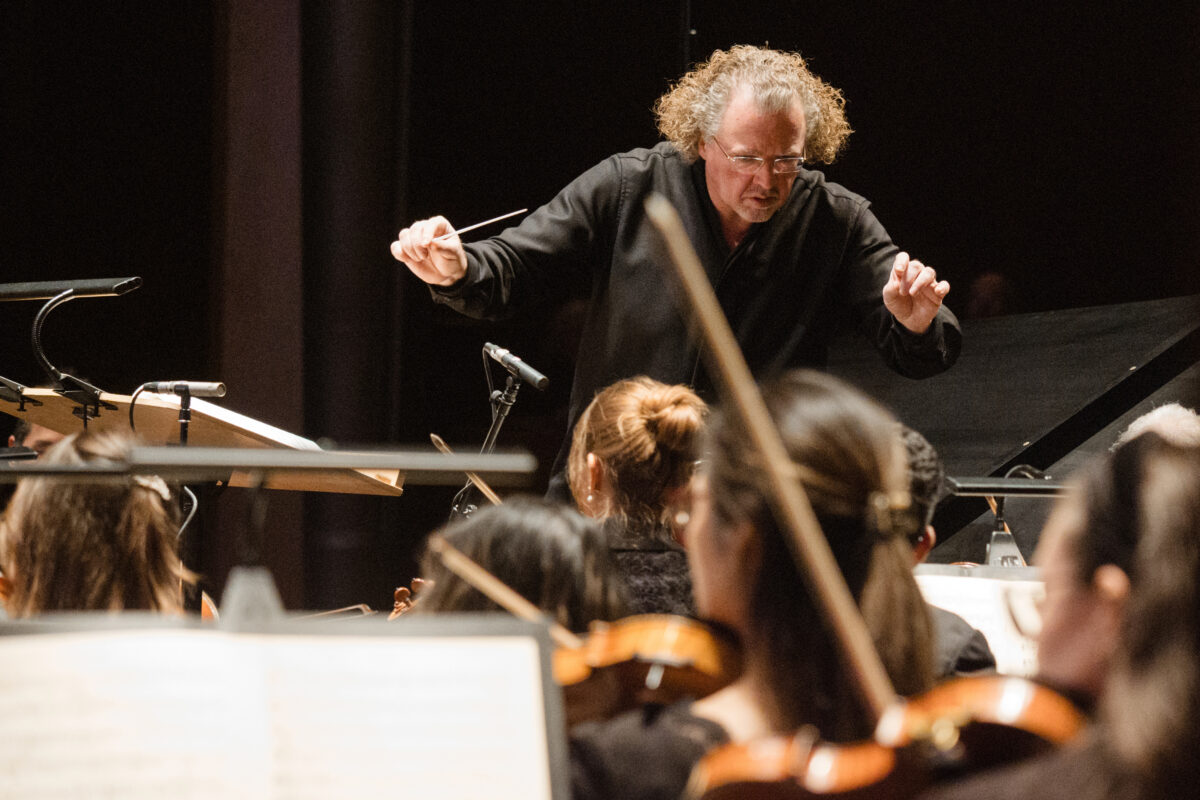
Although technically a concert performance, its many staged elements borrowed freely from its theatrical predecessors. The screensaver-like above-stage video projections recalled Taymor’s eye-wateringly colorful visual language, while the “double duty” assigned to many performers felt inspired by McBurney. Mei Gui Zhang‘s Pamina was repurposed as a narrator, Will Liverman’s Papageno made his entrance by erupting out of the audience, and conductor Stéphane Denève stepped beyond the customary authority of a conductor into something closer to an extra character or master of ceremonies: commenting, chastising, and breaking the fourth wall so often that it stopped registering as a special effect and became the evening’s default mode.
These decisions are understandable. They serve to defuse much of what intimidates newcomers about opera. Rather than expect the audience to arrive already fluent in an archaic symbolic language, let alone a literal foreign one, the production meets us where we are. Taking this one step further, the spoken passages were delivered a distinctly 21st-century register of English. Heavily editing and extrapolating from the original text, the adaptation (by Cori Ellison) delivered a steady stream of gags that leaned even more heavily on Will Liverman’s Papageno as the evening’s comic engine than is customary. Meanwhile, Pamina’s running narration, initially a friendly guide through an unwieldy singspiel, increasingly restated stage action already plain to the eye. Besides reassuring the audience that “you haven’t missed anything,” they seemed to promise that nothing too unfamiliar or troubling here would be allowed to stand unmediated.
The risk of this approach is not so much that it refuses the opera’s puzzling and uncomfortable thematic overtones, but that it keeps them at arm’s length as material for knowing in-jokes and contemporary side-eye. The Magic Flute can withstand a great deal of tonal inconsistency; it is no small part of why the work remains evergreen. But when the opera’s more difficult questions – the ambiguities of enlightenment, the definition of “wisdom” and who is permitted to possess it – are flattened into pre-packaged stances, they can then be safely signaled, briefly applauded, and then bracketed from the comfortable perspective of the 21st century. Take, for example, an interpolated speech for Narrator-Pamina in which she explains that “as the daughter of a strong, independent woman,” she continues to resist Sarastro’s imprisonment, only to be repeatedly rebuffed from entry into the community on the grounds that “I am a woman.” The line certainly succeeded in eliciting mild boos of disapproval, but the moment felt canned.
Between the contemporary jokes, St. Louis-specific references, and the running feminist commentary, there was little room left for the score to do its slower, stranger work. Rather than allow the music to tell us when to trust or doubt, when to laugh, and when to doubt our own laughter, the narration did – with the consequence that the music could feel like an afterthought rather than the main event. And indeed, from the start, the orchestra’s reading of the score felt blandly cautious. While competently played without technical issues, the overture lacked the necessary sense of an invitation to adventure, the bubbling-over of barely-contained curiosity. In Act I, this caution turned into a tug-of-war with the soloists over tempo: the singers wanted to run, carried by the agitation of the opera’s early scenes, while the orchestra held back. While disagreements over tempo became less obvious over the course of the evening (Denève seemed particularly attentive to holding Liverman’s Papageno in check in Act II), the orchestra’s playing never quite coalesced into an interpretation – somewhat surprising for a concert performance.
The evening’s best singing supplied the dramatic and musical momentum that the orchestra lacked. Ben Bliss, by now a familiar Mozartean presence, brought his extensive experience in the role to bear, shaping and propelling the entire evening. Like a less-experienced dancer elevated by secure partnering, the orchestra seemed to find a new expressive ease when accompanying Bliss in extended scenes, such as Tamino’s approach to Sarastro’s temple. Much has been written about Bliss’s instrument, which is bright but not harsh, well-supported and graceful throughout its range. Happily, these characterizations hold up. I have little to add beyond noting how welcome his instinct for period-appropriate ornamentation is in an age when Mozart’s scores are usually read with pious literality.
Bliss’s great virtue as an artist is that he can make a certain kind of male heroism legible precisely by not overloading it with personality. He reads as an avatar of the heroic tenor, projecting whole-hearted earnestness onto his roles without excessive self-regard. In Don Giovanni, that quality can even become the point: In Bliss’ hands, Don Ottavio’s righteous promises to restore justice read as naive and hollow compared to Don Giovanni’s suavely assertive amorality, serving to splinter the audience’s trust in the heroic archetype itself. For Tamino – a character who lacks psychological inner life – Bliss is close to ideal, not less because he adjusted his Tamino to the room. His hallowed prince took on a subtly self-effacing Midwestern niceness (Bliss is a Kansas native, after all), resembling nothing so much as a goofy, sometimes-beleaguered young dad. Throughout, he was happy to play along with the running gags without ever giving the impression that he was above them.
Mei Gui Zhang’s Pamina was a winning stage presence: physically vivacious and a capable actress. Vocally, however, her instrument is small, and it developed an alarmingly harsh quality when pushed in volume. Her “Ach, ich fühl’s” arrived in short-breathed phrases: a series of little sighs where one long, suspended line might have been more devastating. Powell Hall is not enormous (if anything, its shallowness can create balance problems in denser moments) and yet her sound often seemed to dissipate before penetrating into the space. I could not escape the feeling that her singing – pretty, but close and contained – was meant for a microphone rather than for the room.
In her final scenes, however, something seemed to shift. Zhang seemed to find more bloom and ease, as if she had stopped managing a picture-perfect portrayal long enough to let her voice open fully. The question is why it took so long. Whether it was mixed direction or a slow warm-up, the result was that Pamina’s voice – so crucial to the story’s emotional core – only became audible near the end.
Zhang assumed her dual role as narrator gamely, but the choice itself remained puzzling. One could only conclude that the dramaturg, like many latter-day Disney screenwriters, decided that a princess locked in a tower (or temple) awaiting rescue was simply not interesting to modern audiences, and therefore had to be given “more to do.” Pamina’s verbal interpolations lent her character a certain girlboss energy that did not match her music, and furthermore seemed unnecessary. Her struggles, at the end of the day, are not unfamiliar to the modern-day psyche: Seemingly forsaken by her entire social world – family, friends, and lover – Pamina experiences a dislocation of identity so wrenching that it nearly brings her to suicide. It is these struggles that make her reclamation of her life and her love – marked by the hair-raising F-major modulation of “Tamino mein, o welch ein Glück!” – so moving. This harmonic and emotional revelation makes the rest of the plot (initiation, pairing off, and restoration) feel like a genuine personal victory, rather than a phoned-in happy ending. But for SLSO’s Pamina, this romantic happy ending felt like a let-down – at the end of the day, the added commentary did not actually transform Pamina’s conventional fate. One was left wondering what, exactly, this modernization was meant to accomplish beyond reassuring us that the production knows which parts of The Magic Flute make contemporary audiences uneasy.
As for Will Liverman’s Papageno, I had an odd reaction: I wished I had heard him sing more. In his early scenes, tempo disagreements made it hard to savor his actual vocal work. Afterward, the show seemed determined to use Papageno chiefly as a delivery system for complaints about food and alcohol, leaving him with surprisingly few moments in which his singing could do the characterization. By the end of the opera, however – much as with Zhang – something shifted. His baritone acquired a lovely cohesion and ease and his sound suddenly relaxed, the phrases no longer rushed. I could have listened to much more of that.
The biggest applause of the night came for Rainelle Krause’s Queen of the Night. Krause has an unusual instrument. In the middle register the voice is pale and lacking in projection, but as she ascends into the stratosphere, the sound acquires a different physiology altogether: it comes into focus, brightens, and suddenly carries. The very top has a curiously hollow sound, like the flute stop of an organ. And as for the first-order technical demands of the role: Can she hit those notes, cleanly, repeatedly, and in tune? Yes, Krause very much can.
But the Queen is not only an athletic event. Those high Fs are meant to feel like the tip of an emotional whip being cracked: betrayal and fury so concentrated that love itself threatens to curdle into violence. The role belongs to a familiar operatic archetype – the dangerous and mystical mother who might kill to defend her child, or kill the child who refuses her instruction. It is the same psychic territory that animates Norma and Azucena, both mothers whose powers can turn holy or horrifying. Visually, Krause evoked all the right signifiers, delivering campy, witchy, moonlit glamour (is Chappell Roan taking notes?). Yet because her middle register lacks the physical heft to deliver real emotional punch, her lower passages felt obstacles to be gotten through on the way to the money notes, rather than the places where the character’s anguish and danger is announced.
The supporting cast did their work ably throughout. Special mention belongs to the Three Ladies (Teresa Perrotta, Jennifer Feinstein, and Daryl Freedman) whose blend had warmth and cohesion that lit up the stage whenever they appeared. The St. Louis Symphony Chorus, directed by Erin Freeman, sang with heartfelt commitment; the initiation music in particular achieved a spare, ritual clarity that the production elsewhere seemed determined to demystify.
By the end, the evening’s ambitions were unmistakable; so, too, were the costs. The singers were often asked to compete with the staging’s busy commentary – narration, gags, and Denève’s unusually active presence – and that competition seemed to blunt their best work. The busyness, however, was clearly intentional. Denève has been quoted describing The Magic Flute as a work that “promotes the idea that men and women should have equal power,” and the dramaturgy persistently steered us toward that conclusion. The result was less a dramatization of the opera’s moral and political tensions than a pre-digestion of them: we were coached in what to feel about its contradictions and mysteries before the music had the chance to make them felt, and before we had time to grapple with them ourselves. Rather than an opera that spoke through its music, we were given an opera that spoke for its music.
Such is the paradox of disenchanting The Magic Flute (or any opera). When the production is at pains to meet the audience where they are, to make sure everyone is in on the fun, and that everyone agrees on what is funny, outdated, or simply irrelevant, it removes the conditions under which enchantment can happen: the freedom to be momentarily unsure, to be seduced without being coached, and to let the music unfold its meaning in the privacy of one’s own attention. What replaces it is an always-on interpretive guidance system – a production determined to be everywhere at once, filling every silence with a joke, a cue, or a clarification, so that no ambiguity is left unresolved, no lingering questions left to trail us out of the hall.
Was I entertained? Quite. Enchanted? No.
The St. Louis Symphony Orchestra under conductor Stéphane Denève plays up the schtick in a concert performance of The Magic Flute – and obscures Mozart’s magic in the process.