
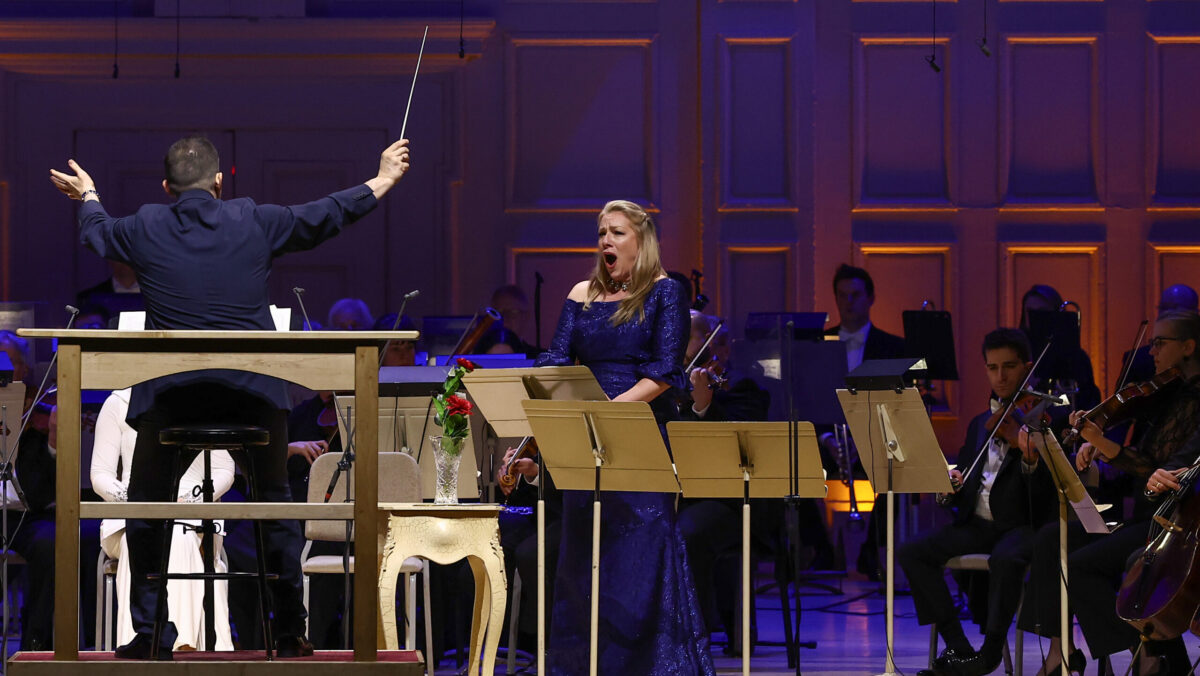
Andris Nelsons conducts the BSO with Jennifer Holloway / Photo: Winslow Townson
While I generally think Susan Sontag was a more thoughtful viewer of opera than we give her credit for, she was rather hard on Samuel Barber and Gian Carlo Menotti’s Vanessa which received a luxurious, lightly staged concert performance by the Boston Symphony Orchestra last weekend.
“It seems unlikely,” she says in “Notes on Camp,” “that much of the traditional opera repertoire could be such satisfying Camp if the melodramatic absurdities of most opera plots had been taken seriously by their composers. […] (Compare a typical 19th century opera with Samuel Barber’s Vanessa, a piece of manufactured, calculated Camp, and the difference is clear.)” A harsh value judgement on a work that is never not genteelly engrossing at the very least. Yet, I think it’s important that Sontag makes this observation specifically when she’s discussing seriousness and intentionality: “The pure examples of Camp are unintentional,” the artificially manipulative Vanessa ostensibly not being one, “they are dead serious.”
At its core, Vanessa is an opera about wholehearted, delusional belief; the title character has been waiting two decades for her lover Anatol’s return, and when Anatol, Jr. shows up instead of his father, she blindly charges ahead, seemingly oblivious to the fact that he’s a better match for her sullen niece Erika whom, unbeknownst to her, he has already seduced and impregnated.
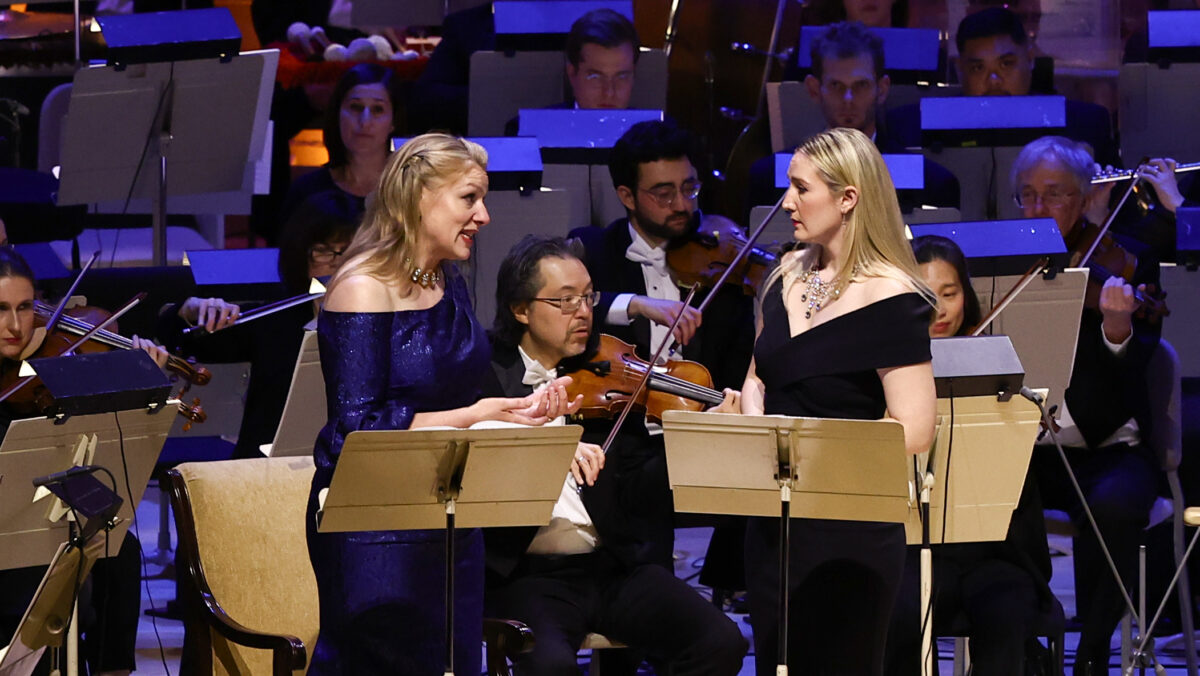
Jennifer Holloway and Samantha Hankey in Vanessa / Photo: winslow Townson
These characters, Vanessa especially but also Erika and her grandmother, choose what to believe in so they can preserve their tenuous relationships to their surroundings. Barber and Menotti, too, believe deeply in these characters. While Menotti’s euphonic and aphoristic libretto has its ditzier moments (“Do take care of my azaleas and the parakeets…”), it often doesn’t say much of anything at all; it allows the emotions to seep out through Barber’s score, often unsaid, sometimes unsung, and never unheard.
I have often said that opera is not about, as is often leveled, the suspension of disbelief; rather, it is about the imposition of belief: in the power of the voice, in the convergence of music and text, in the constantly shifting equilibrium between what we see and what we hear. Vanessa takes the imposition of belief up thematically to a damningly circular conclusion with Erika eventually re-covering the mirrors of Vanessa’s perpetual self-shiva and settling down to begin her own wait for her lover’s return. The orchestra plays the same motif that started the piece with Vanessa’s own vigil. But recognizing Vanessa—or anything, for that matter—as Camp, unintentional or not, is (or at least was) its own kind of subversive imposition of belief. While the world today deconstructs and self-destructs, an opera like Vanessa encourages us to pile experience, emotion, and expression on thicker and surrender to their contradictions.
Perhaps this explains the noticeable revival of interest in the fruits of the operatic midcentury: Vanessa was performed in concert in Washington last year, and R.B. Schlather’s Williamstown Theatre Festival production will come to Heartbeat Opera in May. In December, Lincoln Center Theatre presented a lovely Amahl and the Night Visitors with Joyce DiDonato as the Mother and in March, Boston’s Odyssey Opera will present Menotti’s The Last Savage in concert. Just last February, Joshua Barone banged the drum for this repertoire loudly in an article for The New York Times that asked, in an oblique retort to Peter Gelb’s own op-ed criticizing thorny modern and contemporary operas, why the sweeping, English-language, and (most importantly) tonally lush operas of Barber, Menotti, Blitzstein, and others are ignored by the theater most suited to showing them off at their best.
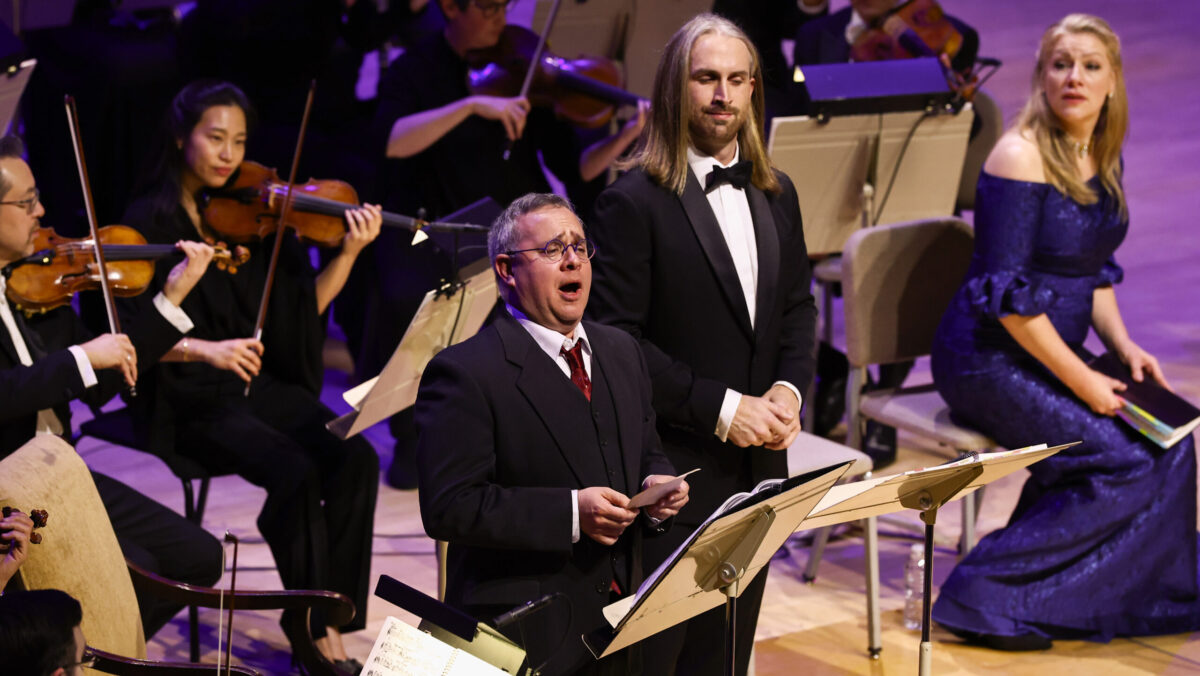
Patrick Carfizzi and Ganson Salmon in Vanessa / Photo: Winslow Townson
But there is more to these operas than merely their craft to admire, as Barone would have it; that willful sensation of surrender sought through this repertoire might be what Sontag describes as the “tender feeling” of Camp, and maybe our campiest operas like Vanessa are speaking to us more loudly now because they command their own characters, and us in the process, to invest, to be present, to firmly impose belief in the potentiality of opera. It seems like everyone is looking for something concrete to believe in these days. For those of us aesthetes who cling to the ritual of opera, we hope that salvation will come through faith alone in the art form because there is something of real value in what opera can hold; that belief in truth and beauty and the limits of expression feels as dire and existential as the selection of dinner sauces does for Vanessa and Erika.
That Vanessa has a high-budget technicolor symphonic scope is also part of the appeal; in selecting it as the concert opera to mark 250 years of American democracy (excerpts from that other most American opera, Nixon in China, will follow at the end of March), Music Director Andris Nelsons put the outsized musical stakes of this Nordic telenovela front and center.
As might have been welcome in last year’s choppier, more austere Die tote Stadt, Vanessa was largely cinematic in its sweep. But Nelsons still found moments to highlight individual instruments, such as the Act II dance music which morphs from a party polka into a trumpet voluntary played by Thomas Rolfs. Though the singers were on occasion overpowered by the ecstatic, churning take on the score—the moment when Erika resolves to attempt suicide was nearly lost in a battle between the onstage Orchestra and the crisply synchronized members of the Tanglewood Festival and Boston Lyric Opera Choruses positioned outside the auditorium doors—the Orchestra’s heat was welcome on a sleeting Boston Saturday night. And the final quintet, the opera’s iconic ensemble piece, coalesced hypnotically.
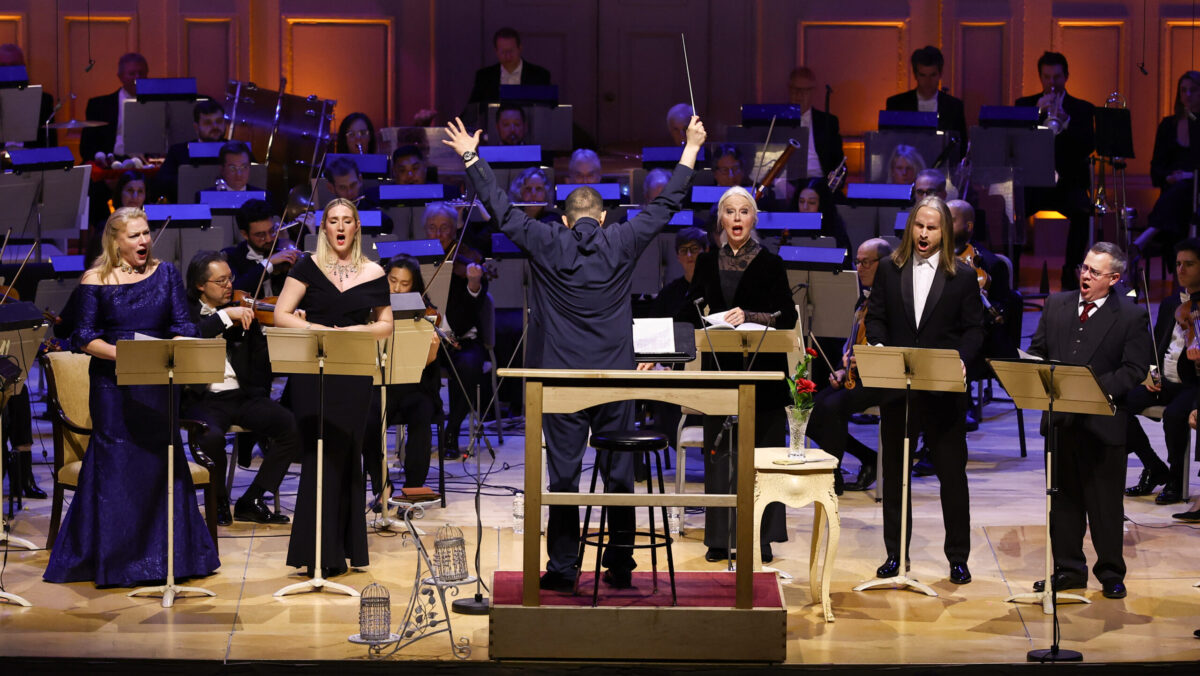
Andris Nelsons conducts Jennifer Holloway, Samantha Hankey, Anne Sofie von Otter, Ganson Salmon, and Patrick Carfizzi / Photo: Winslow Townson
In the two leading roles, Jennifer Holloway and Samantha Hankey were ideal complements, with similar amber-hued timbres and blonde coiffures but diverging vocal approaches. As Vanessa, Holloway, a former mezzo recently relaunched as a soprano, brings genuine glamour and a curiously structured voice; there is now scarcely a middle voice to speak of, but both an expansive passaggio and a developed chest register resonate freely and robustly. Her anguished soliloquy before Anatol, “Do not utter a word,” was feverishly emotional with ringing Bs. She is a subtle, captivating actress (even if she was late to announcing her own engagement; a missed Act II entrance led to some momentary confusion onstage).
Hankey, on the other hand, is mostly middle voice which is attended to with pristine diction and careful attention to dynamics. She gave Erika, the most interesting of the three female roles, a presence more commanding than recessive and “Must the winter come so soon?” had a radiant simplicity with cascading diminuendi. But her upper register also has strength with the climactic B at the end of the first Act landing soundly.
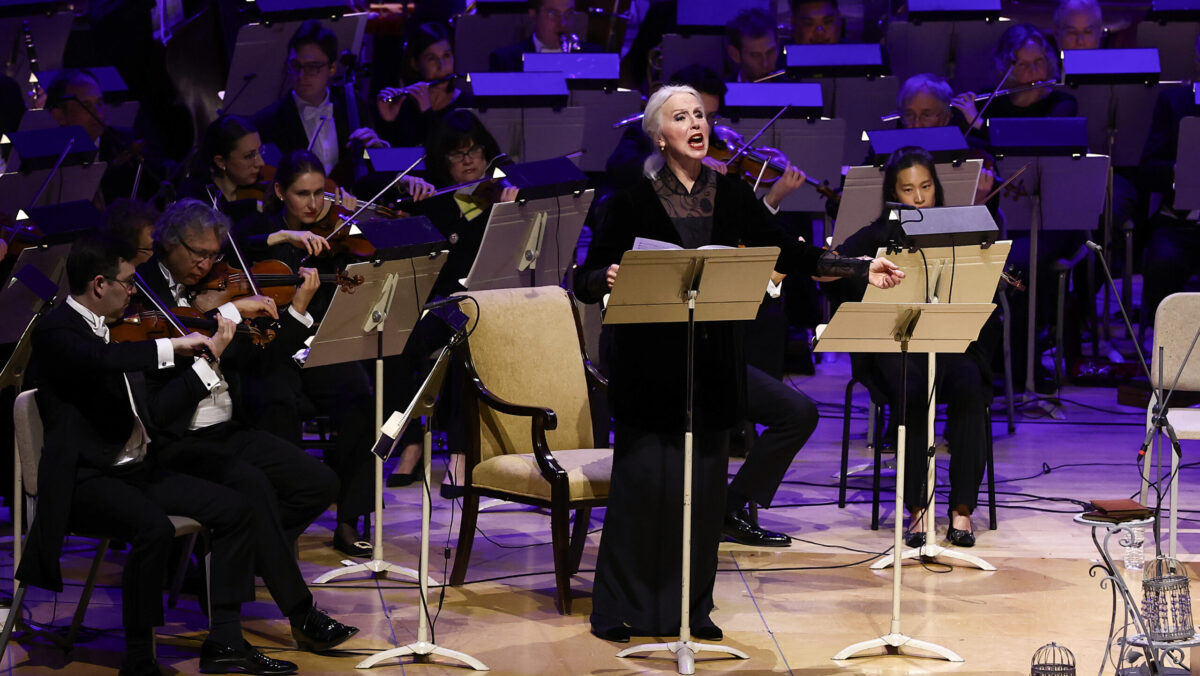
Anne Sofie von Otter in Vanessa / Photo: Winslow Townson
According to his bio, tenor Ganson Salmon specializes in stepping into the ungrateful role of Anatol “on very short notice,” which he did again here, replacing an ill Pavel Černoch. (He also did so during the D.C. run last year.) His tenor is compact and unlyrical, ringing out only in the higher, declamatory passages of the role. Patrick Carfizzi, also substituting last-minute for Thomas Hampson, sang firmly and with beautiful detail as the Doctor that hangs around Vanessa’s estate. And as the Old Baroness, Anne Sofie von Otter was a rewarding theatrical presence, if a muted vocal one, and Wei Wu sang nobly as the Major Domo and Footman.
The BSO has subtitled this season “E pluribus unum,” celebrating the “myriad voices that have woven the rich tapestry of American music.” I don’t think I’m alone in having a complicated relationship with my own patriotism these days. But thanks to Samuel Barber, Gian Carlo Menotti, and Andris Nelsons, for three hours in Symphony Hall last weekend, I felt my faith in the power and persuasiveness of American creative voices restored—now that’s something I can believe in.


