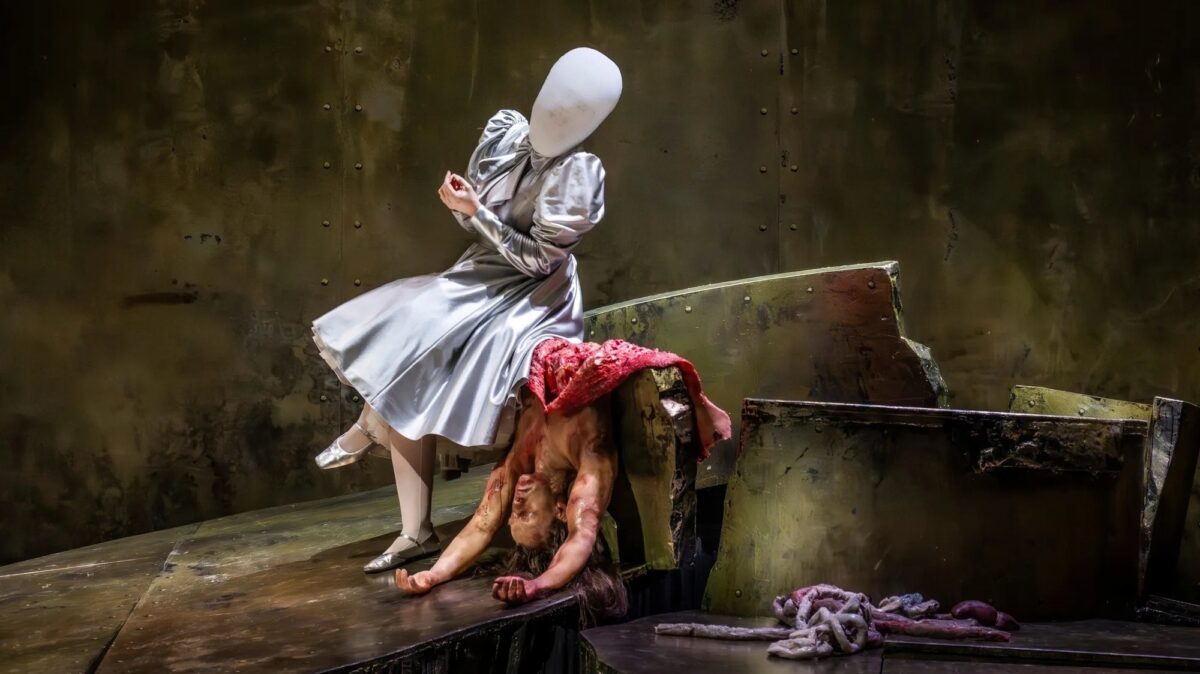
In Evgeny Titov’s production of Strauss’s Salome at the Komischer Oper, Salome does not receive Jochanaan’s head on a silver platter, but rather, attains self-realization while cradling his intestines. Komischer Oper’s new production of Salome encourages audiences to set aside their preconceived diagnoses of the princess of Judea, for in Titov’s production, Salome is not a victim or femme fatale, but rather, is searching for her “true face.” Salome’s absence of identity is manifested by a white mask that obscures her every expression, taking “Wie blass die Prinzessin ist” to a whole new level.
Due to her lack of face, the audience is left to follow Salome’s every movement; the hyper-choreographed production provides ample danced material for interpretation. The voice and body language of Nicole Chevalier (Salome) fluently embodied Titov’s vision. Even when rolling around on the floor, Chevalier’s voice did not waver, singing endless phrases with ease. At the end of the opera, when I’d assume she was at her most fatigued, Chevalier sang with a precise gentleness, adding depth to a character many write off as mad. Likewise, Chevalier’s body responded to Strauss’ orchestration so much so that it rewrote my interpretation of certain plot points. For one, after Jochanaan (Günther Papendell) sings (somewhat flatly) “Du bist verflucht” at the end of the third scene, there is a long orchestral interlude, one that is typically utilized for a set change. However, in Titov’s production, Salome performs a choreographed dance where she is seemingly possessed by her newfound desires for Jochanaan. During the contrabassoon solo, Salome laughs manically between bodily thrusts, the orchestration used as a mouthpiece for her ultimate plan.
Amid Salome’s frenzied dancing, the once-barren backdrop lifts to reveal Salome’s imagined evil scheme. Previously, the set (Rufus Didwiszus) featured only a hanging round lamp representing the full moon. The shadows cast from the moon created powerful silhouettes, especially as Jochanaan emerged from the cistern. When the backdrop finally rises during the orchestral interlude, a wall of severed heads is revealed. Foreshadowing Salome’s ultimate punishment for Jochanaan, the collection of heads further clued the audience into Salome’s conspiracy. When, ultimately, we did not get Jochanaan’s head on a silver platter, the wall of heads felt as if they were included only for shock factor and a great marketing image.
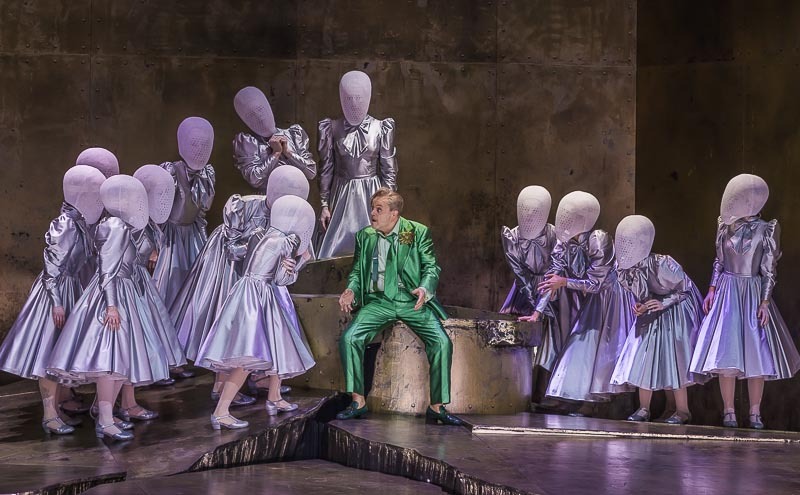
In the awaited dance, that of the seven veils, the audience is presented with a ballet of Salomes performing in a Swan Lake formation. The choreography by Martina Borroni elicited laughter from the audience, meant to break the tension typically associated with the striptease. While the choreography was evocative, I was easily distracted by the loud thumps emitted from the dancers’ shoes, which overpowered the orchestra, creating their own soundtrack. As the Salomes danced, Herod (Matthias Wohlbrecht) thrusted along in a Joker-esque green suit. This is the second production I’ve seen this year in which the Dance of the Seven Veils features a chorus of Salomes, with the most recent production at the Metropolitan Opera by Claus Guth presenting a ballet of past traumas.
At the climax of the opera, Salome does not receive Jochanaan’s head on a silver platter. Rather, the executioner flings a disemboweled Jochanaan over the cistern’s edge like a gutted fish with intestines spilling onto the ground. Salome sensually opens his gills, sliding her hands down into his abdomen, fishing for his heart—a dramatic interpretation of “the Word became flesh.” Salome then drapes his body off the moon-like lamp, finally kissing him in a Spiderman style. Concluding the opera by rubbing blood in the shape of a smile on her white mask, Salome is no longer pale nor pure and has “found her face.”
While I enjoyed Titov’s concept, there were a few moments that seemed to be included solely for shock factor. For one, why was Joachanaan foaming at the mouth after emerging from the cistern? Why was Joachanaan bald? Was it to elicit laughs from the audience when Salome sings of her love for his hair? Why did Titov hyper-stereotype the five Jews, dressing them in shtreimel and gold chains? Are we not past this offensive representation? Finally, why did Herod have a chorus of slow-motion, nipple tweaking followers?