Jan Windszus Photography
Hot take: Rise and Fall of the City of Mahagonny should be programmed by every American opera company during this current political moment. With music by Kurt Weill and a libretto by Bertolt Brecht, the opera explores themes that are all too prevalent today: capitalism, gluttony, and utopia turned dystopia. Set in a fictional American city founded by criminals, the opera explores the downfall of a society where everything is legal, “as long as you can pay for it.” While Mahagonny has not been featured on a major American opera company’s roster since 2007 (last performed at the now-closed Opera Boston), it is consistently performed abroad; the Komische Oper Berlin is reviving their 2021 production this December, while the English National Opera is staging a new production come February.
The first collaboration by Weill and Brecht, Aufstieg und Fall der Stadt Mahagonny premiered on March 9, 1930, in Leipzig. Unfortunately, the opera’s premiere was met with protests organized by the far-right Nationalsozialistische Deutsche Arbeiterpartei, a dark foreshadowing of the political world to come. Before the premiere, Weill’s “Mahagonny Songspiel,” a cycle of select songs from the opera, was performed in 1927. The structure of the opera seems to unfold from Weill’s Songspiel; rather than a continuous narrative, the audience is presented with a montage of musical vignettes from imagined Mahagonny. This “anti-opera” format was introduced as a form of protest by Weill and Brecht, aiming to disrupt the contemporary opera industry’s narrative and formal expectations.
The opera opens on three criminals — the widow Leokadja Begbick (Ariana Lucas), Dreinigkeitsmoses (Seth Carico), and Fatty (Ivan Turšić) — who decide to establish a new city named Mahagonny, a paradise promising cheap alcohol, readily available sex, and a ‘cigar on the front-porch’ lifestyle. Soon, lumberjacks from Alaska and groups of prostitutes find their way to Mahagonny, our protagonists Jim Mahoney and Jenny among them. Unlike most operatic love stories, Jim and Jenny have a transactional relationship. Their duets do not sing of eternal love, but rather, whether underwear should be worn or taken off during sex. When a hurricane threatens the city, Jim hysterically declares that there are no more rules in Mahagonny, anything goes!
This lawless declaration introduces Act II, where the audience is presented with four themes of decay: gluttony, sex, boxing, and drinking. Each of these deadly sins results in the harm or death of a character — one of the Lumberjacks eats himself to death, Jenny is seen working through a line of customers, another Lumberjack is beaten to death in a boxing match, and after buying out the bar, Jim is left broke and unable to pay his tab. Due to his debts, Jim is sentenced to death, but not before having his eyes gouged out. The opera ends with God visiting Mahagonny, and in Komische Oper’s production, God was embodied by an animatronic cow riding a tricycle, a “parody of Darwinism and monotheism.”
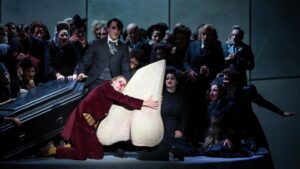
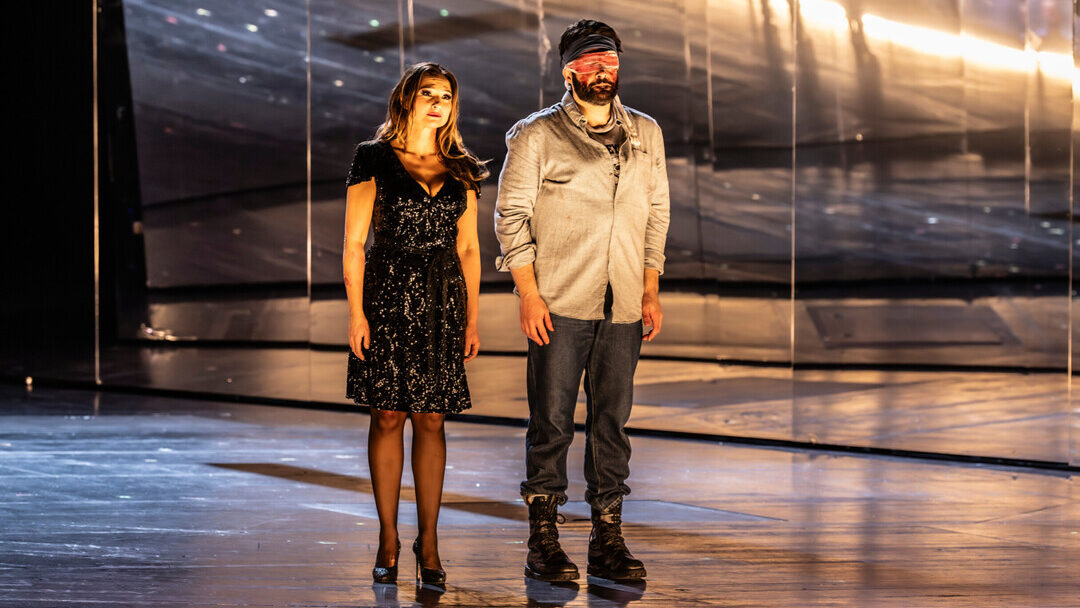
Rise and Fall of the City of Mahagonny inspires rich interpretations, whether staged through the lens of Weimar politics, as commentary on 1930s American society, or a reflection of contemporary political struggles. Director Barrie Kosky disregarded these interpretations and seemingly rejected engaging with the opera’s dense metaphors or religious symbolism. For example, in the first scene, as Dreinigkeitsmoses and Fatty introduce themselves, they shed their religious garb, Dreinigkeitsmoses taking off his cross while Fatty’s פאות (payot) are cut off. There is also no clear setting nor time period suggested, as the stage design (Klaus Grünberg) is merely a wall of mirrors, and the costuming (Klaus Bruns) loosely resembles modern American fashion. Leokadja Begbick was seemingly dressed as a southern pageant queen with teased hair and exaggerated eyeshadow, while Jim wore a graphic tee from a Berlin hardcore record label paired with combat boots.
Jan Windszus Photography
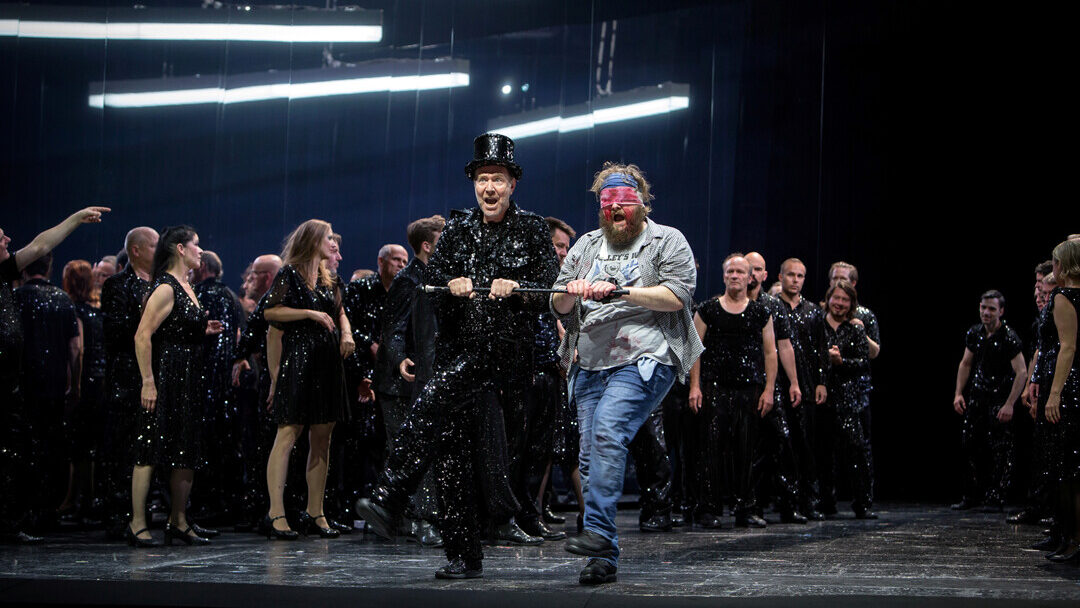
In the second Act, the entire cast, except for Jim, was outfitted in glitter (as glitter apparently equates to there being no rules)! There were a few effective props scattered throughout the production that directed the audience to potential interpretations. Characters continuously threw coins in a bucket, producing an identifiable clinking sound that could only be understood as sonic reminders of capitalism. Likewise, the omnipresence of mirrors encouraged the audience to reflect on the deadly sins we may partake in.
Gerard Schneider, who sang Jim Mahoney, was electric, embodying the hysterical Jim to the point where audiences began to empathize with his character. Nadja Mchantaf, who sang Jenny, almost had too beautiful a voice for the role. High notes flowed from her as if she were singing Mozart, but her English diction was unclear — her text was swallowed in the beloved “Alabama Song” to the point of incomprehension. An unexpectedly stunning vocal performance was given by Hubert Zapiór, who sang the role of Bill, one of Jim’s Lumberjack friends. Zapiór, a Komiche Oper ensemble member, is also singing Don Giovanni and Eugene Onegin this season, and I will happily sit through my hundredth “Deh, vieni alla finestra” to hear the beauty of his voice again.
Unfortunately, throughout the evening, there was a disconnect between the orchestra and the singers, conductor Alexander Joel having a difficult time connecting the two musical bodies. There were many noticeable moments, especially in larger choral numbers, where singers were scanning the pit to catch a glimpse of Joel’s baton for salvation. The only cast member able to be excused for being out of time is Schneider, post-eye gouging! Towards the end of the opera as the refrain “there is no greater criminal than a man with no money” was sung, I could not help but reflect on “the land of the free,” where we punish the poor while giving the rich a slap on the wrist.