After I entered the Brooklyn Academy of Music’s Opera House on Friday May 19, 1989, I felt an inkling that my musical life would be richer going forward. I’d be hearing Les Arts Florissants live for the very first time in its revelatory production of Lully’s Atys. I had traveled from Ohio to attend it twice, as LAF back then double cast the principals of its opera productions. When Atys returned to BAM in 1992, I had moved permanently to NYC.
BAM had previously been the site of another life-changing show when I ventured to Brooklyn for the first time in December 1984 to be mesmerized by Philip Glass and Robert Wilson’s Einstein on the Beach. My infatuation with Wilson continued—I was especially bewitched by his version of Heiner Müller’s hamletmachine at NYU two years later—until I grew weary (post-MET Lohengrin) of his mannered, glacial style. However, despite a rare lapse or two by LAF, I’ve never tired of the ensemble’s immaculately stylish way with baroque vocal music. In the many years since that mind-blowing Lully, I’d wager I’ve attended every local LAF performance, including two this fall. Once, we even schlepped to SUNY Purchase in the pouring rain to hear a wonderful Acis and Galatea. And as their gloriously wacky production of Rameau’s Les Paladins was unfortunately never seen here, I caught it in Paris—twice!
Back in the day, BAM would have imported Paladins or the group’s recent lavish stagings of Mondonville’s Titon et l’Aurore and Rameau’s Les Fêtes d’Hébé, but the economic climate at the Brooklyn institution has changed dramatically. However, December saw a most welcome reunion when BAM once again presented LAF in three performances of a Christmas-themed all-Charpentier program, its first appearance at the Howard Gilman Opera House since a singularly disappointing Rameau double-bill in winter 2019.
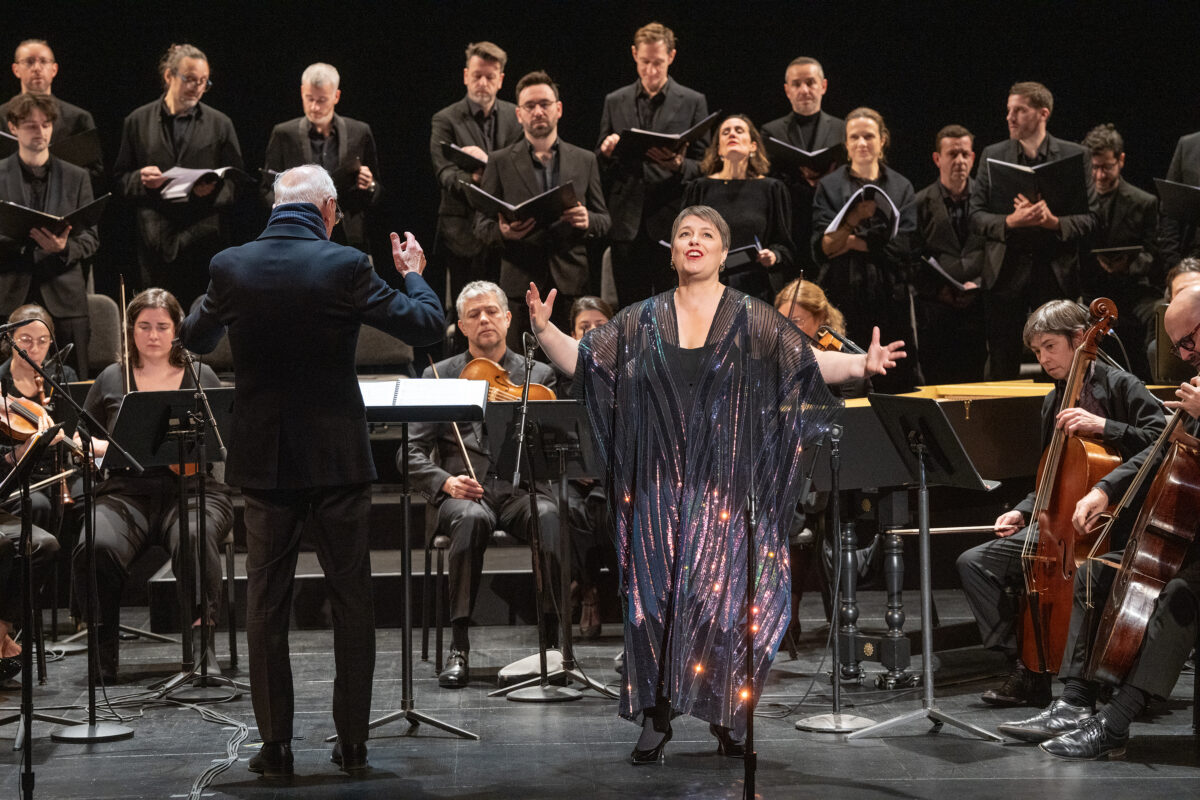
As many European groups travel to this country with reduced forces, it was gratifying to see LAF arrive with twenty-two singers and the same number of instrumentalists, all under the direction of LAF founder William Christie. The afternoon’s first half featured Pastorale sur la Naissance de Notre Seigneur Jésus-Christ, while the better-known Messe de minuit pour Noël followed after intermission.
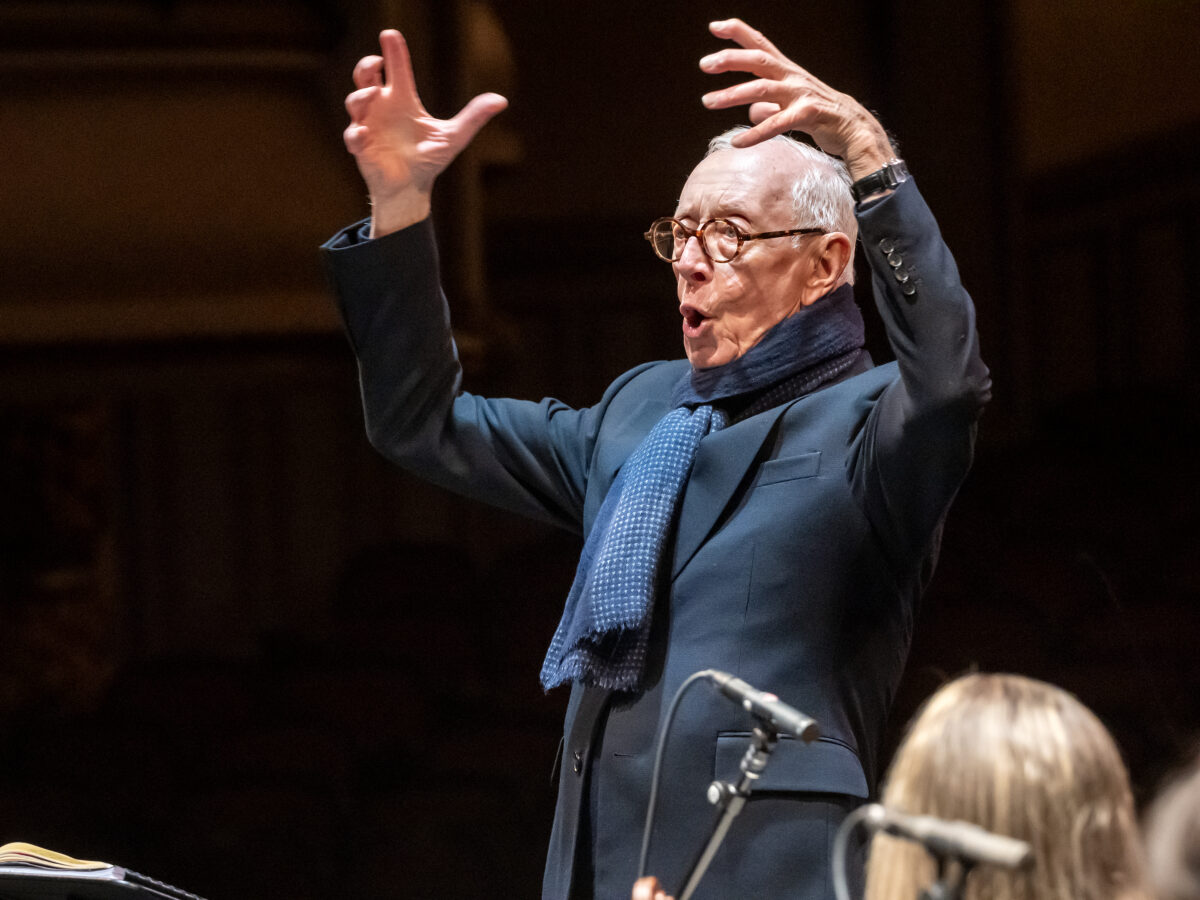
Photograph: © 2025 Richard Termine.
Although its Atys proved a crucial step in reviving Lully’s reputation, LAF has only performed one other opera by the composer: Armide. Marc-Antoine Charpentier must then be the composer who has been most consequentially promoted by Les Arts Florissants. The group’s enormous discography includes many Charpentier CDs, and even its name is taken from the composer’s short chamber opera, which LAF is currently touring with the twelfth edition of Le Jardin des Voix, the ensemble’s hugely successful young artist academy. The towering Médée (his sole tragédie mise en musique) has been recorded and staged twice by the group, the most recent a production by the Paris Opéra marking Christie’s 80th birthday. Happily, breathtaking productions of both Médée and David et Jonathas, his searing Biblical music drama, have been presented by LAF at BAM, and I attended its pairing of Charpentier’s one-act Actéon with Purcell’s Dido and Aeneas, featuring Sonya Yoncheva as Dido in 2010.
LAF previously presented Messe de minuit pour Noël in December 2001 when it positively glowed in the warmly reverberant acoustic of the Church of Saint Ignatius Loyola on Manhattan’s Upper East Side. At the BAM Opera House, the wondrous piece again succeeded, though it proved less moving in the exceedingly secular atmosphere. The uniquely haunting quality of Charpentier’s writing was apparent from the very first measures of the Pastorale, in which LAF’s ravishing recorders and oboes blended serenely with the eloquent five-part strings until the always wondrous chorus joined. Occasionally Christie’s tempi felt unusually slow, but otherwise the inimitable LAF élan was much in evidence.
The oddest thing about the 2025 edition of Charpentier @ BAM was how its vocal performers were billed. Beginning with the original concert announcement, three soloists were named: Emmanuelle de Negri, Bastien Rimondi and Alex Rosen. The program PDF included color photos and extensive bios of the three. However, they performed throughout as members of the chorus, occasionally stepping forward for solos or smaller ensembles, as did eight other singers.
While it was true that de Negri (dressed in black adorned with a rainbow of sequins) and Rosen performed prominent solos, so did their colleague Virginie Thomas, who wasn’t singled out in the BAM materials at all. By the way, last year, the elegant Thomas released Nymphes, a delicious CD gathering together tidbits from operas by nine French baroque composers featuring nymphs and dryads. She is joined on the recording by LAF’s dazzling first violin and musical assistant Emmanuel Resche-Casterta and always-superb harpsichordist/organist Béatrice Martin who both also shone at the BAM concert.
In 2007 tenor Paul Agnew, long associated with the group as a singer, began to also conduct LAF. Although he led the group’s first-ever production of Rameau’s Platée and conducts its new recording of Gluck’s Orphée et Eurydice, his responsibilities with the group have focused most often on smaller-scaled, often unaccompanied 16th and 17th century vocal music. For its debut appearance at the Frick Collection’s brand-new Stephen A. Schwarzman Auditorium, Agnew directed a strikingly solemn program dedicated to the museum’s exhibit To the Holy Sepulcher: Treasures from the Terra Sancta Museum. Agnew was joined by sopranos Miriam Allen and Hannah Morrison, contralto Mélodie Ruvio, tenor Sean Clayton and bass Edward Grint.
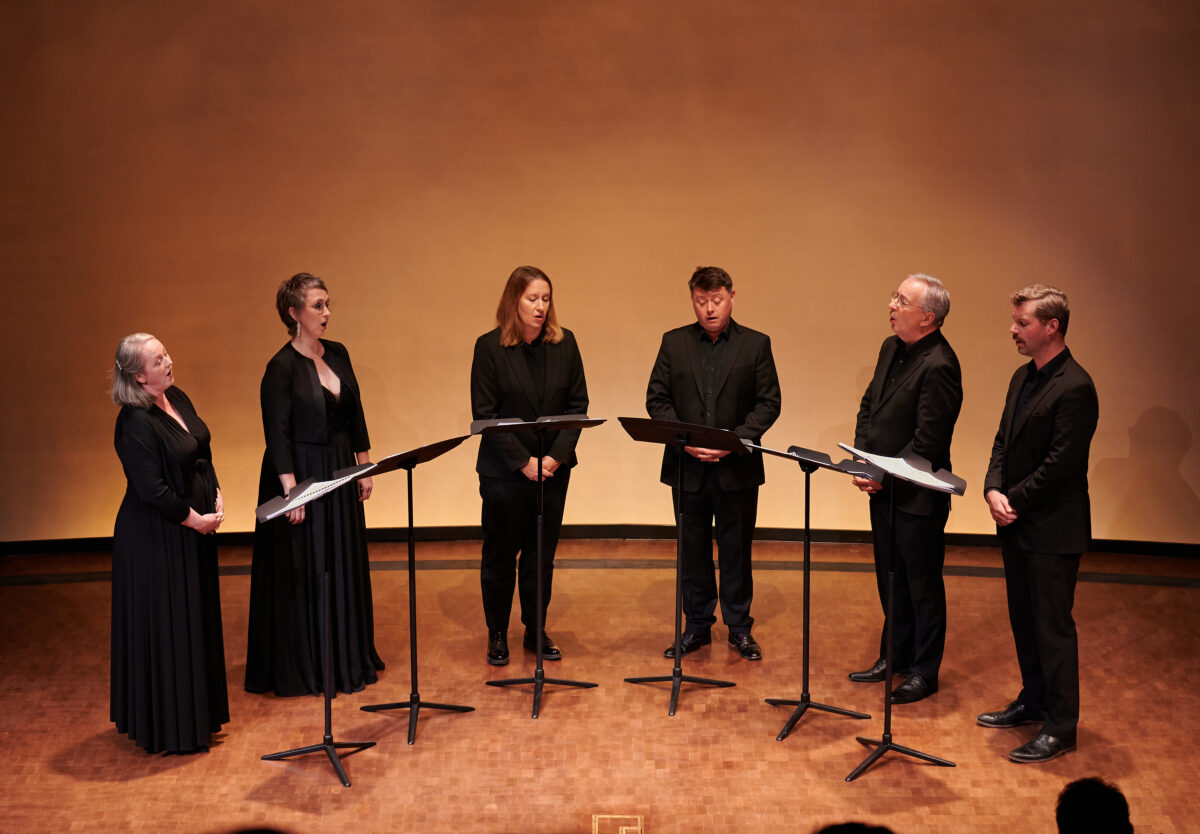
Photograph: © 2025 Cris Sunwoo
Their concert in late October was my second visit to the luxuriously refurbished Frick Collection, but my first to attend a concert at the intimate 220-seat Schwarzman space. Interest has been so great to experience the new venue that the entire 2025-26 season sold out on the first day tickets were available to the public. One of the more unique features of the cooly inviting space is that its seats lack their expected labels. Instead, each audience member discovered a unique printed program whose cover was branded with their seat number!
Agnew’s perfectly matched sextet tirelessly leaned into often exquisite dissonances throughout a relentlessly demanding program. Its fourteen pieces mixed plainchant with works most prominently by Gesualdo in addition to Lotti, Cardoso, Orlando di Lasso, Monteverdi, Jacques Maudit and ending with William Byrd’s “Resurrexi.” Agnew just once or twice needed to signal to his singers to correct a tempo or adjust the balance; otherwise, they sang with gripping concentration and a remarkable rapt beauty of tone.
Beyond brief opening spoken remarks by Agnew after an introduction by Jeremy Nay, the Frick’s Head of Music and Performance, the music was performed in a continuous flow without break. The audience was so overcome by the group’s sublime commitment that the applause went on and on but no encore was offered, unlike at BAM where Christie offered two additional Charpentier delights.
Christie and Agnew have been making regular appearances with students at the Juilliard School since that institution’s Historical Performance Program began. However, none have been scheduled for this season, so many of us anxiously await the next LAF appearance during 2026-27, but until then we can revel into the group’s complete Erato recordings reissued last year on 40 CDs, currently available at around $3.00 a disk!