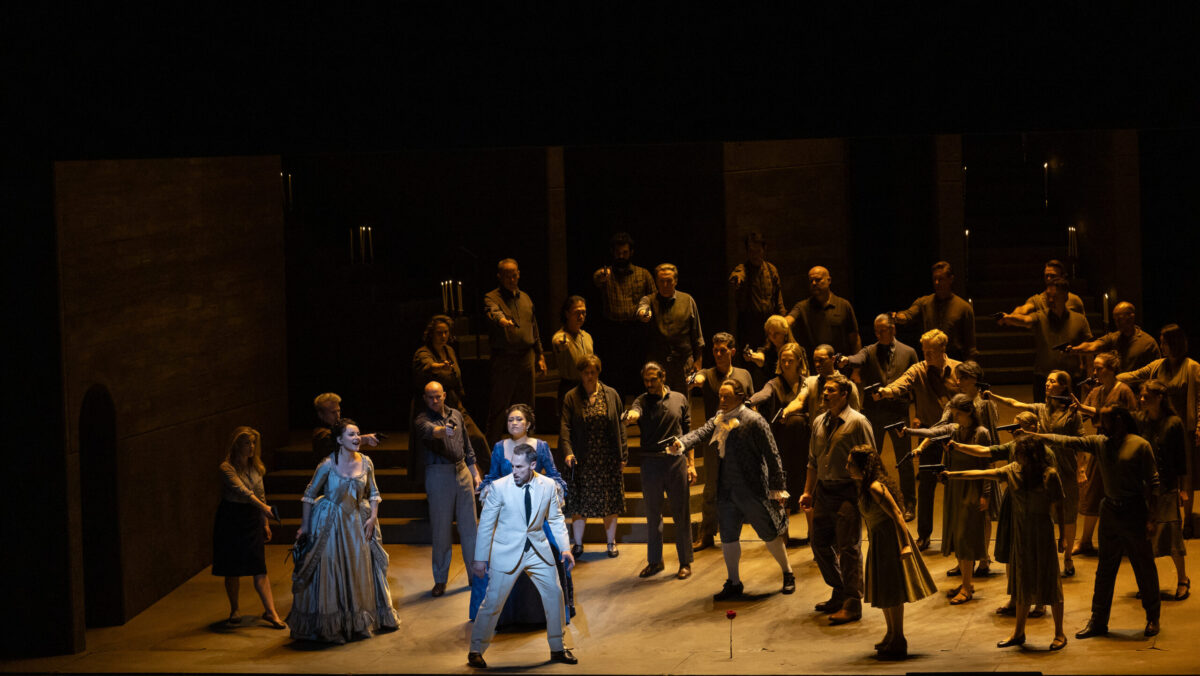
A scene from Act I of Mozart’s “Don Giovanni.” Photo: Marty Sohl / Met Opera
It took a while for the second cast of Don Giovanni at the Metropolitan Opera to come into focus – probably the result of a compressed and/or insufficient rehearsal period. Nonetheless, it was a much more impressive ensemble than the less fortunate group who premiered this revival last month with scattered and disappointing results.
The Met’s new Principal Guest Conductor, Daniele Rustioni, in his first season in that position conducted with relentless propulsion like he had a fire in his pants — sometimes I thought this was more Verdi than Mozart. Rustioni kept the energy high and the show moving along but moments of lyrical suspension and dramatic contrast were skated over. The orchestra played well for him and he kept things together, but this is not my favorite way of interpreting Mozart’s masterpiece. Don Giovanni is full of contrasts musical and dramatic and I felt that there were depths that were not plumbed and beauties that were passed by too quickly. It also sounded all a bit samey – and as I said, Don Giovanni is all about turning on a dime from the profound to the ridiculous.
Not one member of this cast came on sounding their best or registering strongly except maybe for Brandon Cedel (Masetto) and Andrea Carroll (Zerlina). Kyle Ketelsen sounded good but emerged with no strong presence or personality – Don Giovanni, like Carmen, needs sexual charisma and that is one thing that you have or you don’t. You can have everything else but if that certain something ain’t there – it ain’t happening. (See also: Isabel Leonard in the current Carmen revival.)
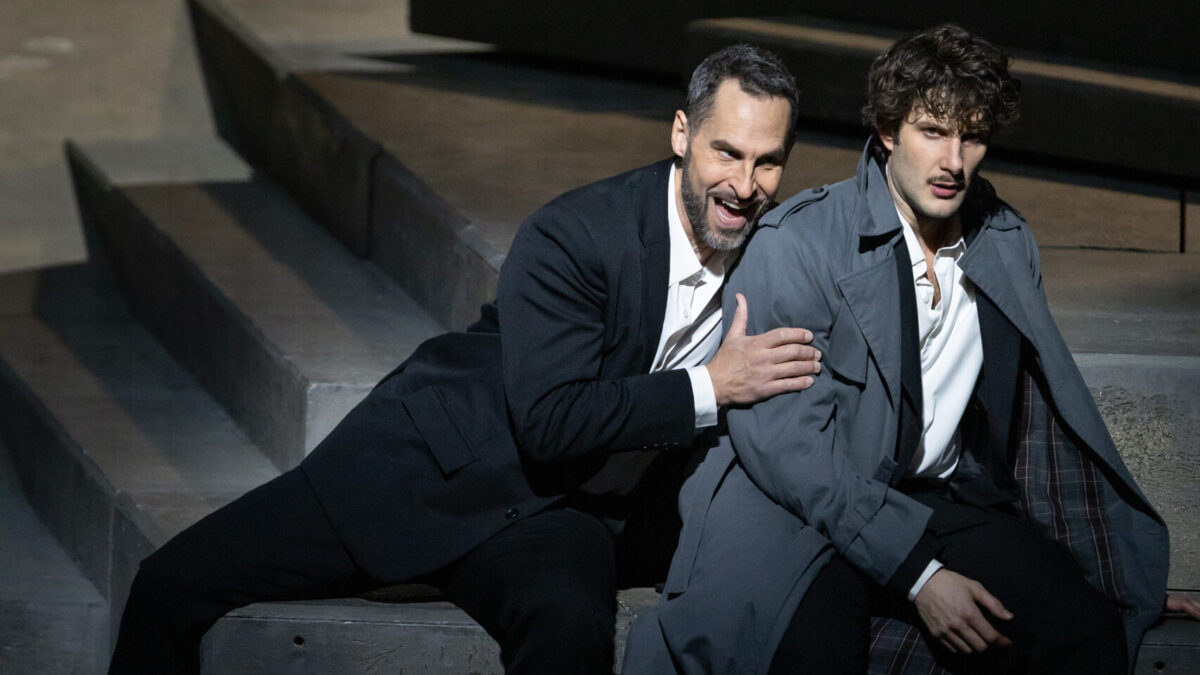
Kyle Ketelsen as Don Giovanni andTommaso Barea as Leporello in Mozart’s “Don Giovanni.” Photo: Marty Sohl / Met Opera
At the beginning of the evening, debuting Venetian baritone Tommaso Barea, came off as too young and callow (and too good-looking) as Leporello. He is a Masetto, especially in a house this size. (Barea and the rich-voiced and hearty Brandon Cedel could have profitably switched roles.) The otherwise excellent Anita Hartig seemed to struggle with Donna Elvira’s low notes in the role’s wide tessitura while the Chinese soprano Guanqun Yu seemed a lyric soprano out of her depth as Donna Anna, putting a lot of effort into a low-impact performance. Paul Appleby, an artist I respect (especially in recital), was an officious and overly declamatory Don Ottavio, braying out phrases that should instead be caressed.
But in the second Scene of Act I, things started to coalesce and everyone settled into their groove. Hartig in particular, an experienced Donna Elvira internationally, found an interesting mixture of bitterness and rue in the discarded lover and the voice began to flow with a beguiling, smoky timbre with a dash of tight vibrato to add intensity. Yu’s vengeance aria “Or sai chi l’onore,” meanwhile, revealed more vocal mettle and temperament though I found her ornamentations fussy. Her “Non mi dir” was well sung but not as melting or brilliant as it can be. She is a good singer, not a star.
Ketelsen came to show polished stage skills and smooth vocalism but Rustioni’s driving tempo of “Fin ch’han dal vino” pushed him into desperate bluster and his “Deh, vieni alla finestra” lacked melting legato seduction. The bigger picture is that the 2023 production by Ivo van Hove portrays the Don as a charmless figure driven by power and control – cold, efficient, prone to violence when crossed or trapped, and entirely lacking in empathy. It’s not necessarily wrong on a fundamental level, but there needs to be a patina of seduction and charm to achieve his wants and needs. Peter Mattei in the premiere run had the charisma to convince us of the Don’s persuasive ways.
Appleby’s interpretation of Don Ottavio also developed into that of a man in need of control (not a passive wimp) – he wanted to be sure Donna Anna was still a virgin and didn’t seem trusting or sure of her honor. The overemphatic vocal approach was consonant with this characterization but he eventually relaxed and while there was some flow to “Dalla sua pace,” the voice lacked ideal purity and float. Barea never gained authority, though the voice is pleasant if too light and lacking in deeper resonance.
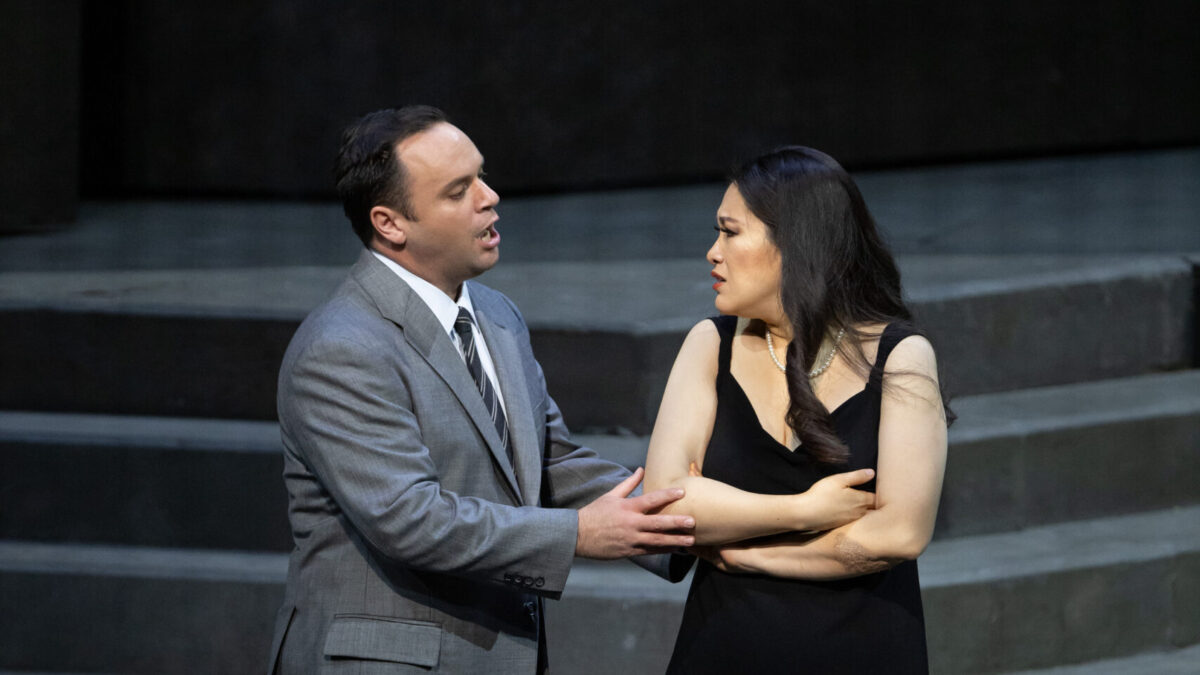
Paul Appleby as Don Ottavio and Guanqun Yu as Donna Anna in Mozart’s “Don Giovanni.” Photo: Marty Sohl / Met Opera
Andrea Carroll, who sang one performance of Zerlina for her Met debut in the production’s premiere season, is a singer who I was totally unaware of and she completely won me over. Her mettlesome Zerlina was no innocent (nor should she be in this production, where she is rolling around in the street with her fiancé and stripping down to her slip in public in her first scene). Carroll’s lyric soprano had tonal point and fruity color with supple phrasing and easy flexibility. She was appealingly natural onstage with no simpering or coyness. I am curious to see her in other roles.
The Ivo van Hove production, despite some annoying directorial clichés, works well enough in Act I despite a rather arid, lifeless urban mise-en-scène. It starts to fail on the job in Act II, the big problem being the lack of any disguise and overly bright lighting when the Don and Leporello exchange clothing. When the Don greets Masetto and his bully boys “disguised” as Leporello, it is just Ketelsen on a brightly lit stage with no cape or hat to cover his face – just the Don in his usual black suit saying he is Leporello looking exactly as he did before as himself.
Similarly, Donna Elvira has to pretend to be deaf, dumb, and blind not see that Barea’s much younger, mustachioed (but not bearded) “Don” is a plain-as-day imposter. The unit set is not versatile enough to give any sense of a graveyard for the scene with the ghost of the Commendatore; Soloman Howard just walked around the stage in a bloody shirt as a very corporeal, mobile, and less-than-supernatural statue, singing with a rich, resonant, imposing bass even if he looks rather young and muscular for an elderly nobleman (especially when a ghost). It’s like van Hove got lazy or wasn’t even trying. The whole lack of concept or imagination undermines the finale.
I think this cast will settle in and gain authority as the run continues until 22 November. The production and musical approach will remain as they are with the good points and decided bad points. The cast has elements worth checking out despite big holes in the ensemble.
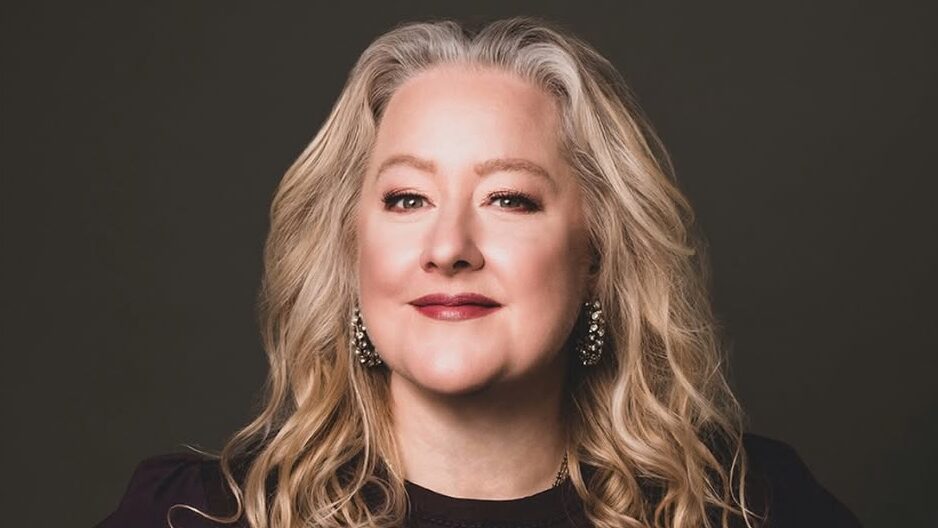
The final performance of the Fall cast of Puccini’s Turandot on 18 October featured a new icy princess in the person of Australian dramatic soprano Rebecca Nash, a resident cover who has never before gotten a scheduled appearance having jumped in as Elektra (for her debut), Ortrud, and the Färberin halfway through Act II of Die Frau ohne Schatten!
Meanwhile the cast around her remained as before. Michael Fabiano as the Unknown Prince Calaf sang with burnished tone that got a little pressed on the highest notes. By this point in the run he had wisely eschewed the optional high C on the phrase “No! no! principessa altera ti voglio ardente d’amor!” He was stylish and rich-sounding and brought more humanity and detailed acting to the role than the bellowing semaphoring automata we usually see in this role in this production.
Masabane Cecilia Rangwanasha again impressed with a deluxe instrument as Liù but also bewildered with inconsistent breath support and phrasing. By then, she had gained control over Liù’s Act III arias which generally went well with some fleeting inconsistencies. She needs to keep the support under the voice – I suspect there is a big spinto sound there somewhere and maybe taking the voice off the support is a function of lightening it for purely lyric roles like Liù. If she is going for a Jessye Norman sound (hopefully with more soprano top register) then she needs to get under that sound physically in a healthy way. She is starting to add heavier roles like Élisabeth di Valois in Don Carlos but I worry how they will work with her current technique which seems inadequate to heavier repertoire at this stage and down the line.
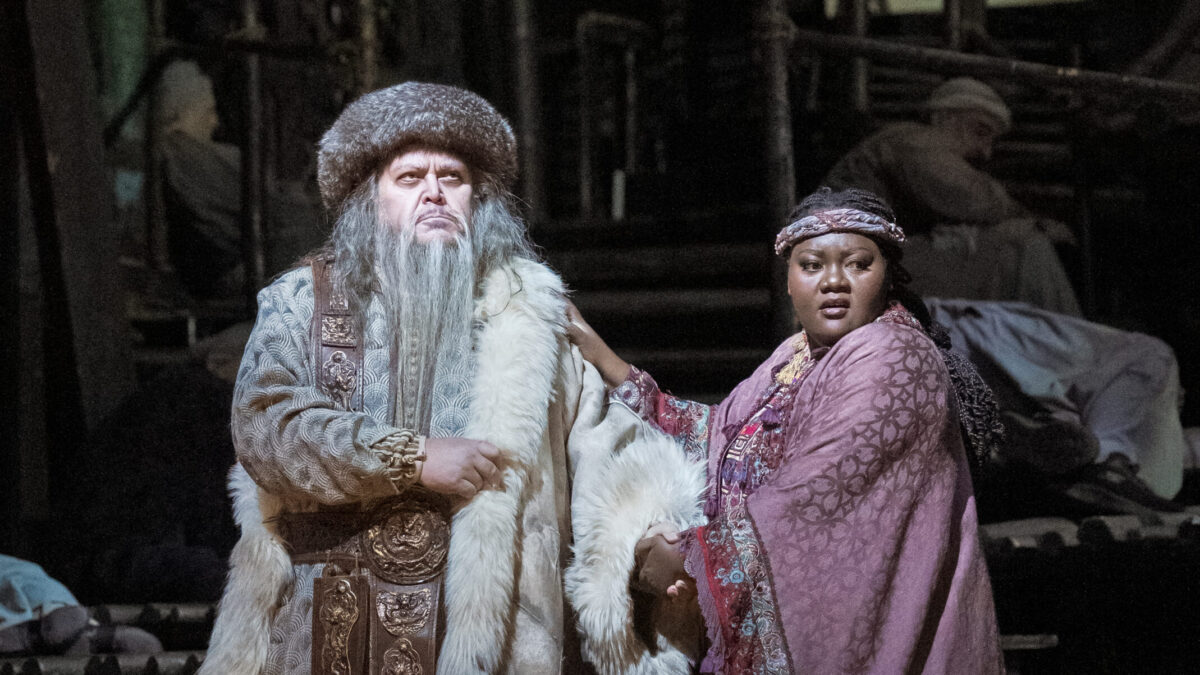
Vitalij Kowaljow as Timur and Masabane Cecilia Rangwanasha as Liù in Puccini’s “Turandot.” Photo: Ken Howard / Met Opera
Vitalij Kowaljow was a rich-voiced Timur and the trio of ministers were apt and very listenable. Carlo Rizzi relished the dissonances and darker colors of Puccini’s brilliant score, conducting Turandot as the complex 20th century score it is rather than a late 19th century pastiche.
As for our one-off diva? Nash seemed physically cautious on the multi-leveled set but was vocally in charge and authoritative. The tone is not huge – Angela Meade had the bigger more thrusting sound in the theater. Nash’s is more of a concentrated, resonant sound probably built for a medium-sized theater rather than a huge arena-like space, but she sang with easy, unforced legato and phrased elegantly with musical intention. High notes, needing to be neither hoisted up nor screamed out, were sung and sung well; Nash always knew exactly what she was doing with the vocal line and had the means to do it. The Met is very lucky to have Rebecca Nash around – even if she is merely waiting around backstage just in case.