Karli Cadel
The San Diego Opera (SDO) kicked off its 61st season on Halloween night with Ruggero Leoncavallo’s verismo masterpiece Pagliacci. Whoever came up with that idea deserves a prize, as not only did the story of a murderous clown fit the theme of the day, but the occasion also encouraged the audience to dress up, and the San Diego crowd certainly didn’t disappoint. Many attendees arrived that night dressed as clowns or other commedia dell’arte characters, boosting the festive spirit even before the show started.
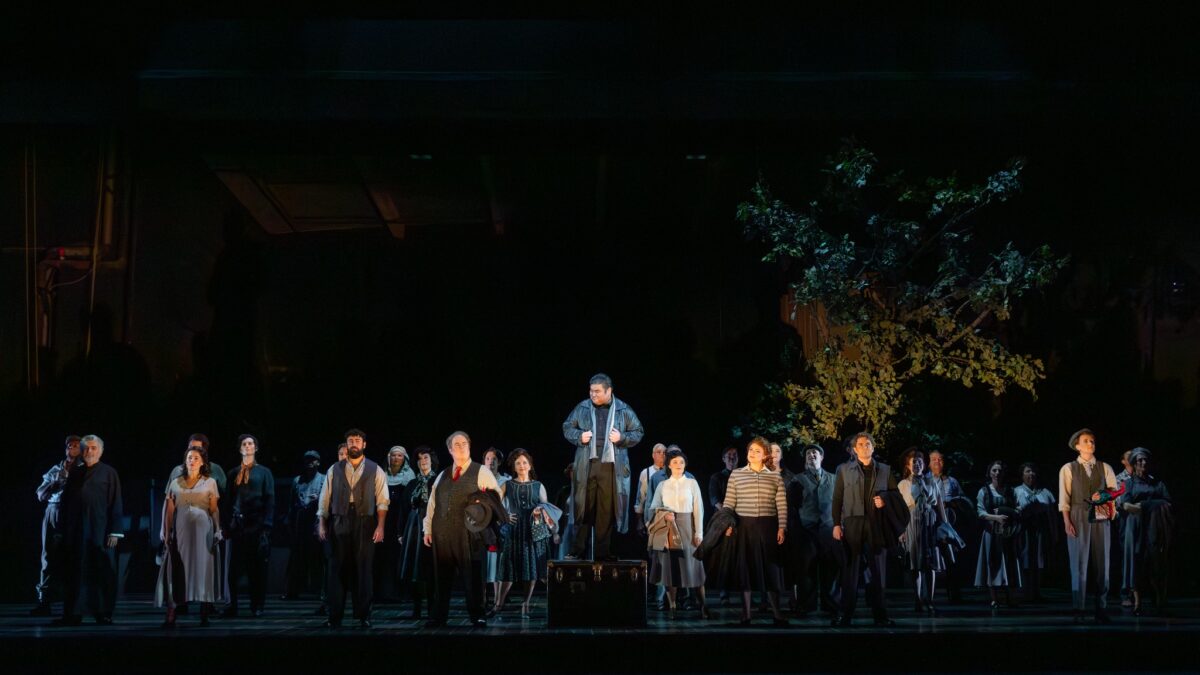
There was much to admire in Christopher Mattaliano’s staging, especially in how effectively he used minimal sets and props. He updated the story to the 1940s, and Paul Palazzo’s bright, reddish-brown lighting (notably in Act I) gave it the appearance of a Technicolor film. Allen Moyer completely stripped the Civic Theatre stage bare, with only a short backdrop indicating the troupe’s stage area. The rest of the Civic Theatre stage was left empty, with side pulleys, for example, clearly visible. He simply placed a raised platform in the center of the set, with a single tree as background. The stark emptiness created an uneasy, foreboding feeling for the audience right from the start.
The curtain opened to reveal a ghost light. The Prologue was cleverly staged, with the song sung not by Tonio but by the actor playing the role (in plain clothes), adding another layer to the story and making it almost a play within a play within a play. Toward the end of his soliloquy, each singer and chorus member (also in everyday clothes) appeared one by one to support the statement in the prologue, not unlike the Prologue of Sweeney Todd: The Demon Barber of Fleet Street. It was a totally unexpected moment that, in my opinion, worked well.
Karli Cadel
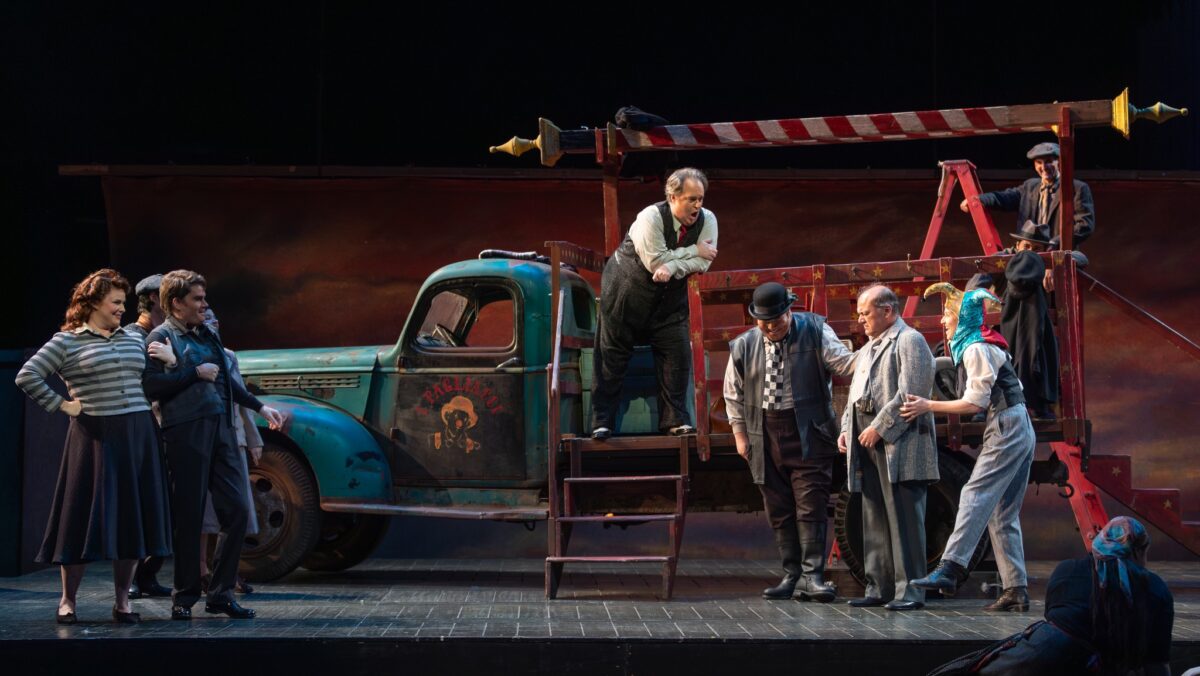
Canio’s commedia troupe arrived in Act I not by cart but in a battered truck, and the entire first Act revolved around unveiling that truck and preparing for the show. It was simple, effective, and highlighted the veristic characteristic of a traveling troupe. That simplicity carried over into Act II, when the stage was divided into two sections by a red curtain to represent the commedia dell’arte play’s stage and backstage. (In this production, the play was staged facing stage right rather than the audience.) The chorus, acting as the audience, was scattered outside the raised platform—mostly stage right, facing the commedia stage. The ingenuity of these choices was twofold: first, by showing the stage and backstage separately, the focus shifted from watching the play to observing the actors moving in and out of roles. Secondly, since the play was performed in such a confined, claustrophobic space, the events of Act II played out in a tense, pressure-cooker environment that culminated in the double murder. The actor playing Tonio (from the Prologue) returned with the ghost light to utter “La commedia è finita!,” tying the finale to the Prologue and ending the show in a frenzied state.
However, choosing to use only a small part of the Civic Theatre for the stage also posed a challenge, one mentioned in several reviews of past Mattaliano performances: it didn’t do much to improve the projection of unamplified voices, and on Friday, it affected the balance between some singers and the orchestra, especially in the first Act. From my seat on the orchestra level, the orchestra sounded much louder than the singing onstage in Act I. Luckily, the balance improved in the next Act. The red curtain that separated the commedia stage from backstage also somehow blocked the audience sitting in house left from seeing what was happening behind the scenes, reducing the scene’s impact.
SDO assembled a group of talented singers as the principals for Pagliacci, most of whom were making their SDO debut. As the leader of the troupe, Jonathan Burton brought intelligence and sensitivity to his portrayal of Canio. A veteran of fourteen productions, he mentioned in an interview that his goal was to “make this protagonist believably human, no cardboard lout.” His Canio wasn’t a drunken, aggressive type but rather an overthinking one, driven by jealousy into acting irrationally. Unfortunately, he was the one most affected by the unbalanced projection mentioned earlier, so you can imagine my relief hearing him launch into a deranged maniac in Act II!
Karli Cadel
To my ears, Kidon Choi was the best of the bunch as Tonio and as the actor playing Tonio in the Prologue and at the end. He smartly transformed his warm, booming sound into a range of colors and phrases to create an Iago-like chameleon, shifting from pity and menace to manipulation and even buffoonish sarcasm as Taddeo in Act II. His Tonio was undoubtedly the most tragic of all, a man desperately in need of love who was severely rejected and even bullied.
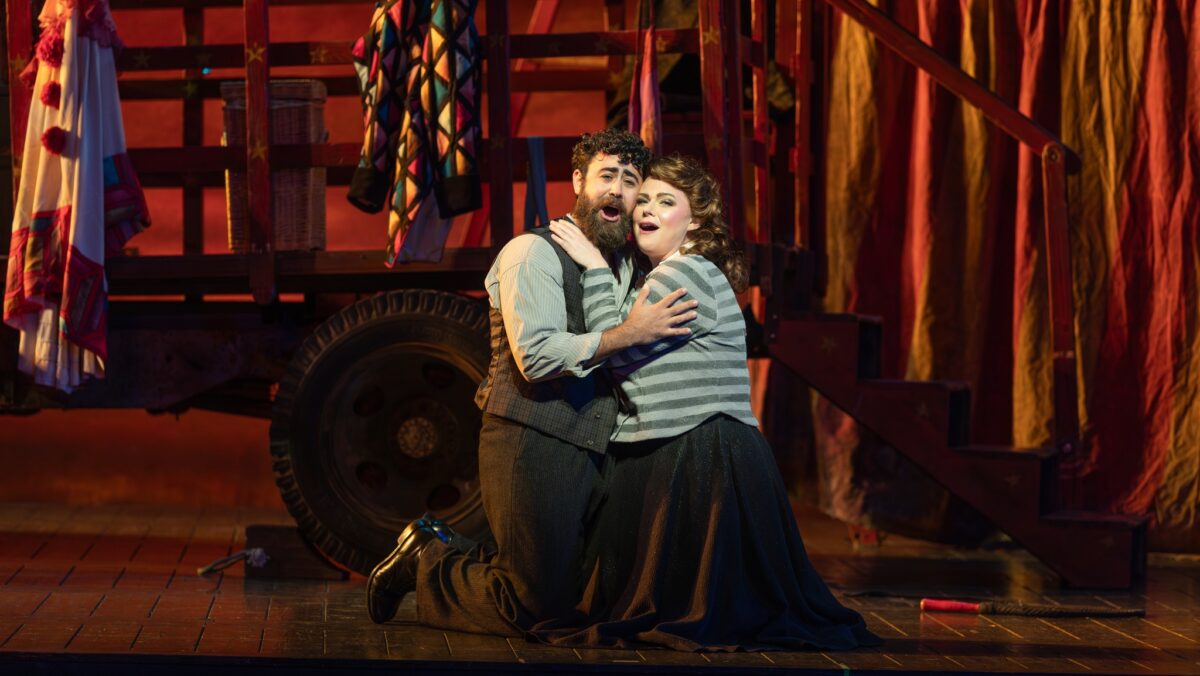
Hailey Clark portrayed a glamorous Nedda; her bright, silky tone evoked a youthful, playful person trapped in the life of a traveling troupe. Her “Stridono lassù” especially shimmered with effortless delivery and delicate phrasing. Subsequently, her love duet with Silvio, sung stoically by Eleomar Cuello (who replaced the indisposed Timothy Murray), was marked by unbridled passion and intense desire, making her yearning to leave the troupe clear. Arnold Livingston Geis cheekily serenaded her as Arlecchino perched atop a ladder in Act II, giving the audience a little respite before the storm.
The SDO Chorus, led by Bruce Stasyna, and the Children’s Choir (under Ruthie Milgard) proved to be valuable assets in this production. Not only did they sound cohesive and wonderful, but they also provided significant blocking that advanced the story, especially in Act II. Principal Conductor Yves Abel led the San Diego Symphony in a lively performance full of excitement and energy. His conducting of the commedia dell’arte play in Act II was particularly outstanding, carefully building tension to its explosive finale. I only wish the balance in Act I had been a bit better.
This was an auspicious start for SDO, and the audience enthusiastically gave the cast an extended standing ovation. The season will continue with a one-night-only performance of Damien Geter’s multimedia song cycle Cotton, performed by J’Nai Bridges and Justin Austin on January 16, 2026.


