Elliot Mandel
The film director Ridley Scott had an amusing retort to historians who questioned the accuracy of his depiction of the Battle of Waterloo in his 2023 movie Napoleon starring Joaquin Phoenix: “Were you fucking there?” Similarly, no one alive today was around for the birth of the art form of opera, but the revelatory concert performance of Jacobo Peri’s Euridice (1600) co-produced by the Haymarket Opera Company and the Newberry Consort on 25 October in Chicago made a compelling case for putting you in the room where it happened.
The choice of the now familiar tale of Orpheus and Eurydice by Peri and his librettist Ottavio Rinuccini proved to be prescient—many composers from Monteverdi to Gluck to Hans Werner Henze would make use of it. The plot as it appeared in Ovid’s Metamorphosis is straightforward: Eurydice dies and the distraught musician Orpheus journeys to the underworld to plead for her to be returned to the living. The god Pluto grants his wish on the condition that he not turn around and look at her until they are back on earth. Of course, he turns, he looks, and Eurydice returns to Hades forever. Peri and Rinuccini faced a problem however: their Euridice was to be performed at the wedding celebration of Henry IV of France and Maria de Medici, so as not to spoil the bride and groom’s big day, they simply rewrote the end of story. Euridice is restored to Orfeo by a reasonable Plutone and they live happily ever after! And so at least at the beginning of the operatic tradition, the soprano does not die.
Elliot Mandel
What makes Euridice the first opera? According to musicologists, it was Peri’s conscious innovation to move beyond the static, partly musical intermedi of his day by combining speech and song. This “song-speech” caught on immediately and directly inspired Monteverdi and others to expand the form. The elements that would become standard in opera are there: music and words expressing powerful emotions of love and loss, vivid characters interacting with one another, and fine instrumentalists accompanying their story. Does it sound like Puccini? No, but it does sound somewhat like a chamber opera by Britten or George Benjamin to my ear.
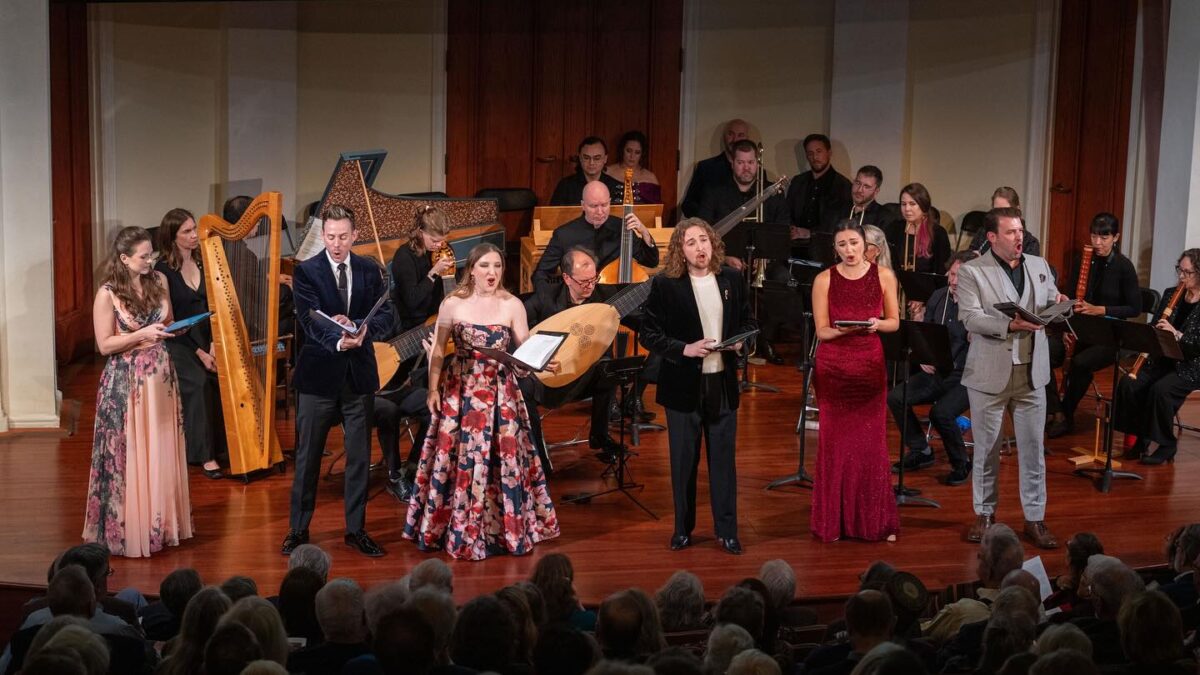
The conductor-less performers of both ensembles made Euridice come alive. Tenor Scott J. Brunscheen as Orfeo sang expressively with a clear, fine tone. Soprano Erica Shuller infused the title role with warm and lush sounds. Countertenor Ryan Belongie as Arcanto and tenor Michael St. Peter as Aminta moved the plot along with inspired vocalizing and Hannah De Priest in the dual role of Dafne and Nymph II was a vibrant stage presence and sang with passion and skill. Jonathan Woody’s powerful but controlled bass-baritone was perfect for a menacing but ultimately generous Plutone.
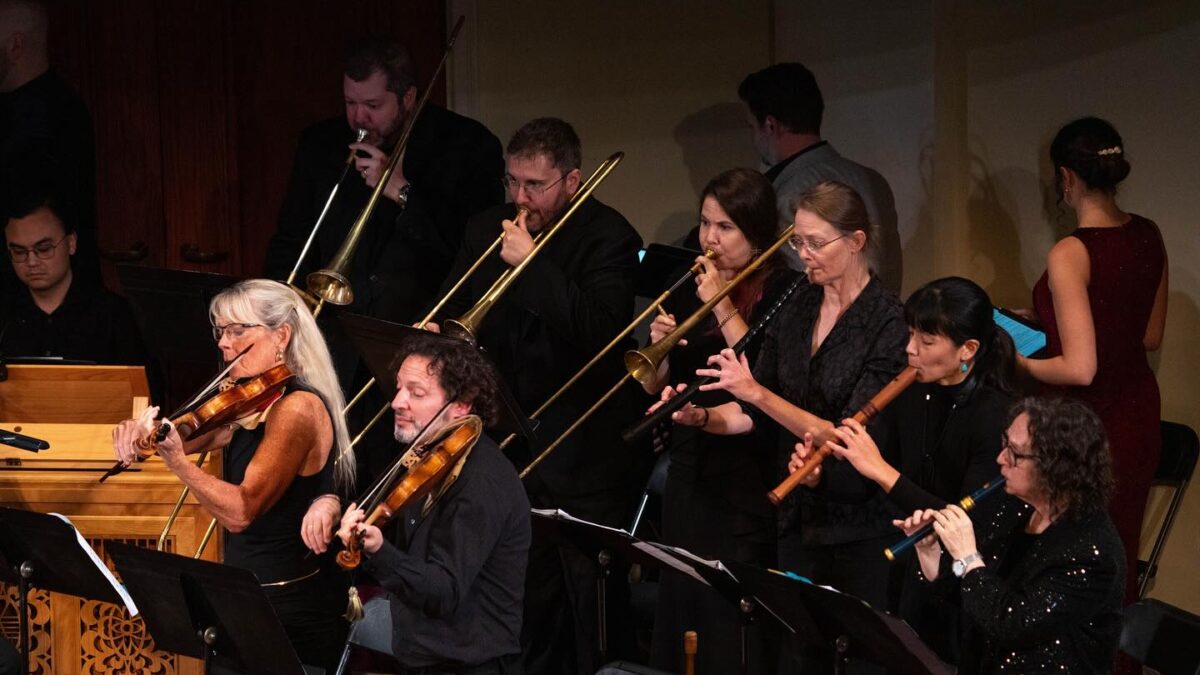
The singers of Haymarket were ably complemented by the musicians of the Newberry Consort. They provided both generous support for the vocals and virtuosic musicianship in the sinfonias and interludes, handling their sometimes unwieldy early modern instruments with great aplomb. The acoustics and space at the Nicholls Concert Hall at The Music Institute of Chicago were well-suited to this production.
Any attempt to recreate exactly what a performance was like four hundred plus years ago is bound to encounter difficulties and require choices—the documentary record is simply too sparse and incomplete. But the scrupulous and imaginative approach taken by the Haymarket Opera Company and the Newberry Consort as elucidated in the most exemplary program notes I’ve ever read is truly inspiring. We are very fortunate to have in Chicago these two cultural treasures.