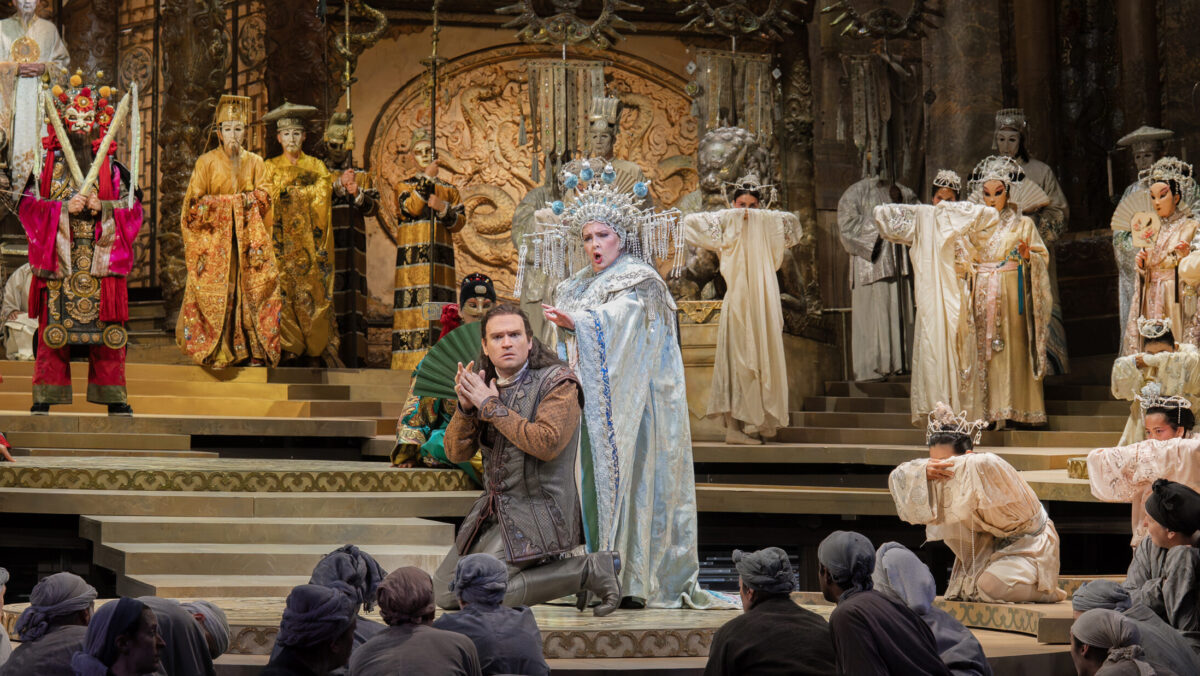
Michael Fabiano as Calàf and Angela Meade as Turandot in Puccini’s “Turandot.” Photo: Ken Howard / Met Opera
Some reviews are harder to write than others. There are those rare evenings where everything comes together: singers on fire, conductor thrilling but sensitive, thoughtful production. Far more fun to write about are the disasters, when the temptation to dish out one withering but witty putdown after another can overstep the bounds of kindness towards the performers.
The last time I heard Angela Meade and Michael Fabiano together in Trovatore it was pure chaos: illnesses, cracked high notes, twisted ankles, unannounced replacements on a turntable set. Meade and Fabiano have delighted and frustrated Met audiences ever since their well-documented Met competition win in 2007, and when they first sang Lucia together as students at AVA few would have predicted that they would go on to sing Turandot 16 years later.
It’s neither a roaring success nor disaster — rather, it’s a performance that allows for an honest appraisal of both artists. Not much needs to be written about Zeffirelli’s hilariously gaudy production: the audience applauded the giant golden palace in Act II, and I burst out laughing when the ribbon dancers leapt onstage like overly enthusiastic flower girls at a wedding. Credit to Fabiano, though, for almost managing to make the leather leggings look hot.
It may be an exceedingly low bar, but Michael Fabiano is the most sensitive Calaf I’ve heard on the Met stage. He phrases stylishly, with impeccable breath control and burnished tone on everything up to an A. Even the high notes, which have been a gamble for him lately, were confidently approached if not flawless: the high C in “Principessa altera” landed flat, while the B in “Nessun dorma” was squarely on pitch but sounded bottled. He’s a fabulous actor, managing to project Calaf’s fanatical obsession towards Turandot as well as genuine tenderness towards Timur and Liù. All of this is what one comes to expect from Fabiano at this stage in his career.
Angela Meade’s Turandot is a different beast entirely. Having spent years as a bel canto specialist, her recent move into Wagner and Strauss has been cautiously successful; her first Turandot in LA received rave reviews here but sounded alarmingly wobbly in the broadcast. Meade’s voice has never recorded well, but even in the house her voice can sound fluttery, hollow, and vague in pitch. At the same time she’s impressively loud — her “Straniero ascolta” pinned me to the back on my seat — and her high notes are pleasingly secure. I may sound like I’m damning with faint praise, but after so many Turandots who are neither loud nor secure I’ll take it. It’s also the most dramatic commitment I’ve seen from Meade: her diction was crystal clear, and she melted beautifully into confusion, self-loathing, and resignation in “Del primo pianto.” It’s the best performance I’ve seen from her.
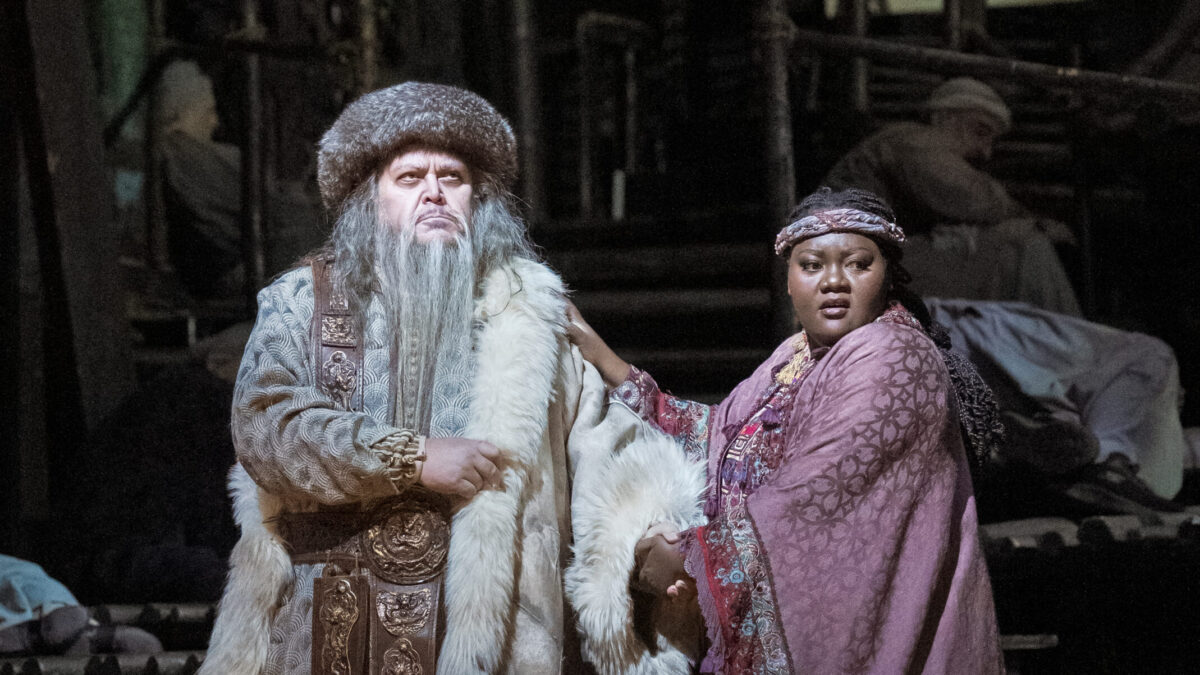
Vitalij Kowaljow as Timur and Masabane Cecilia Rangwanasha as Liù in Puccini’s “Turandot.” Photo: Ken Howard / Met Opera
She made for a fascinating contrast with Masabane Cecilia Rangwanasha, the young South African soprano making her Met debut as Liù. Rangwanasha possesses a quality instrument, with an opulent sound and luminous glow, as well as a compelling stage presence. At her best she’s stunning — the way she floats the end of “Signore ascolta” is breathtaking — but she also ran out of gas and went seriously flat at the end of “Tanto amore Segreto.” I’ve been following Rangwanasha ever since she was a young artist in London’s Royal Opera House, where she sang everything from Handel’s Susanna to Verdi’s Élisabeth de Valois with poise and charisma. Liù is a role that should hold no terrors for her, and I’ll put it down to first-night nerves.
The rest of the cast is strong: Vitalij Kowaljow is resonant and heartbreaking as Timur, Thomas Capobianco manages to be audible as Altoum despite being miles upstage, and Le Bu is an imposing Mandarin. Hansung Yoo’s Ping is the pick among the trio, with gleaming tone and gorgeous portamenti. Tony Stevenson and Rodell Rosel are old pros as Pang and Pong, but their character tenors blend poorly with Yoo’s rich sound. It’s all presided over by Carlo Rizzi, who directs the orchestra and chorus efficiently. He favors fast tempi and well-blended orchestral sounds — he doesn’t bring out the colors and dissonances of Puccini’s score, but he gets the job done effectively.