Cory Weaver/San Francisco Opera
Opening Night Galas are often flashy and over the top, all spectacle and little substance. But on Friday, September 5, San Francisco Opera (SFO) kicked off its 103rd season with Giuseppe Verdi’s sixteenth opera,Rigoletto, in a Gala that showed precisely how to do it right. Amidst a landscape that was becoming increasingly hostile towards Arts organizations, the company not only delivered a spectacular performance of the Verdi’s masterpiece but also, more importantly, garnered a heightened sense of community support from donors, patrons, and the audience in general who seemed to back the institution in an almost defiant stance. In over a decade of attending the Opera, I have never seen such a high-energy crowd, and it was incredibly thrilling to witness!
SFO spared no expense to ensure the Opening Night was as successful as possible. The boxes were decorated with pink and purple flower garlands representing the two sides of clown faces—happy and sad—and Tal Rosner’s colorful projections from the Pride Concert were efficiently reused to welcome the audience and set the mood. I was personally happy to see those projections again, as they were truly breathtaking! The opera began promptly after a short video featuring General Director Matthew Shilvock, President Jack Calhoun, and Chairman of the Board Barbara A. Wolfe welcoming the audience to Season 103, followed by the Orchestra playing the National Anthem conducted by Music Director Eun Sun Kim.
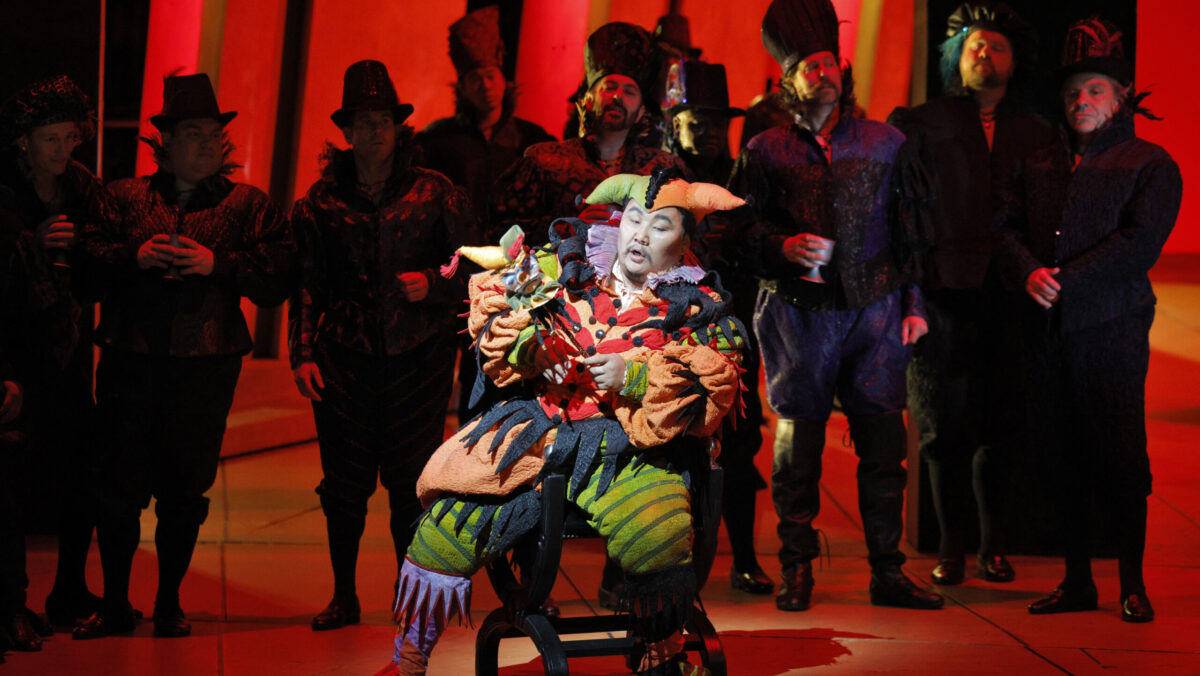
This SFO production of Verdi’s 1851 adaptation of Victor Hugo’s sharply critical Le roi s’amuse was first staged in 1997 by Mark Lamos and was revived in 2001, 2006, 2012, and 2017 by different stage directors. A planned fifth revival was canceled due to COVID-19 in 2020. Jose Maria Condemi directed this revival with a sense of urgency, especially in managing the movements of everyone (including the courtiers and noblemen) onstage. In a staging that emphasized surrealism (Michael Yeargan’s sets were heavily inspired by Italian surrealist artist Giorgio de Chirico, and Justin A. Partier revived Mark McCullough’s shadow play lighting), Condemi added a sense of intrigue and mystery by positioning everyone on stage as if they were but fate’s pawns.
Costumes by Constance Hoffman were sixteenth-century court attire. Partier (and McCullough)’s color palette for lighting was particularly striking. In stark contrast to the rest of the sets, he chose to bathe both Gilda’s home and Sparafucile’s inn in red, an obvious reference to the color of lust in Dante’s Purgatory, drawing parallels between Gilda’s and the Duke’s secret rendezvouses in those spaces.
Maestro Kim masterfully captured the energy of the crowd and translated it into her interpretation as she led the Orchestra in a taut and precise reading that brought both clarity and structure to Verdi’s darkly atmospheric music. Entering her fifth season as SFO’s Music Director, Kim’s leadership felt more assured and prominent, and she clearly established a strong rapport with the Orchestra. Even more noticeable this time was her sensitivity in supporting the singers on stage, enabling each to shine brightly. Little wonder the SFO audience loved her and showered her with hearty applause!
Nevertheless, the main reason to catch this Rigoletto was undoubtedly the singing, as SFO assembled an exceptionally talented cast to bring out the drama, led by Mongolian baritone Amartuvshin Enkhbat in the title role. Enkhbat, who mesmerized as Renato in last year’s Un ballo in maschera, has made Rigoletto his calling card and performed it all over the world. (By the time this run ends, he will have sung it more than 120 times!) His familiarity with the role truly showed on Friday, proving why he is now considered one of the leading Rigoletto interpreters as he embodied the court jester wholeheartedly through his acting and, particularly, in his voice. Every phrase was delivered with great care and with a variety of nuances and colors that felt natural and effortless.
Cory Weaver/San Francisco Opera
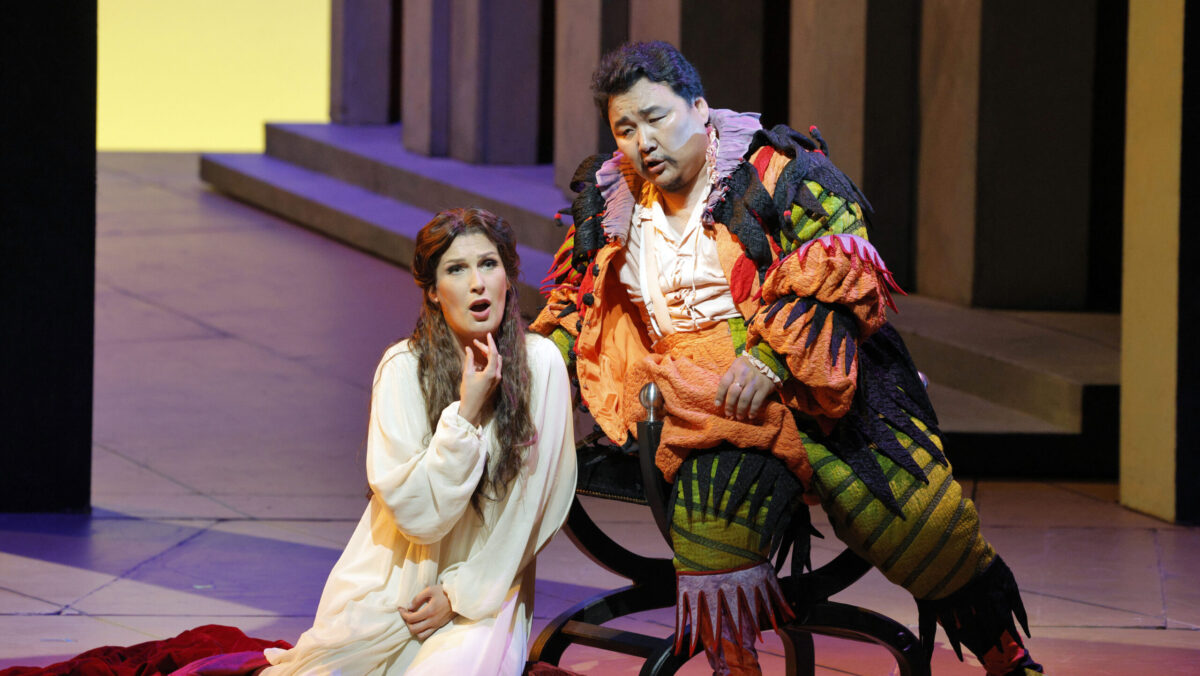
In an interview included in the program notes, he mentioned that he believed being a lowly court jester was “probably the only way for someone like Rigoletto to exist” and tried to show “how Rigoletto must act to survive” in such a cruel world. On Friday, that element of fear clearly radiated throughout his performance. When his Rigoletto mocked Monterone, for example, it was almost as if he had to do it, not because he wanted to. Such an interpretation added more depth to the titular role, in my opinion, and helped explain why Monterone’s curse haunted him.
Enkhbat faced a worthy opponent in Romanian soprano Adela Zaharia as his daughter, Gilda. In her fourth performance of the role, Zaharia, who delivered a stunning Donna Anna in Don Giovanni three years prior, offered a nuanced and fully realized portrayal of Gilda. Her bright, resonant voice and effortless coloratura made her performance especially captivating. In another interview, Zaharia described the role as rebellious and empowering, and on Friday, her unique interpretation proved to be utterly mesmerizing on stage. Her Gilda wasn’t a naive victim but a full-fledged woman with feelings and the power to make her own choices. This was most evident in the famous “Caro nome” aria in Act I, which she sang with a firm resolve to love rather than just expressing love at first sight. Zaharia also maintained a great rapport with Enkhbat; their multiple duets felt genuine and believable as a father-daughter duo, and “Sì! Vendetta, tremenda vendetta!” at the end of Act II was particularly heart-wrenching in its delivery.
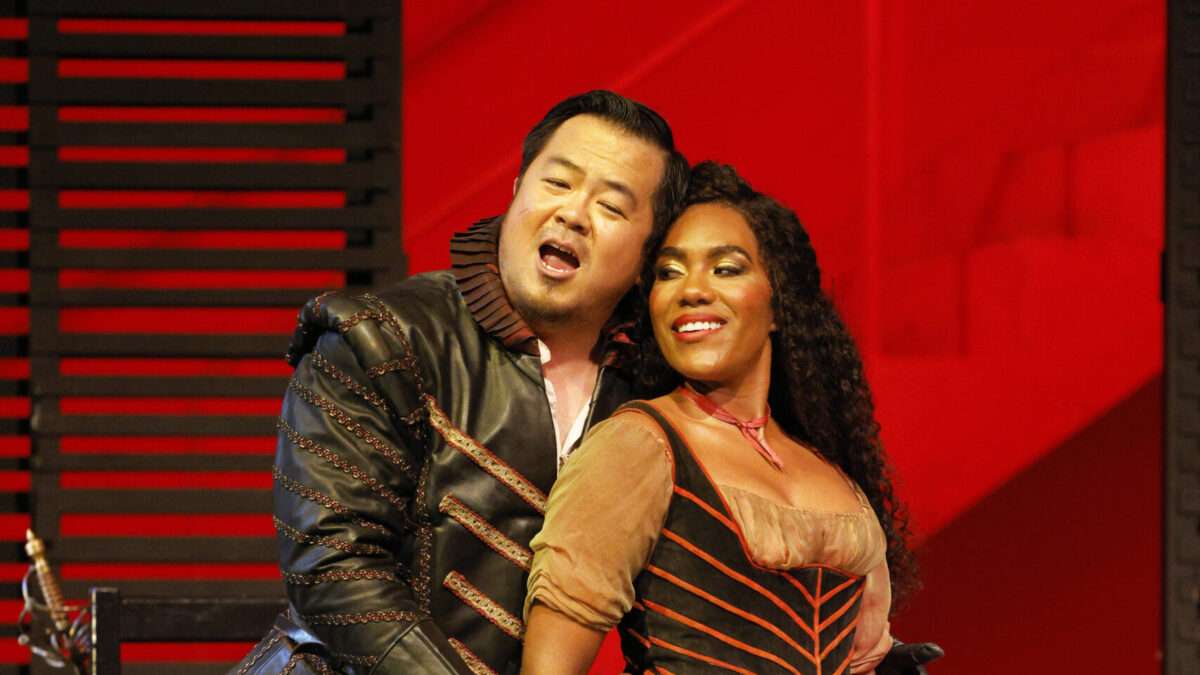
The debuting tenor Yongzhao Yu sang earnestly with an appropriate swagger as the lecherous Duke of Mantua. Yu’s voice was bright if on the lighter side and on Friday, nerves seemed to get the better of him in Act I where he sufferedaudibility problems. He rebounded nicely after the break and provided a strong counterpart to his starry co-stars, particularly in the quartet “Bella figlia dell’amore.” I do not doubt that he will improve in subsequent performances.
Cory Weaver/San Francisco Opera
Even more impressive was the other SFO debut, bass Peixin Chen as Sparafucile. With a deep, booming voice, he transformed into an absolutely terrifying assassin, infusing the role with a sense of calm and danger. Chen showcased extended, resonant low notes in his duet with Maddalena, “È amabile invero cotal giovinotto/ Ah, più non ragiono!” sung coquettishly by J’Nai Bridges, truly luxurious casting for this show. Chen will return as Supreme Lord Laozi in The Monkey King, and I hope SFO will bring him back with more substantial roles in the future!
All the comprimario roles were adequately filled by a strong cast, including Aleksey Bogdanov’s dignified Count Monterone, Stella Hannock’s cunning Giovanna (the production seemed to suggest that Giovanna worked as the Duke’s agent), and a pair of Adler Fellows, Jongwon Han and Caroline Corrales, as Count and Countess Ceprano. The Chorus, under the direction of John Keene, once again excelled and provided a significant contribution as courtiers and noblemen.
A quick look at ticket sales indicated that Rigoletto is selling very well, which is a great sign for such an extraordinary production. Six performances remain, including the livestream on Saturday 13 September. No matter what you do, don’t miss experiencing the dynamic duo of Enkhbat and Zaharia!


