Bronwen Sharp
Of the three great Mozart-Da Ponte operas, Le nozze di Figaro might provide the greatest amount of pure pleasure to the audience: a stream of great arias, duets, and ensembles, humor, pathos, farce, bad behavior thwarted, no nasty tricks, no rape, no moralizing, nobody dies, and a (mostly) happy ending.
Okay, it’s true that the Count spends most of the opera trying to bed his servant Susanna before she marries Figaro, betraying his loving wife in the process, and at the close we suspect he’ll betray the her again, but these are the only shadows cast over the sunniest of the three collaborations.
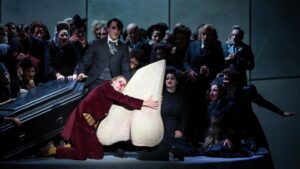
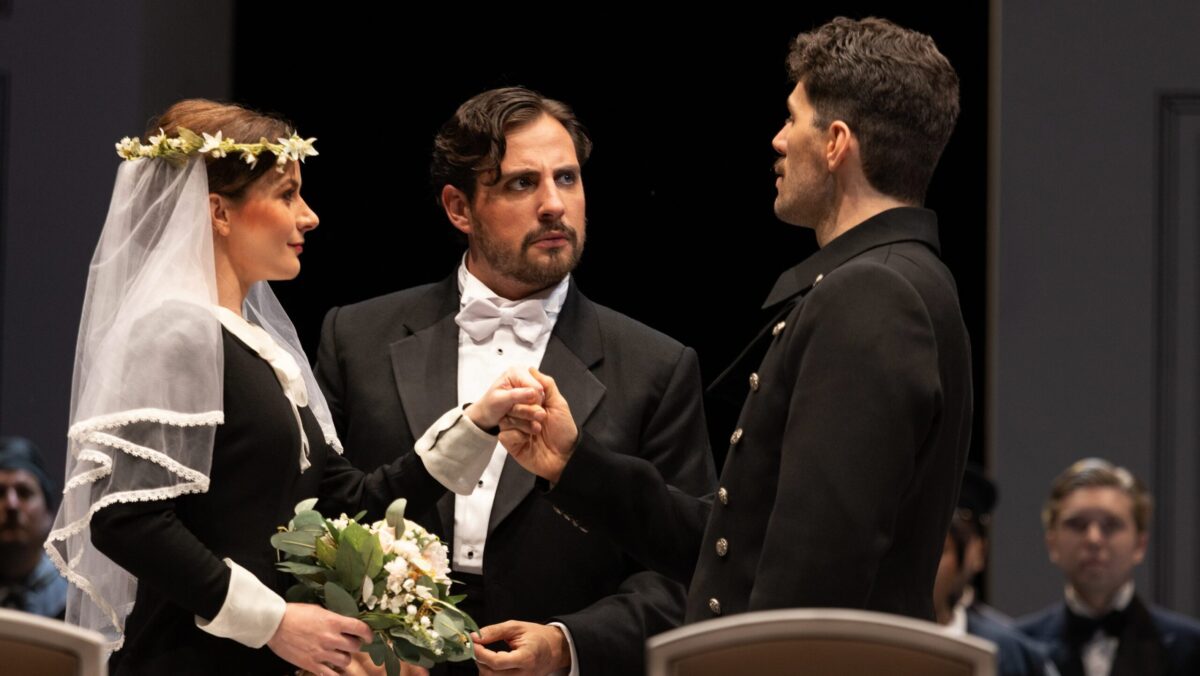
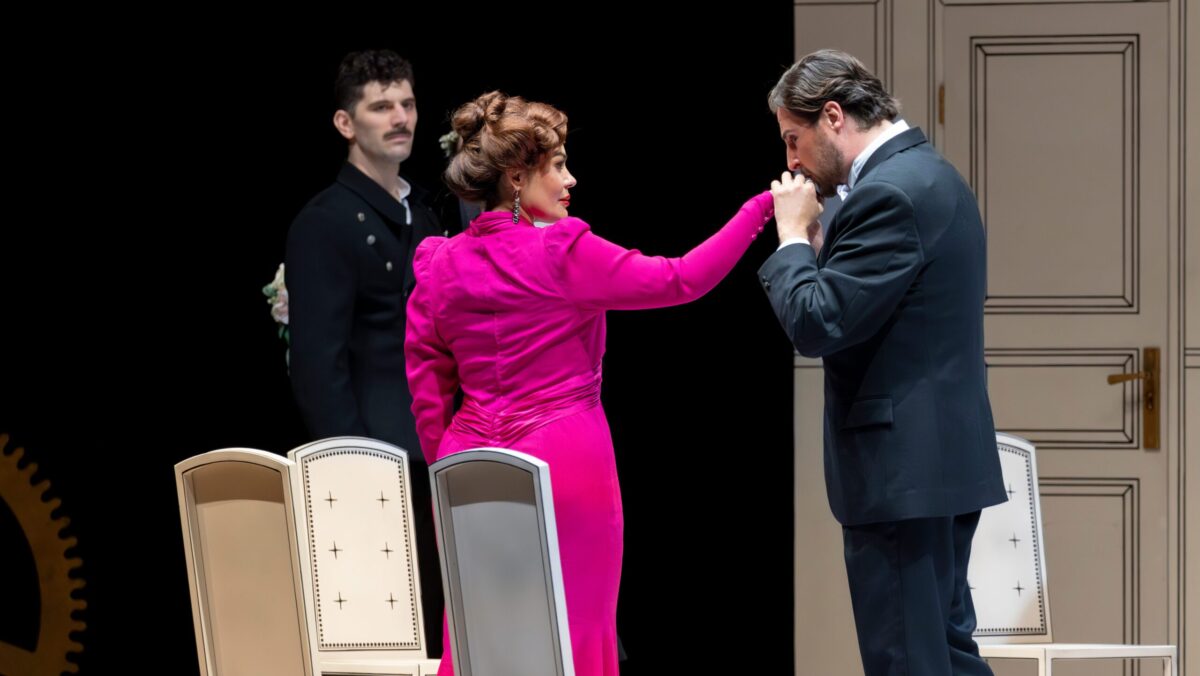
This season, Santa Fe Opera has revived its 2021 Laurent Pelly production, a jolly confection set sometime in the 1930s. This particular conceit means that the singers are costumed in almost-modern dress. The servants wear uniforms, the upper classes don’t, but there’s still some blurring of the class divisions. Should a noble like the Count appear in his pajamas and a bathrobe before anyone other than his manservant and wife?
That noted, the update doesn’t have much impact on the effectiveness of the opera, which is cleverly staged on Chantal Thomas’s rotating set, which resembles a giant clockwork with mobile walls and many, many doors, all the better to facilitate the complex comings and goings that power the opera. According to Pelly, the clockwork mechanism refers to La folle journée (the crazy day), the title of the Beaumarchais play on which the opera is based, but it could also refer to the intricate plot and the split-second timing needed to bring it off.
Santa Fe has put together a generally-excellent international cast of singers for this revival. The Italian bass Riccardo Fassi made a fine company and U.S. debut in the title role, playing Figaro as a bit of a dunderhead and singing with a solid, if slightly gritty, tone. Well, as Susanna says in the very first scene, “Perché io son la Susanna e tu sei pazzo.” (I am Susanna and you are a fool.) He is a charming fool, though, and as we know, he loves Susanna dearly.
Liv Redpath, his Susanna, has a crystalline soprano and the finest Mozartian line in the production and she was a delight throughout. The Chinese mezzo-soprano Hongni Wu was a flustered and adorable Cherubino, apprentice singer Isobel Anthony a confident Barbarina.
The production experienced some turnover in its Countess Almaviva during the run. Jacquelyn Stucker sang the first performance; the initially announced Spanish soprano Marina Monzó sang two performances, then withdrew for personal reasons. Ailyn Pérez, who sang a recital at the Santa Fe Chamber Music Festival on 23 July, was already in town and knew the production, so she stepped into the role.
Tira Howard
Pérez is a wonderful singer; her Rusalka in that opera in Santa Fe’s 2023 season will stay with me forever. But from her performance, it seems that Mozart roles aren’t working well for her just now. She was fine in ensembles and duets, crisp in recitatives, but during the Countess’s two arias, her attacks were messy and she had difficulty sustaining the exposed line.
The French baritone Florian Sempey, like Fassi making his U.S. and Santa Fe debut, was an amusing, rather than threatening, Count Almaviva and also not a buffoon, in keeping with the generally light and kindly tenor of the production. The veteran Maurizio Muraro was an authoritative Bartolo, charmingly matched by the delightful Marcellina of Lucy Schaufer, both in Santa Fe debuts. Steven Cole was a witty Basilio.
Pelly’s direction kept the production moving swiftly along and kept the complicated plot perfectly clear. He also landed a difficult moment perfectly: Sempey’s “Contessa, perdono,” when all is revealed at the end of the opera, was so well staged and acted that there was no laughter and the gravity of the moment was clear to all.
Santa Fe music director Harry Bicket conducted with a light touch, with every musical detail in place, every tempo in balance, and ideal support to the singers.
Curtis Brown for The Santa Fe Opera
Henry James’s great novella The Turn of the Screw is famous for its disquieting sense of horror and its ambiguity. Arethere ghosts at Bly? Is the Governess hallucinating the dangers to the children? How does Miles die?
When I last read The Turn of the Screw, I found a single sentence that might resolve the matter, but how much weight does that sentence have against the balance of the novella?
Benjamin Britten’s opera has come in for criticism exactly because it resolves the ambiguity by putting the ghosts on stage: yes, it seems that they’re real. (Or if not, every character on stage has an unusually vivid imagination.) Myfanwy Piper’s libretto is explicit about the interactions between Peter Quint and Miles, Miss Jessel and Flora, the Governess and both the ghosts.
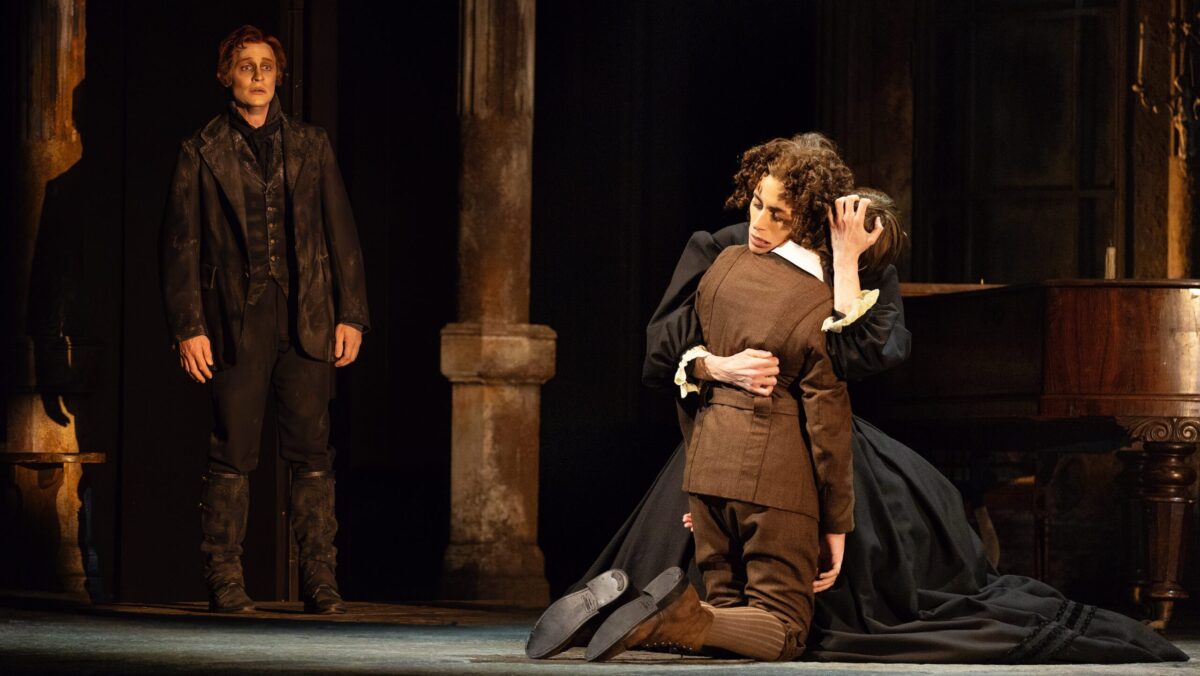
Louisa Muller’s production, a Canadian Opera Company production originally from Britain’s Garsington Opera, the first at Santa Fe Opera since 1983, is as straightforward and as easy to follow as the libretto. Like the novella, it’s set in the 19th century. In Christopher Oram’s unit set, Bly is slightly decrepit, the woodwork in imperfect condition and even a bit moldy, as if the mansion’s decay reflects both neglect and the moral decay brought in by Peter Quint. The production and Oram’s costumes are predominantly in black and shades of brown, with flashes of white in nightdresses and color in the children’s outfits and toys.
Everything about the performance was well-executed, with excellent singing, though I wish there had been more mystery and more terror early in the opera. The final scenes, leading up to Miles’s identification of Quint and his death in the arms of the Governess, did grow in tension and power.
Gemma New led the chamber orchestra confidently, drawing eloquent playing from each instrumentalist. Soprano Jacqueline Stucker’s Governess, her first outing in the role, combined fragility and fear with growing strength in defense of the children. Jennifer Johnson Cano was a forthright, naive Mrs. Grose.
Everett Baumgarten, 13, looks younger than his age and made an excellent Miles; similarly, 14-year-old Annie Blitzwas charming as Flora. Soprano Wendy Bryn Harmer sang powerfully as Miss Jessel and tenor Brenton Ryan was a scary, yet seductive, Quint and ruminative Prologue.