Cory Weaver
West Edge Opera (WEO)’s 2025 Festival opened boldly the weekend before last (2-3 August) with strong performances of two very different operas that explored the polar extremes of personal sacrifice. In the world premiere of Dolores, a brand new opera about American civil rights leader Dolores Huerta, the title character and the union leader Cesar Chavez sacrificed everything (including almost his life) to fight for the farm workers’ causes. On the other hand, the biblical French Baroque opera David and Jonathan explored the extent to which a ruler is willing to make sacrifices to stay in power. Both presented an exceedingly timely social commentary on the times we live in and grand entries to West Edge Opera’s long list of achievements.
Composer Nicolás Lell Benavides and librettist Marella Martin Koch’s Dolores is the second full-length opera to be commissioned and developed by WEO, following last year’s Bullrusher. Dolores was born from WEO’s Aperture program, an opera incubation project founded during the COVID-19 pandemic, and it underwent five years of development, including the hour-long public preview workshop in August 2023 that involved the real-life Huerta herself. (Benavides is her third cousin.) The work is a co-commission with Opera Southwest (who will present it in October), San Diego Opera, and The Broad Stage.
Rather than capturing Huerta’s entire life story, the opera focuses on a narrow yet pivotal period of her life, specifically the spring and summer of 1968. Three years into the Delano Grape strike and after Chavez began his 25-day fast, United Farm Workers (UFW) co-founder Huerta turned her attention to Senator Robert Kennedy and became an ardent supporter of his presidential campaign up to his assassination on June 5, 1968. (The strike ended two years later and Huerta subsequently becomes the unstoppable champions of labor, immigration, LGBTQ and women’s rights.)
While Benavides claimed in an interview that the opera wasn’t “meant as a history lesson”, nevertheless, it followed closely the actual events in 1968, including the crucial moment when Huerta stood on the stage with Kennedy as he celebrated winning the California primary, moments before he was gunned down. Furthermore, Koch’s libretto drew from many of the characters’ actual words, including Huerta’s own (and UFW’s famous slogan) Sí, se puede (Yes, you can), which memorably turned into a rousing choral piece (with audience participation!) that ended the opera. Little wonder that during the intermission, many in the audience reminisced about living through parts of the opera.
There was a lot to recommend in Benavides’ music, from his assured mode of juggling many musical genres (jazz, musical theater, Latin, and even mariachi influences), his unusual scoring for the tiny orchestra (which included electric guitar), and, particularly, his ability to achieve a balance between the heavy and light moments by peppering the score with many humorous and almost comical scenes, some attributed to the Tricky Dick (nickname for Richard Nixon) role, whose appearances felt like a much sinister King George III from Hamilton!
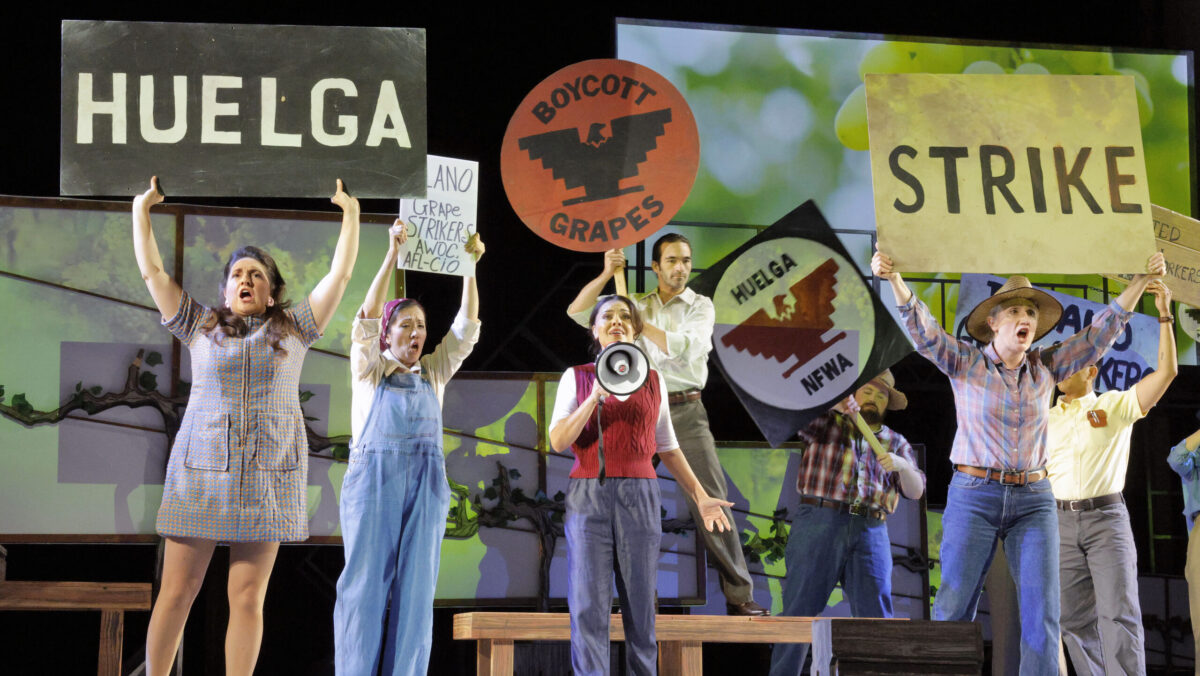
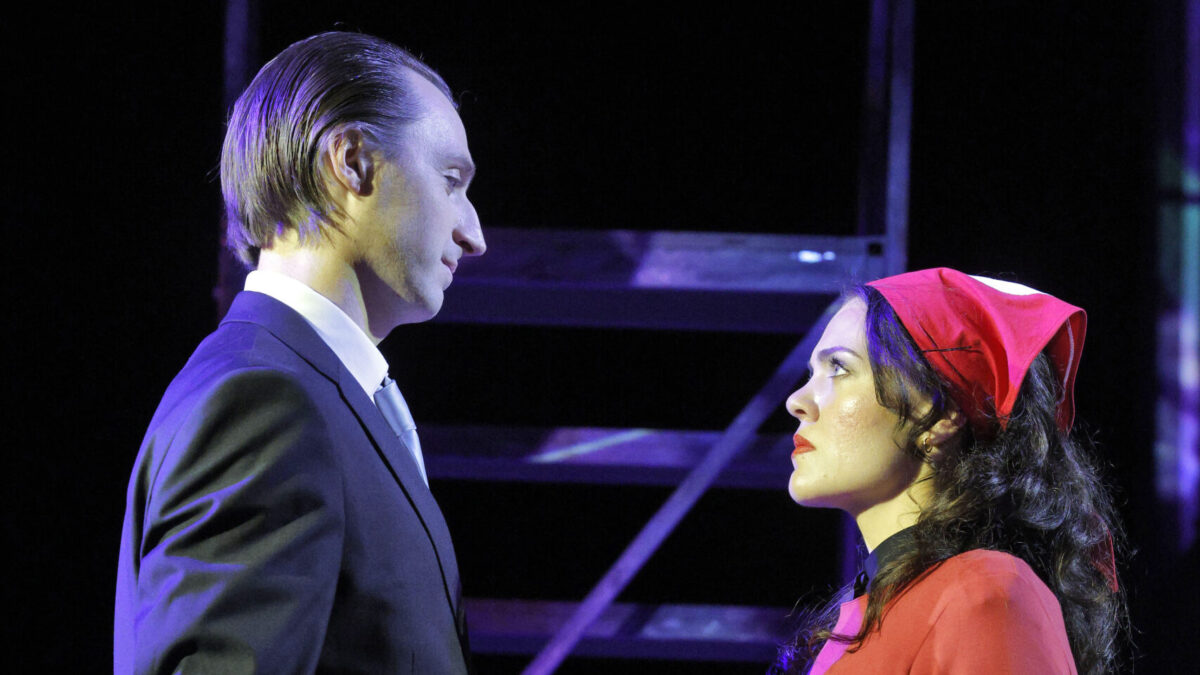
In his Director’s Note, Octavio Cadenas hoped to highlight the immigration narrative of the story by focusing on the human aspect: “behind every headline and statistic is a person, a family, and a history.” There was a sense of simplicity to his production as if to highlight that this was a story of us, “common folks.” Cadenas and his team used projections of real photographs – taken from personal, historical, and cultural archives – that Yuki Izumihara projected on Liliana Duque-Piñero’s series of decreasing-sized blank canvases.
Duque-Piñero also placed a higher platform (with a big canvas behind it) and a tall rotating staircase that was used to emphasize crucial points. Ulises Alcala dressed everyone on stage in period-appropriate costumes. Everything was staged respectfully to the time and place of the actions, to the extent that it felt like watching a documentary at times, once again evoking recollections in the audience who had lived through those times.
My only problem with the piece as an opera – especially as someone who hadn’t lived through the era, and who wasn’t aware of much of Huerta’s work before the show – was that in an opera filled with strong male characters (Larry Itliong, Cesar Chavez, Bobby Kennedy, Tricky Dick), the title role often took the backseat and felt secondary. Her feelings, actions, choices, and sacrifices in the face of the events often seemed inaccessible. This was particularly evident when Kennedy came into the picture and the opera was almost in danger of becoming a Kennedy opera. Only at the end, with a Joan of Arc-like gesture and amidst the “Sí, se puede” chantings, did the title role fully bloom into a leader and a trailblazer.
Cory Weaver
WEO assembled a robust cast to bring out the drama, led by conductor Mary Chun. Chun, who also conducted the 2023 preview workshop, was able to coax a reading with power and grace from the 16-person orchestra, which was certainly no small feat. More importantly, she brought out all the colors, nuances, and various influences in Benavides’s music, making the whole proceedings feel well-rehearsed and alive. Similarly, Mark Morash’s 12-person chorus contributed significantly both as the farm workers and as Kennedy’s campaign crowds.
The male soloists were well-cast and uniformly excellent. Fresh from making his Met debut earlier this year, Alex Boyer made a charismatic Kennedy; his booming voice lending his characterization a much-needed gravitas. On the other hand, Samuel Faustine stole the show as Tricky Dick; the bright timbre gave an intimidating quality to the role, which he varied and grew more menacing each time he appeared. Baritone Rolfe Dauz and bass-baritone Phillip Lopez were polar opposites in their interpretations of union leaders Itliong and Chavez; Dauz was explosive and forceful, while Lopez was warm and sympathetic. Lopez was particularly efficient during the fast scene; Chavez’s banters with his wife Helen (played by Chelsea Hollow, also doubling as Ethel Kennedy) were exceptionally heartbreaking. Caleb Alexander and Sergio Gonzales completed the comprimario roles with their winning performances as Paul Schrade, leader of the United Auto Workers, and Juan Romero, the busboy who held Kennedy after the assassination.
Naturally, all eyes were on Peruvian-American mezzo-soprano Kelly Guerra, who assumed the titular role, and she certainly didn’t disappoint. Bringing a dark, sonorous sound and imposing physicality, Guerra embodied the role wholeheartedly as a union leader torn between hopes and anxieties for the future. The endings for each Act showcased her take on Dolores the best; in the solemn prayer at the end of Act I, she bared her soul to wish for better futures for her family, The Cause, and Kennedy, while in the aforementioned Act II ending, she fiercely promised to go on and fight for The Cause, ending the opera in a feverish state.
A prolonged ovation greeted the cast and the production crew after the opening show. Nevertheless, the audience went completely berserk when the real-life Huerta approached the stage, took the mic, and urged the audience that we couldn’t give up in this terrible time in history. “We know we will win, right?” ¡Sí se puede!
Cory Weaver
A whole different mood greeted the audience the following day, when WEO premiered its second opera this Festival Season, Marc-Antoine Charpentier’s David et Jonathas (David and Jonathan). Cast (originally) in five Acts and a prologue, the tragédie en musique is based on the Hebrew Bible’s First Book of Samuel with a libretto by Father François Bretonneau (a Jesuit priest). It was first performed at Collège Louis-le-Grand, a Jesuit college, in 1688, in tandem with a Latin play, Father Étienne Chamillard’s Saul, where each Act of the opera was followed by one Act from the play.
A fully staged performance of a French Baroque opera is far and between right here in the Bay Area. As far as I recall, the last one was when the Philharmonia Baroque Orchestra (PBO) presented the modern-day premiere of Jean-Philippe Rameau’s La Temple de la Gloire at Zellerbach Hall, UC Berkeley, at the end of April 2017. It was unfortunate that the COVID-19 pandemic thwarted the plan for PBO to stage Jean-Marie Leclair’s only surviving opera, Scylla et Glaucus, in April 2020.
David and Jonathan’s relationship – in which they formed a covenant and took a mutual oath – has fascinated theologians and scholars for centuries. While the traditional Christian interpretations treat it as a form of homosociality – a mere non-sexual camaraderie between two men – modern interpretations inch towards a homosexual relationship. After all, “Jonathan became one in spirit with David, and he loved him as himself.” (1 Samuel 18:1)
Director (and WEO’s General Director) Mark Streshinsky and conductor Adam Pearl decided to re-edit the opera into a more coherent two-Act story, similar to their treatment of Francesco Cavalli’s Eliogabalo four years ago. Essentially, Streshinsky and Pearl expanded the Prologue into a whole Act with music pulled from various Acts to create the reenactment scene of David’s fight with Goliath and the creation of the covenant before and after the Witch of Endor’s scene. The bulk of the actions across the five Acts (with David taking refuge with the Philistines until the death of Jonathan) were compressed into Act II. Purists might hate it, but I think the opera retelling worked brilliantly to present a more coherent story and a logical explanation for Saul’s jealousy-turned-madness.
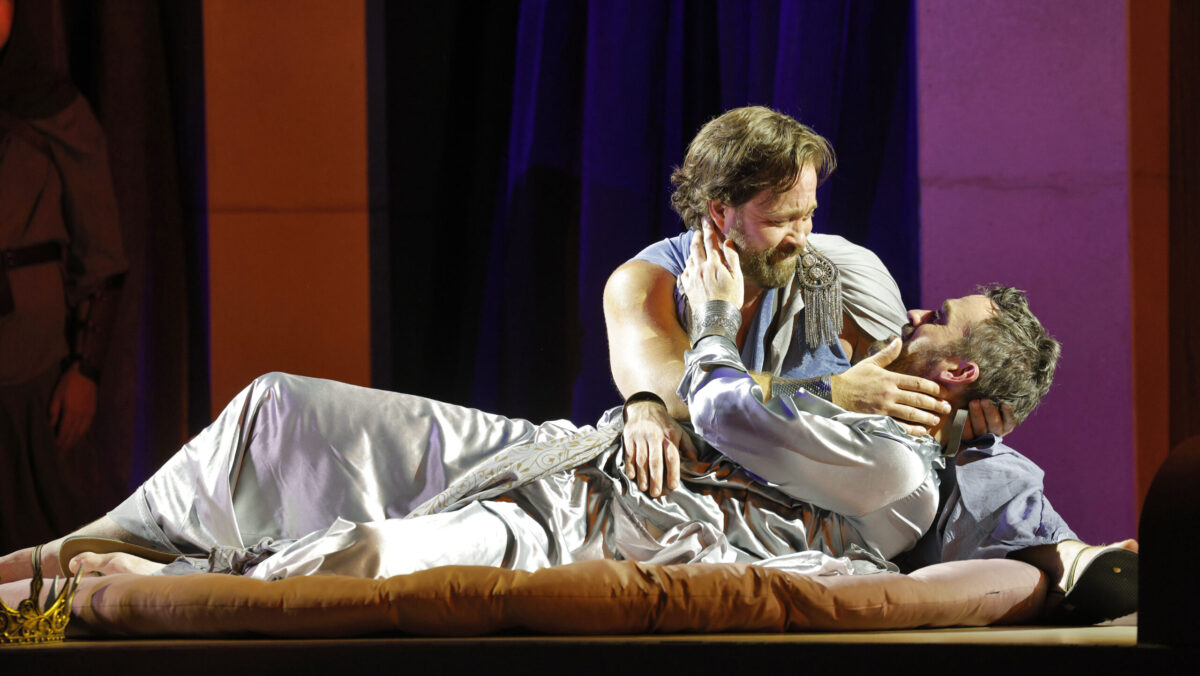
In Streshinsky’s vision of the opera, there was no doubt that David and Jonathan were lovers; in fact, he staged the covenant as a sort of gay wedding, complete with a pretty graphic consummation of their love. (Hence the content advisory for nudity and sexual situations.) In fact, he (and Pearl) went even further to cast Jonathan as a tenor! Initially written for a boy soprano, the role has so far been sung by a soprano in pretty much all recordings made of this opera. The decision to transpose it for a tenor was a sound one, as it gave both David and Jonathan equal footing in the relationship, and WEO was blessed to have two remarkable tenors with very different timbres.
The reworking placed more emphasis on the character of Saul, which Matthew Worth brilliantly portrayed as a king consumed by hatred and jealousy (sound familiar?) to the point of losing his mind and declaring unnecessary war with tragic consequences. Saul now became the most interesting character in the opera, and Worth impressively charted his gradual degradation with his deeply resonant voice and through his mannerisms.
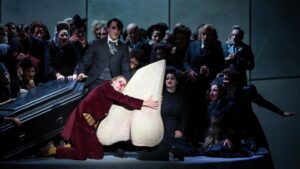
Scenic designer Ember Streshinsky placed three L-shaped movable frame structures, plus a square, bed-like pedestal, at the center. The combinations and rotations of such frames efficiently denoted the locations, such as Saul’s palace and the couple’s bed chamber. Props were used sparingly, except for Paul Hayes’s gigantic Goliath puppet (with an enormous “member” in the opera’s most cringeworthy scene), which was played for laughs (and Saul’s desperation).
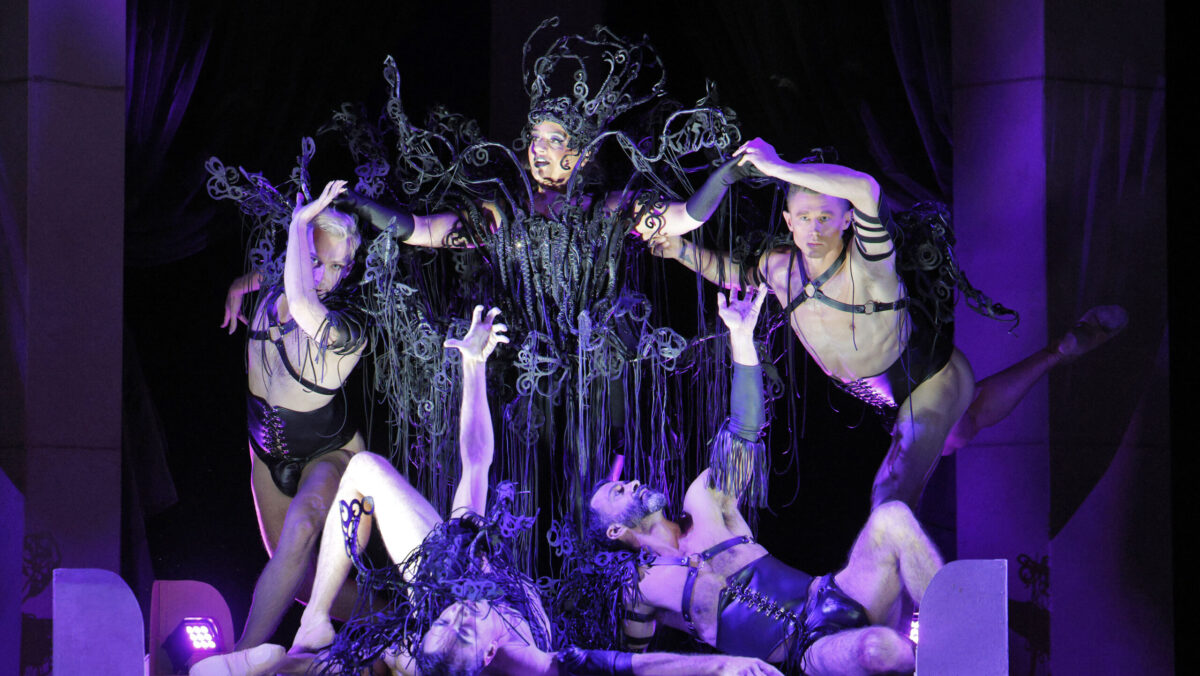
The most impressive “props” on stage were actually the inclusion of four scantily-clad dancers (Marcos Vedoveto, Christopher Nachtrab, Max van der Sterre, and James Jared) who gracefully moved between the singers and the chorus in a spellbinding choreography by associate director and choreographer Benjamin Freedman, paying homage to both Baroque dances and MTV-like sequences. Marina Polakoff dressed pretty much everyone on stage in tunic-like clothes, except for the Witch of Endor (in a black gown as if ready to compete in RuPaul’s Drag Race, with matching attire for the dancers) and Joabel (in steel armor). The combination of her costumes and Michael Oesch’s colorful, dramatic lighting gave the production a phantasmagorical quality.
Cory Weaver
At the risk of sounding like a broken record, WEO assembled an exceptional group of singers for this; there was not a weak link in the cast. Interestingly, they were also all sounding idiomatic (not always the case with Baroque performances around here) and with superb diction, thanks to coach Daphne Touchais.
Tall, handsome, and, yes, buff, Derek Chester and Aaron Sheehan were totally believable as a pair of lovers, David and Jonathan. Their undeniable chemistry was projected in the way they embraced, kissed, and looked at each other. Vocally, Chester’s sonorous, slightly darker sound contrasted well with Sheehan’s bright, trumpet-like instrument, and they made the most of their many (love) duets. Watching them perform kinda made you wonder why no one thought of performing the opera this way before! The comprimario roles were handled beautifully with a group of soloists that made their presence felt, from Wilford Kelly’s authoritative Achis, Benjamin Pattison’s slickly arrogant Joabel, Richard Mix’s otherworldly (Ghost of) Samuel, and, especially, the only female principal in the cast, mezzo Laurel Semerdjian, who memorably stole the show both vocally and physically in her brief appearance as the Witch of Endor. Morash’s small chorus completed the vocal excellence with their considerable contribution to the whole performance.
Throughout the show, I couldn’t help but marvel at Pearl’s conducting of the 14-person ensemble from the harpsichord. Not only did he lead with elegance and vigor, but he also managed to make the orchestra sound idiomatically French —a truly remarkable feat. I felt transported to the halls of Versailles by listening to them! Pearl also maintained a steady hand in guiding the proceedings while being sensitive to the singers’ needs. It was completely invigorating to encounter such a high level of musicianship in this production!
WEO’s third and final production in this year’s Festival, Alban Berg’s Wozzeck, opened on 9 August. Nevertheless, there is only one show left for both Dolores and David and Jonathan, and they will play on the same Saturday, August 16. Whether you want to be part of the movement or want to experience one of the finest presentations of a French Baroque opera around, be sure not to miss either!