
Enrico Nawrath/Bayreuther Festspiele
“They fuck you up, your mum and dad,” begins a periodically viral poem by Philip Larkin. Such is the premise of the Bayreuth Festival’s current production of Der Ring des Nibelungen, directed by Valentin Schwarz and conducted by Simone Young and now in its fourth year. Like any self-respecting superhero or horror movie of the 2020s, it’s really about trauma. It’s not been the most popular production in Bayreuth, but I found it moving, stimulating, occasionally frustrating, and, most fortunately of all, consistently strong musically and full of good performances.
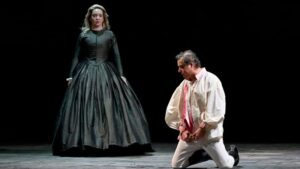
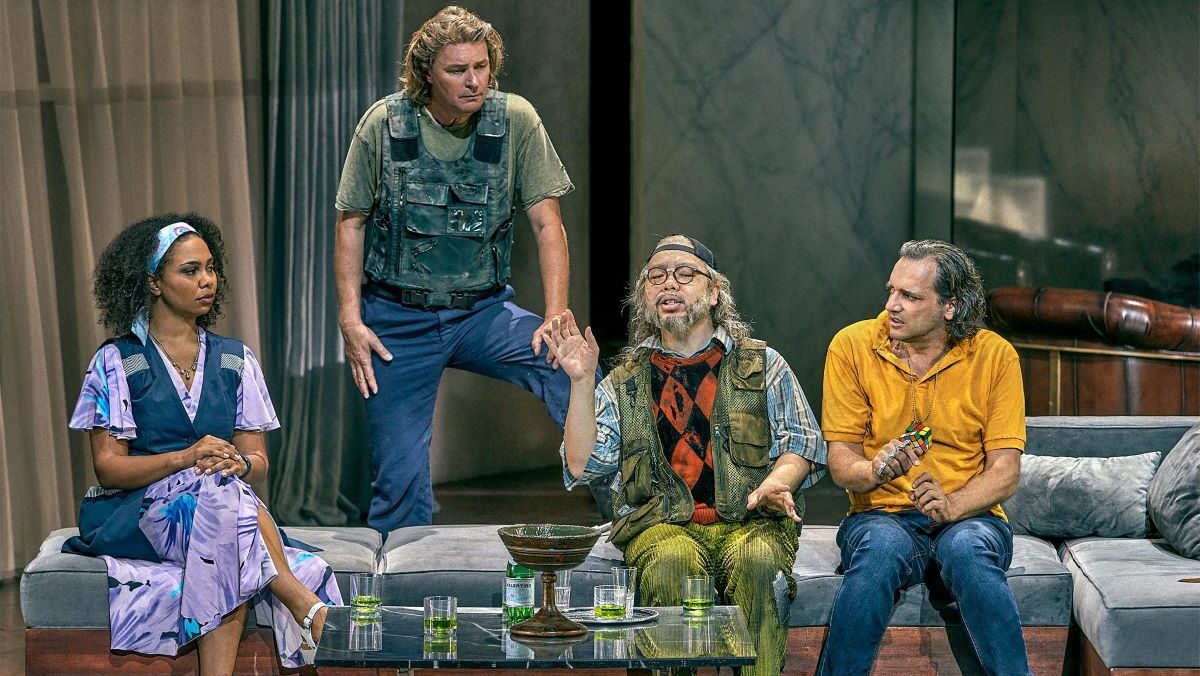
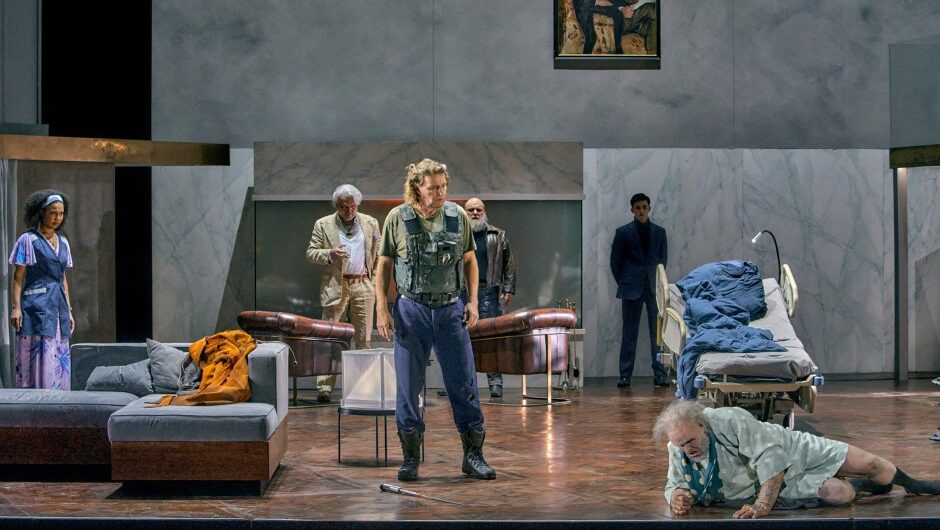
Schwarz’s production is bracingly contemporary. It all takes place on the gods’ estate, which begins as a gleaming, modern structure and ends it in decay, a downward trajectory echoed by its inhabitants, all members of a single family (the set design, which like most at Bayreuth is fantastic, are by Andrea Cozzi). Patrice Chéreau’s legendary Bayreuth Ring gave us the decline of the European aristocracy in the face of industrialization; Schwarz’s takes us from the glamorous violence of a Sunday night on HBO to the trashiest reality TV exploitation. The human characters—as well as the Rhinemaidens and, in a striking revelation, Erda—are servants, used and frequently abused by their employers. Sometimes it puts the soap into opera.
American companies often frame opera staging as a bridge between the historic work and the contemporary audience, a way to explain things to audiences and make pieces more “relevant.” Not so in Bayreuth. Audiences here are assumed to know and care about the texts already. (There are no surtitles, so it’s tough if you don’t.) Productions work with that knowledge. This staging isn’t ever the one Ring to rule them all; Schwarz cares about some themes and characters more than others and is perfectly fine with leaving, say, the intricacies of the sword-forging process to another production. There are numerous text and musical elements that are skipped or contradicted by the stage action. You might consider this a dealbreaker. It didn’t bother me.
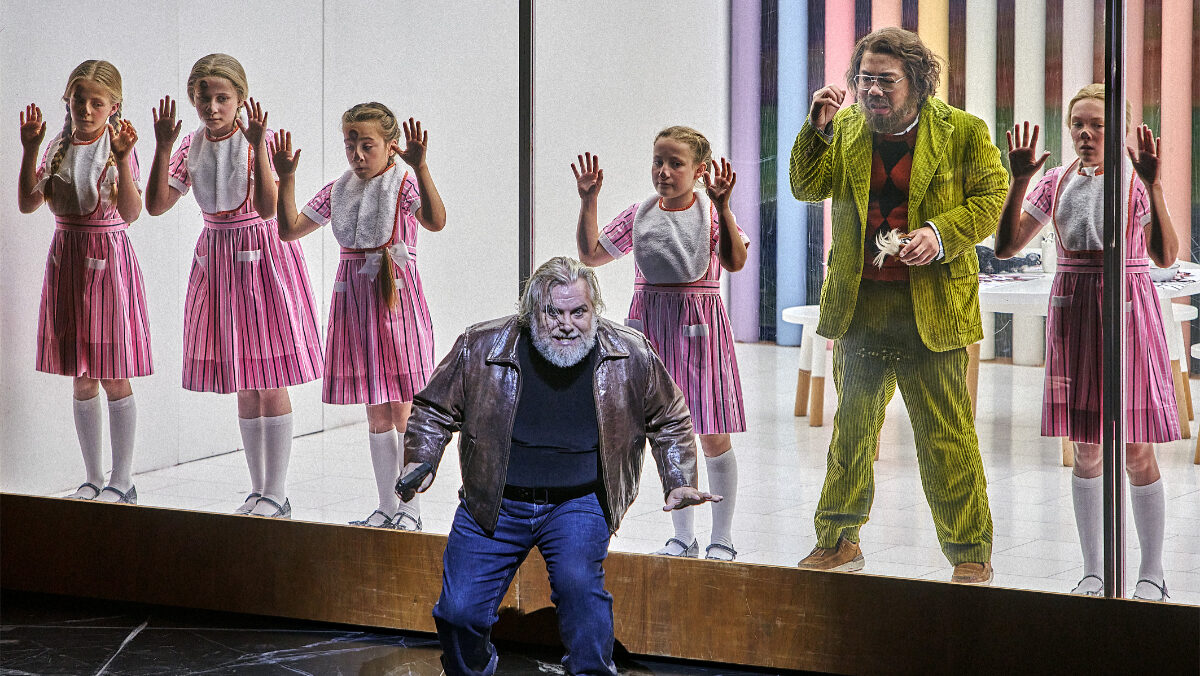
Most centrally, the production excises magic. The Rhine gold isn’t an object but rather a person, a boy in a yellow shirt who eventually grows up to be Hagen. Alberich, in one of the production’s several changes to the family tree, is Wotan’s outcast twin brother. As time passes, the gods age. The child promises the one thing these mortal gods can’t have: youth and renewal. Valhalla has an ominous nursery of little girls; the Valkyries try to recapture their youth with plastic surgery; Fafner is an old man on life support who Siegfried kills by simply pushing over. Freia (no apples) is a catatonic addict, who, after her violent abduction by the gangster giants, takes her own life at the end of Rheingold. We also don’t get many signs of the natural world—even Grane, Brünnhilde’s horse, is a man, her loyal emotional support henchman.
Enrico Nawrath/Bayreuther Festspiele
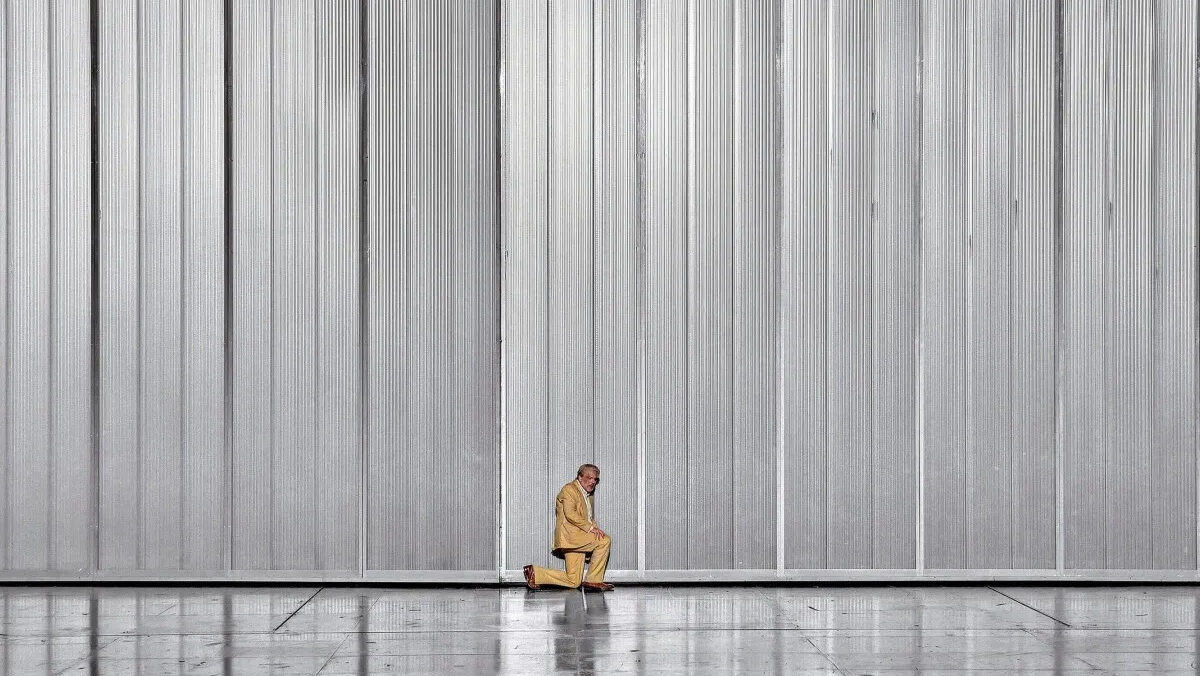
In the back half, things become dreamier, particularly in static stretches like Siegfried’s awakening of Brünnhilde, the Norns (staged as Brünnhilde and Siegfried’s daughter’s dream), and Hagen’s solo monologue. Schwarz has a knack for striking images, the best of which may be Wotan left alone with himself and the consequences of his actions in front of a huge wall at the end of Walküre. However, Schwarz then deflates the balloon. Fricka enters with a bar cart, ready to cheerfully toast the restoration of order in the house.
We see damage passed on from generation to generation, most obviously stemming from the various abductions and Wotan’s “dalliances” with most of the women in his orbit, here explicitly sexual assault, including against his own daughters. Can the survivors Brünnhilde and Siegfried escape this poisonous inheritance? (Siegfried charmingly first tries out normal life by hanging out with the Waldvogel, who is Fafner’s nurse.)
At the opening of Götterdämmerung, Siegfried and Brünnhilde are a married couple with a daughter. But you can see their breakup coming, and there’s no magic potion of forgetfulness here, just Siegfried’s need for revenge. (Günther and Guturne, hilariously, are idiots modeled on the long-running reality TV show Die Geissens—Germany’s answer to the Vanderpumps.) The ending, which has been slightly tweaked this year but still is not fully satisfying, gives us both the hanging body of Wotan and a hint of hope creeping in as the redemption through love motive emerges.
Enrico Nawrath/Bayreuther Festspiele
In a 2021 New Yorker essay, Parul Sehgal described the ubiquitous “trauma plot” as full of characters whose “history comes spilling out, in confession or in flashback.” Characters in the Ring, notoriously, are always giving us backstory, some of which we’ve seen onstage and some we haven’t. This is in part a relic of Wagner’s compositional process, which began with a single opera, the eventual Götterdämmerung, and then worked backward. But here, it’s also testimony: characters relate and relive and can’t escape their traumas, which we recognize as destined to repeat. This truly is the Ring for people who have read A Little Life.
Those testimonies don’t all line up. The production is dramaturgically messy. Once Hagen reaches Götterdämmerung, he isn’t the gold anymore. Nothung the sword begins as a glowing pyramid (which also represents Valhalla, I read it as an all-purpose mystery object akin to the glowing briefcase in Pulp Fiction), then the sword is a refashioned cane, and sometimes it’s a gun. The Tarnhelm doesn’t exist at all. Schwarz’s explanation for this, which I heard ridiculed by multiple audience members, is that Wagner’s libretto, written backward as it was, isn’t consistent either.
This inconsistency—as well as the production’s occasional lack of engagement with the existing score and text—does detract from the production’s cumulative effect, making it harder to build resonances from evening to evening. But I also think that staging against Wagner can be highly productive. Theodor Adorno wrote that “only what injures the Wagner orthodoxy is true,” and that experimental productions should amplify rather than smooth over contradictions and ambivalence. It’s a Bayreuth cliché to justify doing just about anything by claiming that “Wagner wanted it this way,” and usually that’s also a tactic to forestall doing anything else. I don’t need to elaborate on why dutifully obeying all of Wagner’s wishes (or what you think are Wagner’s wishes) isn’t a good idea, so I’m happy to live with some inconsistency even if Schwarz’s is sometimes less a matter of dialectics and more like the Lost writer’s room getting really confused in the middle of Season 5.
Enrico Nawrath/Bayreuther Festspiele
But ultimately I think Schwarz’s production finds plenty to say in the Ring about family, about what we get from our parents and how we fuck over the next generation, and what it might mean to escape. Sehgal, in her New Yorker essay, argues that the “trauma plot flattens, distorts, reduces character to symptom, and, in turn, instructs and insists upon its moral authority.” Schwarz’s very inconsistency and lack of tidiness—Waltraute seems to be the crazy aunt, an unreliable narrator, but we never really find out for sure—is what gives the production its needed ambivalence and prevents it from flattening into banality. This is a knot pulled too tight to fully unravel. The music would seem to be the moral authority, but as events sometimes counteract the score, we can’t trust it, either. Like the characters themselves, we can only try to piece together what happened.
The experience of doing so was consistently musically satisfying and occasionally magnificent. This, this production’s fourth year, will be its last, and as in 2024 it was led by Simone Young, the first woman to conduct the Ring in Bayreuth. Her interpretation was notable for its agility and refinement, with a wonderfully subtle approach to textures, natural transitions, and a sense of balance in the house’s unique acoustic that was always singer-friendly without sacrificing orchestral depth. Her tempi were often on the slow side, sometimes a bit too much (the end of Rheingold) and sometimes to terrific effect (the Todesverkündigung). It was a formidable performance and a reminder that we don’t always need to chase the hottest 23-year-old baton-waver on the circuit. Decades of experience can pay off.
Enrico Nawrath/Bayreuther Festspiele
The most controversial element of the cast for me was Klaus Florian Vogt as a dadcore Siegfried. He is an institution at Bayreuth, but his flute-like tenor has usually been heard in lyrical roles like Lohengrin and Walther von Stolzing. That youthful vocal quality is rare in Siegfrieds and with him you can’t expect a Forging Song with roaring ‘ho ho hos.’ He did it his gentler way, but that gradually grew on me; this was a Siegfried who did actually sound like a clueless boy, his sweet tone resonating in the house like few others’ and his diction perfect. The production does require a truly heinous turn in Götterdämmerung that he doesn’t have the range as an actor to pull off (involving, with no forgetfulness potion, Siegfried’s abetting of Günther’s rape of Brünnhilde at the end of Act I), but I’m not sure anyone else could manage that either.
Catherine Foster as Brünnhilde was new to this production but not to this role in Bayreuth; I heard her in the previous production. Her voice has held up well through more than a decade of this strenuous singing. She sometimes requires time to warm up and got off to some rough starts, but when able she radiated authority and intensity. Her bright, cutting sound is best in the score’s loudest moments, something like the opposite of Vogt, but her sense of drama and character carried her through the softer ones as well.

Enrico Nawrath/Bayreuther Festspiele
Other singers were in their first few years at the Festspiele but seem poised to join the regulars. First and foremost, note the name of Anna Kissjudit, whose Erda provided the most purely beautiful singing of the entire cycle. The Hungarian contralto is at the beginning of what I hope will be a fabulous career; her sound is warm and rich and vibrant and easy throughout her range and filled the house effortlessly. Michael Spyres had triumphed as Walther von Stolzing only a few days before his Siegmund in this cycle; his approach to this lower role again was Italianate, with exceptional breath control and phrasing.
Tomasz Konieczny’s Wotan found a wide variety emotional notes for an exceptionally monstrous take on this character. While his singing was not always clean—the first two roles are rather high for him and the text does not always come through—he succeeded as a singing actor. Christa Mayer doubled many of the mezzo roles in the cycle, as is customary in Bayreuth, and while her voice sounded a little worn as Fricka she brought a poignant drama to Waltraute. Jennifer Holloway, whom you may remember as a mezzo from various New York productions, was new to this production as Sieglinde and sang with passion and intensity but with a voice that often turned shrill, with an overly pronounced vibrato.
As a near-manic Alberich, Olafur Sigurdarson was a very lively presence, similarly Ya-Chung Huang sang the difficult role of Mime with accuracy as well as theatrical dynamism. Daniel Behle was an amusingly sarcastic Loge. Mika Kares was a Hagen less notable for the size of his voice than its deep, gravelly timbre. (Vocal size was more notable in Vitalij Kowaljow’s Hunding.) Victoria Randem was an unusually full-toned Waldvogel and made the most of her expanded role in this production. Michael Kupfer-Radecky and Gabriela Scherer effectively chewed the scenery as the Gibichungs. As one hopes to hear in Bayreuth, smaller roles like Donner, Froh, the giants, the Norns, and the Rhinemaidens were excellently cast with singers who we hopefully will hear in larger roles in the future. (In the case of Nicholas Brownlee’s golf club-swinging Donner, very soon; strong Freia Christina Nilsson has already been promoted to Eva in the new Meistersinger.)

Enrico Nawrath/Bayreuther Festspiele
When I saw Frank Castorf’s Bayreuth Ring in 2015, I remember almost everyone hating it. There’s been a large-scale rehabilitation in the past few years and many now call it a classic. I suspect that Schwarz’s Ring will undergo a similar process; judging by the rapturous reception of everyone except Schwarz and the design team, that is already underway. Next year’s Ring production will be generated by AI, God help us all. (What will the booing at the end look like?) For all its flaws, this Ring is, like its gods, totally human.
Bayreuth this year has unfortunately made headlines because, unusually, on opening day a few tickets remained unsold for some productions other than the new Meistersinger and the Christian Thielemann-led Lohengrin. I don’t know what message to draw from this yet, other than noting that if you, reader, want to go to Bayreuth next summer (or this summer, if you’re quick) it’s not as inaccessible as you might think, though it can be very expensive.
It’s also kind of worth it. You schlep out there and you get an aura. The acoustic is amazing, the orchestra is fantastic, and everything else is, well, you get some very long intermissions to discuss whatever it is with everyone else who is there (and they’ll talk—that’s how I found out about Die Geissens). If you don’t like what you saw, you can still come back for something totally different in a few years. (Probably featuring Klaus Florian Vogt in a whole new improbable role—he’s doing Loge next year, why not, sure.) Perhaps the gods of Schwarz’s Ring are right to fear the loss of their fleeting youth; in Bayreuth the skeleton of Wagner remains but the rest is running on a short clock. That’s the premise of the festival’s workshop model, and this Ring again demonstrates how that can make for timely and urgent work.