Monika Rittershaus
Wandering the sun-scorched streets of this ochre-colored town, I began to wonder whether opera, with all its fragility and grandeur, was designed to withstand a heatwave. At the 2025 Festival d’Aix-en-Provence, it had to do more than that. This summer’s edition, which ran from June 4 – 21, took place in the wake of the sudden death in May of Pierre Audi, the festival’s charismatic and visionary artistic director. One of opera’s true evangelists as well as one of the most powerful and well-connected players in the world of music, Audi used his time in Aix to help reinvent the festival through the works he commissioned from George Benjamin, Kaija Saariaho and Pascal Dusapin, as well as through the directors he engaged, including Barrie Kosky, Romeo Castellucci, and Simon Stone. His loss hung over the festival like a high, slow-moving cloud, and yet his tireless spirit was palpable in the five opera stagings he programmed for this season, which, even before his passing, had been designed to be his last in Aix.
This summer was my first attending the festival, which lies outside of my traditional Teutonic summertime circuit, bounded by Bayreuth, Munich, Salzburg, and the Ruhr. I was spurred to finally attend by all that I had heard of Aix’s evolution, under Audi’s stewardship, as a place of musical and artistic risk-taking as well as the directors who had signed up for this year’s program. Another not insignificant factor was how I kept running into Audi over the past year and change: in New York, where he staged “Inside Light,” which was basically an expensive listening party and laser light show at the Park Avenue Armory (where Audi was also artistic director) that was based on Aus LICHT, his monumental three-day-long presentation of large excerpts from Stockhausen’s legendary – and cosmically bonkers – septology seen in Amsterdam in 2019; in Brussels, where his powerfully focused Götterämmerung completed La Monnaie’s “Ring” after the company fired Castellucci, the cycle’s original director, officially over budgetary concerns; and in Rome, where Audi spent a month rehearsing Alcina to ensure that this transplant of a decade-old production had the freshness and vitality of a premiere. On each occasion, he reiterated an invitation to Aix. My resistance was already weakening. After his death, it totally broke down. Having skipped the first five years of his tenure, I was determined to catch his final act.
Going into the festival, the production I was most excited for was the new “Don Giovanni,” staged by Robert Icke, a British theater director who has been called every name in the book – wunderkind, enfant terrible, iconoclast– for his adaptations and updatings of the likes of Aeschylus, Chekhov, Schiller, and Schnitzler. I’m always curious to see how theater directors make the transition to opera. In Europe, and especially the German-speaking world, this is a very common state of affairs. It’s practically de rigueur for places like Bayreuth, Berlin, and Munich to engage acclaimed and provocative dramatic directors for their upcoming seasons. (In the U.S. and U.K., the worlds of theater and opera tend to be more separate.)
Aesthetic cross-pollination is crucial for opera, a genre defined by artistic hybridity, to stay vibrant. But directors who come from theater need to think carefully about what it means to do opera and think hard about when choosing their repertoire. (Christopher Rüping, one of Germany’s best young directors, turned down a dozen offers to stage opera until the Bayerische Staatsoper gave him the opportunity to develop his own version of Il ritorno d’Ulisse in patria, which he combined with Joan Didion’s The Year of Magical Thinking for a musical-theatrical meditation on waiting, grief, and letting go that was one of the most moving things I’ve ever seen.)
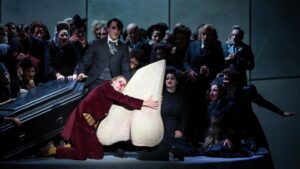
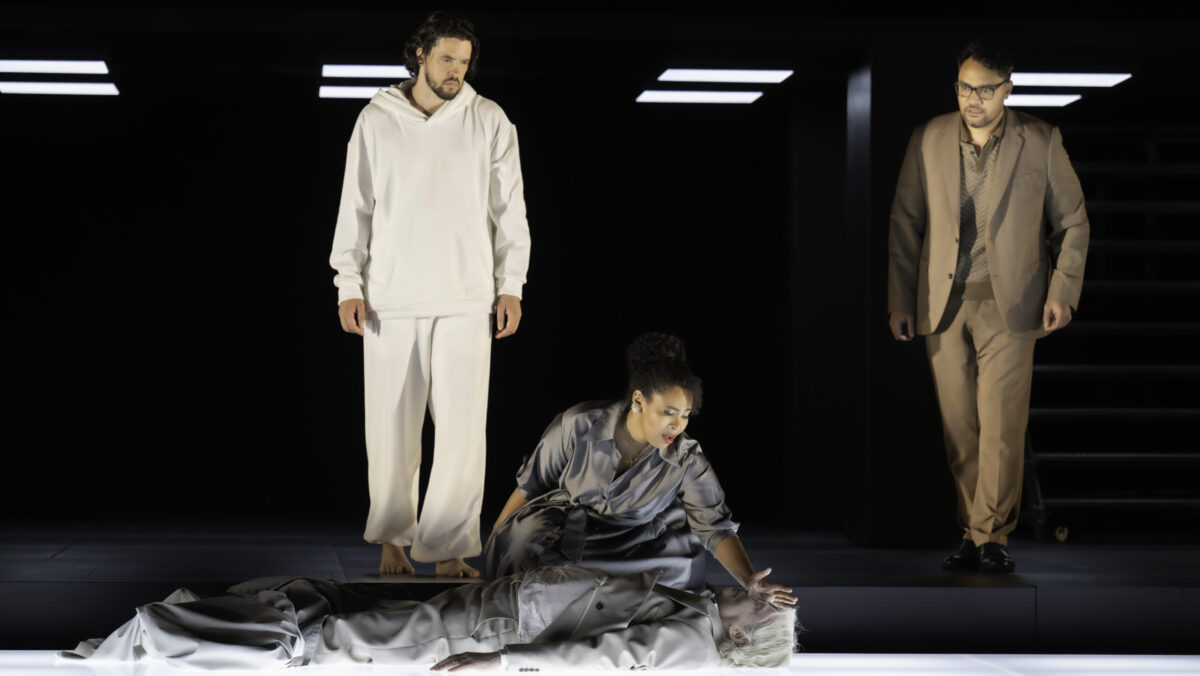
I’m no stranger to Icke’s theatrical approach and consider myself a fan. I also give him a lot of credit for daring to inaugurate his operatic career with a work that is notoriously difficult to stage well. Sadly, however, Icke seemed to approach Don Giovanni (seen 4 July) purely as a theater director: that is to say, without sufficiently taking into account the defining role that the music plays in telling the story, defining its characters and setting up its moral, emotional, and dramatic stakes. Icke had some extremely clever ideas and many baffling ones, and he might have even pulled off his Don Giovanni as twisted incest soap opera, à la David Lynch’s “Twin Peaks,” where the title character was the projection of a girl (Anna) who had been sexually abused by her father (the Commendatore) while her mother (Elvira) failed to protect her, had he kept the focus squarely on the characters.
Monika Rittershaus
And no, I don’t mean the largely gratuitous black and white video that showed Zerlina or Don Giovanni in (mostly unflattering) close-ups for lack of anything else to do. As it was, there were far too many layers to unpack and ciphers to decode. As the evening progressed, these riddles seemed increasingly gratuitous. Not only did his production render much of the libretto unintelligible: it was barely legible on its own terms. (Somewhat harrowingly, the themes of sexualized violence that Icke bored into echoed throughout my week in Aix, leaving me to wonder if the festival and the artists working there were tapping into the traumatized subconscious of a country that has roiled by the horrific revelations of the Pelicot trial and the more recently concluded case of a former surgeon sentenced to 20 years in prison for raping and assaulting 299 victims, most of them children.)
Icke’s approach was oddly divorced from the score and gave the impression that he had failed to understand a basic truth of opera: that music is not illustrative but constitutive. In opera, the notes do not merely support or echo the libretto—they complicate, subvert, redefine. Icke gave us high-concept theatre, but he didn’t seem to be listening to what Mozart was saying.
Fortunately, Sir Simon Rattle and the Bayerische Rundfunk Symphonieorchester were. Their reading was sharp, brisk, and dramatically alert, qualities that one sorely missed in Icke’s staging. The cast delivered on many fronts: South Tyrolean baritone André Schuen returned to the role of the Don after several years of putting it to the side and sang with virile elegance. South African soprano Golda Schultz was a white-hot Donna Anna; Magdalena Kožená, as Donna Elvira, was less vocally secure, though expressively intense. Amitai Pati was a lyrically urgent Ottavio but sang a touch too softly. Madison Nonoa and Paweł Horodyski were delightful as Zerlina and Masetto. Clive Bayley was a thunderous Commendatore, while Krzysztof Bączyk’s Leporello, kept at a glacial remove from the central action of this production — Icke didn’t seem to know what to do with him — failed to impress as the beleaguered servant.
Jean-Luois Fernandez
Icke had a lot of resources at his disposal. If not entirely squandered, they certainly were not put to best possible use. Arriving less than 24 hours after Mozart’s antihero was dragged to hell, The Story of Billy Budd, Sailor, an abridged version of Benjamin Britten’s 1951 opera in a new chamber arrangement by the young British composer Oliver Leith and directed by Ted Huffman, was a masterclass in doing a lot with very little (seen June 5).
Huffman, an American director and Aix veteran who has directed both classic works (L’incoronazione di Poppea in 2022) and new ones (Philip Venables’s The Faggots and their Friends Between Revolutions, which Huffman wrote the libretto for, in 2023) was originally signed up for a different work entirely. He was forced to pivot when the festival, facing severe financial constraints, cancelled that large-scale production. (The festival hopes to salvage it for a future edition). The substitute plan came together in a matter of months; the director, composer, cast and musicians only had two and a half weeks to rehearse.
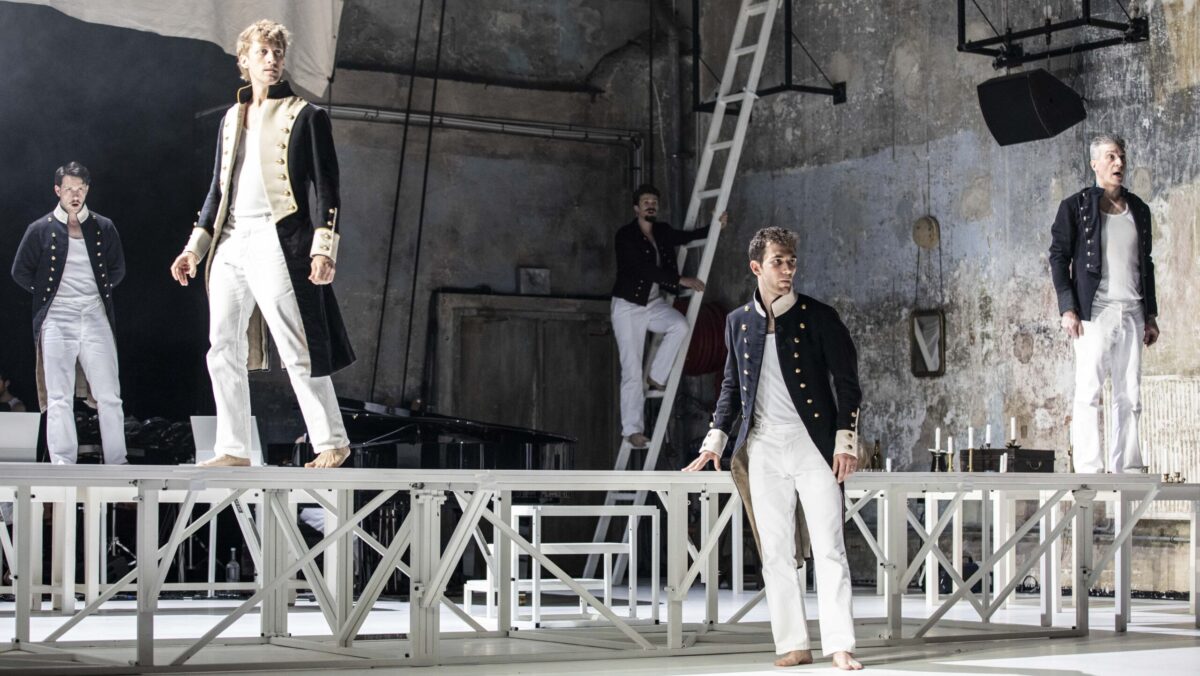
Leith’s radical reduction is masterful and gripping. He whittles down the gargantuan scale of Britten’s original to the barest essentials. Onstage, six singers and four musicians, who play keyboards and percussion, form a tight unit, conjuring the opera’s maelstrom of homoerotic desire, brutality, rage, and remorse with muscular confidence. There was no budget for new sets and costumes, so Huffman and his team raided the festival’s warehouse, carrying long white tables and a few well-chosen costumes and props into the theater to create a stage-within-a-stage that creaked like the boards of a ship.
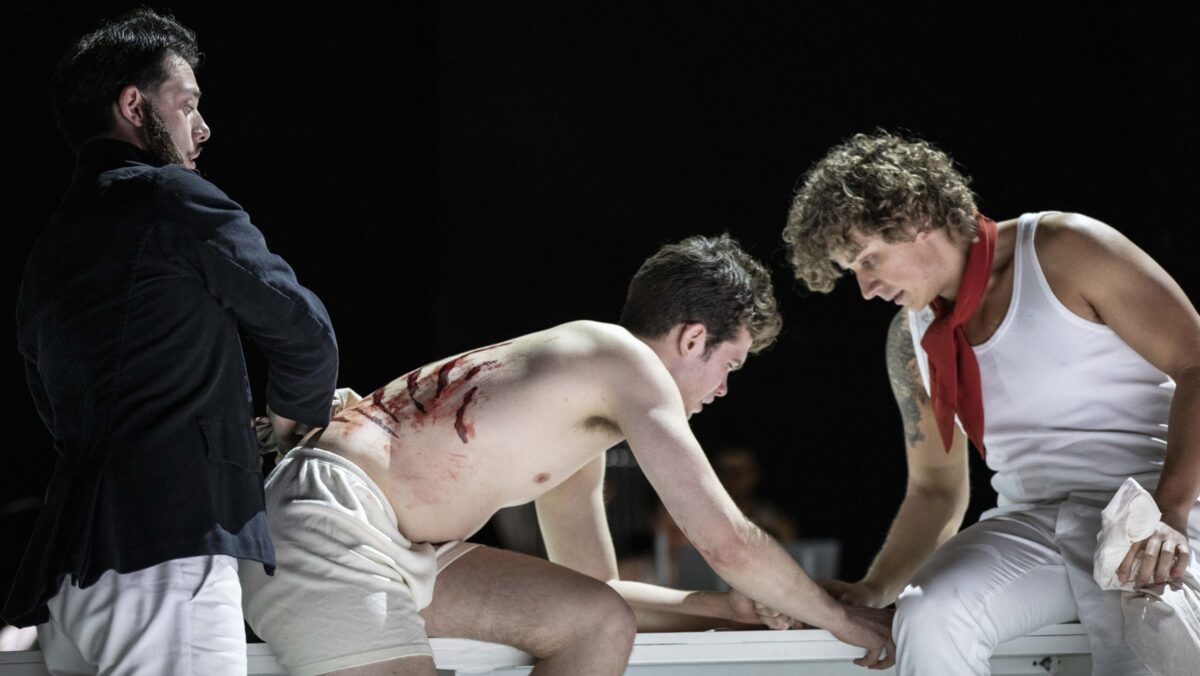
Jean-Louis Fernandez
White remained the production’s dominant hue, suggesting both Billy’s purity and the vast ocean. So much about the evening felt as exposed and raw as the flayed back of the Novice, one of the few details that Huffman rendered realistically gruesome. The effect was like a dab of red on an otherwise immaculate canvas.
All the singers played multiple characters – except for Ian Rucker, the young American baritone who sang the title role – switching roles by donning a wig or throwing on officer’s coat. There was little pretense of realism and the production’s meta-theatricality heightened the sense of Leith’s chamber reduction as something of a “Little Billy Budd Passion.” The sound world evoked both Britten and something more introverted and elemental. The music suggested the lapping sea, suffocated longing and haunted regret.
Inside the jewel-like (and blessedly air-conditioned) Théâtre du Jeu de Paume, a two-hour-long performance of rare intensity and concentration unfolded with directness and simplicity. The cast was uniformly excellent and well-matched: Rucker’s honey-voiced Billy; Joshua Bloom as the villainous Claggart; Christopher Sokolowski as the idealistic Vere; and Hugo Brady, Noam Heinz, and Thomas Chenhall in assorted other roles.
Monika Rittershaus
I left Billy Budd full of admiration for what I had witnessed and experienced, the palpable devotion of everyone on and behind the stage and how beautifully everything had come together despite difficult circumstances. It was a reminder that in the right hands, scarcity can sharpen theatrical intention. I barely had time for a mediocre dinner — Aix, I discovered to my horror, is something of a food desert and the handful of good restaurants are all booked out in advance — before the premiere of Gustave Charpentier’s Louise, a hit of yesteryear that is remembered today, if it all, for the soprano aria “Depuis le jour” (seen 5 July). The reasons for its neglect quickly became obvious.
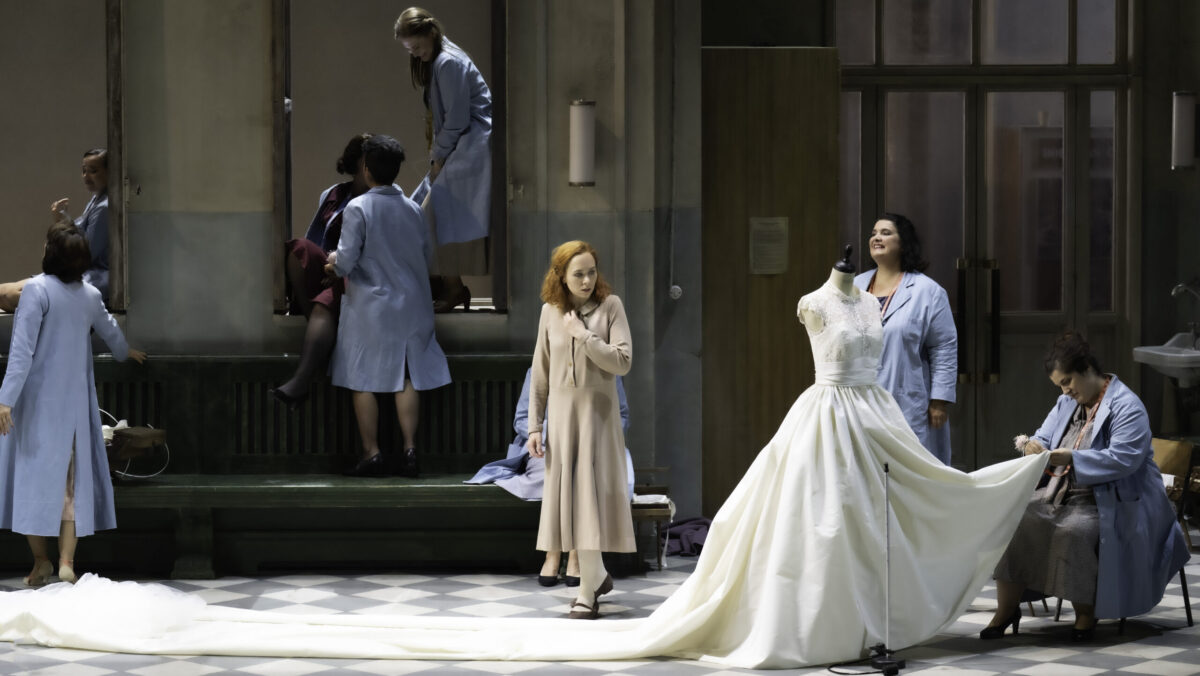
Charpentier called the opera a roman musical (“musical novel”) and he seems to have wanted to give verismo a French twist. Its title character is a young seamstress in Paris who becomes intoxicated with both the city and the bohemian poet Julien, who is her neighbor. Their love is frowned on by Louise’s protective and earnest working-class parents. “Louise” is credited with injecting a new degree of naturalism into French opera, but, as the production so aptly demonstrated, it mostly remains of historical interest. It’s a tiresome melodrama where everyone is pining one minute and fêting Paris as the earthly paradise the next. Life! Love! Youth! Paris! The twaddle becomes tiresome almost immediately. Imagine a third-rate rewrite of La bohème without raw emotion and without memorable characters or settings.
Monika Rittershaus
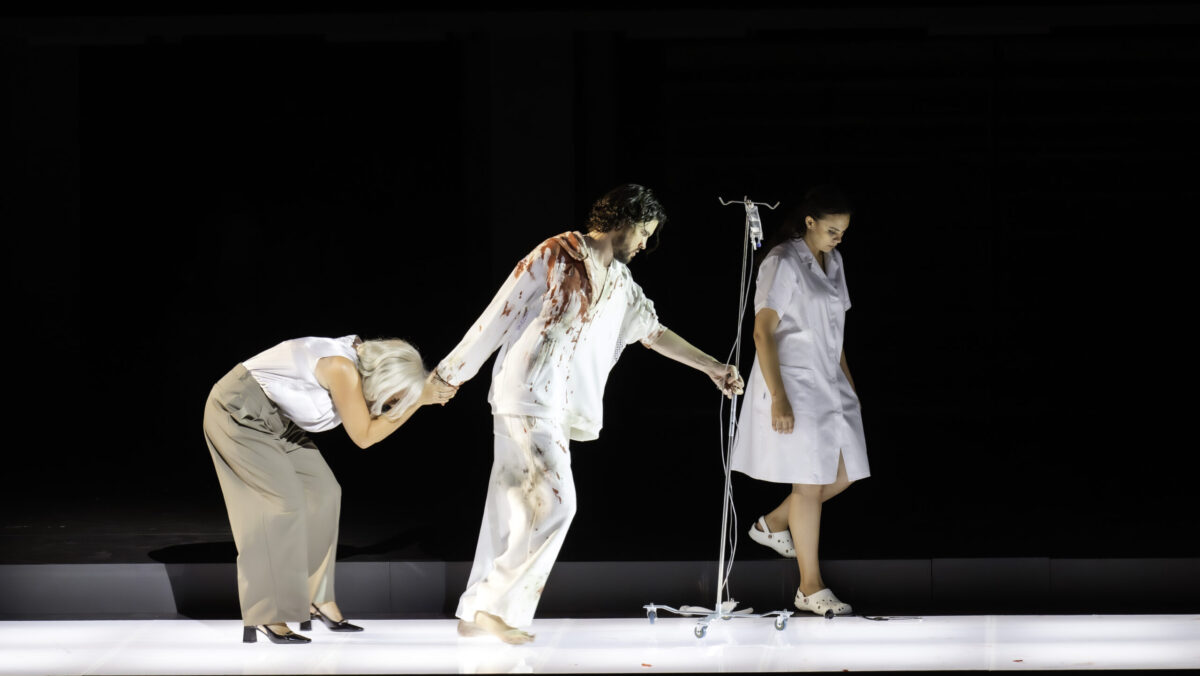
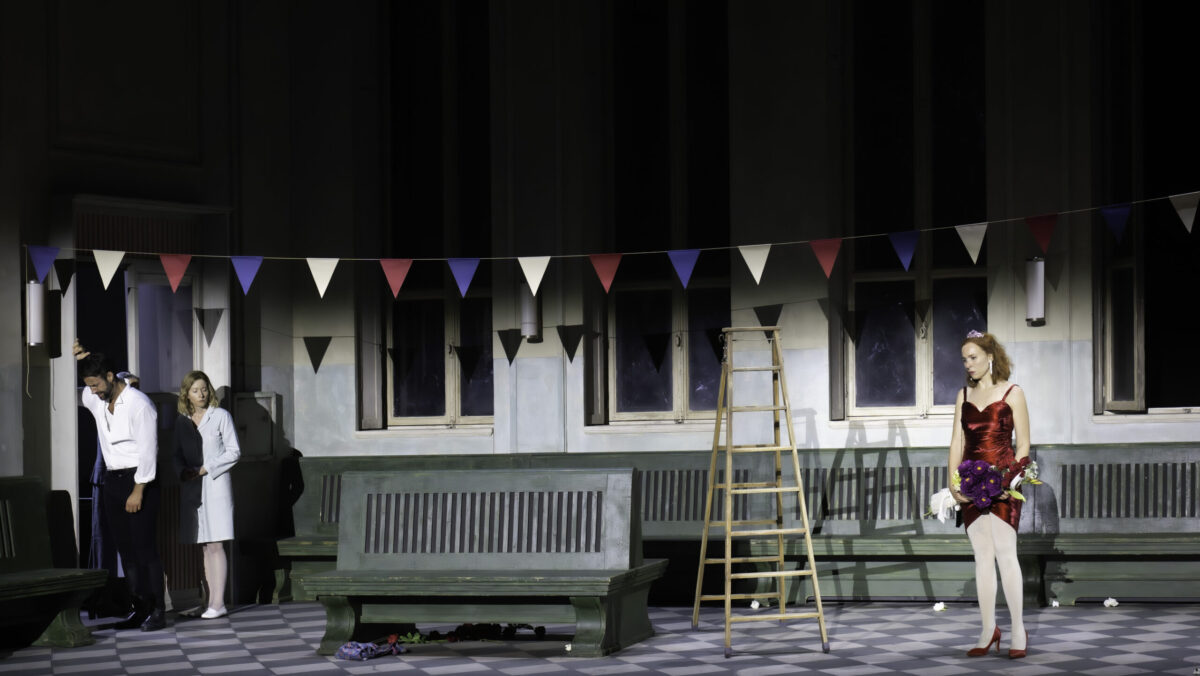
The handsome single set production, which played on the outdoor stage of the Théâtre de l’Archevêché, was typical of director Christof Loy. It relocated the work to the late 19th century clinic of the French neurologist Jean-Martin Charcot, whose pioneering (though deeply misogynistic) work on hysteria influenced his most famous pupil, Sigmund Freud. Loy’s solution to the opera’s banal declarations of doomed love and syrupy paeans to Paris was to stage the entire thing as a psychodrama. Louise, a girl sexually molested by her father, checks into the clinic where she relives the cycle of abuse while pre-enacting fantasies of escape, first through finding a protective beau and then – spoiler alert! – through suicide.
The checkered lobby of the clinic, dominated by a long green bench and large rectangular windows (sets by Etienne Pluss) was an effective backdrop for the intimate family scenes and love duets, but became overcrowded and chaotic in the numerous Paris-by-night set pieces. As always with Loy, the principals were well directed. Their dramatic performances carried an anguished and emotional charge that was almost mercilessly subverted by the perversity and unsentimentality of Loy’s concept.
Soprano Elsa Dreisig gave a brave and committed performance in the title role, though her pearly voice lacked the vocal heft required to make the part soar. The English tenor Adam Smith struggled as Julien, a vocally punishing and dramatically underwritten role. Much better were Nicolas Courjal as Louise’s emotionally overbearing (and, as per this production, depraved) father and Sophie Koch as her severe and embittered mother. In the hands of conductor Giacomo Sagripanti and the Orchestre de l’Opéra de Lyon, the score sounded lush but generic. Some works are forgotten for a reason.
Ruth Walz
The following evening saw a return to intimate Musiktheater, with the world premiere of The Nine Jeweled Deer at LUMA, an arts center in Arles (seen 7 July ). Billed as a chamber opera, it was roughly on the same scale as “Billy Budd.” Yet the production featured an almost preposterous array of onstage and behind-the-scenes talent: the Israeli composer Sivan Eldar; the Indian American musician and storyteller Ganavya Doraiswamy; the MacArthur-winning artist Julie Mehretu; the best-selling American novelist Lauren Groff; and the southern Indian classical music vocalist Aruna Sairam, all under the aegis of American avant-garde legend Peter Sellars.
This summer find Sellars at work at two of Europe’s major opera festivals. His next assignment is at the Salzburg Festival in August, where he will stage Schoenberg’s Erwartung and Mahler’s “Der Abschied” from Das Lied von der Erde in a single production called “One Morning Becomes an Eternity.” When I interviewed him earlier this year, he told me that newly fashioned pieces like these were partially an attempt to get away from the gigantism of the opera of empire.
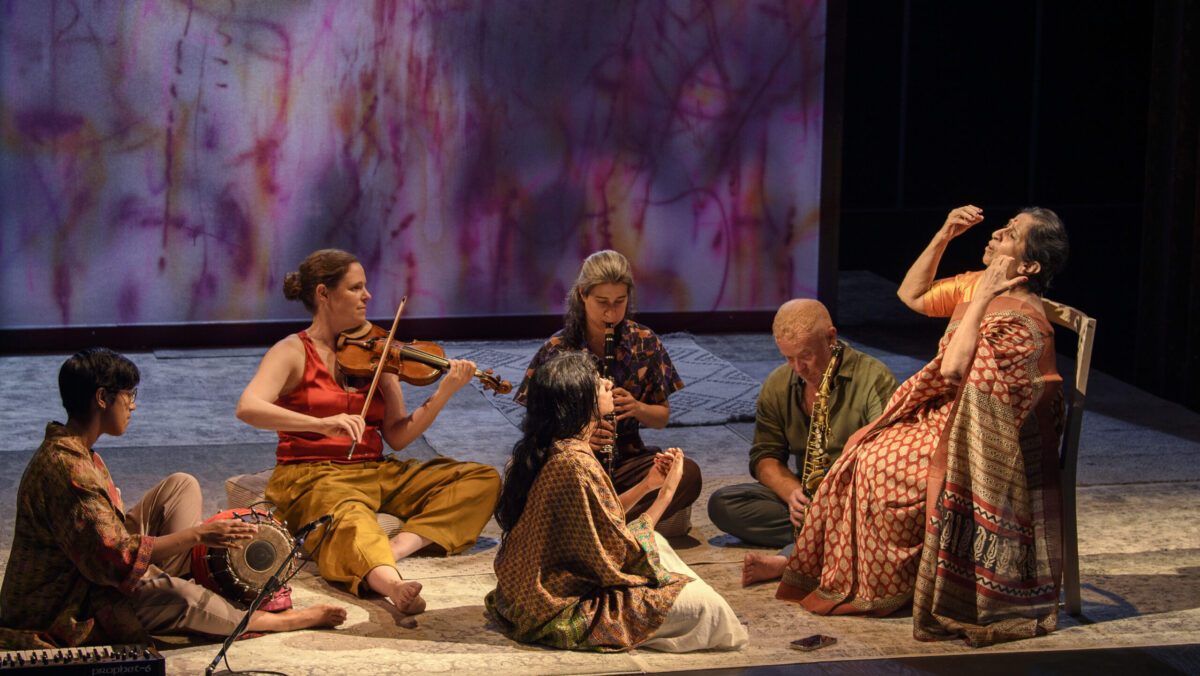
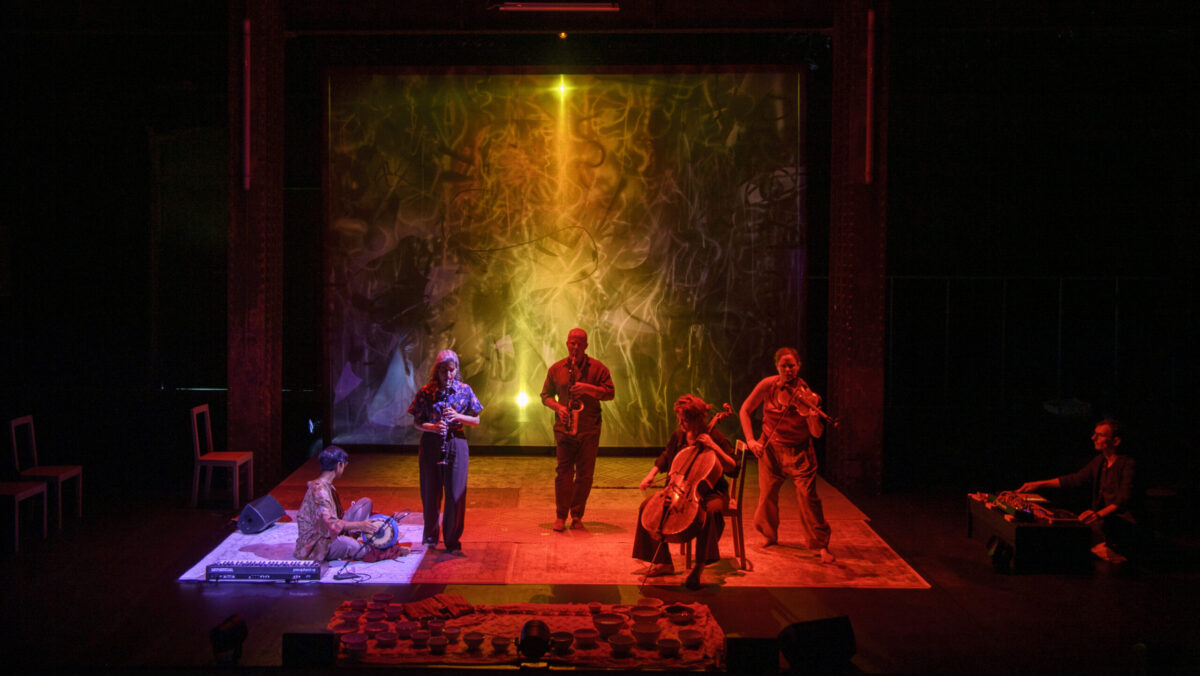
In much of his recent work, Sellars seems to have served less as a traditional director and more as a spiritual guide through a production. And so it was in this arrestingly beautiful yet often-perplexing work, a one-of-a-kind fusion of electronic music, jazz improvisation, ragas, storytelling, and visual art that felt like closer to a ceremony than a performance. We witnessed, and to an extent, became part of, something that felt like an archaic ritual from the future.
Ruth Walz
Streams of spiritual thought, fable and personal reminiscence flowed together into what might, very roughly, be termed the plot. Its backbone was a Buddhist Jataka tale, depicted in an ancient cave drawing in the Thousand Buddha Grottoes, in China, of a magical jewel-encrusted deer who is hunted by a greedy king after being betrayed by a man she saved from drowning. The piece created resonances between this allegorical act of violation and modern victims of sexual violence through tales of female solidarity and a form of music therapy practiced by Doraiswamy’s grandmother.
Groff’s modern retelling of the Jataka tale, projected as text on a screen and read aloud by the author, was sparse, precise and poetic. Mehretu’s abstract paintings, riots of color and markings that suggest a variety of meanings, were transferred to large fabric scrims and framed the performers. As light passed through them (James F. Ingalls did the hypnotic lighting), they seemed to float and expand. Seated on a carpet, Doraiswamy and Sairam chanted and vocalized as five musicians played wildly over the electronics performed by Augustin Muller from the Paris-based IRCAM, where Eldar developed the piece. It was often hard to tell who had done what and how much of the score was notated or improvised. That blurriness seemed to be the point, with the outlines of individual egos intentionally indistinct.
On the bus ride back to Aix after the show, I heard a critic grumble about cultural appropriation (Sellars, Eldar, and Groff are white) and a composer told me the whole thing had seemed phony to her. Thinking back to the performance several weeks later, I still don’t quite know what to make of it, but I can’t accuse it of insensitivity or insincerity. It was frequently mesmerizing but also elusive and felt overlong – especially in the hangar-like exhibition space where the premiere was held on this balmy July night.
Monika Rittershaus
A refreshing breeze coursed through the Théâtre de l’Archevêché the following evening for the premiere of La Calisto (seen 8 July). If the festival’s four previous productions had dealt soberly and severely with themes of sexualized violence and sexual violation, providing an Aix-Ray of perverse desires and the lengths to which the powerful will go to sate them, Francesco Cavalli’s Ovid-inspired dramma per musica from 1651 served as the festival’s satyr play.
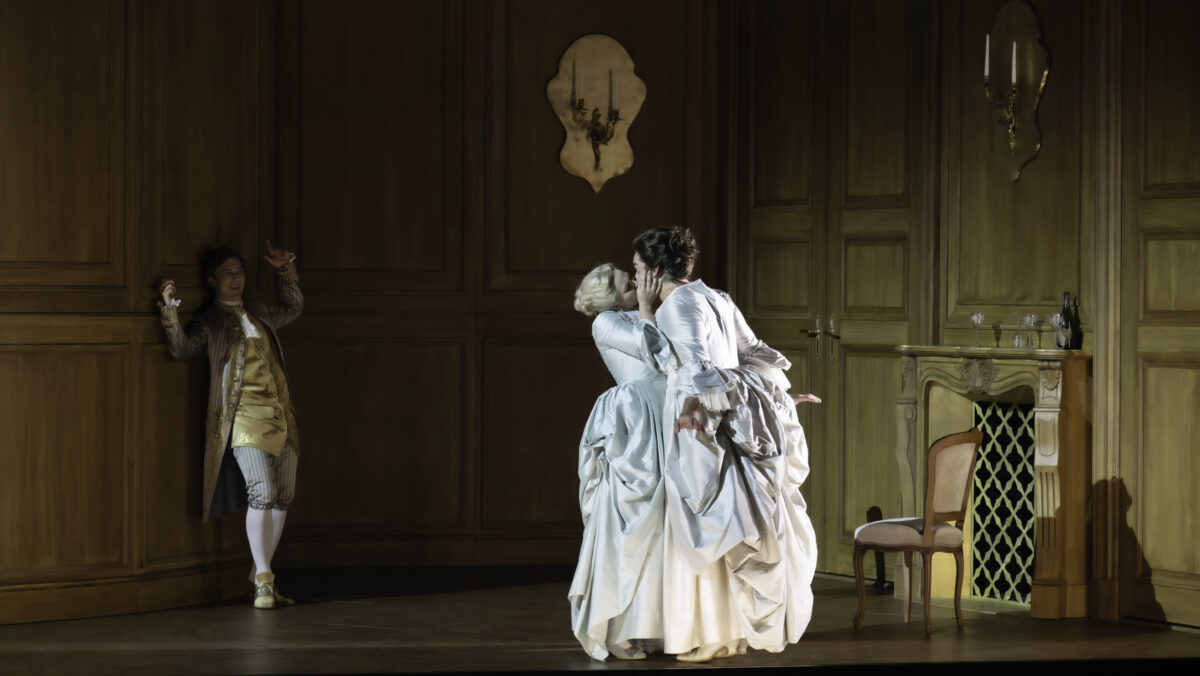
In La Calisto, Jupiter lusts after a nymph who is devoted in chastity to the god’s daughter Diana. Following Mercury’s shrewd advice, he assumes Diana’s form and leads Calisto into a grotto for some heavy petting. When the real Diana returns, she is startled to find that the nymph is now a nympho who wants to spend every moment in carnal devotion to her mistress. Meanwhile, the virgin goddess of the hunt is not as pure as she seems either. Despite her vows, she in love with the smooth-faced poet Endimione. All manner of concupiscent complications ensure.
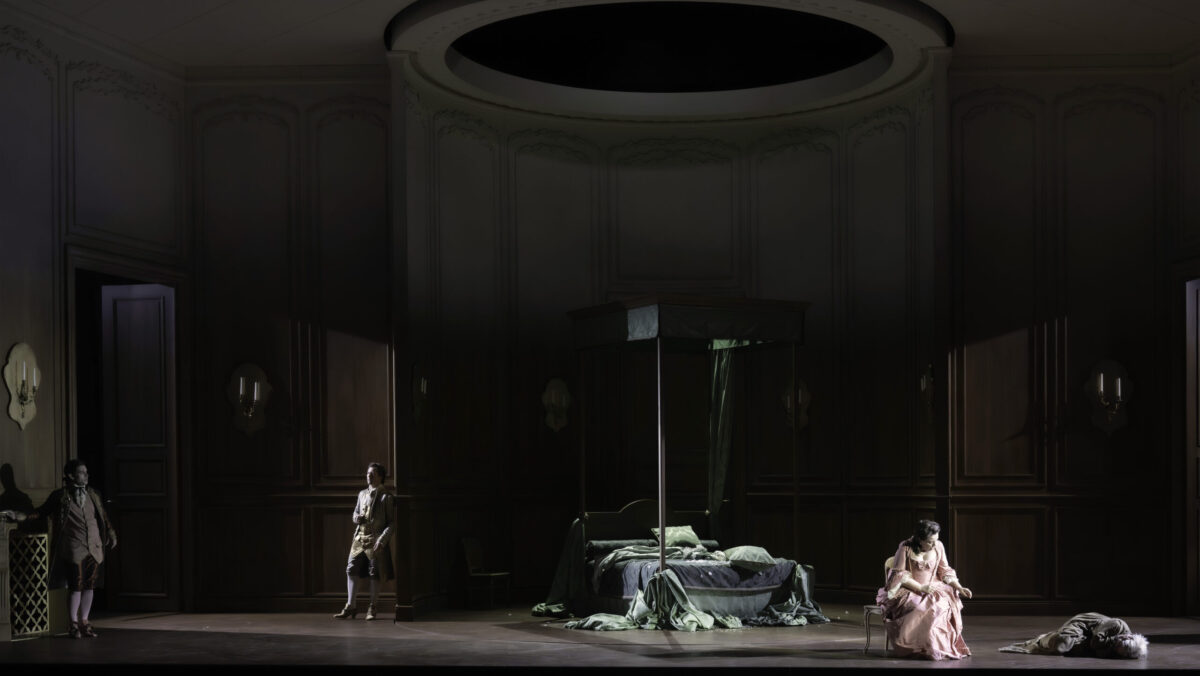
The Dutch director Jetske Mijnssen served up a single set production that proved extremely versatile and dynamic, thanks, in part, to a turntable in the center of the dark wood-paneled salon that spanned the stage. The set’s upper half was painted a ghostly white, which seemed to suggest that the production’s Baroque setting was both homage and pastiche. Period frocks, ruffles, corseted dresses and wigs abounded, as did candelabras and upholstered furniture, but the mood was breezy and irreverent, perfectly in synch with the naughty narrative and the sparkling score.
Monika Rittershaus
It was clever, sexy, and superbly performed by a young cast, led by the radiant French soprano Lauranne Oliva as Calisto. The American bass Alex Rosen was equally booming and bumbling as Jupiter, and his falsetto passages as the fake Diana had a perfect comic tone and delivery. As Diana, Italian mezzosoprano Giuseppina Bridelli impressively ping-ponged between fending off Calisto’s advances, secretly pining for Endimione (the countertenor Paul-Antoine Bénos-Djian in a pensive performance) and raging at her dad for dressing up as her and shtupping her nymph.
Sébastien Daucé led his baroque music orchestra Ensemble Correspondances with unfailing wit and propulsive verve. Onstage and in the pit, the performances crackled with rhythmic vitality and expressive color. Each of the 13 cast members understood the high degree to which music and text are fused in this key example of the Venetian Baroque. (It ain’t called a dramma per musica for nothing!) My one reservation about the production was that it emphasized the opera’s raunchy high jinks at the expense of its darker, more tragic aspects. Then again, after so much abuse and trauma spread across the earlier offerings, it was gratifying to finish this Aix-rated festival with a comic climax.