Monika Rittershaus
Richard Strauss completed his penultimate opera on June 28, 1940, after a creative process that mirrored Europe’s own violent convulsions. From 1937 to 1940, the work stalled repeatedly while Strauss simultaneously composed Daphne, quarreled with librettist Joseph Gregor over Capriccio, and suffered illness that delayed progress for months. The Salzburg premiere in 1944 was reduced to a single dress rehearsal due to wartime restrictions. By the time Die Liebe der Danae received its first full performance in 1952, three years after Strauss’s death, the world had moved beyond his musical universe.
At the Bavarian State Opera, Claus Guth excavated this neglected work that satirizes Jupiter’s attempted seduction of the princess Danae and revealed something bracingly contemporary pulsing within its mythological framework, a resurrection rather than a restoration that confirmed that some operas require historical distance before their deepest meanings come into focus.
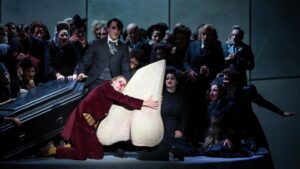
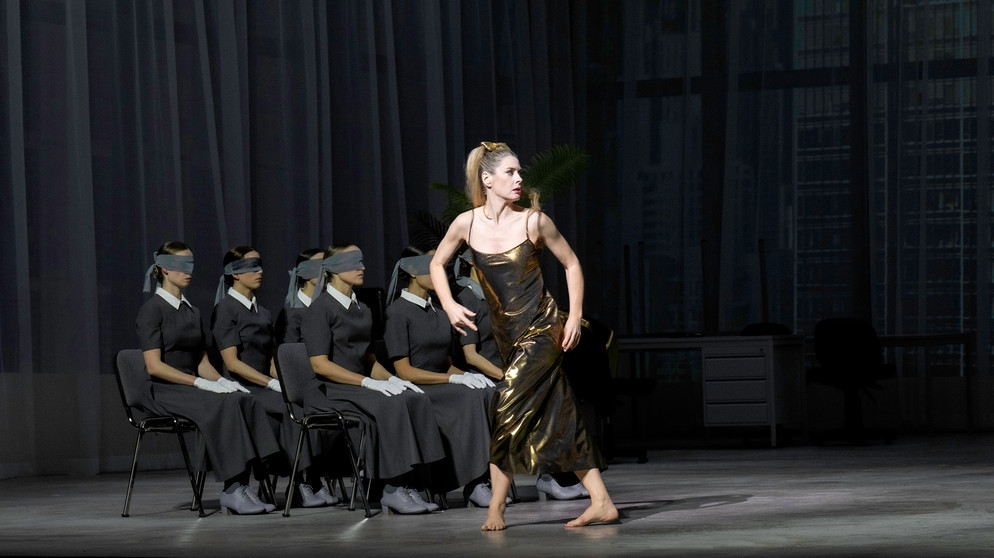
Guth relocates the action from mythological Greece to a penthouse office in a New York skyscraper, where Danae’s father Pollux materialized as a grotesque parody of Donald Trump. Vincent Wolfsteiner embodied this figure with synthetic hair, an exaggerated red tie, and a bulging corporate suit, ruling over a decaying empire surrounded by towering glass monuments. Creditors have already begun dismantling the furniture by the time the curtain rises. Michael Levine‘s set imprisons the characters in sterile gray interiors with panoramic views of other skyscrapers, their glass walls suggesting both surveillance and entrapment. Helicopters hover beyond the massive windows, materializing when Midas, who is also courting Danae, arrives by private jet. Guth replaces mythological grandeur with late capitalist decay, creating imagery that felt immediate, familiar, and disturbingly prophetic.
This conceptual framework revises the opera’s political and emotional stakes; Pollux becomes an emblem of collapsing patriarchal capitalism, while Danae emerges as a child of the Instagram age, hyper aware of appearances and fluent in self-performance. Yet through Guth’s direction, she evolves into someone emotionally authentic and morally independent. Her choice to embrace love over wealth no longer seems mythic or symbolic but personal and revolutionary. Even in scenes crowded with ensemble movement, Guth maintains exceptional clarity, making every gesture purposeful and readable. Act III reaches a particularly devastating conclusion with images of the bombed Munich in 1945 projected behind the action, followed finally by a solitary figure of Richard Strauss himself, walking in his garden while Munich lay in ruins. The opera ended not with catharsis but with historical reckoning that stripped away fantasy and left only memory, only the terrible weight of what survives when civilizations collapse.
The opera itself places ferocious demands on any company brave enough to attempt it. Strauss requires enormous orchestral resources, singers of superhuman stamina, and a willingness to stage the seemingly unstageable. His late style juxtaposes moments of transcendent melodic beauty with harmonic instability and elaborate contrapuntal architecture while Joseph Gregor’s libretto compounds these difficulties through its philosophical abstraction and occasionally wooden rhetoric. Critics have long noted its lack of Hugo von Hofmannsthal‘s psychological finesse, and many passages read like German translated from ancient Greek, then filtered through ponderous academic jargon.
Malin Byström conquered every obstacle the title role erected before her. Her voice sliced cleanly through Strauss’s dense orchestration with focused warmth and expressive control that never wavered, even in the most exposed passages. More crucially, she constructed a psychologically coherent character arc that transformed an idealized mythological figure into someone fully, recognizably human. Byström’s Danae rejected both divine seduction and material luxury, choosing instead the terrifying risk of genuine emotion. She shaped this transformation without sentimentality, using clarity and intelligence rather than vocal excess to earn our deepest sympathy and admiration.

Geoffroy Schied
Andreas Schager assumed the punishing role of Midas with heroic endurance. In the second Act’s merciless duet, reminiscent of Siegfried and Tristan for its relentless demands, Schager met every challenge while preserving the character’s essential vulnerability. In Schager’s interpretation, Midas becomes a figure weighed down by his supernatural gift rather than liberated by it. I told my German cohorts that he should change his last name from Schager to Schlager (“mega-hit”).
Christopher Maltman portrayed Jupiter as a dangerously sincere patriarch whose entitled authority masked genuine bewilderment. His baritone delivered authority while simultaneously revealing the character as someone who believed absolutely in his own mythology. When he finally surrendered Danae, it was not because wisdom had dawned but because he encountered something he could neither possess nor comprehend. That realization landed with devastating force, transforming cosmic comedy into human tragedy.
Ya-Chung Huang brought sleek, predatory intelligence to Mercury, channeling clear allusions to Wagner’s Loge while giving the role a contemporary edge. His Mercury resembled a corporate fixer, a divine consultant who managed transactions with ruthless efficiency and amoral precision.

Monika Rittershaus
Sarah Dufresne, Evgeniya Sotnikova, Emily Sierra, and Avery Amereau, as the quartet of Jupiter’s discarded lovers, sang with technical precision and distinctive personality while avoiding easy caricature. Instead, they offered a collective portrait of wearied survival, women who had experienced divine attention and lived to process its aftermath. Their ensemble singing blended beautifully, their German diction remained crisp throughout, their stage presence was sharp and intelligent, and their contribution among the evening’s greatest strengths.
Sebastian Weigle conducted with a deep understanding of Strauss’s musical architecture, balancing both flexibility and restraint. The Bavarian State Opera Orchestra responded with precision and nuance that never sacrificed clarity for effect while maintaining dramatic momentum throughout. Under his leadership, a lucid and detailed understanding of the characters’ psychologies emerged from Strauss’s harmonic vocabulary. The same could be said of the Chorus.
Guth’s production demonstrates that despite the longueurs of its libretto, which Hofmannsthal actually sketched and left Gregor to complete, Die Liebe der Danae can stretch beyond intellectual exercise to become urgent contemporary commentary. It speaks directly to present crises, confronting power, desire, greed, and authenticity with honesty. Under these circumstances, it matters profoundly.