
Bayreuther Festpiele/Enrico Nawrath
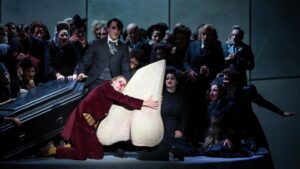
When Wagner began writing Die Meistersinger von Nürnberg, he subtitled it “comic opera.” As it began to grow to its eventual four-and-a-half-hour length, he ceded that it was a “large comic opera.” But by the time he finished it, though, it was simply “opera.” The Bayreuth Festival’s new production, directed by musical theater specialist Matthias Davids and opened on 25 July, aims to restore comedy with images of a toy town Germany. The cast is winning; the production is occasionally amusing but insidiously reactionary.
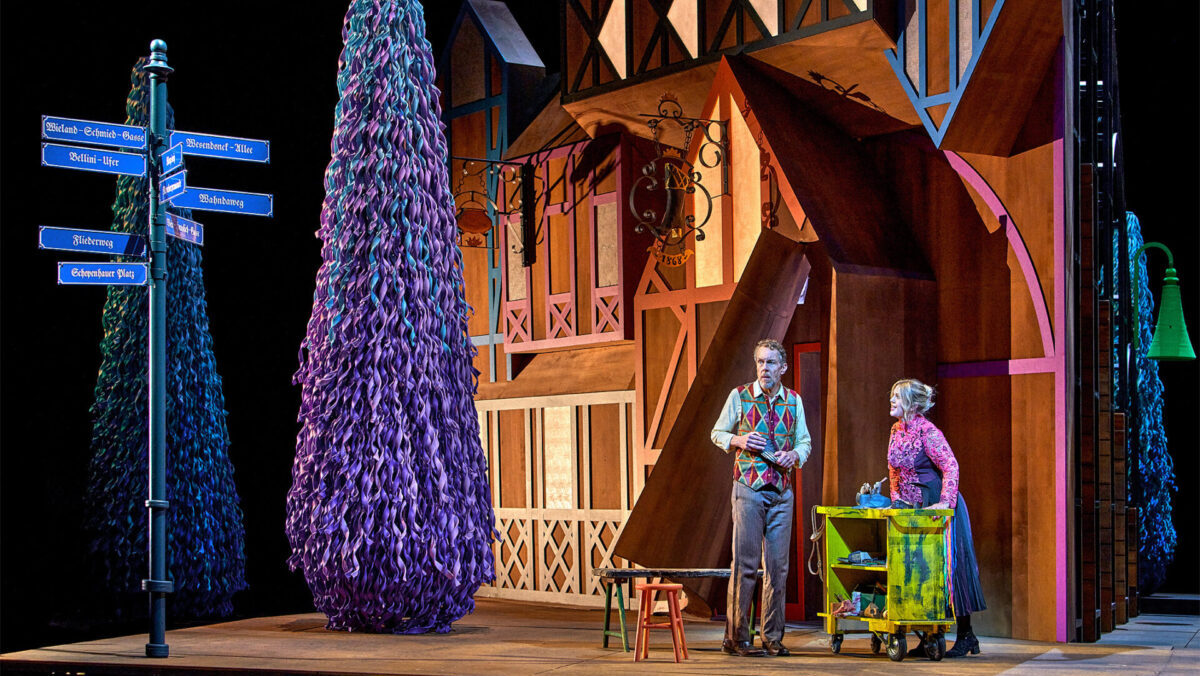
Davids’s setting mixes modern and traditional elements, with the more forward-looking characters in t-shirts (David and the other apprentices) and the traditionalists in the Lederhosen and Dirndl still sported by a few Bayreuth audience members (Beckmesser, Pogner, and Eva—though she not by choice). (The costume designer is Susanne Hubrich.) Andrew D. Edwards’s sets create a succession of striking, somewhat abstract images, starting with a giant staircase extending up to a tiny church, followed by a schoolroom that echoes the Bayreuth auditorium itself.
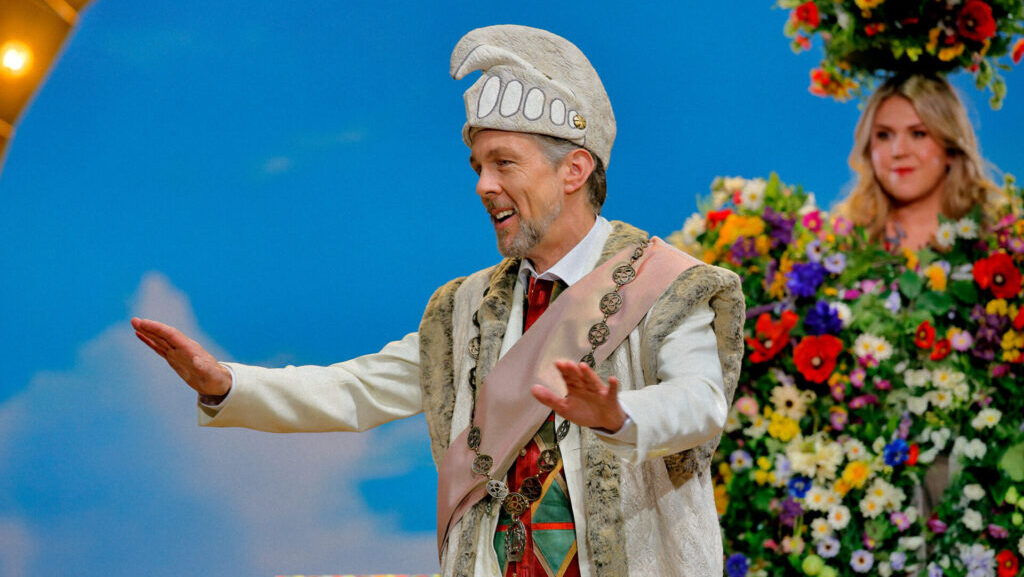
Yet many of these images come to nothing. You think something or someone is going to tumble down all those stairs, or maybe struggle up them, but not really, and the staircase vanishes at the end of the first scene, never to return. Unfortunately, that’s only one of the many dropped threads in this production, which never establishes a clear perspective on its text. I would also be more receptive to Davids’s agenda if his comedy were actually funny. Like the Mastersingers’ cartoonish, faux-medieval knight’s helmets, it suggests something funny rather than actually making you laugh.
Perhaps some of the issue was a lack of coordination with the pit. Conductor Daniele Gatti has been mostly out of view since 2018 due to accusations of sexual misconduct, and I was not happy to see Bayreuth contribute to his ongoing rehabilitation. His idiosyncratic tempos, unexpected moments of rubato, and horizonal approach to Meistersinger’s often polyphonic orchestral textures made this a distinctive reading but also something of a matter of taste. It also didn’t help Davids’s happy-go-lucky comedy take flight.
Davids’s focus is on the central triangle of Walther, Eva, and Sachs, with Sachs’s turn to traditionalism in the finale motivated by his thwarted desire. Eva seems to have less affection for Walther than to see him as a ticket out of conservative small-town life—she changes her traditional clothes for modern ones to exit with him at the end. Others I talked to enjoyed the direction of these characters but I found it generic and static and I could see the performers often resorting to those filler gestures singers do for lack of other options. (I should mention that I was not here on a press ticket and my seat was at the very back of the main floor, so those closer or watching the broadcast likely had a different experience, though I think it is fair to judge a production from any vantage point in the house.)
Where the performance succeeded most was its singing. First and foremost, Michael Spyres’s Walther was a great success, sung with an Italianate legato and phrasing you don’t often hear in Wagner and a rich, bronze tone that, while stretching just the faintest bit on the top notes of the Prize Song, stayed fresh the whole evening. Christina Nilsson also made for a stellar Eva, her silvery soprano has a beautiful presence and suggests stellar Sieglindes and Salomes to come. Georg Zeppenfeld made for a wry, jaded Hans Sachs, though his bass sometimes sounded dry and strained at the top.
Bayreuther Festpiele/Enrico Nawrath
The brunt of the comedy, such that it was, was provided by Michael Nagy’s Sixtus Beckmesser. Nagy has a very warm baritone as well as being tall and handsome and thus had an uphill climb to appear to be a loser bereft of charm and talent. Armed with a heart-shaped electric guitar and a steadfast commitment to the bit, he mostly sold his character’s pratfalls—even as they were undermined by as his inability to make his intentionally awkward vocal lines sound bad.
Beckmesser, as a character, also represents the antisemitic stereotypes Wagner ascribed to Jews. Davids does not engage with this; he stages the text rather than the subtext. To him, this is an opera that is simply about a love triangle (…rectangle?) and a singing contest. But does anyone really need four and a half hours of Eva figuring out she needs to move out of her parents’ house? Meistersinger is about that, but it’s more importantly about the relationship between the artist and their public, music’s place in the national imaginary, and what to do when your audience doesn’t adequately appreciate your transcendent genius. In other words, it’s about why Wagner built Bayreuth in the first place and why despite it all we’re still trekking out to this festival with its ridiculous ticket policies and overpriced pretzels. I’m not opposed to fun, but no one comes to Bayreuth for fun. We come here, to quote Nicole Kidman, for magic!
The production saves most of its ideas for the final scene of communal celebration. This is Wagner’s image of an ideal Germany, and for Davids it is a kitschy, colorful spectacular with a giant inflatable cow and a revue-style dance number (choreographed by Simon Eichenberger) involving the whole chorus, including some lookalikes of German icons Angela Merkel (who was there) and TV personality Thomas Gottschalk (who wasn’t).
Contest trophy Eva is encased and immobile in what appears to be Florence Pugh’s flower dress from Midsommar, which briefly made me think this production was going to go in a very different direction (sadly, it did not). For Bayreuth insiders this was a chance to hear the new chorus, a smaller ensemble under a new director after the previous group was fired en masse. The new chorus produces a powerful sound despite its slightly reduced size but the sometimes ragged ensemble has prompted local Schadenfreude.
Bayreuther Festpiele/Enrico Nawrath
It is perhaps folly to take a single Bayreuth production as a manifesto, but it is Meistersinger, which is nothing if not a manifesto, and given Bayreuth’s small sample size, what other options do we have? After Katharina Wagner’s sometimes incoherent but provocative and daring 2007 production and then Barrie Kosky’s pointed indictment of the opera’s place in Nazi iconography in 2017 (both available on DVD), I can understand the desire to go lighter. But nowhere is heavier than Bayreuth, and this is a retreat. (Nor does lightness necessarily mean escapism—just look at Tobias Kratzer’s delightful and very queer Bayreuth Tannhäuser, now also out of circulation.) This was the first Bayreuth attended by new conservative Chancellor Friedrich Merz, as well as a bevy of other right-wing politicians. This Meistersinger shows us a happy, homogenous Germany that comports with their vision (where hiring Gatti is barely a conversation), as they are seated in the theater.
Davids knows he still needs to be critical in the opera’s most incendiary passage, Hans Sachs’s exaltation of “holy German art” at the end of the opera. Beckmesser unplugs the inflatable cow, it wilts, and everyone looks confused. Then Sachs plugs it back in and it reinflates. This suggests a putting of the toothpaste back into the tube that I do not believe you can do—Sachs and his thoughts are still there. If this idea had been unpacked throughout the opera, maybe we would have gotten somewhere.
In the 1950s, Wieland Wagner coped with economic precarity and Bayreuth’s toxic role in the Third Reich by stripping back his productions to bare minimalism. Davids isn’t doing that—his vision is busier and less elegant. But in both cases, the insistence that a production can isolate the story and music from the world around them diverts our attention from the politics which lie at the very heart of these works. I suspect this production will be popular, but if it’s a sign for the future, that’s cause to be concerned.
Author note: I am in Bayreuth working on an academic research project on the recent history of the festival and am conducting interviews with audience members, particularly those who have been regulars. If you are interested in sharing your thoughts on the festival, please email me in English or German ([email protected]).