Steven Pisano
Since I’ve long been of the opinion that Macbeth (Florence, 1847), Verdi’s tenth opera, was his first masterpiece, but we usually hear performances of its 1865 Paris revision, I was eager to attend Teatro Nuovo’s presentation of the original, to grasp how much of the score had been altered over the years. The performance took place last Wednesday at a new locale for the company, that prima donna of West 55th Street, the colorful, madly Arabesque New York City Center, and had the usual Teatro Nuovo complement of impressive young singers and original old instruments, valveless horns and such.
Was this curious creation, Macbeth, a hit back in its day? Certes! In its first ten years, the work was performed (company maestro Will Crutchfield informed us, in one of his always delightful pre-performance chats) in over one hundred opera houses on the Italian peninsula alone—to say nothing of New York, Constantinople, St. Petersburg, Havana, Budapest and Dublin. (Not in England until 1938, however—the English have no sense of humor about Shakespeare.)
All this in spite of the fact that Shakespeare was almost unknown in Italy in young Verdi’s day, the only works having been translated were some of the ones, like Julius Caesar and Romeo and Juliet, that were set in Italy and derived from Italian stories. What language, whose translations, then, did he first encounter the plays? We don’t know; his letters boast of his acquaintance but never footnote it, and he spoke no English. The play Macbeth had never been staged in Italy—apparently, it was Verdi’s opera that inspired interest in it, which was soon very popular there, the translated verses often borrowed from the libretto. Indeed, the first translator of all of Shakespeare into Italian was Michele Carcano, a friend of the composer, and the similar vocabulary of his Macbeth to the opera libretto makes one wonder who inspired whom.
The story of Macbeth was a most unusual choice for an opera in that era. It is a drama without a love story, even as a subplot—the Macbeths, baritone and dramatic soprano, are not only married but so much in love they never bother to sing about it—and second, there is almost nothing for a tenor to do. (The Parisian impresario who revised the work wanted to give the fellow a drinking song, but Verdi quashed that.)
Steven Pisano
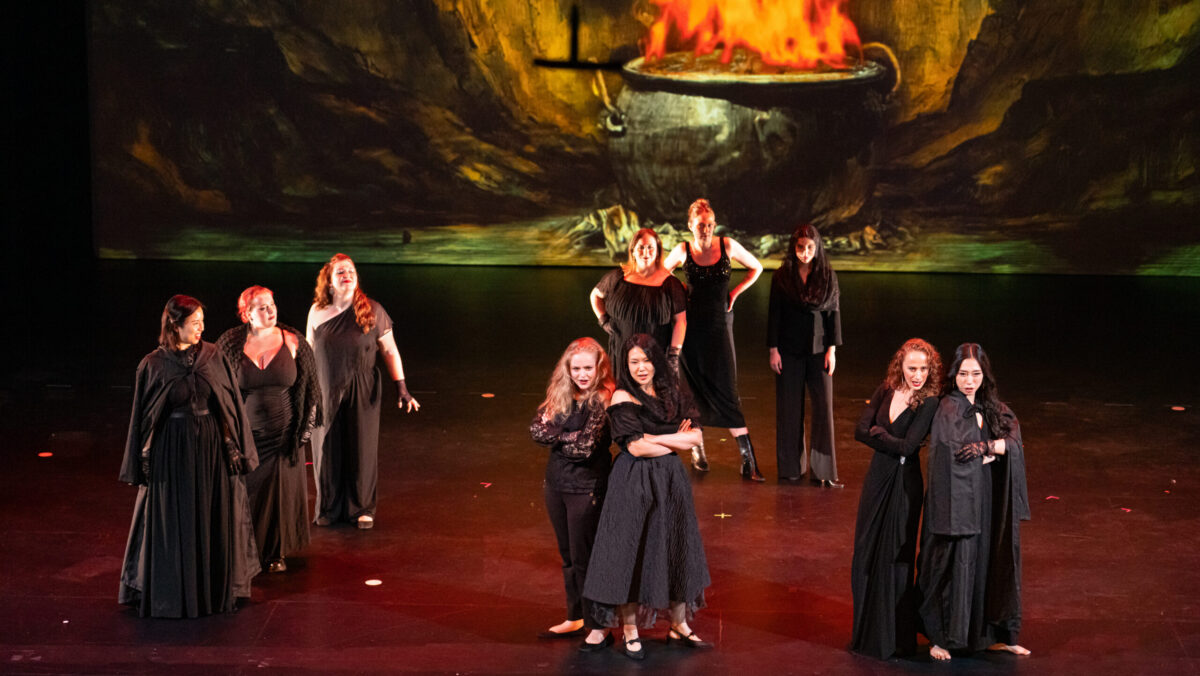
Then, there was the sheer weirdness of the tale—besides the Thane and his Lady, Verdi pointed out to his puzzled librettist, the only truly important character is the chorus of ominous Witches. Celts of the far north may like this sort of thing, but Italians are more cynical. They weren’t used to old ladies uttering prophecy amid ballet interludes. The Pope insisted that they be turned into fortune-telling Gypsies when the opera was performed in Rome—did this give Verdi ideas for Azucena?
To everyone’s surprise, the craziness was a hit. Audiences found its novelty hair-raising and spell-binding—led to it, I suspect, by the popularity of Meyerbeer’s Robert le Diable (1831), with its ballet of ghostly nuns. Florence knew Robert—it had been performed there in 1840, and the star soprano had been Giuseppina Strepponi, later Signora Verdi.
Of course, even the English could not see Shakespeare’s Macbeth in those days—Davenant’s Restoration farrago, full of mad music and Halloween effects, still held the stage in London, and this Verdi had seen a few months earlier, when premiering his I Masnadieri before Queen Victoria. It seems likely that it was his intellectual friend Andrea Maffei, well acquainted with German intellectual trends, who pointed out the appeal of Shakespeare’s taut, tightly focused play with its lead characters destroyed by ambition who resemble no others then on the stage. North of the Alps, Wagner made an opera out of Measure for Measure, but in the south, Shakespeare was still little known, only represented by Salieri’s Falstaff and Rossini’s Otello.
The version that Teatro Nuovo gave us, conducted by Jakob Lehmann, was full of unfamiliar music along with the well-known: an aria and cabaletta showpiece for Lady Macbeth in Act II—replaced in Paris by the grand, murky “Le luce langue”—plus Macbeth’s more traditional aria and cabaletta in Act III when confronted with the prophecies and apparitions of the Witches; an entirely different (and much inferior) refugees’ chorus to open Act IV; and a rather abrupt death scene for the king.
I’ve always been stunned by the sequence in the last act as we usually know it: the heartbreaking chorus, Macduff’s despair, Malcolm’s war cries, the magical Sleepwalking Scene, Macbeth’s meditation, the “battle fugue,” however they stage it, and the triumphant “Bardic” hymn that concludes the revised opera. Verdi floors me with his propulsion, the shock of contrast from one movement to the next, how he takes us, emotionally, precisely where he wants us to go.
Steven Pisano
From the earlier version, we learn that the original sequence was smoother—and therefore less of a thrill—than the revision. The recomposed chorus flows seamlessly into Macduff’s sorrows, then is shocked into movement by the “Birnam Wood” up-and-at-‘em of 1847. Abruptly, then, the Lady’s Walk takes us to a different world entirely (the music was never altered from the original), the melody that haunts us though it is never sung because the singer, uneasily asleep, cannot hear it. Then we come to Macbeth’s “Tomorrow” soliloquy, an old-fashioned broad melody, to the crowning chorus of relief that suits the arc of the story perfectly.
One factor particularly struck me: The 1865 Paris revision is heavily weighted towards the soprano, who has the best original arias and the revised ones, and in revival the Ladys have usually held center stage. The 1847 Florence original, in contrast, is centered upon the baritone, his twisting, self-tormenting thought processes. A great deal of his music was chopped out in the rewrite. Act III, for instance, is very properly about Macbeth, what he asks the Witches, what they tell him, and his response. A great deal of that was transformed to meet the demands of “French grand opera,” with more dancing and less consideration. Then, in 1865, Lady M comes on for a short, loud duet, a howl of “Vendetta!” when there’s no character on whom to take it. This gives us a strong, energetic heroine only a few minutes before we see her fallen apart in pathetic nightmare. It is an awkwardness, and in performance I always resent it.
Julian Budden claims the Paris version was not at first a popular success, and Verdi let it go in the momentum that led him on to Don Carlos, Aida, Otello and Falstaff. Macbeth did not return to the regular repertory till the German revivals of the 1920s and in 1938 at Glyndebourne (the opera’s English premiere), 1952 (with Callas) in Florence and, in 1958 (with Rysanek and Warren) at the Met. And now it is given everywhere. I’ve seen it performed quite decently in Prague and Istanbul, besides by four or five companies in New York. With a pair of great vocal actors, an eldritch female chorus, and soldiers who can fight to a fugue, Verdi’s Macbeth is still an excitement, more of a revelation with each vivid performance. Teatro Nuovo lacked the thunderous punch this music can pack, but provided a pleasant ride.
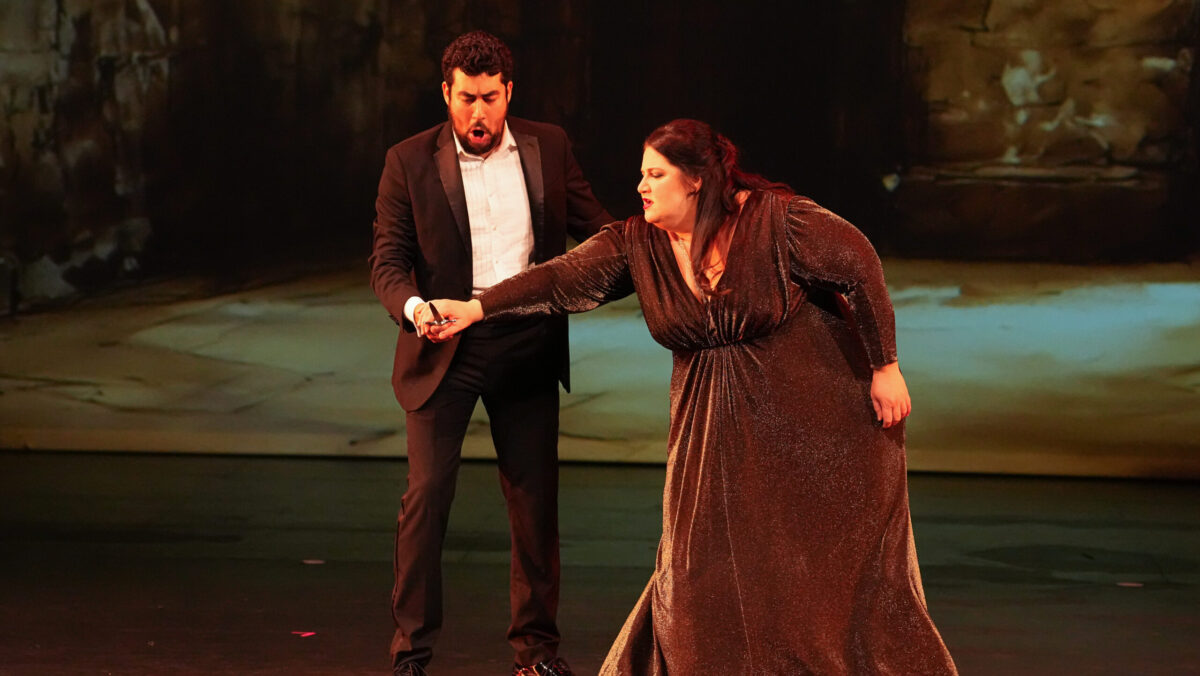
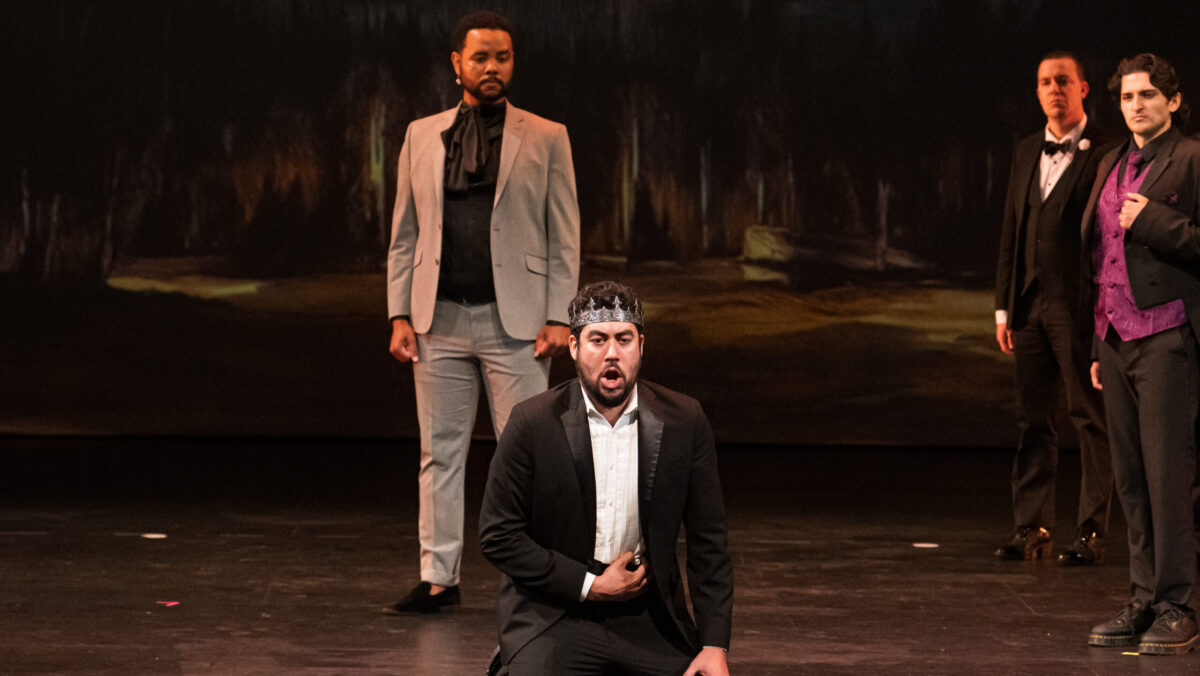
The four lead singers all had first-rate voices that would require very little touch-up to become stars. On the other hand, the semi-staging in formal dress did the opera no favors. Macbeth stood stiffly. Lady Macbeth stomped the stage like she was taking out the garbage. Macduff preened on his solo. Banco mercifully ran to the wings to be stabbed. (In twenty productions of this opera, I have only once seen Banco’s murder convincingly handled.) This is not the way to convince an audience of Verdi’s theatrical genius—we all know he was, but the stage directors and cast might lift a finger to help him get it across.
Steven Pisano
As I’ve said, the 1847 version of the opera centers upon the baritone in the title role. For Teatro Nuovo, we had Ricardo José Rivera, who never forgot the Thane’s moody obsessions. His warm, velvety command of the baritone range confirmed the impression he made last year as the remorseful villain in Anna di Resburgo—his duet with the soprano was the high point of that occasion. I can’t think of a Verdi baritone from Nabucco to Iago that I wouldn’t like to hear him essay.
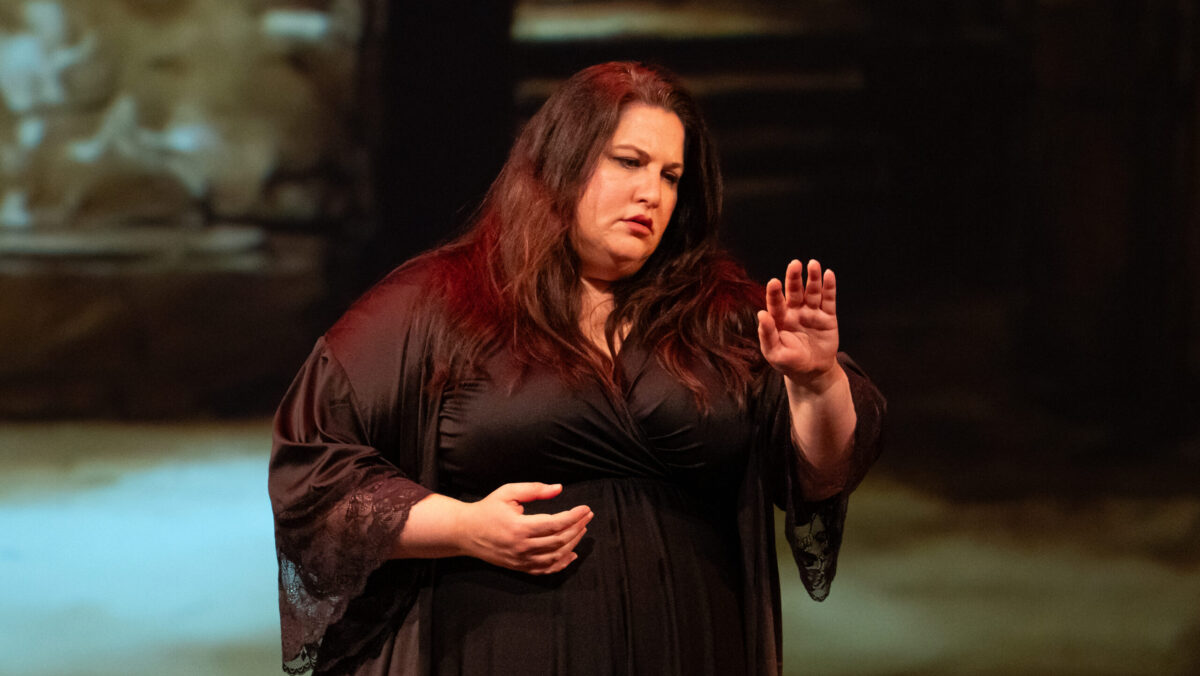
His Lady was Alexandra Loutsion, whom I have heard sing with distinction on a number of occasions. It’s a powerhouse voice, with the beauty and the evenness that several other sopranos in this repertory seem to lack, down to low, even comical notes, and now and then her phrases did not seem rooted very deeply. Her ornamentation—and in Italy in 1847, coloratura was expected of any lady on the stage—was somewhat haphazard. It is not natural to her, and her trills can be tuneless. After Vespri, indeed, Verdi gradually eliminated that requirement for his prima donnas. Loutsion, happily, has a wider forest to explore—middle Verdi roles like Amelia and Leonora would suit her well, and she is rumored for Aida at the Met.
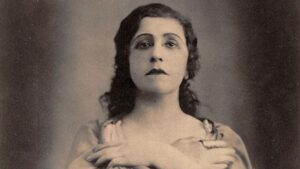
On the other hand, the Thane’s Lady is a titanic acting role, and actresses like Varnay, Rysanek, Verrett and Zampieri have been its great exponents. Modern opera singers are expected to be beyond park-and-bark, but that too often is what we get. Loutsion clearly could not imagine herself in the Lady’s tormented predicament—is there no one in the company to help her out? There was nothing sleepy in her sleepwalk, nothing blood-chilling in her delivery. Too, she could, with profit study ladylike stage deportment. A plod looks like a plod.
Martin Luther Clark sang Macduff’s aria with suave phrasing and emotional restraint that aroused audience enthusiasm, and Cumhur Görgün made a very pleasing if not room-filling Banco. Both gentlemen showed clear signs of understanding how to put across a Verdian line—as did all four of the lead singers. That was a pleasure.