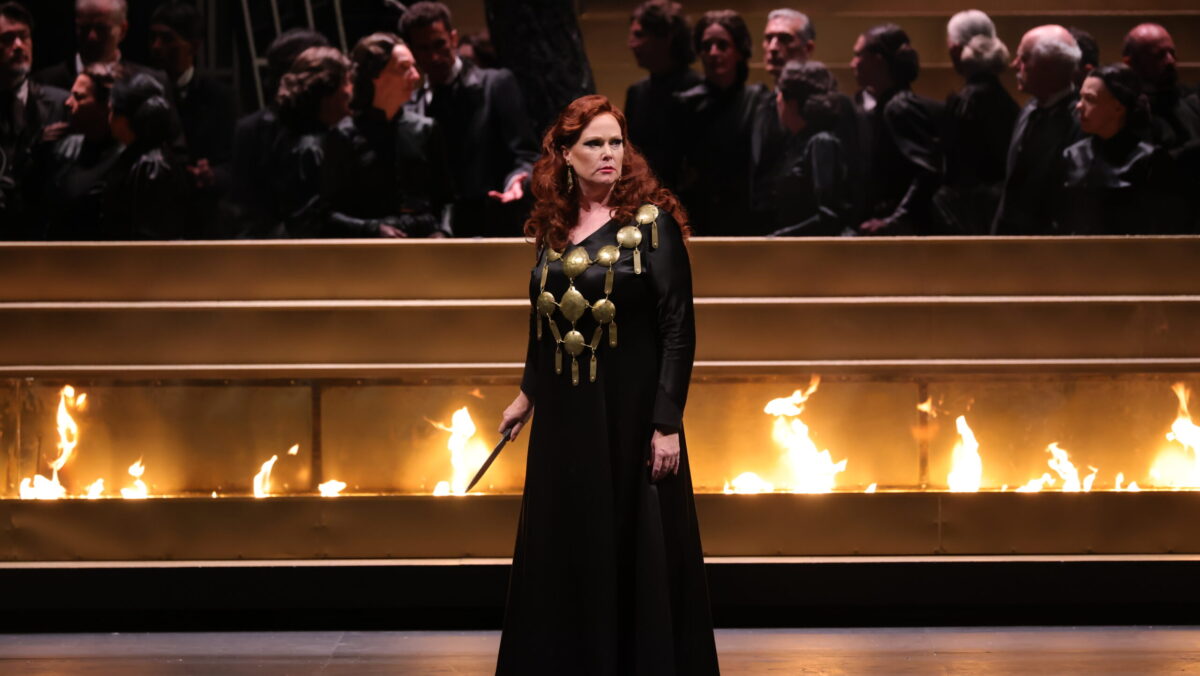
Brescia e Amisano © Teatro alla Scala
Even before the curtain went up on the final performance of the new production of Norma at La Scala last week, it was being treated as a legendary event. Marina Rebeka, who seems to never be able to make it to the end of a run in Milan, had withdrawn citing illness. Marta Torbidoni, the assigned cover, had already sung an additional performance beyond the one for which she had already been announced. So it came as somewhat of a surprise when it was announced that Jessica Pratt would be ending her vacation early, per her unusually candid Facebook page, to sing the final performance with just hours of rehearsal of a role she had only performed once before.
Pratt is beloved in Italy — so much so that the Australian coloratura has settled outside of Florence – where she is praised for her technical proficiency, emotional expansiveness, and lucid upper register. It may be hard for an American readership to imagine since Pratt hardly sings this side of the Atlantic, but for an Italian audience, this was like when Kurt Adler announced to the San Francisco audience in 1981 that Margaret Price was sick, so they’d be getting Leontyne Price as Aïda instead.
So the pressure was on in a sold-out house, the theater’s final performance before its summer break and the end of its first run of Norma in 40 years. She delivered in spades.
Pratt, as would Frank Sinatra, does Norma her way; not least in terms of the key for her solid, fast-paced “Casta diva,” which she upped to G despite the rest of the run having been in F, but in the way she manages the voice overall. The priority is clearly preserving the basic tone color – sweet, glassy, quavering – that extends across most of her range, from an easy top to a softer middle. Though this doesn’t mean she’s sacrificing characterization for timbre; she slammed all too rarely into a healthy chest for calculated dramatic effect (“Schiavi d’una matrigna,” for example, as she steels herself to knife her littluns), marrying ugly thoughts to a more raw sound.
The raised key is clearly more than just congenial to her, too — it’s existential; “In mia man,” laying lower as it does, found her distorting that base sound just to be heard, and in the coloratura runs, the nimble glottalizing called to mind a sweetly barking seal. With a smaller voice that nevertheless projects immaculately, Pratt is not a dominatingly magisterial Norma, but what does shine through is the imposing sovereignty of her musicianship and her full commitment to bringing to life the character with the means at her disposal. She knows her voice and how to use it, throwing herself completely into a pensive, anguished Norma who was especially tender in the scenes with her children. Despite her brief preparation time, the entire interpretation felt thoroughly prepared yet still open and spontaneous. For all this, she was cheered to the rafters.
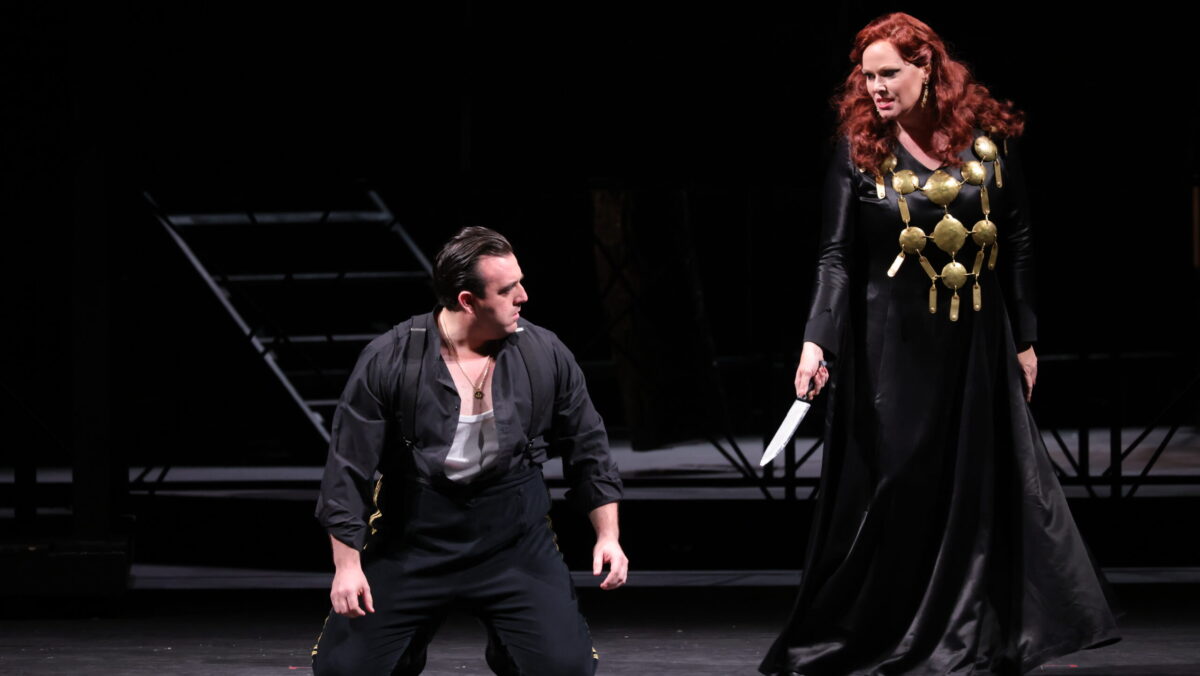
Brescia e Amisano © Teatro alla Scala
Norma, in Olivier Py’s new production, is perhaps the most ambiguous of the characters; Py smears history on thick, the production simultaneously drawing a parallel between the Roman occupation of Gaul to the Habsburg occupation of Lombardy before the Risorgimento while also referencing, amongst other things, the Allied bombing of La Scala in 1943, the similarities of Norma’s character to Medea (Norma might be an actress of some sort in Py’s conceiving), and that famous painting of La Scala by Angelo Inganni with the ghostly figure peering out from the second floor of the darkened building.
There are many ideas, most of which only feel like 60-70% fleshed out, and too much swishy choreography (by Ivo Bauchiero), but it’s an engaging enough watch as the action unfolds in an abstracted set of La Scala itself (designed by Pierre-André Weitz) filled with labyrinthine catwalks, dramatic staircases, and spinning on a noisy turntable. Ghosts haunt this theater and particularly this opera, Py seems to say in this epochal revival, and there’s not much that can be done to kill them. A sound enough conclusion.
But no firmer hand was there across Thursday’s performance than that of Fabio Luisi whose conducting was bold and detailed, rife with musical textures each distinct but commonly rich. (The overture had such unison playing that it sounded briefly like a pipe organ.) While he was attentive to his soloists, not least that evening’s prima donna, the conducting was just huge; big and emotional while never overwhelming the singers.
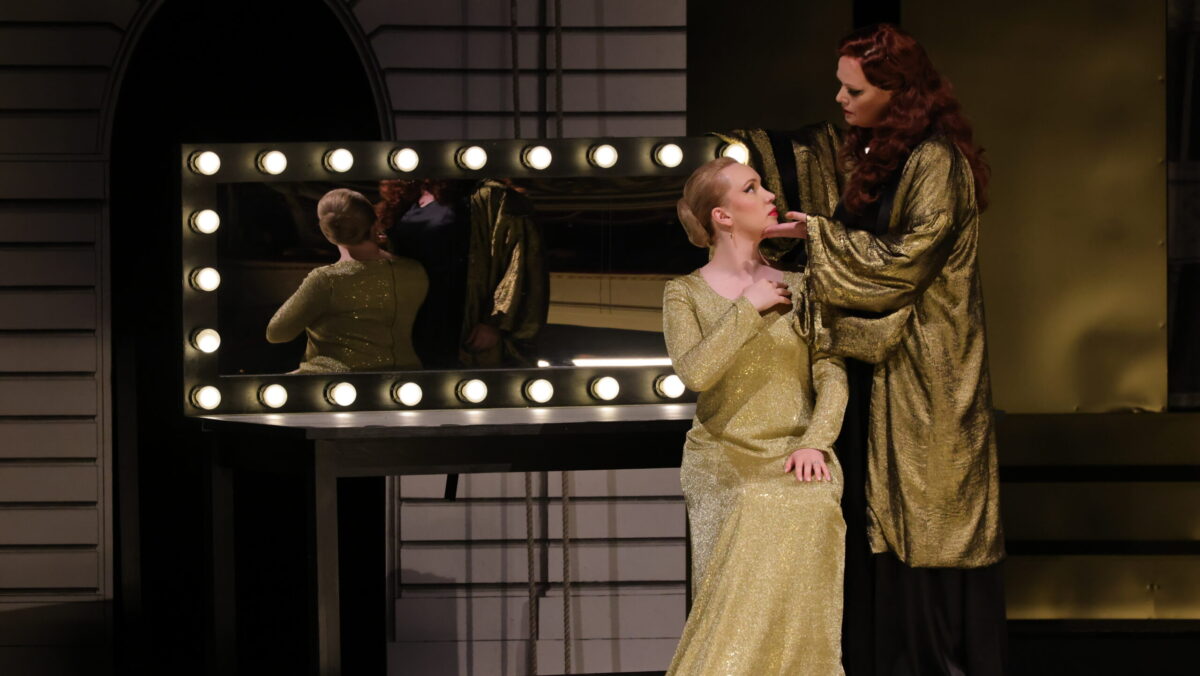
Brescia e Amisano © Teatro alla Scala
Luisi might also take credit for tempering the more hysterical vocal impulses of Freddie De Tommaso as Pollione. In tighter shape than he was as Cavaradossi in New York last fall, what shone through were less the mannerisms and more the outright deficiencies of his singing. Those familiar sobs and scoops, here kept to a minimum, seemed less like stylistic choices and more reflective of just a baseline inability to mix registers. His breath control is his greatest asset, allowing for long phrases in “Meco all’altar di Venere,” alongside a surprising sensitivity as an actor.
More memorable was Vasilisa Berzhanskaya as Adalgisa. Though perhaps a size too large a voice to comfortably complement Pratt’s Norma, her singing was as authoritative as Luisi’s conducting while simultaneously easily flowing and delicately floaty across a massive, fully supported range. But like Pratt, she, too, is in full control of her voice and scaled her volume back for her duets with Norma. My taste for a mezzo Adalgisa is only slightly less trashy than my taste for certain Real Housewives franchises, but hearing these two singers with such different sounds blend in such a satisfying way was thoroughly vindicating. Even Laura Lolita Perešivana as Clotilde got the memo and sang with real bite, while Michele Pertusi was a gentlemanly and warmly sung Oroveso.
But this warm evening in Milan will be remembered chiefly for Pratt’s success against intimidating odds as she became only the sixth soprano (and the third in just the past month) to perform the role there since Maria Callas did in 1955. I had been looking forward to hearing Marina Rebeka, but the best nights at the opera are undoubtedly the ones that surprise us. Last Thursday at La Scala was certainly one of those.