Opera is a meritocracy
 They want it. The career. They want it really bad.
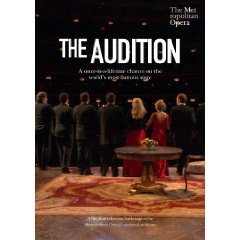
So we learn from Susan Froemke’s Metropolitan Opera-commissioned documentary about the participants in the final round of the 2007 MetNational Council Auditions, which is out on DVD this month. Our own doyenne reviewed the film when it was screened as an HD theatrical event, and by now many of us know the winners and their work.
Since you are all wondering whether to rush out with $20 in your hands, perhaps a few remarks on the DVD release are in order.
We only first glimpse the competitors in April of 2007, when they have already been invited to the semifinals in New York, having made it through fierce competition in regional auditions. Eleven are chosen for the finals. Why them? How did these get here? As one of the judges tells us, “Making a career in opera is not one in a hundred… It’s one in thousands.” They are looking for singers “who have what it takes, who will make an interesting artist one day.” In other words: why not them?
Froemke has given us a very sensitive and perceptive, but disinterested, film that reveals these young singers in tender and emotionally unpredictable moments, in a competition where the stakes could not be higher. She avoids overdramatizing their plight almost at the expense of her point-of view. The result is grandly-paced documentary, and a voyeuristic pleasure (if that is the word, since it is hard to feel either envy or Schadenfreude for their situation) that plays far above the reality TV bar.
Well, almost. Tenor Michael Fabiano, at 22 the youngest of the singers documented, indulges a cameraman with a diabtribe about the audition process, specifically the tricky business of putting on smiling faces with backstage buddies who are, after all, competitors. Defensive in posture and with something of a chip on his shoulder, he grinds the axe a bit. But it’s hard to hold this against him, since the self-doubt in his rambling is both palpable and understandable under such pressures. And it isn’t likely to detract much from his career either, since he happens to be a spectacularly gifted Verismo tenor, an intuitive artist with amazing power and ping.
But not all singers get to the Met Finals quite so fully formed. The judges are also laying down bets – about whose voices will mature and find a Fach, and who has the personal strength for this punishing career path – in short, who will have staying power. During a preliminary audition, Alek Shrader, a lyric-leggiero tenor in the Florez/Banks mould, already has the the high c’s and the character for a Nemorino or Almaviva incubating solidly. Alas, during a preliminary audition he has some trouble ending “Una furtiva lagrima” in tune, winding up a half-step flat at the end. Though his face betrays nothing as the accompanist sets down the final chords, it must have been crushing.
But, to tell the truth, in these early coachings, most of the singers are struggling. Many seem awkward displaying much more than the notes, mugging or gesticulating cheaply as they perform an aria out of context and lacking a director’s concept. Maybe it’s just auditions. Or maybe they’re not ready yet, but they’ve got It. How do the judges know?
[kml_flashembed movie="http://www.youtube.com/v/odqrkmePyPQ" width="425" height="350" wmode="transparent" /]
“Someone who has something to say. Someone who is connected to the music –what the composer has to say. It’s about communication, not just about singing” is how Jonathan Friend, the Met’s Artistic Administrator, describes his ideal. Gina Lipinsky, a Met vocal coach, echoes him: “Opera is moving away from the idea that a voice is all that matters – everybody is looking for a package.”
One thing this film captures subtly, though vividly, is the extraordinary musical transformation that takes place during their time at the Met. The week spent at the Met preparing for the final audition is as much workshop as competition, because the Met supplies expert coaching, musical and repertoire guidance, and breathing classes. Ryan Smith, Kiera Duffy and Amber Wagner make particular strides.
In the final concert, all seem to have overcome many of the flaws in their earlier singing: voices have opened up; top notes, once crude, now have polish and gleam; music and text have connected; baritones know what to do with their hands. The experience has transformed them into artists, ready for whatever the future holds. Though, even after the winners are announced, that future remains a mystery.
Bonus features included in the DVD include a lively conversation with Renee Fleming, Susan Graham and Thomas Hampson, all once winners of the Met auditions. They reminisce about their experiences as young contestants, and offer advice to aspiring singers on repertoire and audition preparation. Also included is lengthy on-location footage from regional auditions in Texas, where we get a closer look at the weeding-out process, and eavesdrop on some very candid discussions between jury members Friend and Speight Jenkins. The DVD release is region-free, and lasts 157 minutes.
Postscript: One talented and genuine singer from Atlanta, Ryan Smith, sounds rather tight in “Che gelida manina” at the start of this film, but finishes with a triumphant performance that is mature, ardent, and crafty. Ryan was diagnosed with lymphoma not long after being named a winner in the 2007 auditions, and he died in 2008. Though we don’t learn too much about him from the film, his singing was a pleasure to witness, and his death is a tragedy.
-
Topics: 192, amazon, Camp, contest, hd, Metropolitan Opera, our own, Review, squirrel, Wagner
-
People: Alek Shrader, Amber Wagner, Kiera Duffy, Michael Fabiano, Renée Fleming, Speight Jenkins, Susan Froemke, Susan Graham, Thomas Hampson
-
Places & Organizations: Metropolitan Opera