“I will never sing the role again. It was frightful. We were a set of madwomen…There is nothing beyond Elektra. We have lived and reached the furthest boundaries in dramatic writing for the voice with Wagner. But Richard Strauss goes beyond him. His singing voices are lost. We have come to a full stop.”
Live recordings of Hans Knappertsbusch conducting Parsifal seem to proliferate like stairways in M.C. Escher prints.
Pierre Boulez continuously challenged me and totally changed the way I listen to music.
On Thursday evening Jennifer Wilson “finally” made a belated, disappointing Met debut as Turandot.
The production by Sebastian Baumgarten is the type of regietheater that’s not a rethinking or reconstruction, but just a hot mess.
Anja Silja staked a claim as a leading Senta of her era with a series of searing performances of Der Fliegende Holländer while in her early twenties.
It seems almost comical to think now but the designer-director Jean-Pierre Ponnelle, who died in 1988, was at one time considered the height of regie-theatre scandal.
Herbert von Karajan once said listening to some of his old recordings made him envy painters who could simply burn the pictures they disliked.
The curious things about accepted wisdom is that sometimes it’s correct.
If Frank Castorf‘s work on Der Ring des Nibelungen at Bayreuth accomplishes nothing else, it should serve as a sort of loud disorganized reminder of the dangers of indulging in the intentional fallacy.
The 1965 season was a time of big changes at the Vienna State Opera.
I’m told that the public were, if hardly enthusiastic, at least ambivalent toward the Frank Castorf Ring up until the first performance of Siegfried, at which point things got really ugly and the booing started in earnest.
The complete recording of Der Ring des Nibelungen conducted by Christian Thielemann at the Bayreuth Festival is now on sale for only $5.99. And, no, I am not making this up.
A new CD features the ten most gorgeous minutes recorded by a tenor in Wagner since World War II.
Since 2010 I’ve been reading nothing but horror being heaped upon the Met’s new Ring. It’s been like a cross between a cruise ship size buffet spread of internet snarking and a slasher film re-cast with music critics.
This Hans Neuenfels staging for the Bayreuth Festival caused quite a stir at its 2010 premiere, but now, with time and distance, how radical is the production?
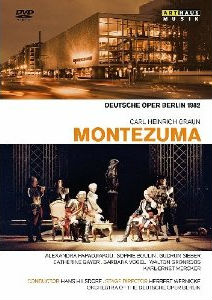
Sometime in 1753, Frederick The Great of Prussia, following a tiff with his great friend Voltaire, began writing an opera libretto in French prose that was to elucidate his ideas about the role of an enlightened monarch.
Certain contemporary opera directors have taken to portraying Wagner protagonists as visual artists to better illuminate the characters’ moral and aesthetic struggles.
Hans Neuenfels‘ new staging of Lohengrin for Bayreuth is the grimmest version of this work I’ve seen. Not that this opera is all bright lights and lollipops, but he gave us a particularly dark take on the work, motivated, in part, by Wagner’s writings at the time of the opera’s composition.
Fertilization; birth; growth; decay. Eating; digestion; defecation; fermentation; biogas recovery; food production. Wagner’s Tannhäuser is a meditation on the relentless, repetition of cycles that define our existence and man’s insistence on the possibility salvation despite all the biochemical evidence to the contrary.
Five decades before the Met turned to computer-assisted planks to help tell the story of Wagner’s Ring cycle, the company stirred controversy and comment with another staging of the tetralogy. General Manager Rudolf Bing imported a stark, abstract production from the Salzburg Festival in order to secure the services of Herbert von Karajan, who not…
A documentary about the heldentenor Max Lorenz would seem to be an ideal prism through which to examine the moral ambiguities and trade-offs of artistic life in the Third Reich. The preeminent Siegfried, Tristan and Tannhauser of the Nazi era was considered so essential to the success of Bayreuth that Winifred Wagner told Hitler that…
In the summer of 2007, at the height of the heated speculation and public debates over who would succeed Wolfgang Wagner as the head of the Bayreuth Festival, his daughter, Katharina Wagner presented a new production of Die Meistersinger von Nürnberg at the festival, replacing the mind-numbingly boring one by her father (his third at…
“Theater ohne Regie gibt es nicht – das ist ganz einfach dann lediglich Literatur.” So writes Jürgen Flimm in the Berliner Morgenpost: “Theater without direction does not exist; it is simply only literature.” UPDATE: Our Own Batty Masetto has provided a translation after the jump.
Tell us: Filth or dementia?
Hasten thee to feed another quarter of conversation for The Talk of the Town!
Sign up for our free Newsletter.
Support Parterre Box
Donate to keep opera's liveliest publication free and independent. No paywalls, no institutional backing, no bootlicking.
Get our free newsletter
Opera's top reads delivered to your email weekly…ish.
Join over 100k readers.
The best opera magazine on the web.
Reviews, breaking news, critical essays, and brainrot commentary on opera from those demented enough to love it.
Essentials
Copyright © 2026 Parterre Box.
All rights reserved.
Registration or use of this site constitutes acceptance of our Terms & Conditions and our Privacy Policy. Do Not Sell or Share My Personal Information.
Sign up for Parterre’s free newsletter.
Exclusive opera reviews, commentary, and top reads
delivered to your email weekly…ish.