
Go off, diva
Bold performances by Chiara Isotton and Asmik Griogrian at the Met prove that reports of the death of diva worship have been greatly exaggerated.
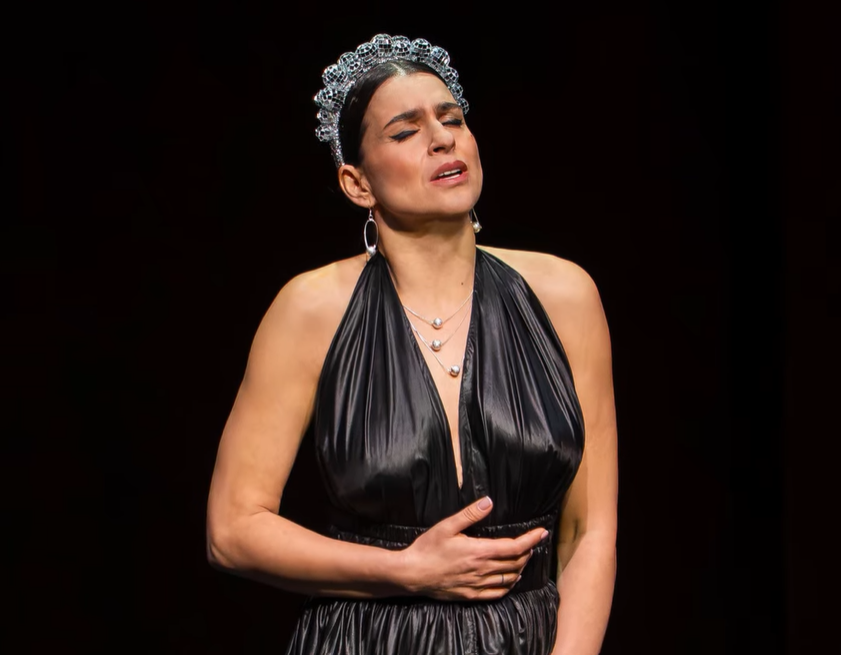
Photo courtesy of the Metropolitan Opera
In the opening sentence of Mawrdew Czgowchwz, James McCourt coins the term divadienst, a spin on Frauendienst, the name of a medieval German epic that revolves around selfless chivalric devotion to a noblewoman. McCourt’s seminal novel from 1975 depicts many over-the-top fans of the fictional title prima donna—archetypes that no doubt many of us have met in real life. The internet is filled to overflowing with fervent commenters bemoaning that opera “ain’t what it used to be” because there are no great voices today capable of casting spells that were common “back in the day.”
Recently attending both Eight Veils: Asmik Grigorian in Concert and the final performance of Cherubini’s Medea at the Metropolitan Opera prompted me to wonder if divadienst cultists might still exist. The rapt audiences at both Met events responded with long and loud ovations of the sort one doesn’t hear so often at the opera these days, suggesting that perhaps “diva worship” may not be a thing of the past after all.
Since its 1953 Florence revival starring Maria Callas, Medea has attracted many of opera’s monstres sacrés,nearly all of whom have preferred Franz Lachner’s 1855 adaptation in Italian to Médée, the composer’s 1797 French opéra-comique. While commercial recordings document the portrayals of Callas, Gwyneth Jones, and Sylvia Sass, one can also find broadcasts or pirates featuring the Medeas of Inge Borkh, Magda Olivero, Leyla Gencer, Katia Ricciarelli, Leonie Rysanek, Montserrat Caballé, and Grace Bumbry. Their appearances were likely developed as star vehicles, as the Met’s current production by Sir David McVicar was for Sondra Radvanovsky.
As she had had a major success in Berlin in the original French version, this season the Met asked Sonya Yoncheva to relearn the opera in another language with Lachner’s very nineteenth-century accompanied recitatives. To the surprise of some, Yoncheva did appear opening night and had a success, but true to form she also missed two of her six scheduled performances, ceding the role to Chiara Isotton, her cover, who had previously replaced Yoncheva as the Met’s Fedora in 2023. After the Norma mid-adventures later that year, the Met knew it needed a strong cover for Medea, so Isotton was given her own performance on November 21. The Florentine soprano had previously proven her aptitude for Cherubini/Lachner by replacing Radvanovsky for her entire run at the Canadian Opera.
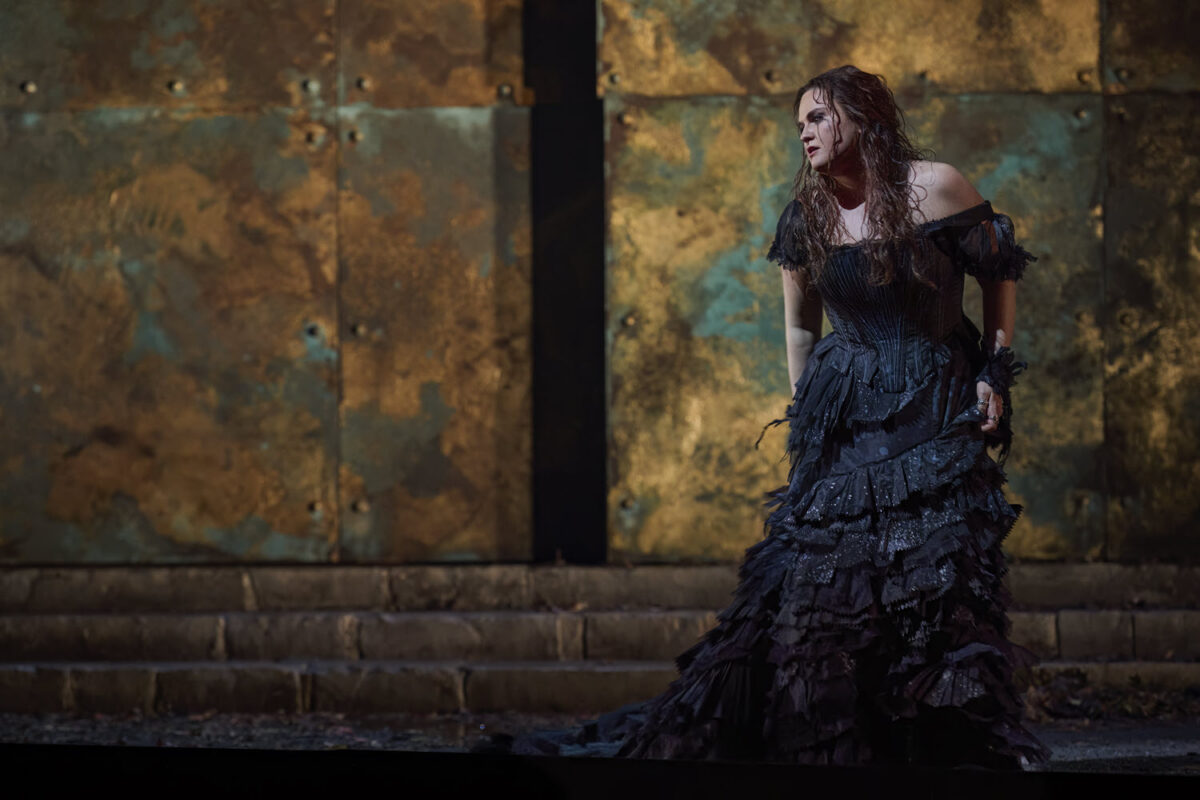
Photo: Michael Cooper, courtesy of the Canadian Opera Company
Though Isotton has sung important roles in major houses, she might not be considered a superstar that fans expect as Medea. Therefore, I wondered how her performance Saturday night would be received. When the curtain rose on Isotton alone on stage for her solo bow, she was received with as lusty an ovation as I’ve heard at the Met in recent years. But while I was left feeling grateful for her fierce commitment, to my ears she was less than ideally cast, in particular lacking the stamina for the long and demanding role. Act I’s fiercely tender “Dei tuoi figli la madre,” the opera’s best-known excerpt, found Isotton in command but as the evening progressed she tired, the voice thinned out, and she threw herself about the McVicar staging with flagging vigor.
A quick glance at Isotton’s repertoire reveals that she’s most often cast in verismo roles with such rarities as Respighi’s La Fiamma and Smareglia’s Nozze Istriane on this season’s calendar. Her gutsy approach, pungent chest register, and erratically searing high notes would seem less suited for classical Cherubini than for those operas along with the numerous Puccini roles she sings: Minnie, Tosca, Giorgetta, and Manon.
And yet many in the audience were clearly transfixed: she was giving the kind of “leaving blood (and sweat) on the stage” sort of performance that opera fans clearly still hunger for. I imagine Isotton, clearly moved by the strong ovation from an audience who bought tickets to see her (unlike her earlier two fill-in Medea performances), had acquired a healthy number of new fans.
However, the ovation that greeted Asmik Grigorian and accompanists Petras Geniušas and Lukas Geniušas after Eight Veils was of a very different order. As the final notes of Strauss’s Salome still echoed, the stage lights went out, and a ferocious roar and near-unanimous standing ovation exploded the likes of which I’ve never been a part of at the Met. For eighty-or-so minutes the three had woven together eight arias and a myriad of musical allusions (including many to Salome) in a completely absorbing, utterly unexpected way. While I might quibble about this or that aspect of the evening, an important opera figure later commented that it was the greatest evening they had experienced in decades of attending the Met. While I might not go that far, I will say that it was an essential, unforgettable journey which luckily was streamed worldwide.
Performing nearly all (I’ll have more to say about that) of eight exceptionally challenging arias in a single recital might be the stuff of legend, but it’s not entirely without precedent. When Jessye Norman died in 2019, I posted on this site a broadcast of a similarly astounding concert by the late soprano during which she performed a Mozart concert aria, Ravel’s Shéhérazade, Berlioz’s La Mort de Cléopâtre and Wagner’s Wesendonck Lieder, concluding with the Liebestod from Tristan und Isolde! It was inevitable that such a tour-de-force would remind those of us who may still subscribe to divadienst of Eleanor Steber’s magnificent 1958 Carnegie Hall recital (excerpts once available on a VAI CD), surely the model of the utopian recital given by Mawrdew Czgowchwz in which her seven song cycles elicited seventeen encores!
But neither Norman nor Steber nor even Czgowchwz ever attempted what Grigorian presented at the Met. Eight Veils wasn’t about an artist showing her stuff while making lots of entrances and exits. Grigorian arrived with her accompanists and planted herself between the two pianos and scarcely moved until the end (except for a short, well-deserved break for water). She was clad in a voluminous dark grey gown and crowned with a mirrored tiara that occasionally caught the light and its resulting bright reflection for a split second blinded me once or twice.
Before they entered, Peter Gelb, microphone in hand, warned the audience not to applaud until the entire recital was over, but his message was scarcely needed, as Eight Veils proved so fascinatingly seamless that there really wasn’t a moment when applause might have happened. The ongoing, unpredictable interaction between the vocal and the bravura instrumental devised by the artists did mean that several of the arias were truncated, a decision that resulted in no little frustration. The most jarring example occurred when the climax to “Un bel dì” suddenly burst forth nearly an hour after the aria began!
Grigorian is such a mesmerizing artist that I would wave away objections that she didn’t do enough to differentiate Rusalka from Cio-Cio-San or Turandot from Lady Macbeth. Her richly dark soprano, in prime condition and secure from earthy lows to powerful—if not always effortless—highs, shirked nothing as she intensely traversed this involving tour of her recent career highlights, which concluded with the entire final scene of Salome, the work which was Grigorian’s international breakthrough in 2018. Gestures appeared quite sparingly as she mostly kept her arms at her sides. Her concentration broke only once as one of her silver stilettos must have gotten tangled in the folds of her gown, causing her to briefly lose her balance, but she recovered and flashed a brief smile.
Of the eight, I found her “Tu che le vanità” the most interesting and moving excerpt, as she invested Elisabetta’s ruminations with a powerfully wistful yearning; her floated “Francia!” was a particularly ravishing moment. While Grigorian’s voice might not be labeled conventionally “beautiful,” it can convey a kaleidoscope of emotions best experienced in staged performances like the ones I’ve attended of Salome, Madama Butterfly and Eugene Onegin.
When I discovered that Eight Veils was to be a single continuous movement, it seemed unlikely an encore would be offered. However, I did think that if there was to be one, it might be the “Habanera,” as it would be a surefire crowd-pleaser and the title role of Carmen was her most recent success at the Salzburg Festival. However, she slyly introduced another encore chestnut, “O mio babino caro” from Gianni Schicchi, an opera she has performed in a complete Il Trittico in Salzburg and Paris.
Eight Veils was a supremely well-prepared world premiere that doesn’t appear again on her schedule this season. Jenufa (which I haven’t seen yet) runs until early December, and rumors have swirled that Grigorian will soon bring her Salome to the Met in the Claus Guth staging she’s already performed in Moscow. Reports have also suggested that she will take on Isolde at the 2029 Bayreuth Festival opposite Michael Spyres.
Because of my rather idiosyncratic, Catholic tastes in opera, I never thought of myself as a card-carrying divadienst cult-member, but this past week proved once and for all that I must be.

Christopher Corwin
Christopher Corwin began writing for parterre box in 2011 under the pen name “DeCaffarrelli.” His work has also appeared in , The New York Times, Musical America, The Observer, San Francisco Classical Voice and BAMNotes. Like many, he came to opera via the Saturday Met Opera broadcasts which he began listening to at age 11. His particular enthusiasm is 17th and 18th century opera. Since 2015 he has curated the weekly podcast Trove Thursday on parterre box presenting live recordings.
Comments