
Moravian mishegoss
The Metropolitan Opera presents a psychologically powerful Jenůfa— and a murky stew of inherited trauma to take us into the holiday season.
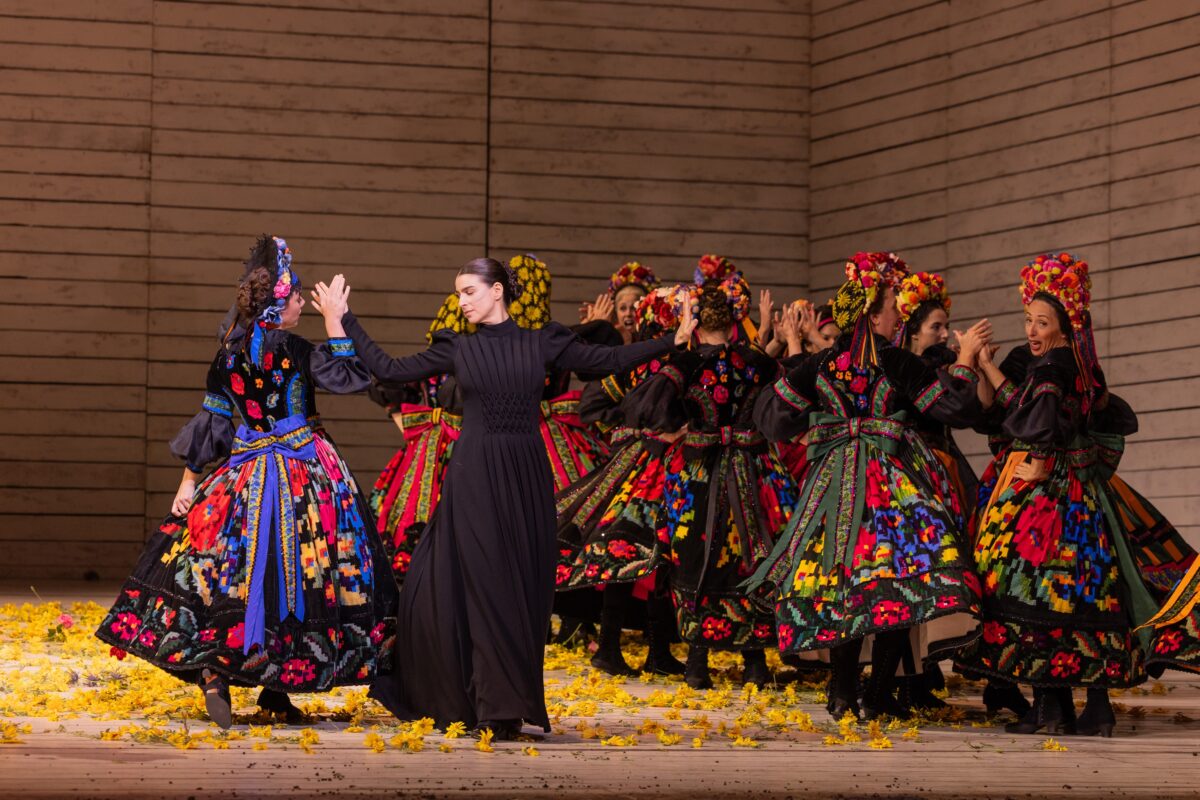
Photo: Evan Zimmerman
As the curtain went down on the first act of the Metropolitan Opera’s new production of Leos Janáček’s Jenůfa, I was on the edge of my seat, but I couldn’t pinpoint why. To be sure, the score is gorgeous, and Tomáš Hanus’s conducting was brisk and cinematic. The performances were strong but didn’t exactly send you sprawling on the floor in a state of elation. The gray-on-gray industrial, institutional set was edgy but not all that interesting to look at. It wasn’t until the end of Act II that I realized what made this production of Jenůfa so good—its pacing. It was psychologically dynamic in a manner that I associate more with novels than with opera. By Act III, we’re no longer in the same galaxy as traditional tragic opera. As we await the wedding of Laca and Jenůfa we’ve moved from Strauss to Tolstoy. As a story of family trauma, it is layered and literary and contains sophisticated and modern psychological articulation.
The key to Jenůfa’s psychological realism is the relationship between Jenůfa and her stepmother, Kostelnička Buryja. Its focus on the mother-daughter dynamic, rather than between the lead and her two beaus, creates an opening for raw and primal feeling that even tragic romantic love can’t touch. From Medea to Herodias, opera is full of bad mothers, but rarely is a toxic mother-daughter dynamic expressed with such artistry and ruthlessness. The Kostelnička (Czech for sextoness) is deeply sympathetic, and Nina Stemme’s performance with its rich Wagnerian lamentations is heartrending as she convinces herself that the best way to save her stepdaughter is to murder her grandson. Asmik Grigorian gave an excellent and athletic performance in the title role. Her voice has a strong core and clarion innocence that suited the role and complemented Stemme’s richer saturation. Onstage constantly in all three acts, however, she is overstretched and poorly blocked. The spare industrial set gives her too much space to fill with her voice and presence, and the director misuses her tremendous dramatic skills.
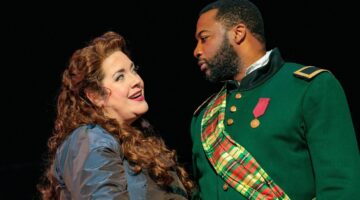
Sean Panikkar, performing as Laca, gave one of the standout performances of the night. From sloppy adolescent miscreant in Act I to reformed and repentant lover by Act III, he took to the role with whimsy and dynamism. His voice has subtle charms, and his acting was swift and fluid. Ryan Capozzo, as Števa, was similarly wily and puckish—the happy village dirtbag who captures ladies’ hearts and then sets them on fire. Števa and Laca are presented as very real and recognizable male archetypes, and the talk at intermission was all about how this was an opera about toxic masculinity.By Act III, however, a penitent Laca is transformed, and the opera is revealed to be a story about inherited trauma, from mother to daughter, from father to son. It offers a much subtler analysis on the harm that patriarchy causes than you’ll find in Verdi or Puccini.
The mayor, performed by Kevin Short, as well as his wife, performed by Eve Gigliotti, and daughter, Karolka, performed by Cadie J. Bryan, were a happy family foil to the miserable Buryjas. The parts were all well sung, and they collectively pierce the fog of the Buryja family’s trauma with color, brightness, and sanity. Elena Zaremba as Grandmother Buryja, whose dead sons begat the horrors we witness among their progeny, is appropriately wiry, the human equivalent of the black raven that poises menacingly atop Jenůfa’s prison.
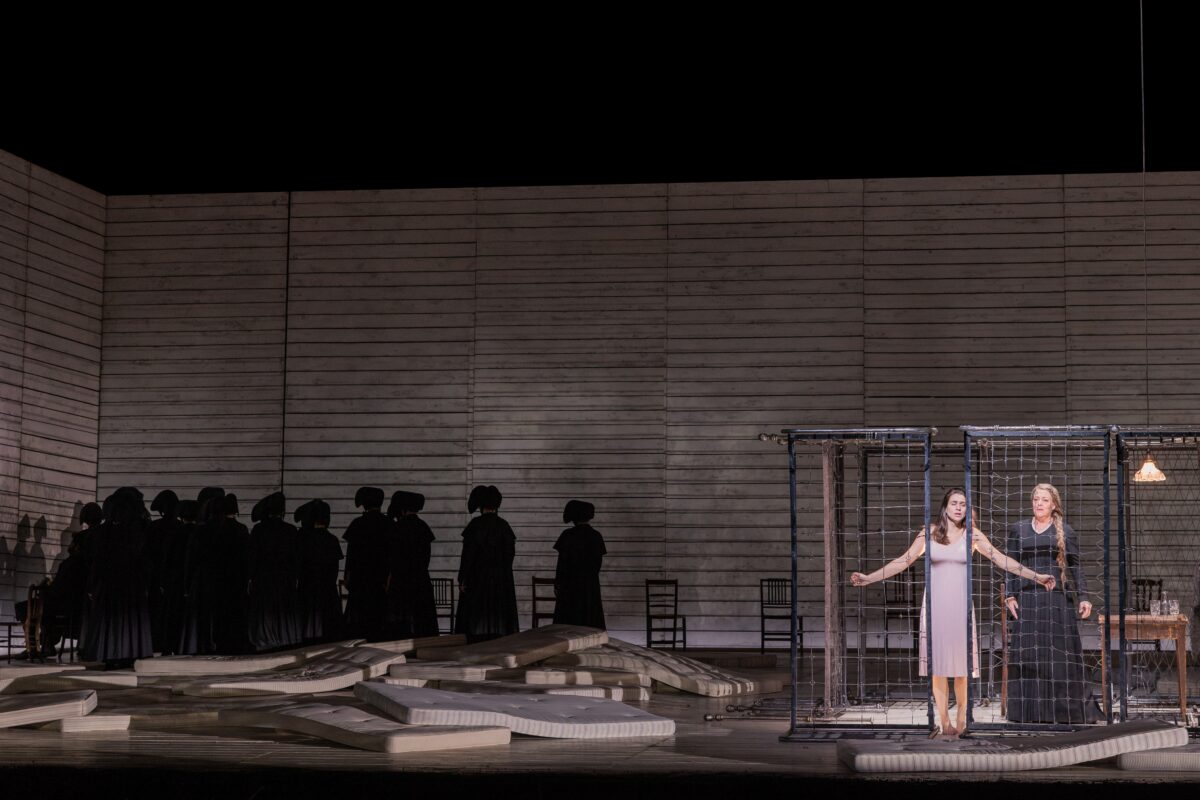
Photo: Evan Zimmerman
The vast, grim set gets strewn with yellow flowers in Act III to point to the coming spring and the thaw that will reveal Jenůfa’s dead child. While effective at the show’s climax, the design felt drab and pedantic in Acts I and II. The Claus Guth production, with a set design by Michael Levine, engages in some on-the-nose symbolism. Baby baskets are poised beside the industrial bedsteads, which transform into a cage for Jenůfa in Act II, with mattresses strewn around it like barricades. The obviousness of the symbolism made me feel as if a complete stranger, for their own baffling reasons, was talking down to me. While there is nothing wrong with stating things plainly, and plenty of theatrical design errs on the side of too much subtlety, the set—particularly the repeated use of the bedsteads—is ugly, and does far less work at highlighting the action than it’s intended to.
The pace of the score and the finesse of Tomáš Hanus’s conducting held this wild and busy opera in its warm grasp. While written in prose and lacking traditional standalone arias, Jenůfa is theatrically as sexy and dynamic as Tosca. Its orchestration is interesting, complex, and beautiful, and in the rare dull moments in the drama, it leaps to fill in the empty spaces. This production put Janáček on the map for me as a thrilling and fast-paced opera composer. It points to how many very fine works in the canon get passed over and ignored in favor of big-name favorites.
-
People: Asmik Grigorian, Cadie J. Bryan, Claus Guth, Elena Zaremba, Eve Gigliotti, Kevin Short, Michael Levine, Nina Stemme, Ryan Capozzo, Sean Panikkar, Tomáš Hanus
-
Works: Jenufa
-
Places & Organizations: Metropolitan Opera
Comments