
The trolley problem
At Boston Lyric Opera, a hardworking cast can’t make magic of André Previn’s disenchanting adaptation of A Streetcar Named Desire.
 By
Harry Rose
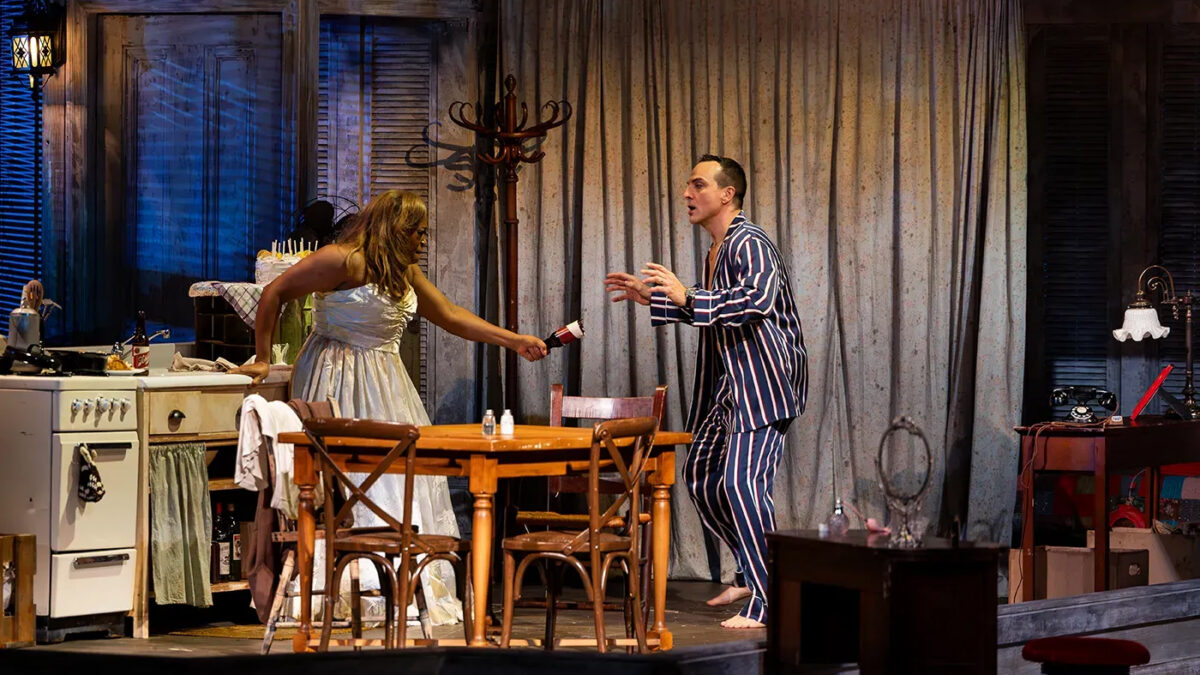
Brittany Renee and David Adam Moore in A Streetcar Named Desire at Boston Lyric Opera /Photo: Nile Hawver/Nile Scott Studios
A Streetcar Named Desire has come loose and is barreling uncontrolled down a track towards a well-meaning cast of singers and production team. But! You have a lever that you can pull that will divert the tram onto another track where Tennessee Williams is lashed to the railroad ties. What will you do? Leave the author intact while obliterating the possibility of an opera, or mangle the playwright at the expense of artists who will never be able to escape his ghost?
We know the decision André Previn made when adapting the play for San Francisco Opera in 1998. Tennessee Williams’s most famous play is dense, lyrical, and rhythmic. At its center, the southern belle in extremis, Blanche DuBois, plums depths of manipulative self-delusion that rival Nathan Fielder’s recent depiction of Elizabeth Holmes. The enigma of Blanche—an enigma that seeps out from the main character to color her entire surroundings—is in how we can both be so thoroughly subjected to the hyperrealistic minutiae of a person’s life while at the same time feeling like we are not getting much (or most or any) of the real story.
Previn’s score proves the futility of working within that narrow and stereotypical conception of opera as a ‘turning to music when words fail.’ If the words are already failing the characters—or working so well that they completely obscure them—then what does music have to add? In the case of Previn’s Streetcar, just three hours of awkward, atmosphere-less languor. Instead of insight, we get screeching streetcar noises. Instead of ambience, we get plodding recitative nudged dutifully along by Daniela Candillari‘s conducting.
Considered, then, on a basis of effort versus reward, the role of Blanche in the opera becomes a surprisingly thankless one. Brittany Renee threw herself in wholeheartedly, giving a highly committed and very physical performance in a part that has her onstage for about 90% of the opera’s three hours. Her Blanche came most alive in her moments of reverie, like during the best-for-last monologue “I want magic,” while the longer conversational passages (including Blanche’s overwrought monologue about her first husband and the agonizingly boring seduction scene between her and her suitor, Mitch—certainly more Previn’s fault than the soprano’s) were wanting for charisma. Previn ascribes most of the lyrical singing in his opera to Blanche’s earnest if put-upon sister Stella (here a stretched but sympathetic Angela Yam), while Blanche has to scrounge around for swigs of legato and seems not just unmoored from, but completely alien to, the musical realm of her sister.
David Adam Moore, as Stella’s brutish husband, Stanley, whose clash with Blanche’s papier-mâiché gentility leads to Blanche’s breakdown, matched Renée, his singing unflaggingly steady if monochromatic baritone and his presence a bit more refined than savage. Brenton Ryan as Blanche’s suitor Mitch, a more genteel foil to Stanley, was charming and sang with a more weighty tenor than I was used to hearing from him. Erika Brookhyser was in brassy voice as Eunice, the no-nonsense upstairs neighbor, while David J. Castillo brought a noteworthy assuredness as the Doctor who escorts Blanche to the asylum in the opera’s final scene.
In her production that first debuted last summer at Opera Theatre of St. Louis, soprano-turned-director Patricia Racette makes no major interventions into the opera’s wan dramaturgy and her staging moves cleanly if unspontaneously. Mostly confined to a lightly cluttered, elevated platform in the middle of the stage, the characters ambled ceaselessly between the claustrophobic apartments two rooms. The production made a somewhat gratuitous use of projections (by Kylee Loera), even during the graphically staged rape of Blanche by her brother-in-law. It’s hard to imagine Previn’s music inspiring a director beyond Williams’s own copious stage directions, but the shadowy lighting by Eric Southern proved an evocative touch.
It’s nice to see regional American opera companies finally working in a coordinated way to bring productions of new or recent American operas to audiences across the country. (Omar and El último sueño de Frida y Diego are other strong examples.) But when it comes to Previn’s Streetcar, it ought to be time to pull the brakes.
Harry Rose
Harry Rose, based in Providence, Rhode Island, is currently pursuing a PhD in Italian Studies at Brown University. Starting out blogging independently as Opera Teen in 2013, he holds the auspicious distinction of being the youngest writer to ever contribute to parterre box (at age 14) and has had the pleasure and challenge of writing for the rigorously discerning cher public since 2012. Increasingly niche hobbies and interests include opera, ballet, theatrical goings-on of the fin-de-siècle, and gatekeeping Camp.
-
Topics: boston lyric opera, Review
-
People: Angela Yam, Brenton Ryan, Brittany Renee, David Adam Moore, David J. Castillo, Eric Southern, Erika Brookhyser, Kylee Loera, Patricia Racette
-
Works: A Streetcar Named Desire
-
Places & Organizations: Boston Lyric Opera

Comments