Fifty percent illusion
Opera Theatre of Saint Louis does its best to give magic in its summer productions of Roméo et Juliette and A Streetcar Named Desired.
 By
Elaine Yao
By
Elaine Yao
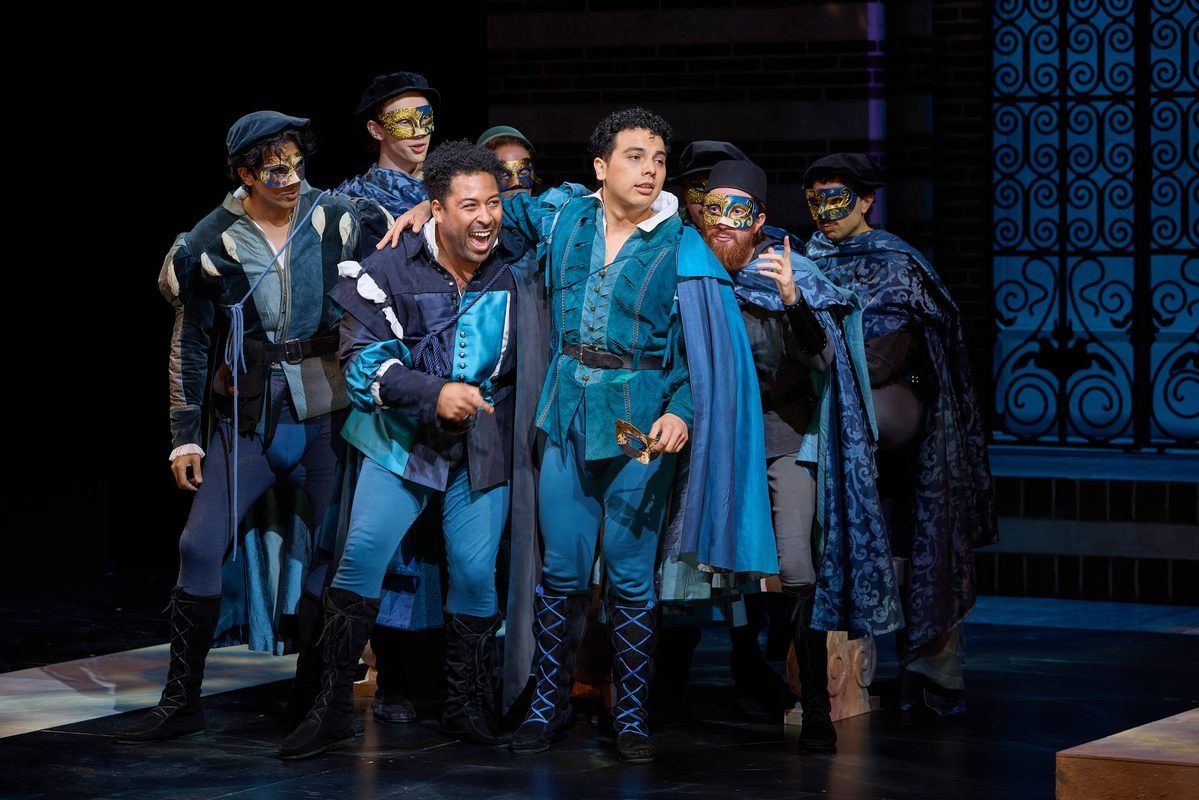
Photo: Eric Woolsey
We’re solidly in festival season, so I hope this message finds you well at Glyndebourne, Santa Fe, or Salzburg – and allow me to fill you in on what’s been going on at Opera Theatre of Saint Louis. Amidst the long days and champagne corks, festival presentations come with their own opportunities and constraints. Stripped of big-house resources and polish (OTSL performs indoors, but there was nary a proscenium nor curtain in sight), these productions are necessarily economical. This can be fun, and clarifying – the choices made reveal what directors, singers, and conductors think an opera can and can’t do without. And if the results are sometimes uneven, the unevenness is instructive about qualities a plusher production might have padded over.
There was food for thought in the choices, too. The festival also offered a musical and an operetta (which I’m unequipped to comment upon), but the two operas proper weren’t pure fizzy festival fare. Gounod‘s lush Roméo et Juliette is easy on the ears, true, but André Previn‘s bracingly modern A Streetcar Named Desire, for all the familiarity of its title, was an artistic risk. There are some similarities between the choices: both are adapted from plays and suited to spare staging. But their philosophies of adaptation couldn’t be more different – Roméo‘s librettists ruthlessly streamlined and paraphrased Shakespeare, while Phillip Littell‘s Streetcar libretto preserves nearly every word Tennessee Williams wrote, and the results differ accordingly.
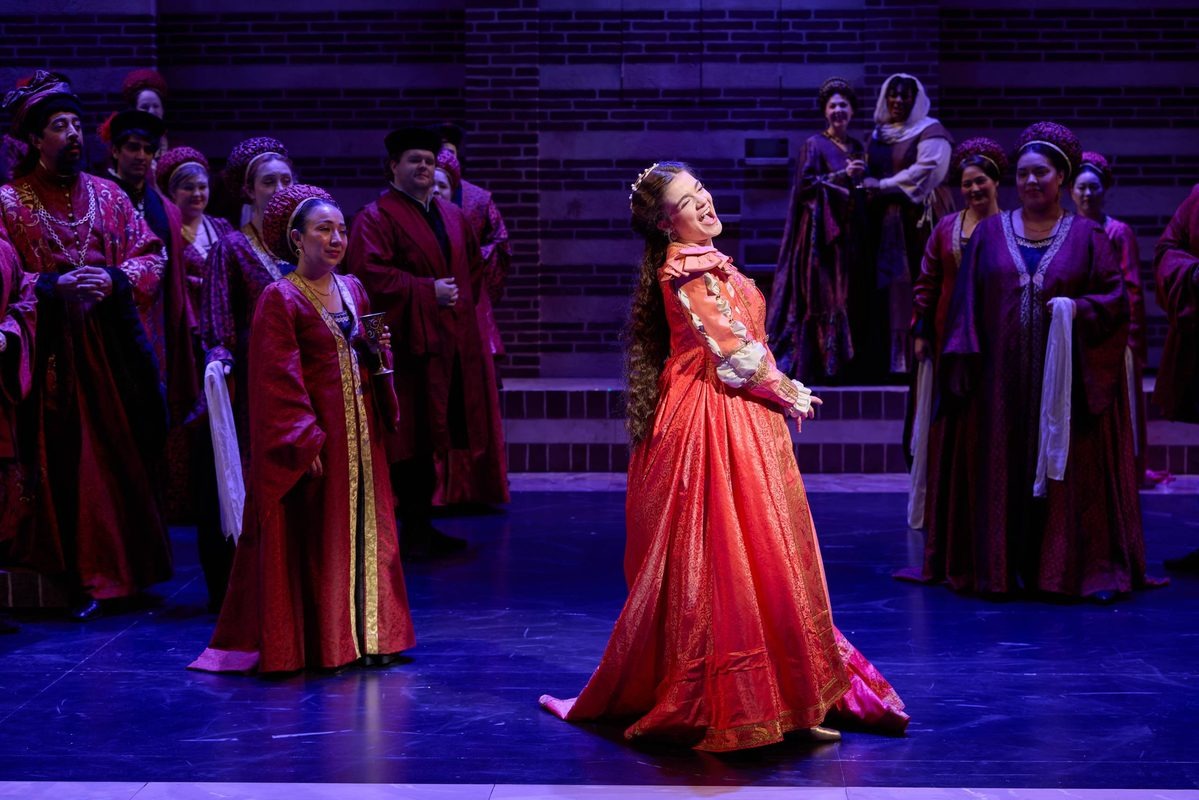
Photo: Eric Woolsey
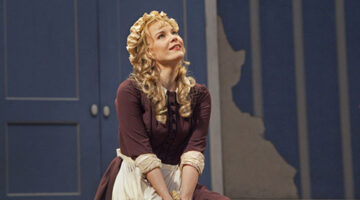
Allow me to begin with the more familiar work. I was, on the whole, impressed with the cast of Roméo, and most of all with Emma Marhefka, who made for a congenial Juliette and perhaps the most complete young singer I heard at the festival. Marhefka dispatched Juliette’s coloratura with security and ease, and her luminous sound remained even throughout her range and across a wide variety of dynamic shadings and colors. Every phrase felt intelligently considered: Within Gounod’s long lines, she located Juliette’s girlish excitement, trembling self-doubt, and increasingly absolute faith in love. The physical characterization seemed more in-progress, and it will be exciting to watch her put her individual stamp on the character over time. Hers is a precocious voice, with time and room to grow.
As a side note: Given how at home in French lyric repertoire Marhefka sounded, I do hope that the next time I hear her sing Juliette, it is actually in French: OTSL has projected supertitles but does all of its productions in English, which I felt to be a minor aural crime here.
The logic of casting Leonardo Sánchez as a romantic lead was clear from the outset. His warm tenor naturally inclines toward ardent passion; I detected hints of an early Juan Diego Flórez. But the fit with this particular role was not quite as seamless: the English text emerged with a Spanish accent, while the French score took on a distinctly Italianate inflection, resulting in an amusingly cosmopolitan quality. The form of ardor he offered was often more martial than dreamlike – had we slipped into “Manrico y Juliette”? He was most convincing when Romeo’s passion turned toward physical violence in the confrontation with Tybalt, but not quite able to find the hushed, almost inward sound befitting Romeo’s more worshipful moments. “Ah! lève-toi, soleil!” was delivered almost entirely at full voice; when Sánchez tried to temper the sound toward mezza voce, the result seemed uneven and uncomfortable, and he quickly returned to full cry.
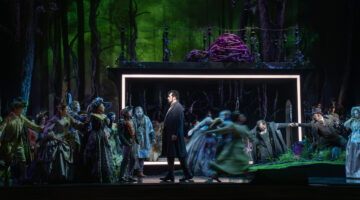
Which is a bit of a pity, because this opera lives in a crepuscular world. Recalling the suspended erotic world of Tristan, its center is a love scene in which time and the daylit world linger only at the edges, while the lovers ascend to a nocturnal, symbolic realm conjured by the orchestra and their interweaving voices. Because that world is made almost entirely of sound, it asks little of the stage. Fittingly, the sets (by Liliana Duque Piñeiro) were minimal but serviceable, relying on the standard color-coded Renaissance garb (Robert Perdziola) and a few moving pillars to evoke the party hall, bedroom, church, and crypt.
There was good work elsewhere as well. The chorus performed with commitment, diction, and dynamic range. Veronica Siebert got well-earned cheers for her turn in the trouser role of Stéphano, in which she expertly tossed off trills and triplets with a limber tone. Nicholas Newton was a steady vocal presence as Friar Lawrence, Micah Perry brought style (and stylish sword fighting) to Tybalt, Benjamin Taylor gave Mercutio affability and ample volume, and Cole Bellamy unleashed a huge, resonant sound in Paris’ few lines.
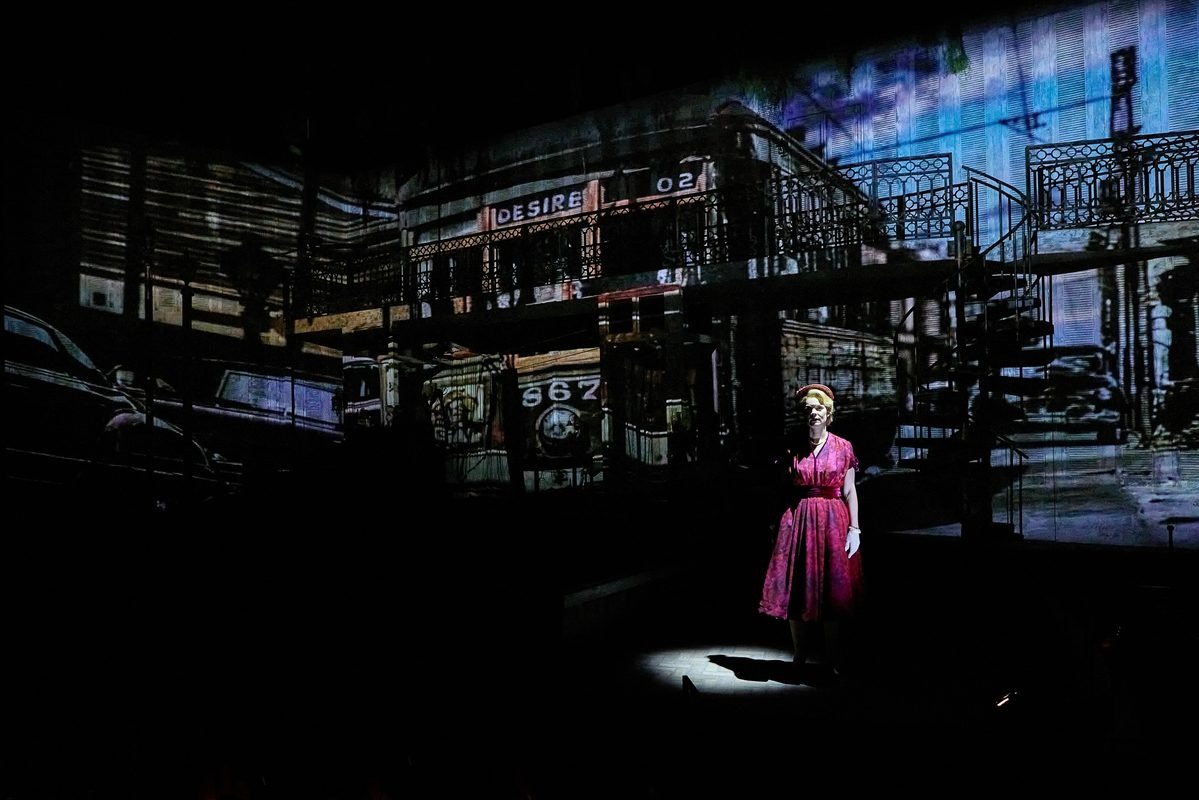
Photo: Eric Woolsey
Now, as we move on, a caveat: I was completely new to A Streetcar Named Desire (I haven’t even seen the Marlon Brando movie!) My first impression of Previn’s opera was primarily of an adaptation determined to preserve as much of its source text as possible. This sense of obsessive studiousness was mirrored by the set (by Andrew Boyce), which conveyed the Kowalskis’ apartment in meticulous, mundane detail. It made for a coherent, gritty, and oppressively crowded piece of theatre – with some music running underneath it.
But not unobtrusive music: Previn’s score is hyperactive. It has garnered praise for its musical fluency, and yes, it’s all there: Shostakovich’s bitter sarcasm, Stravinsky’s rhythmic propulsion, Barber’s ambivalently tonal lyricism, the ache of the blues, and more, all threaded together seemingly without pause. The orchestra, conducted by Daniela Candillari, jazzed, jangled, oozed, and grated accordingly. With so much text to deliver, the vocal lines had little time to settle. The net effect was like being on an old train rattling forward at high speed: constantly jostling, always moving forward, and rarely pausing long enough to absorb the passing landscape. Intermission felt like a much-needed gulp of fresh air; by the second half I had developed a minor headache, and whether it was from the dread of watching the tragedy grind toward its inevitable conclusion, or the relentlessness of words and music talking over one another, I could not say.
The agitation was uncomfortable, but I’ll admit that it was not meaningless. From the start, the score wants to tell us that violence is seething beneath the apartment’s ordinary surface – amidst the drinking, flirting, and quarreling, a crime is about to take place. Heightening the sense of dread, the production (directed by Patricia Racette) opened with black-and-white projections (by Kylee Loera) that had a Hitchcockian cast. This was the French Quarter à la LA noir. The use of projections paid off later: In the scene of Blanche’s assault, the onstage action froze, and most of the violence was conveyed through a black-and-white montage of her screaming face. The musical premonition of crime was finally realized.
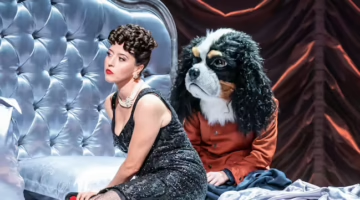
Sara Gartland‘s Hitchcock-blonde Blanche was the visual and dramatic center of the production, and she performed with commitment. Her perfect 50s coiffure and rapidly rotating wardrobe of full-skirted silhouettes, combined with an assertive vocal attack, produced an effect resembling Lady Macbeth of Mtsensk in the guise of Betty Draper. Both vocally and physically, Gartland gave us plenty of Blanche’s armor – all lacquered curls and brassy sound – but not quite enough of the softness, shimmer, and magic of the inner world that Blanche’s arias describe. We saw only very late what the armor was hiding: namely, that Blanche’s frivolity and affectations were the improvised defenses of a fragile, romanticizing mind trying to forestall its own collapse.
Lauren Snouffer‘s Stella was the voice I most wanted to keep hearing. Stella’s music – gentler and more openly full of longing and self-contradiction – felt like the soul of the evening. Snouffer brought out the score’s lyricism, and made legible her character’s complicated mixture of sensuality, resignation, and powerlessness. Her humming at the end of Act I was gorgeously eerie, while she conjured the requisite uncomfortable combination of erotic charge and childlike sorrow in “I can hardly stand it.” If her body sometimes seemed uncertain how to hold more than the downtrodden girl, her singing stayed true.
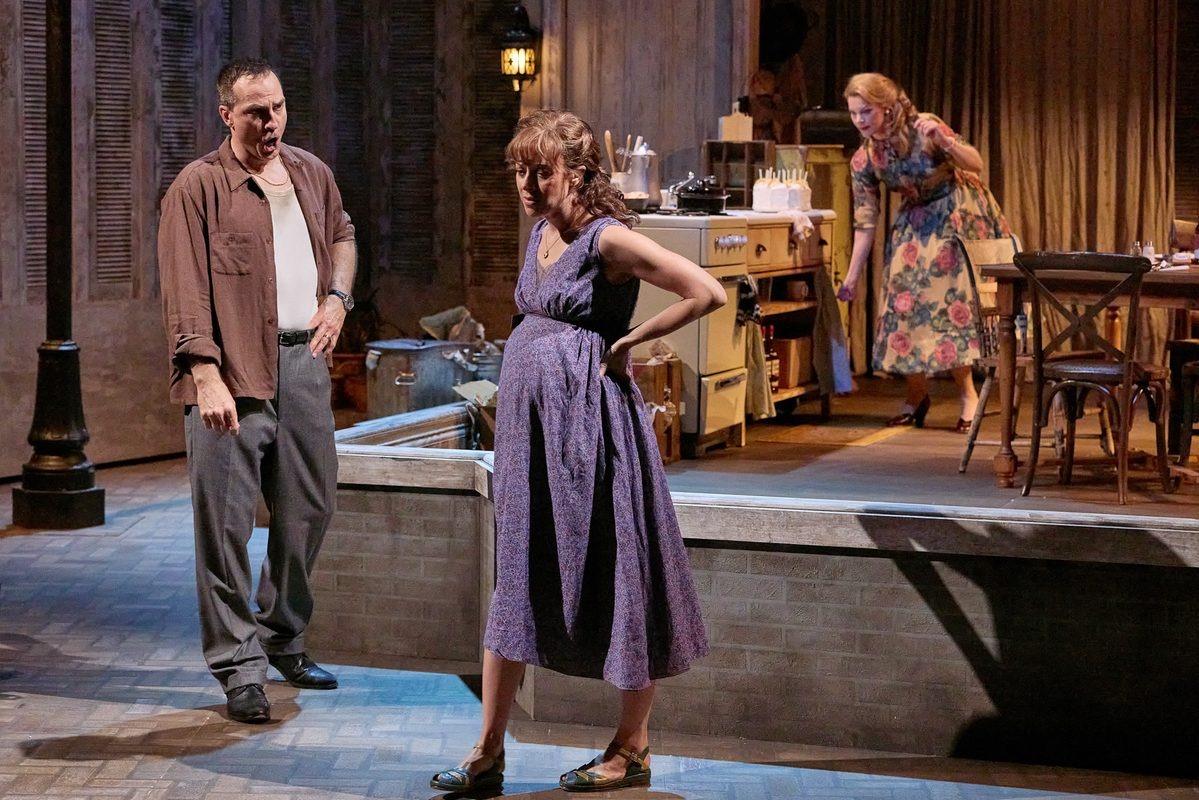
David Adam Moore sang Stanley with veteran assurance, delivering perhaps the most fully three-dimensional characterization of the main trio. His handsome baritone and impressive physicality worked together to produce a man who was brutal, menacing, and despicable, but also recognizably pitiable, and increasingly consumed by the toxic churn of humiliation, self-loathing, and fear of powerlessness inside.
Moore’s scenes with Snouffer were the most striking. Stella might need Stanley, but Moore made clear that Stanley genuinely needed Stella to need him: Her dependence was the proof of his strength, propping up his fragile authority. They appeared as two wounded people clinging to one another, his bigness and her smallness only making the way their bodies crumpled together more affecting. By the end, the listener could accept how completely each relied upon the other to maintain the fiction of their life together. Stella’s final choice was unforgivable, but understandable: Like Blanche, she chooses fiction over reality.
Rounding out the cast, Bille Bruley made a bright and eager Mitch whose naïveté curdled believably into disgust after revelations of Blanche’s history. Ashlyn Brown‘s world-weary Eunice provided a strong, anchoring mezzo presence.
Still, three taxing hours of scarcely-relieved foreboding are hard to stomach. You cannot save these people from themselves, and Previn’s score makes you feel the walls of tragedy closing in on them with inexorable force. But the walls here seem more vividly drawn than the people trapped inside them. With so much instability and danger ringing like alarm bells, the quieter notes of humanity – the poignant reminders of Belle Reve, sisterly care, and wounded trust – were unavoidably drowned out, until too late. It was only when tragedy had arrived, and the score had nothing left to warn against, that we could finally, with some relief, grieve.
Elaine Yao
Elaine Yao is Assistant Professor of Political Science at Washington University in St. Louis. Formerly a PhD student permanently marooned on NJ Transit en route to the Met, she spent years playing Baroque violin badly enough to love it and well enough to know better. Her musical interests remain divided between the 17th century and the paroxysms of modernity.
-
People: André Previn, Andrew Boyce, Ashlyn Brown, Benjamin Taylor, Bille Bruley, Cole Bellamy, Daniela Candillari, David Adam Moore, Emma Marhefka, Kylee Loera, Lauren Snouffer, Leonardo Sánchez, Liliana Duque Piñeiro, Micah Perry, Nicholas Newton, Patricia Racette, Robert Perdziola, Sara Gartland, Veronica Siebert
-
Works: A Streetcar Named Desire, A Streetcar Named Desire (Williams), Roméo et Juliette
-
Places & Organizations: Opera Theatre of St. Louis