Mary, Mary, quite contrary
Thea Musgrave’s Mary, Queen of Scots could learn to lighten up.
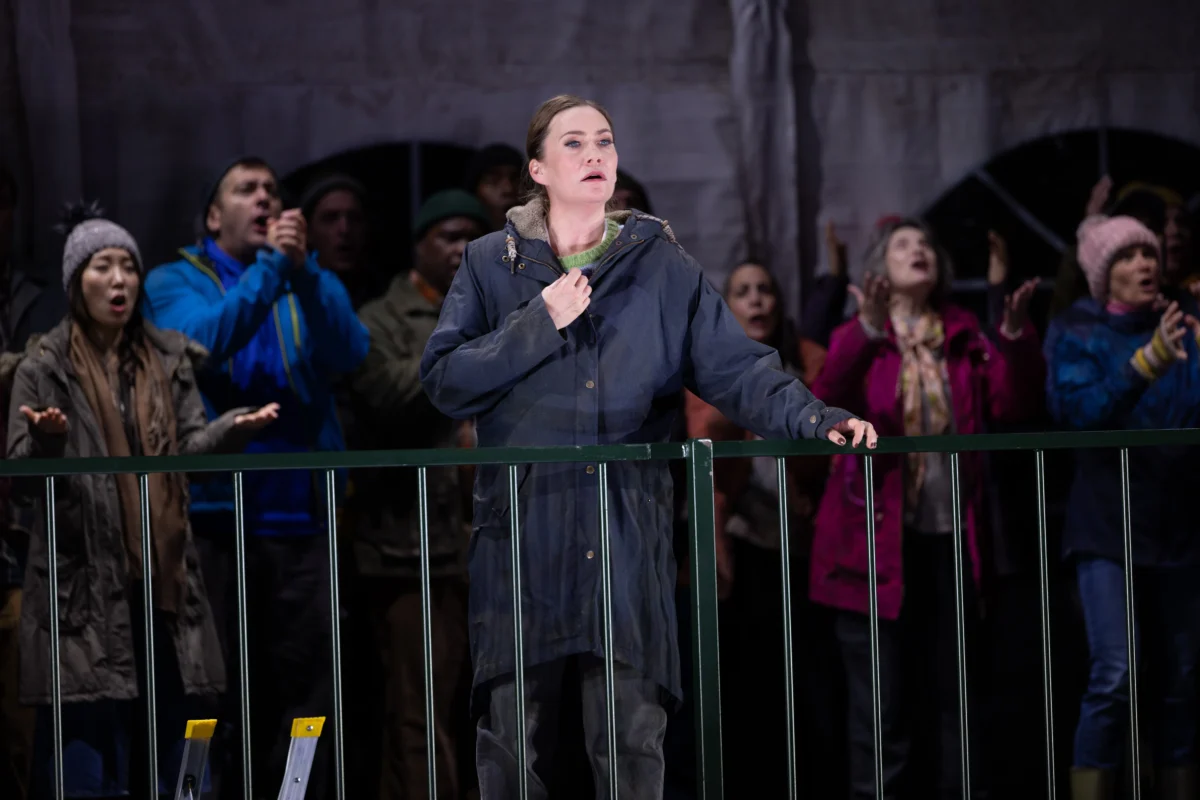
Photo: Matthew Washburn
The Scottish composer Thea Musgrave’s opera Mary, Queen of Scots is important. It is one of a select group of operas by female composers to be presented anywhere. It depicts the life of one of the most important figures in Scottish history. It represents a move away from the strict academic atonality of the mid-20th century, embracing folk music and traditional song.
In Musgrave’s score and in Stewart Laing’s production for San Francisco Opera (in a co-production with English National Opera) every moment is of vital importance. And the opera wears that importance like the ruff Mary may have worn around her neck.
That import weighs down the opera and the production. Counterintuitive as this may seem, Musgrave’s forceful and blunt score does not need a relentlessly forceful and blunt production. An opera like Mary, Queen of Scots needs room to breathe.
Mary, Queen of Scots is the second work of San Francisco Opera’s 104th season. Its opening was delayed due to the San Francisco Opera orchestra strike (I caught the second performance of the run). The opera had its world premiere at Scottish Opera in 1977 and was previously seen at San Francisco Opera as part of its Spring Opera Theatre season in 1979. 47 years later, it’s making its mainstage debut at the War Memorial Opera House.
When the company’s general director Matthew Shilvock began his tenure a decade ago, he said in an interview with WQXR that large opera companies like San Francisco Opera “must be cautiously experimental rather than wantonly so.” I would consider opening a season with two bleak political meditations on the corrosive effects of power to be cautiously experimental.
While Simon Boccanegra teases with Italianate tunefulness and Mary, Queen of Scots with the court intrigue we’ve come to love in the series we binge-watch, neither opera delivers what we hope. Verdi is tuneful, but we spend more time watching the title character agonize about the politics of the personal. Musgrave offers intrigue but she undercuts the voyeurism with brutality and violence. But Verdi understands something about an opera that has an important message: not everything needs to be important.
Musgrave’s score is relentlessly portentous. Scottish airs and Tudor dance tunes provide some short breaks from the gloom. For the most part, horns and winds crackle and prickle while strings zip up and down the staff or congeal in the underscoring to the political intrigue. Musgrave has said in interviews that she views Mary not as a rarified princess but as a flesh-and-blood woman beset by a hostile culture. And that hostility comes through, but in a studious way. Musgrave wrote the opera while on the music faculty at the University of California, Santa Barbara, and it has the feel of a master’s thesis.
There are moments of harmonic richness that would be the envy of any composer, A scene at a court ball at Holyrood Castle finds Musgrave brilliantly juxtaposing Tudor dance with an anxious postmodern romanticism. Her music is most compelling when she does that layering of one musical idiom onto another, because it perfectly captures Mary Stuart’s double lives: French and Scottish, politically agile and politically tone-deaf, wife and monarch, chosen by God and rejected by the patriarchy.
Yet so much of the music draws attention to its own music-ness, its own earnest construction. The greats knew when to write a dispensable ditty. We need to get a bit of space to take in what’s happening; Musgrave rarely grants us that space.
Conductor Clelia Cafiero offered one of the most impressive house debuts I can remember at the podium, eliciting flawless playing from the San Francisco Opera Orchestra. Cafiero negotiated the bigness of the score without succumbing to it. I’m not sure how to describe it, but she had a firm hand while also seeming to have a lightness of touch. To Musgrave’s credit, there are significant stretches where she pushes the music and the narrative forward at such a clip, that we can believe that Mary could find herself bumrushed by fate. Cafiero knew when to take the cue from Musgrave and her conducting can truly be said to have aided the drama instead of merely moving it along. The opening bars, which contain both the pomp and interiority of the drama, are a perfect metaphor for Cafiero being able to walk a fine line between giving moments their due and knowing when to move things along.
The San Francisco Opera Chorus, under the direction of John Keene, rose to the occasion. As was the case the night before in Simon Boccanegra, the chorus has never sounded better, bringing tonal richness to Musgrave’s score — at turns haunting, at turns menacing.
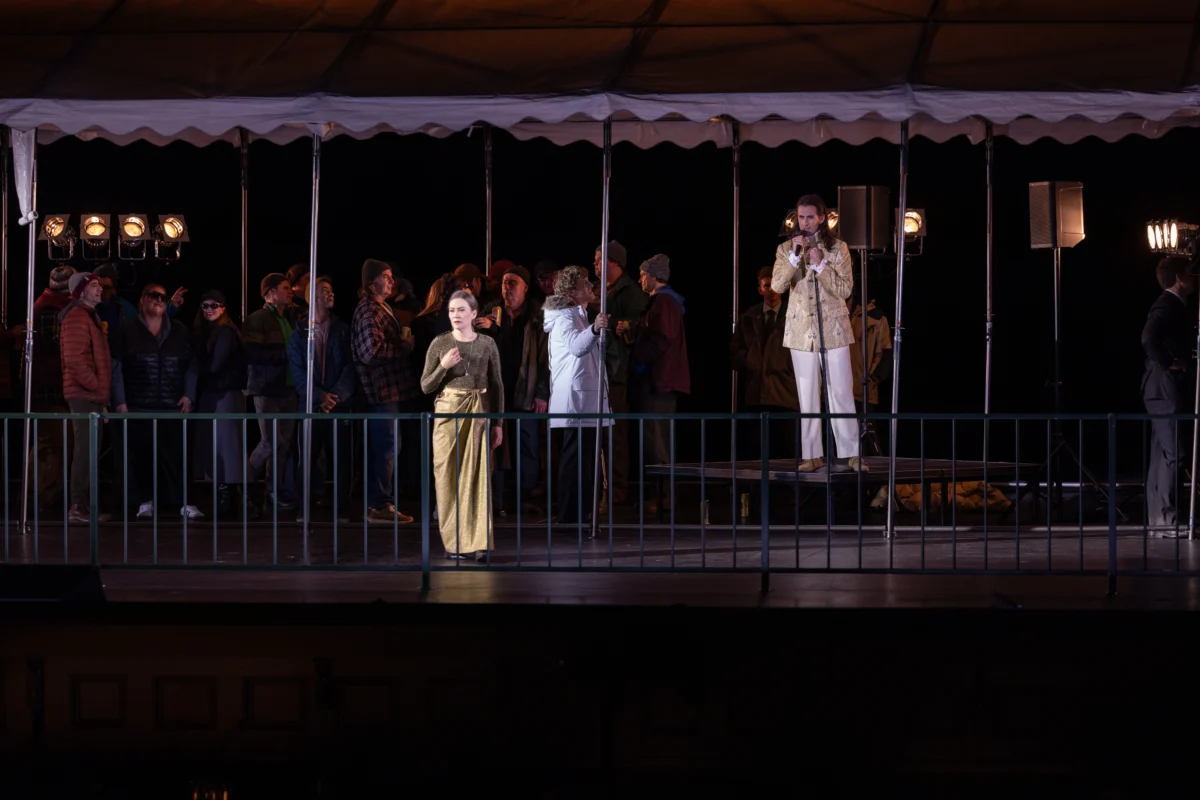
Photo: Matthew Washburn
No curtain rises in Stewart Laing’s production, and it’s clear that Laing took Musgrave at her word when she said she wanted a nuanced and very real Mary. As the audience enters, they are treated to a pre-show spectacle as stage hands costumed in contemporary clothes erect a temporary pavilion onstage (the production’s only set, also designed by Laing). The setting dramatically plays down the glories of the Scottish court. It’s clearly not meant to last, which is historically accurate. In fact, Mary’s son James (later James VI of Scotland and James I of England) would be the last monarch to solely rule Scotland without also ruling its southern neighbor (until he ascended to that throne, too). The ephemeral nature of a tarp-clad pavilion telegraphs the end at the beginning. However, when you have something being built and lumbering into place behind the singers, we’re going to pay attention to the lumbering thing being built. I don’t know why Laing would upstage his own singers.
Laing’s update of the action from Stuart-era Scotland to the modern day probably complicates what doesn’t need to be complicated, ironic given the simple set and costuming (though the execution of simplicity is never simple). Without the outward signifiers of a royal court, we lose some of the spectacle that makes Musgrave’s angular score so blunt and what can make her score such a jarring takedown of pretense. I like to think the tent pavilion was a clever take on the common tented pavilions that monarchs of the era used when on a military campaign. Perhaps it was meant to indicate that Mary was every bit the soldier by necessity of her gender, having to endlessly battle entrenched masculinity. But I don’t think so. It ended up just looking, frankly, a bit cheap — a cost-saving measure for an opera that will surely lose money. I respect the necessity, but it could have been achieved in another way.
As the pavilion is being set up, we realize that we are all awaiting the arrival of Mary Stuart from France. Mary has left France after the death of her husband, the French king Francis II, and with his death went her claim to the French throne. Before her arrival, the men are squabbling (something that takes up a lot of the action in an opera which centers female agency). Mary’s half-brother James, Earl of Moray is illegitimate and cannot ascend to the Scottish throne but harbors a desire for power. A Protestant, he has the Catholic Cardinal Beaton imprisoned and killed when the cardinal uncovers James’ machinations to his sister Mary. So ignites a war between Mary’s male advisors that serves as perhaps as terrible a prison for the queen as the one Elizabeth will confine her to later in life (those events happen after Musgrave’s opera ends).
When Mary arrives, she is a down-to-earth and popular figure, dressed in the same contemporary casual sportswear as the stage hands erecting her pavilion. A theme in Musgrave’s telling of Mary’s life is her approachability, and Laing’s choice to consistently dress her down (late in the opera she appears in a velour track suit) squares with Musgrave’s decision against making Mary anything resembling a typical Renaissance monarch with the attendant flattery and fripperies. Mary’s entrance is portentous (a ghostly female chorus, church bells, quickly undulating strings). She’s no Verdian Othello shouting “Esultate!” after disembarking. In fact, she vocally enters the scene late, singing tuneless greetings to her people.
The indefatigable soprano Heidi Stober was the production’s title character. Stober bowed with San Francisco Opera as Sophie in Werther in 2010 and has been a steady presence ever since. A singer with an authentic stage presence and a rock-solid technique, her repertoire with the company has ranged from Norina in Don Pasquale to Zdenka in Arabella to her most recent outing with the company as Blanche in Les Dialogues des Carmélites. Stober’s turn as Mary will certainly define her career. And, frankly, having seen much of her work with the company, I was not prepared for how much she owned the War Memorial Opera House stage. The woman is simply fearless.
Musgrave’s writing for the voice can be brutal. She sends Mary’s voice hurtling to the top of the lyric soprano range… and she does it a lot. Too much. Stober was unfazed. She embodied the Mary who could tamp down a room full of patriarchs with full-throated B-flats and the Mary who could fret over her newborn alone, blindsided by how everything went so wrong. Flashes of anger and moments of intimacy found her in equally convincing voice. Previously I’ve found Stober’s stage persona to be earnest if deferential. Not here. The sign of how affecting her performance was: For all of Stober’s command of that stage, she brought enough vulnerability and imperfection to Mary that I fully believed Mary would do something as disastrous as escape to England and walk right into Elizabeth’s trap.
Stober was not the only standout. In fact, as with Simon Boccanegra the night before, there was not a single weak link in the cast. The casting team at San Francisco Opera is two-for-two this season.
Now to the men. As her half-brother James, Earl of Moray, baritone Thomas Mole was the perfect opposite end of the fulcrum to Stober. The music he was tasked with singing was also no joke, and his thunderous baritone somehow managed to never turn woolly or woofy even as he negotiated the chattiness of Musgrave’s libretto. Conniving without becoming cartoonish, his villainy was perhaps the best example of Musgrave’s gifts as a dramatist (like so many, she clearly loosened up when it came to creating the story’s many villains).
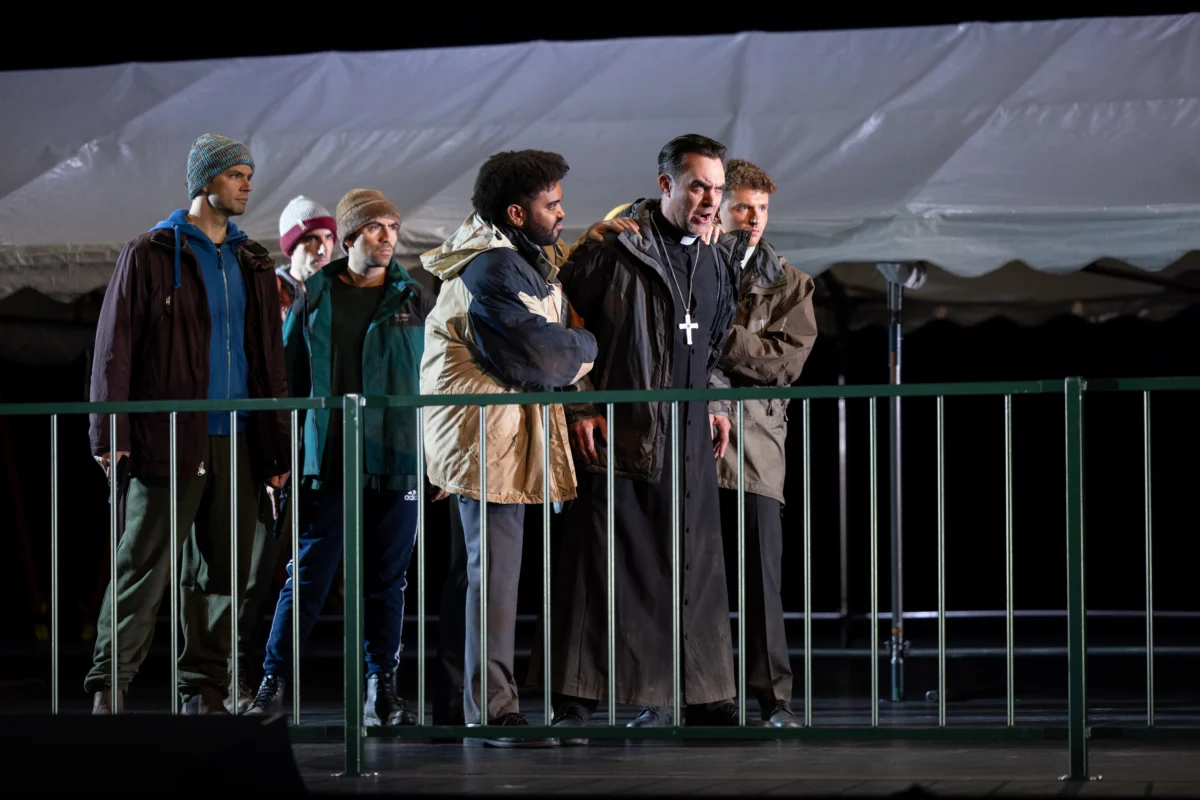
Photo: Matthew Washburn
Similarly, tenor Thomas Kinch’s Earl of Bothwell (forever at war with the Earl of Moray) was another memorable male counterweight to Mary—first a protector, then a menace, then hanging on the periphery, then committing an act of awful violation when he returns. Kinch’s voice in the War Memorial sounds like a true baritenor (I had to peek at the program to pin down his voice type). Bothwell is another character who is consistently asked to sing importantly and loudly. He barely gets a break, and the youth of Kinch’s voice probably made all that bellowing possible. Kinch made it all seem so easy vocally and physically—he was all over that stage.
Baritone Hadleigh Adams as David Riccio (Mary’s Italian courtier) and tenor Christopher Sokolowski (as Mary’s malcontent creep of a husband Lord Darnley) also brought full physical commitment to their roles. Sokolowski appeared to be auditioning for American Ninja Warrior. Blink and you might find him supine, or jumping on a platform, or curled up in despair. Vocally each brought a timbre different from the other male courtiers. Fair play to Musgrave for wisely apportioning the voice types among so many men. Bay Area opera stalwart (and treasure) Philip Skinner was perhaps the only sympathetic male in the entire thing as Lord Gordon, Mary’s only real ally. His beefy bass-baritone sounded so warm next to all the trumpeting by the toxic men in Mary’s court.
As a whole, I can’t remember an entire cast leaning in so much to the acting. Perhaps it was the youth of the cast. I don’t think it’s entirely cynical to assume that this is a cost-saving move. But when you have such exciting singing actors, it’s a net positive. It also made for a production that buzzed with energy. It ensured that a groundbreaking composer got a cast that would show her work in the best light.
I’ve previously said that I wish Musgrave offered us more banality, to give us a chance to take a breath. As the 7:30pm start time arrived, nothing happened. 7:35pm, nothing happened. 7:40pm, nothing happened. This is unheard of at the War Memorial Opera House. Fifteen minutes went by. The audience started to openly wonder what was going on. Eventually company director Matthew Shilvock walked onstage. He announced that some of the orchestra members were caught in Folsom Street Fair traffic and would arrive soon.
Aside from being an only-in-San-Francisco occurrence, it let the air out of the occasion of going to the opera. Every drama needs some comic relief, to relieve the importance. It just so happened that in Mary, Queen of Scots, the relief came before it had even started.

Matthew Travisano
Matthew is a San Francisco-based educator and actor. He has taught and lectured on the performing arts for more than two decades. He has trained a generation of actors in the greater Bay Area at both Oakland School for the Arts and Ruth Asawa School of the Arts, where he has also taught literature, composition, literary theory, and aesthetics. He holds a BA in English from UC Berkeley and a Master's in Teaching (MAT) from San Diego State University.
-
Topics: Review, thea musgrave
-
People: Christopher Sokolowski, Clelia Cafiero, Hadleigh Adams, Heidi Stober, John Keene, Philip Skinner, Stewart Laing, Thomas Kinch, Thomas Mole
-
Works: Queen of Scots
-
Places & Organizations: San Francisco Opera