Man of the masses
Amartuvshin Enkhbat is superb in Verdi’s Simon Boccanegra in San Francisco — even if the drama offstage is more persuasive than this new production.
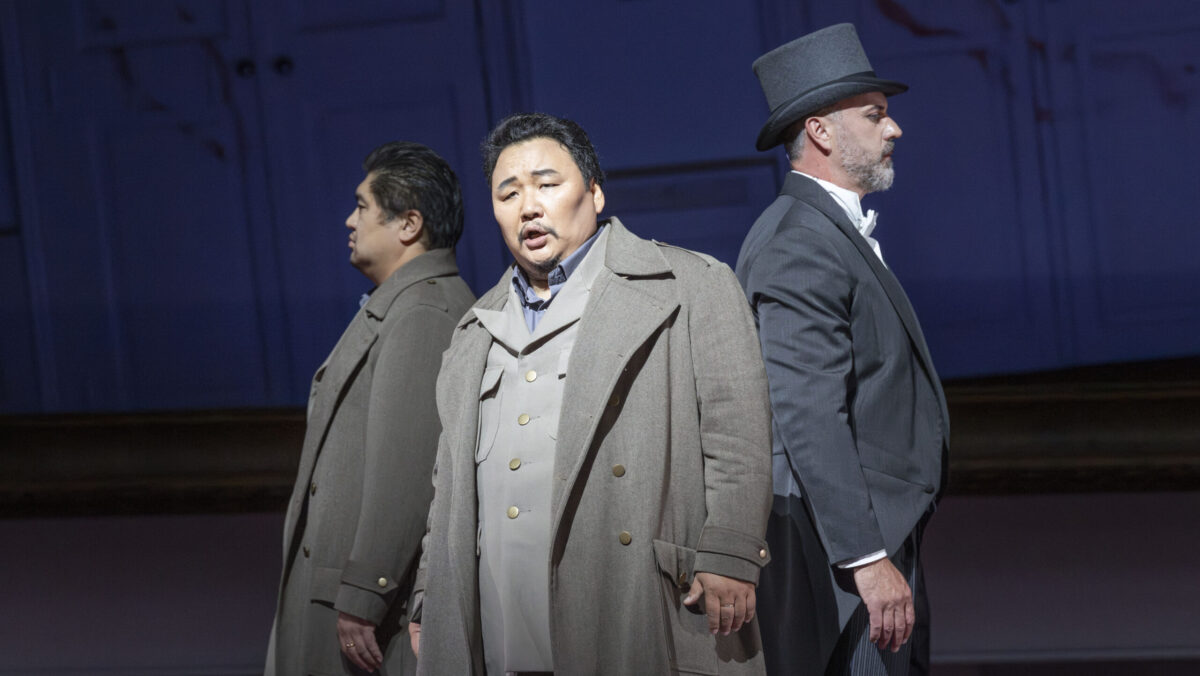
Photo: Cory Weaver/San Francisco Opera
Giuseppi Verdi was arguably the most political of the great opera composers of the 19th century. And he loved a crowd scene. He loved to portray warring factions and political gamesmanship. His talents at orchestration and harmonics find ideal expression when he writes for the amassed human voice. Though named for a single man, the crowd weighs heavily in Simon Boccanegra.
In the same decade that he completed the original version of historical epic (1857) he had completed Rigoletto (1851) and Un ballo in Maschera (1859), two operas that came to mind a lot Friday evening at the War Memorial Opera House as I took in San Francisco Opera’s season-opening production of Simon Boccanegra. In all three operas, there is a bleakness, even a sourness: a single man constantly looking over his shoulder and knowing that they really were out to get him.
Two weeks ago, a crowd amassed outside the War Memorial Opera House. It was the San Francisco Opera Orchestra and supporters who called for a strike against company management. Contract negotiations fell apart and led to the cancellation of half the run of season-opening Simon Boccanegra and the opening of Thea Musgrave’s Mary, Queen of Scots. A strike, however noble the cause or the outcome, however earnest the attempt at a resolution, is always about gamesmanship, power struggle, and optics. And Verdi excelled in narratives about the personal in the politics and the politics of the personal.
What Verdi understood so keenly was that we cannot escape that outside world, no matter how much we think we have the privilege to do so. Our lives are intensely public. Someone is always watching. That can be a good thing (someone noticing something isn’t right and checking in). It can also be oppressive. For Simon, it’s a misery.
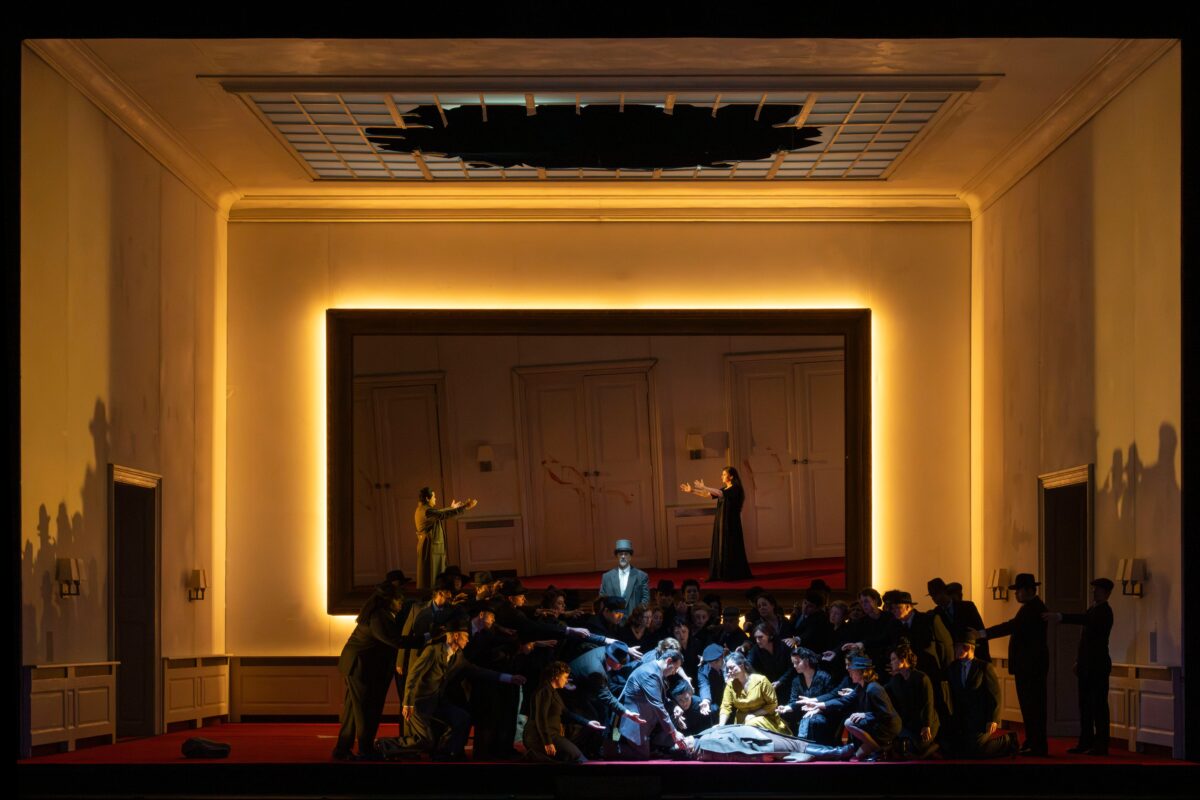
Photo: Cory Weaver/San Francisco Opera
At the start of Claus Güth’s production, originally created for the Hamburg State Opera and re-staged in San Francisco by Katherine M. Carter, we find Simon already dead, prone on the floor like a betrayed martyr. A crowd is amassed around him like the mourners of Christ after he is taken down from the cross. Then in Güth’s staging, everything goes in reverse. The characters walk backward out of the scene, Simon rises and meets his double in a giant mirror hanging upstage. It’s a moment when he gets to notice himself and be the person to see that something is wrong. But for the next three hours, we essentially get the origin story of how a public figure can never really survive his public-ness.
Güth’s production sets the opera in the guise of the Italian Neo-Realism cinema (fedoras, neutral-toned suits, shabby chic, hard lighting). Verdi’s political dramas are all about calculation and planning. Everyone conspires. Everyone waits. Even the accidents are all too perfect. While chaos hovers in Boccanegra, the outcome is inevitable (hence Güth’s device of simply rewinding everything, to show us that it ended how it started). His decision to set the opera in postwar Italy made a rather grim opera grimmer.
Moving the action doesn’t harm the opera — but it also doesn’t add much to the dramaturgy. The medieval setting of the libretto (based on a historical doge of Genoa, not Venice for those playing at home) actually foregrounds something that broke Verdi’s heart: a fractured Italy. The wars between Italian city-states that serve as the context for the opera don’t matter when the opera is set in the 20th century. With trench coats and pistols, it now looks like warring mob clans, something that removes the political heroism of the title character, a heroism through duty Verdi celebrated in no less serious a mode than Wagner celebrated Parsifal’s redemption through love.
Christian Schmidt’s realistic set had surrealist touches. The aforementioned mirror was actually another playing space, just aggressively foreshortened. Through forced, but non-linear perspective, we’re shown the drama underlying the drama as doubles for the characters enact their private anxieties or desires, sometimes entering the main playing space and haunting the action. We see the unseen Maria Fiesco, the woman Boccanegra loved and produced a daughter with. Maria, yet another fallen woman in Verdi, dies offstage after walking across the upstage nether world and smearing her blood across the walls (heavy-handed, but who doesn’t love some blood on the walls?).
The set was also reminiscent of a hotel ballroom in a communist bloc country: antiseptic cream-colored walls, the cheapest of wall sconces, the red high-traffic carpeting. It felt like the civic spaces of Genoa were a trade show at the Bucharest Marriott in the 1960s. That said, the detail work on the realist set was extraordinary, down to the heating/cooling grates that lined the walls. This setting effectively set the opera nowhere, which arguably focused our attention on the relationships and the politics (since there was really nothing else to look at).
This directorial gambit of creating character doubles to deepen the psychodrama has been around for decades. Sometimes it works, and sometimes it doesn’t. It didn’t not work in Güth’s hands. But there were also times when I muttered to myself: “Go away. Shoo!” when Boccanegra’s double would walk on like a forlorn somnambulist. Verdi wrote some criminally under-appreciated trios and duets for Boccanegra, and Güth fussed with them by bringing on the sleepwalkers. I appreciated Güth’s reminder that the ghosts we create in life by our choices never leave us (we see you, Jacob Marley) and that private spaces can be public spaces. But audience giggles (unusual for a War Memorial audience) did speak to the conceit’s overuse and lack of clarity.
The rewinding metaphor, the obsession with going backward was at odds with Verdi’s thesis: We must always press forward, ever forward. Italy must press forward toward unity and leave petty squabbles in the unenlightened past.
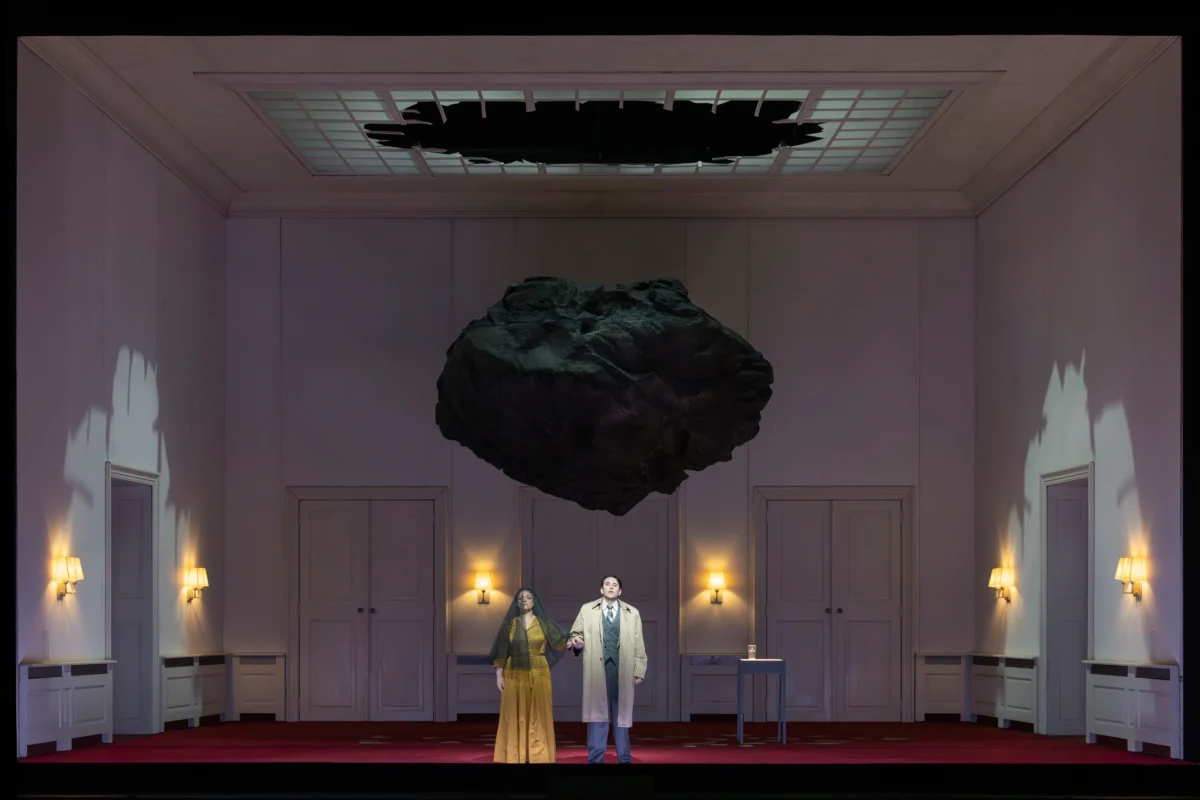
Photo: Cory Weaver/San Francisco Opera
What dominated was a boulder which, over three acts, descended from the ceiling to the floor. It was almost a character in its own right. In Act I, it hovered over the stage, peaking through a smashed skylight like the Sword of Damocles, ready to strike down anyone at any moment. In Act II, it hovered mid-air right over the heads of the singers, vaguely heart-shaped (which unfortunately lent it a rather comic air). In the second scene of Act II, the curtain opened to it resting on the floor for actors to walk around.
Like the double character concept and the sleepwalking concept, the boulder didn’t really do anything for or to the opera. It was something else to negotiate. I am sure there were several thematic associations to be made (the weight of history, the outside world smashing through into privileged spaces, the brute strength of power). But it was ultimately something to be noted once, then disregarded.
What couldn’t be disregarded was the musicianship all around.
San Francisco Opera is squarely a Verdi company. An opera by Verdi has opened the season more than 30 times, and has done so the past three seasons under Eun Sun Kim’s music directorship. In fact, when Kim came on board, she announced an ongoing project to focus on the operas of Verdi and Wagner. I don’t think Kim has had such command of a score like she did with Simon Boccanegra, and I’ve always found her a solid conductor — before Friday, the highlight of her San Francsico tenure was a confident debut Tristan and Isolde two seasons ago. In the past I’ve found her conducting of Italian operas studious and tasteful. Pacing was always good. She never let the air out of the action but also didn’t rush.
Her Boccanegra is one of the best turns at the podium I can remember in my 30 years attending productions at the War Memorial Opera House. Verdi’s score is gorgeous; It’s the score of a composer, like Wagner, for whom the orchestra is a character in the drama, not merely a decoration. I went into the performance having remembered from nearly 20 years ago (the last time I’d seen or heard it) that Simon Boccanegra might be my favorite Verdi score. The forlon, almost nostalgic music that begins the prologue. The diaphanous strings conjuring the sea at the top of Act I. The brooding anxiety of the Council Scene. And I believed it all over again. Kim conducted the opera with all the attention and care of shepherding a new work to the stage. This brought out both the flinty cragginess of the work, but it also brought out its gorgeous agony. The orchestral interludes could have been a concert in themselves.
I don’t think the San Francisco Opera Orchestra has ever sounded better. In particular, Stepanie McNab (principal flute), José González (principal oboe), and Mingjia Liu (principal oboe) reminded us of Verdi’s skill for writing for woodwinds.
And then the singers brought it all home. Returning to San Francisco Opera for his third consecutive opening night in a Verdi role was baritone Amartuvshin Enkhbat. I’d heard his Count Anckarström in Ballo and his Rigoletto and been struck by his sound and sheer vocal power, but I was never won over by his stage presence (I frankly thought he was miscast in Rigoletto). The company also has a frustrating habit of engaging the same singer over and over again year after year. In a season of only six operas, that is a lot. I was not prepared for what I heard in his Boccanegra.
It was perhaps the most commanding performance by a bass baritone since, ironically, I heard Dmitri Hvorostovsky as Boccanegra in 2008 and Paolo Gavanelli as Rigoletto way back in 1997.
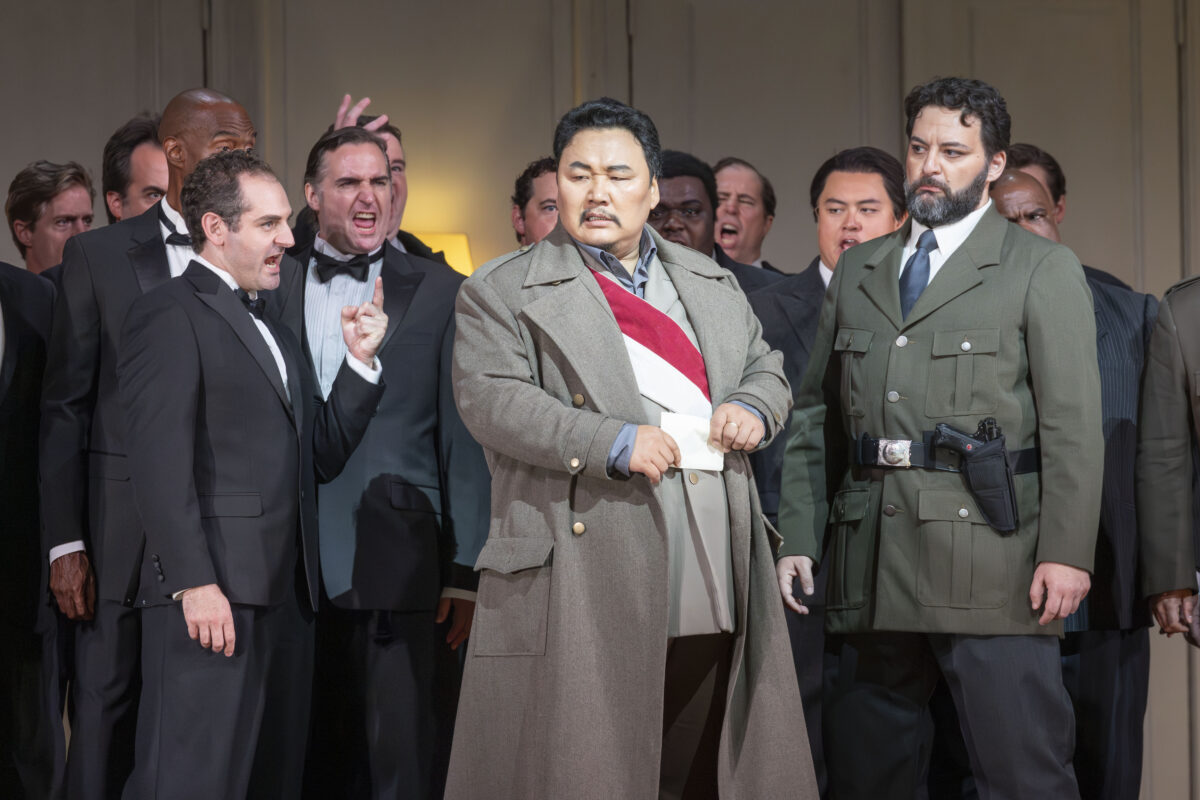
Photo: Cory Weaver/San Francisco Opera
My soprano companion next me called Enkhbat’s voice exactly what it was: surround sound. It has warmed even more over the past few years, sailing around and through you. When his voice was there, it sounded like it was always there. When it wasn’t there, you felt the absence. While Boccanegra is really an ensemble opera, Enkhbat was the marquee event. Temperamentally-speaking, the title role is much more suited to him: He can play troubled and conflicted far better than vengeful or scheming. He’s not the baritone who relishes playing the villain. He’s the baritone who wants to play Hamlet. Unlike in previous roles for the company, here he was also willing to risk ugliness, pushing the voice just a bit more than perhaps bel canto technique would allow when Boccanegra’s anger flared up. I welcomed that human element.
Previously Enkhbat walked the blocking. This time he walked the walk.
His nemesis (and unbeknownst to him his almost-father-in-law, because it’s Verdi), the bass-baritone Christian Van Horn returned to the War Memorial having last strutted the stage as Escamillo in Carmen. His turn as Jacopo Fiesco was a bit muted, one of the vaguer characterizations on offer that evening. I can’t say I’ve ever found Van Horn an actor who will tear up the stage, but I felt a certain diffidence in his portrayal and well as in his vocals. It was still a performance that would be the envy of many a singer, as his plush bass-baritone curled around the notes. I felt myself wanting more bite from his attacks even, forgive me, more villainy despite the fact that, as is everything in the opera, that villainy is complicated. When he triumphantly ascended the boulder at the end, it was an anti-climax.
In her house debut, soprano Eleanora Buratto made Amelia Grimaldi into a formidable woman whose voice could probably quiet a room of fussy patricians and plebeians, if Verdi had asked her to use it for such. Buratto’s voice is traditionally Italian in timbre and coloring. A solid and burnished middle voice rises to an upper register with a metallic sheen and a wider vibrato (which has widened over time), making Amelia’s cries sound less like panic and more like declarations to be heeded. She dispatched her one standalone aria (“Come in quest’ora bruna”) with perfect intonation and a grounded quality that took the character beyond a wistful songbird. Verdi does not push Amelia too hard (there are only two high-Cs in the entire score). However, Verdi also doesn’t give Amelia anything needless to say. When she sings, she means it. And the singer cannot mark anything. Her take on the character was direct, though it seemed at times that maybe Buratto was not entirely sure what was happening with the whole directorial concept (a befuddlement that seemed to come through often among the cast).
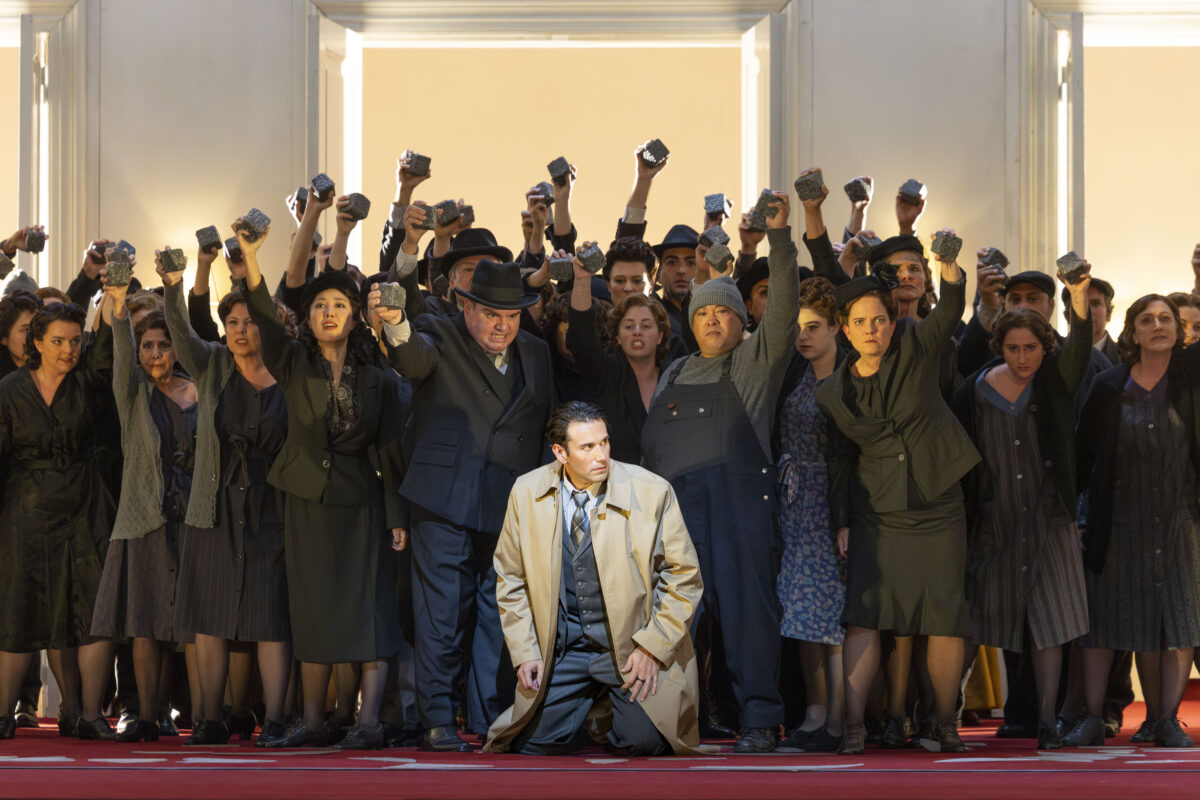
Photo: Cory Weaver/San Francisco Opera
Tenor Joshua Guerrero as the ardent Gabriele Adorno sang like the rent was due or, rather, was about two weeks late. He flung himself at the role, creating perhaps the most convincing character out of a role that Verdi didn’t really see the need to flesh out too much. In an opera of basses and baritones, Gabriele feels like a bit of a twerp. Guerrero ceded no ground to the assembled basses and baritones, deploying his heroic voice (tailor-made for the heroes of French and Italian opera) like every moment was the end of an act. It’s a bright voice with that squillo we all want in a Verdi tenor and a flexibility above the staff that surely has other tenors about to do a Faust to be able to match it.
Aleksey Bogdanov (San Francisco-born) was luxury casting a Paolo Albiani, once a would-be suitor for Amelia and eventually one of the schemers against Boccanegra and eventually his murderer. Bogdanov’s clarion baritone commanded the stage, frankly far more heroic and dignified than a weasel like Paolo even deserves. Other supporting roles were ably filled by baritone Gabriel Natal-Báez (Pietro) and tenor Christopher Jackson (Guard Captain). There was not a voice on that stage that didn’t impress.
Speaking of which, chorus director John Keene has the San Francisco Opera Chorus sounding better than ever, making Verdi’s genius for ensemble writing all the more evident. Paired with Eun Sun Kim’s marshalling of the orchestra, it was probably the best all-team effort for a Verdi opera I’ve ever heard at the War Memorial.
The opera ended as it began. I tried to rewind everything in my mind just as director Claus Güth seems to have wanted me to, tracing where it all went wrong. But the machinations of the plot and the concept overlaying it all weren’t important in the end. In an opera season that began with a strike, in an era of true political upheaval no less raucous than what Verdi depicted, we were left with a night of musical brilliance.
So total a musical triumph as Simon Boccanegra, that when I walked out of the War Memorial Opera House onto Van Ness Avenue and heard a car horn blare as it zoomed by, I was convinced that Verdi had written that into the score, too.
Matthew Travisano
Matthew is a San Francisco-based educator and actor. He has taught and lectured on the performing arts for more than two decades. He has trained a generation of actors in the greater Bay Area at both Oakland School for the Arts and Ruth Asawa School of the Arts, where he has also taught literature, composition, literary theory, and aesthetics. He holds a BA in English from UC Berkeley and a Master's in Teaching (MAT) from San Diego State University.
-
People: Aleksey Bogdanov, Amartuvshin Enkhbat, Christian Schmidt, Christian Van Horn, Christopher Jackson, Claus Güth, Eleanora Buratto, Eun Sun Kim, Gabriel Natal-Baéz, John Keene, José González, Joshua Guerrero, Katherine M. Carter, Mingjia Liu, Stephanie McNab
-
Works: Simon Boccanegra
-
Places & Organizations: San Francisco Opera