Bard from entry
Monteverdi’s L’Orfeo by Haymarket Opera and The Newberry Consort takes its audience to heaven while its title character goes to hell.
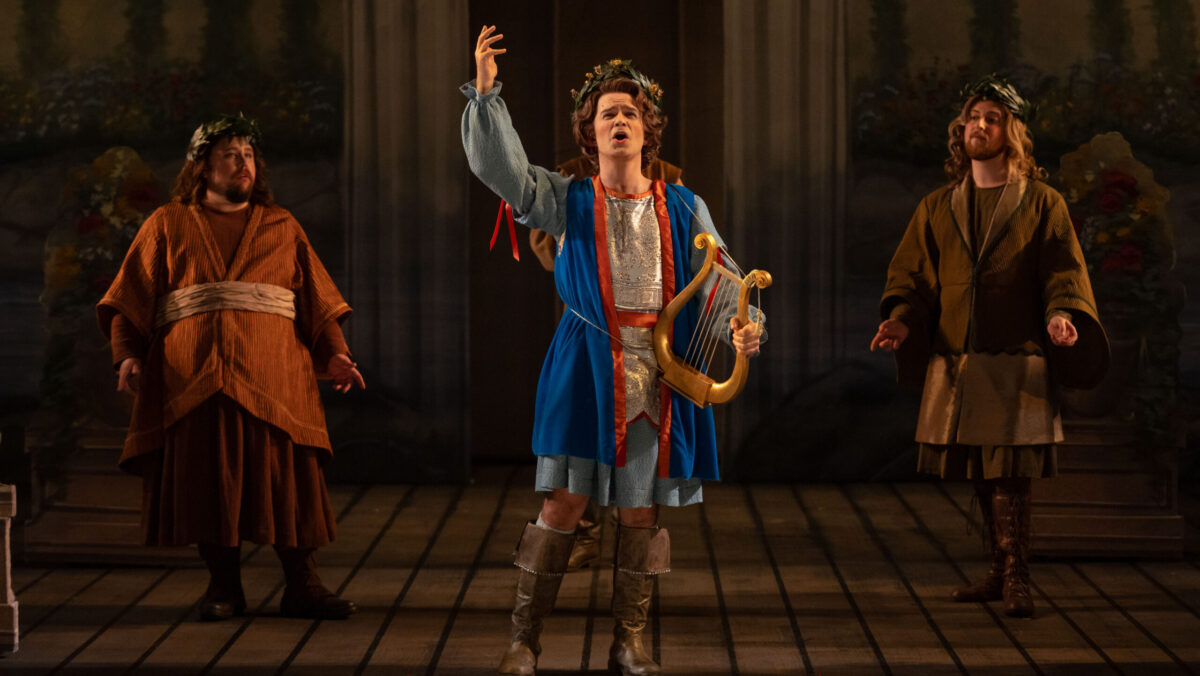
Haymarket Opera Company and the Newberry Consort – L’Orfeo (2026) – Featuring Zachary Wilder / Photo: Elliot Mandel
Across Chicago, classical music is in transition. Next month, the Lyric Opera will open its second complete season under new leadership. Kitty-corner across the Loop, the Chicago Symphony—which just last week announced a zippy, red rebrand—still awaits, for the third year running, the permanent arrival of its (and the Royal Concertgebouw’s) shockingly young Music Director Designate. The list might go on, from renovated summer halls to a new union contract to a sad, and I hope temporary, pause to the activities of one of the city’s most vibrant orchestras.
Fitting, then, that Haymarket Opera Company and The Newberry Consort kicked off the city’s opera season on Thursday evening with a historically informed performance of Claudio Monteverdi’s 1607 L’Orfeo for a sold-out run at DePaul University’s Jarvis Opera Hall. Perhaps the repertoire’s earliest masterpiece, L’Orfeo is, paradoxically and presciently for opera today, about the ultimate peril of a backward glance.
The Haymarket Opera Company creative team, led by stage director Chase Hopkins, have built a company upon looking to the past. Theirs is a deeply researched, richly detailed design and staging practice, as the extensive program notes demonstrate with evident historical ardor. The same is true for The Newberry Consort, who brought to modern ears the sounds that only sackbuts, theorbos, recorders, and cornetti could. And the Jarvis Opera Hall’s intimate theater (built, fittingly enough, into a renovated former church) matches the scale of what was originally a Mantuan court entertainment.
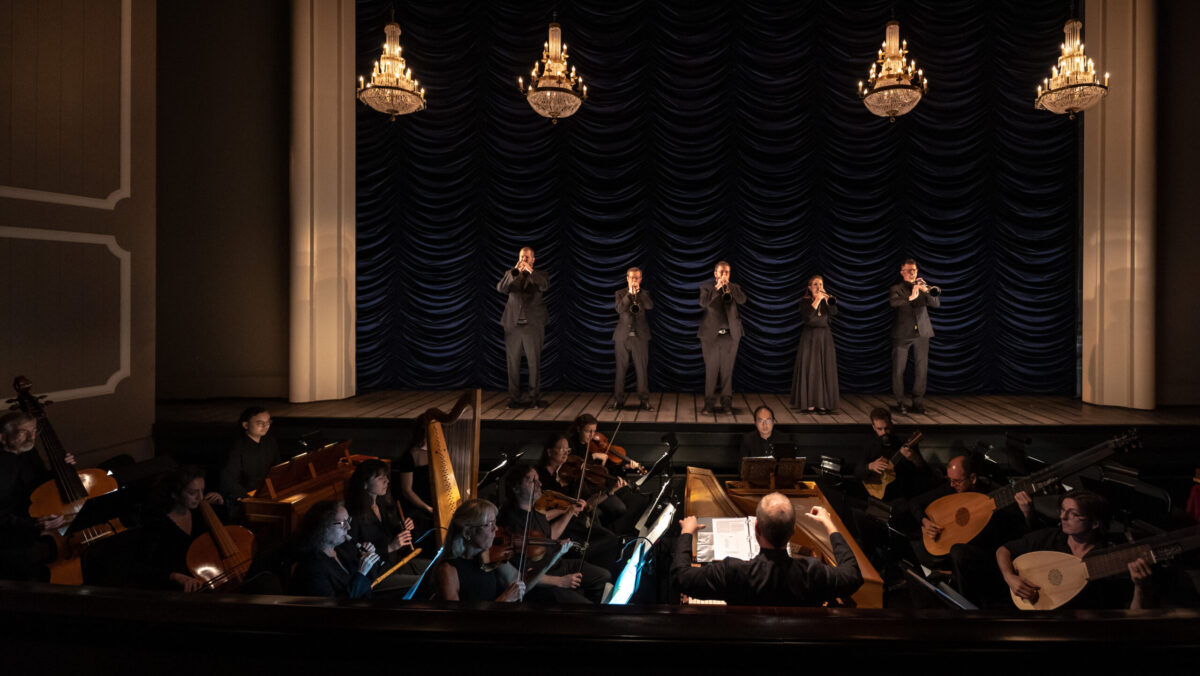
Haymarket Opera Company and the Newberry Consort – L’Orfeo (2026) – Orchestra / Photo: Elliot Mandel
But their L’Orfeo was never retrograde. It is hard to imagine an opera speaking so clearly to the state of the art—to music’s enchanting, beguiling power; to its danger and sorrow; to everything Monteverdi already understood his new art form could do.
In the title role, the early music specialist Zachary Wilder encapsulated the evening’s many strengths. Wilder’s tenor was substantial but light, with a taut, controlled vibrato that highlighted his especially crisp Italian diction. But the great discipline of Wilder’s technique, like that of Monteverdi’s music, was no limit to its emotive expression. The remarkable ornamentation of his “Possente spirto”—the centerpiece aria in which Orfeo, seeking his Euridice (Emily Mwila, singing with beautiful tone but with the slightest hollow edge to her voice), pleads to Caronte for passage to the underworld—portrayed a man willing to go to any length to regain his beloved. In the climax of Act IV, as Orfeo begins to doubt that Euridice really is behind him, Wilder dilated the pauses between his controlled phrases to communicate the anguish of Orfeo’s indecision. The orchestra, under the baton of Haymarket’s Craig Trompeter (co-music directing with Newberry’s Liza Malamut), was always a responsive partner to the singers, but here the audience, too, was held in suspense for Orfeo’s every word.
The only character unbeguiled by Wilder’s Orfeo was, fittingly enough, Jonathan Woody’s Caronte. In the libretto by Alessandro Striggio, Caronte resists Orfeo’s pleas until the sound of the mortal’s lyre simply puts him to sleep. Wearing a hooded cape and big, bushy beard (costumes and makeup were designed, each with historical commitment and theatrical verve, by Stephanie Cluggish and Megan E. Pirtle), Woody embellished his role with a surprisingly economical set of gestures—a finger pointed upward, a sideways glance—that brought a strange, wonderful levity to Caronte’s resistance to Orfeo’s desperate entreaties. (By contrast, a few other performances were hampered by pantomime gestures that glossed the libretto far too literally.)
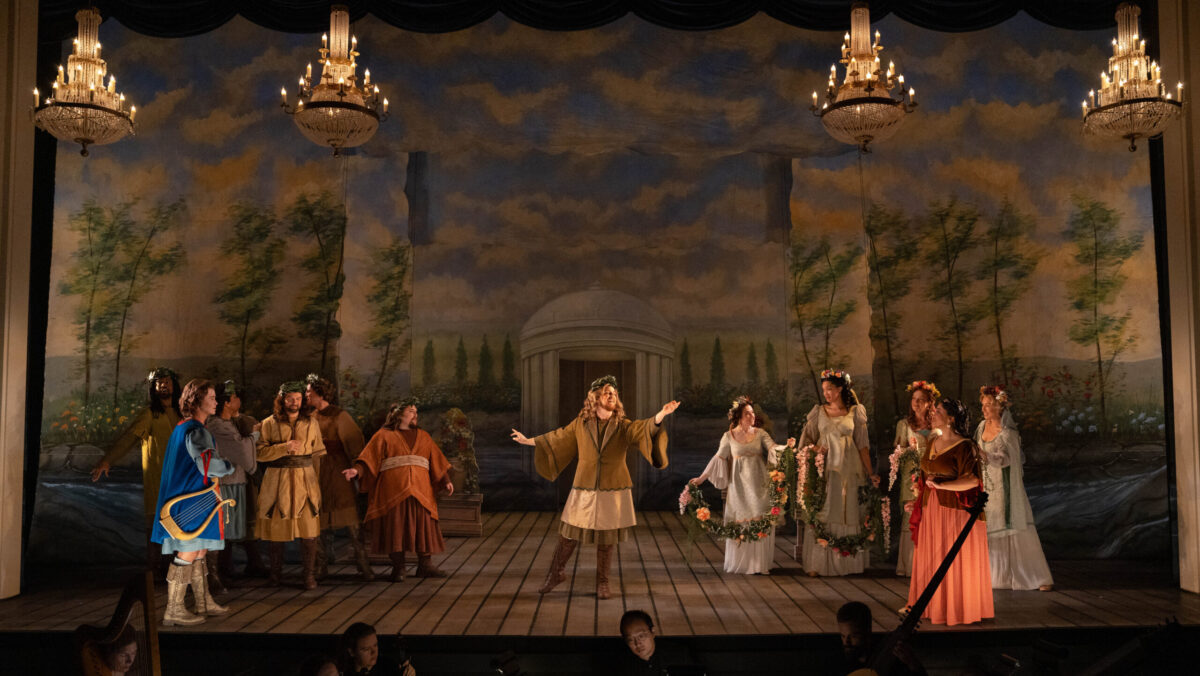
Haymarket Opera Company and the Newberry Consort – L’Orfeo (2026) – Featuring Michael St. Peter and Cast / Photo: Elliot Mandel
Among the rest of the supporting cast, Hannah De Priest sang Proserpina with an especially clear tone and excellent rhythmic accord with the orchestra. A handful of other solo roles suffered from voices that, though beautiful, felt too large, or with vibrati too wide, for Haymarket and Newberry’s restrained, historical style. But, as the opera’s ensembles of nymphs and shepherds and of infernal spirits, their choral singing was exceptional. In Act I, set at the wedding of Orfeo and Euridice before her fateful snakebite, the lush choral textures—particularly in the trio and duet involving countertenor Ryan Belongie—painted a world of such musical beauty that none could have willed it to end. And in the ensuing laments of Act II, the chorus modulated each repetition of their “Ahi, caso acerbo” into a new stage of communal grief, from shock to pain to a final attempt, at the close of the first-half curtain, to process together what they, and we, had just experienced.
These first two Acts lay Monteverdi’s claim to the emotive power of his nascent art form, a power both remarkable and devastatingly changeable. Haymarket’s designs for the production subtly cued the same mutability. At the rise of the curtain for Act III, the lovely, painterly depth of Wendy Waszut-Barrett’s pastoral set had been transformed into a jagged, forbidding underworld—only for the sudden drop of folded canvas panels to reveal, at Act V’s return to the fields of Thrace, that this pastoral world had all along only half-overlaid the realm of shades beneath. Kelly Martin’s lighting design mimicked a candle-lit stage (to the extent possible, presumably, within the boundaries of today’s fire code). As the sun set upon Thrace after Euridice’s death, this underlighting effect traded the glowing radiance of Act I for ghastly, unsettling shadows across the ensemble’s faces. In moments like these, Haymarket’s careful historical research revealed anew the creative vigor of genuinely old stage techniques.
At the opera’s close, Apollo (Evan Bravos), whisking Orfeo up to the heavens and away from the mortal temptation of misogynist inceldom—played here, with generosity, as the extreme outburst of a man prone to anxious mistakes—tells his son that “nothing that delights down here will last.” Perhaps so. But this production shows us that the history of opera nonetheless has power. In the hands of Haymarket Opera Company and The Newberry Consort, L’Orfeo can delight, distress, soothe, and revive, in Chicago today as it must have four centuries ago at the Gonzaga court. When the curtain fell on the fields of Thrace, the shepherds and nymphs of the mortal world below were dancing still.

Bradford Case
Bradford Case is a PhD student in English at the University of Chicago. A bassoonist and former music director of Yale's Berkeley College Orchestra, he is currently the Editor of Chicago Review.
-
Topics: Haymarket Opera, Review
-
People: Chase Hopkins, Craig Trompeter, Emily Mwila, Evan Bravos, Hannah De Priest, Jonathan Woody, Kelly Martin, Liza Malamut, Megan E. Pirtle, Ryan Belongie, Stephanie Cluggish, Wendy Waszut-Barrett, Zachary Wilder
-
Works: L'Orfeo (Monteverdi)
-
Places & Organizations: Haymarket Opera