The kids are alright
Though, really, the young artists of the Merola Opera Program were more than alright in their annual showcase.
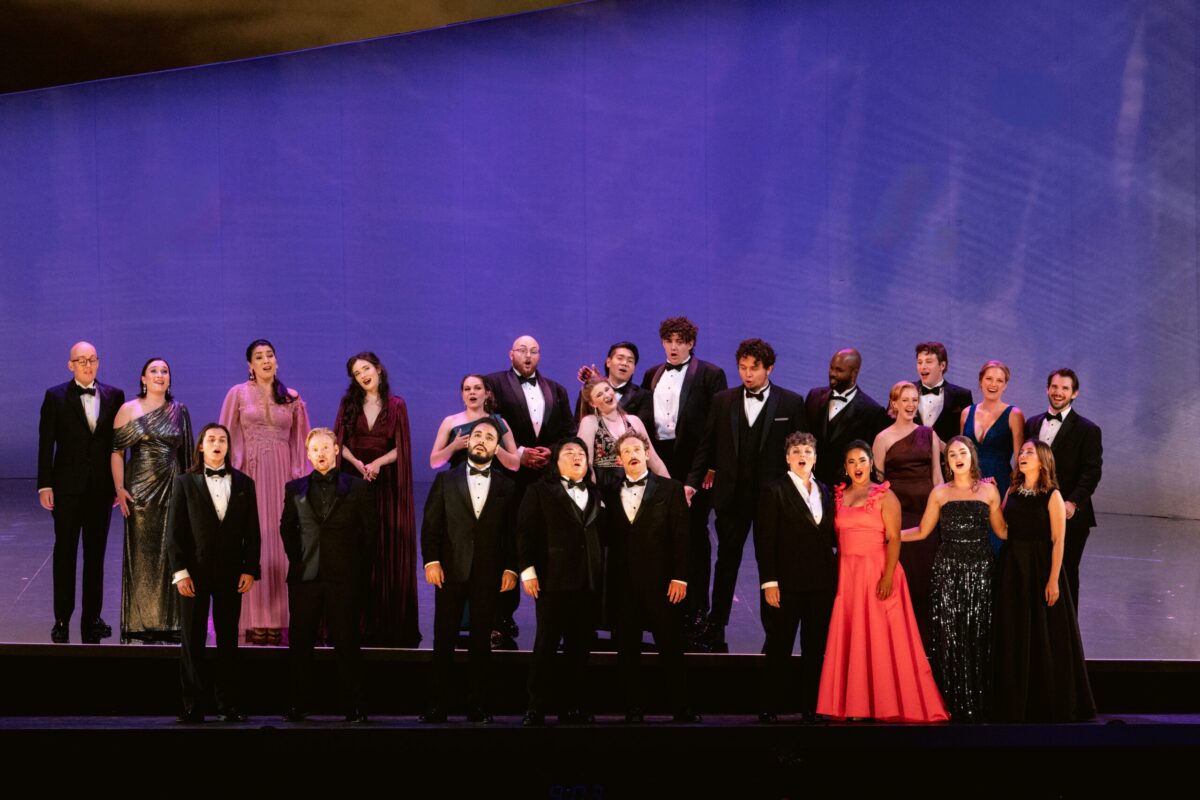
Photo: Kristen Loken
There is something life-affirming about hearing singers at the beginnings of their careers. You can feel the nerves, the anticipation, yes, even the anticipatory terror as each walks onto the same stage that has seen the likes of Leontyne Price, Kirsten Flagstad, Luciano Pavarotti, Shirley Verrett, and so many other luminaries give historic performances.
The end of summer brings a new beginning for many, as schools go back into session. As a teacher, I could not help this being top of mind as I took my seat at the War Memorial Opera House for its annual Merola Grand Finale, a concert featuring the participants in San Francisco Opera’s renowned Merola Opera Program. Each summer some 25-30 young singers, coaches, pianists, and stage directors come to San Francisco for world-class training, coaching, and performance opportunities. The culmination is a concert on the main stage.
Part of the life-affirming nature of young artist concerts is the patchwork of brilliance and awkwardness, of risks taken and rewarded, of the boldness it takes to be an opera singer, and the sheer lunacy it takes to be an opera singer. Another part of the life-affirming nature of young artist concerts are the moments that thrill, heralding a talent whose voice we should be paying to hear in the years to come.
On this valedictory evening, these young singers had nothing less than world class San Francisco Opera Orchestra for accompaniment. And they had conductor William Long, who held each singer so securely and generously that I knew if I had run up on stage and decided to sing something, he would have made it work and made me sound great—even if I couldn’t have made myself sound great by any stretch of the imagination. His conducting supported the singers with clear cues and ideal tempos for their voices. Not one singer sounded rushed or needed to drive the tempo forward. I wished for these young artists that every conductor they would have in future would be half so kind.
The evening was not a competition but a sharing of work, a celebration, and a coming out. So, I hesitate to speak in terms of winners and losers. But there were performances that will stay with me.
Two singers made particularly striking War Memorial debuts. Each made only one appearance (for whatever reason) but they made that appearance count.
The first was mezzo-soprano Ariana Maubach. She appeared alongside tenor Charles Styles in the duet “Il faut nous séparer” from Massenet’s Werther.
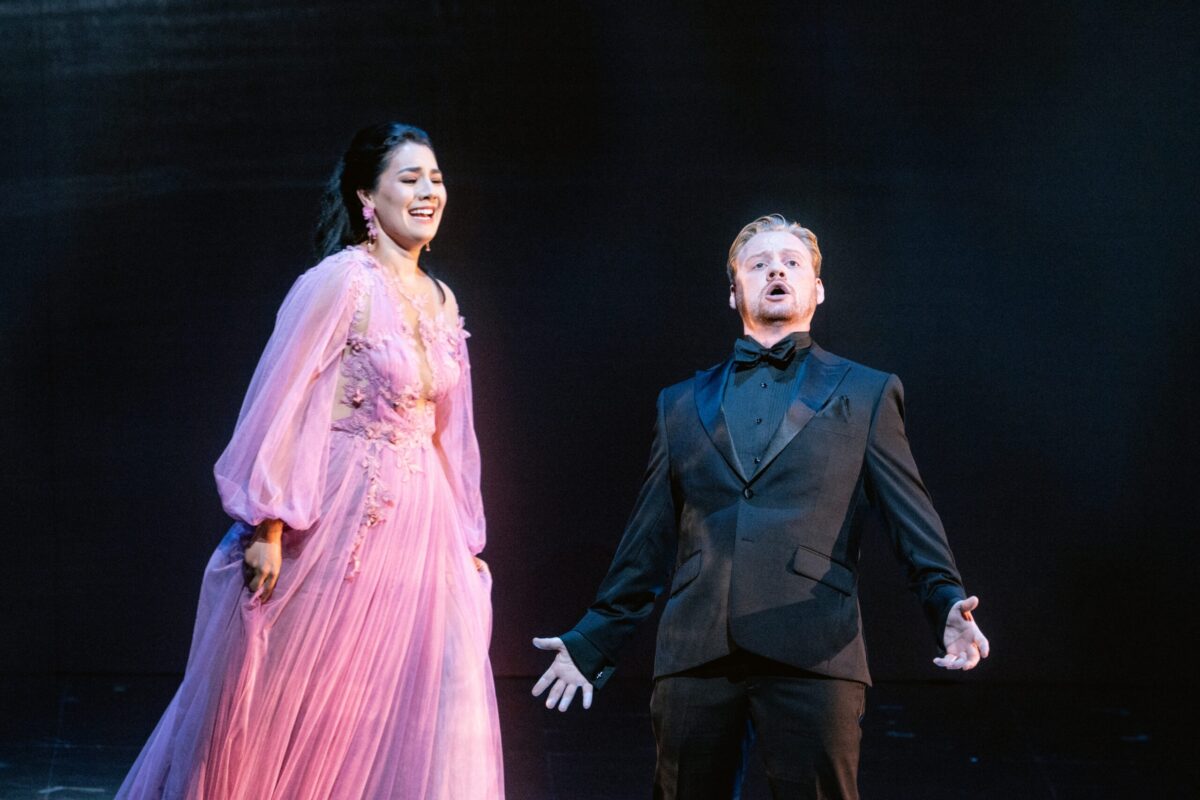
Photo: Kristen Loken
Voices are like vases. Some taper inward as they get to the top, some widen outward as they get to the top, and some are perfect cylinders. Maubach’s is a perfect cylinder. Charlotte sits high for a mezzo-soprano (it’s a role often cast with a soprano), and Maubach has that voice that doesn’t thin out at either end. She was perfectly audible in all parts of her voice. She doesn’t darken her sound, nor does she let it get too bright. Her French was impeccable, and her command of the French lyric style mixed with bel canto technique meant that she did not force the instrument—nor did she stint the drama. She eschewed stock gestures and leaned into singing with honesty. The control she had over her voice allowed us in the audience to sit back and relax, forgetting that she is essentially still a student. I would mount a production of Werther for her tomorrow.
Her partner was a good case study in the joys and perils of being a young singer. Styles has a delightful lyric tenor. No hooting or scooping, just purity of attack and near perfect intonation. It’s a voice ideal for Mozart, Rossini, and Handel (I’d love to hear him as Jupiter in Semele). But Massenet is not Rossini, Mozart, or Handel. Massenet is too heavy for Styles’ voice right now. This meant that Styles did a lot of bearing down and pushing. He had a peculiar habit (like several other male singers in the Merola program) of bending backward at the waist like Santa Claus in pictures of him clutching his rotund stomach and chortling. I imagine it was an attempt to get out more sound, but it didn’t work. Styles’ effortfulness was an awkward contrast to Maubach’s effortlessness. He didn’t need to do it. I wanted him to trust the instrument he had, not try and make one he didn’t.
The other unequivocal standout was heldentenor-in-the-making Matthew Sink. When I scanned the program and saw the rapturous duet “Nuit d’ivresse et d’extase infinie” from Berlioz’s Les Troyens, I immediately thought: “There is no way a young artist can sing Enée. This is madness.” Berlioz can be as punishing as Wagner. Enée just sits so darned high. So, I braced myself for a noble failure and prepared myself to at least enjoy Berlioz at his most romantic and sonorous.
I was wrong.
French opera can expose so many flaws in a big voice. You can’t get away with woolliness or bluster: It just ends up sounding like a Warner Bros. parody. Sink’s voice is so clean, so unfussy. He placed it beautifully in the facial mask without it sounding too bright. This gave his tenor a lightness that didn’t sacrifice the virility that Berlioz demands of Enée. He did not use one preparation note, some hooty attacks at the beginnings of phrases notwithstanding. Midway through the duet, a single moment of slight wobbliness at the top only made it clear how remarkable the other 99% of his notes were. Frankly, I was grateful for that imperfection. Otherwise, in this age of AI, I’d have to question if Sink were truly human.
His Didon was mezzo-soprano Theo Claveles. They were another reminder of what it is to be a student and a singer-in-training. In the opening measures, Claveles ceded the stage to Sink (even standing noticeably upstage of him for a good chunk of the duet). They were singing under him, at times almost inaudible. Then, suddenly, the voice rang out, sending the word “amour” into the heavens, and I gasped. Voices are also like rubber bands. A rubber band needs tension, needs to be stretched for it to do what it’s supposed to do. When Berlioz put their voice under some pressure, Claveles delivered. Theirs is a bigger voice than they seem to realize. By the end, Enée and Dido were an even match made in heaven.
Elsewhere in the program, mezzo-soprano Stella Fitzgerald, as Mozart’s Dorabella and Annio (in La clemenza di Tito), proved herself an able Mozartian and another mezzo who can straddle traditionally mezzo and soprano roles. She will work for years with that technique and that clean attack.
Baritone Enes Pektaş was another singer who excelled in the French style as the title character in Ambroise Thomas’ Hamlet. He negotiated the raw emotionalism of his duet with Ophélie (“Doute de la lumière”) while preserving the integrity of the vocal line. He capably deployed his rich and flexible baritone in a classy performance.
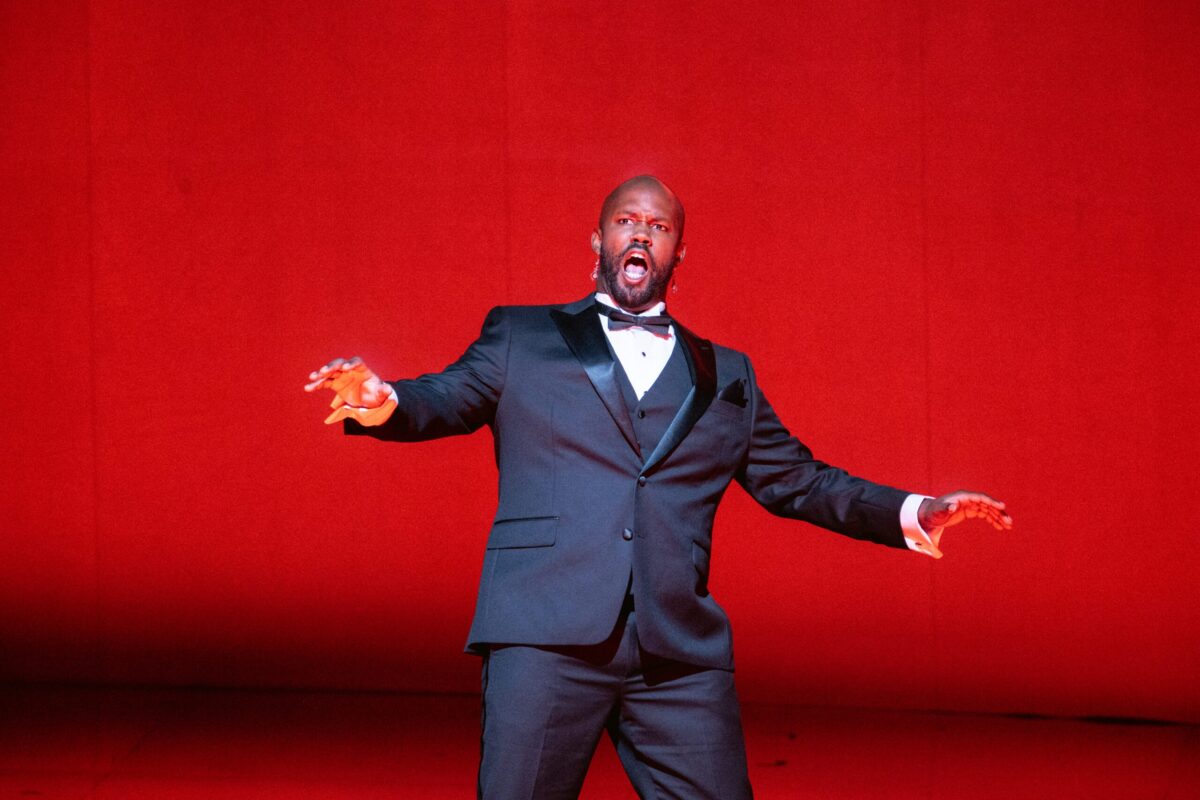
Photo: Kristen Loken
Bass John Mburu showed off his focused and muscular bass in a fun star turn as Caspar in Weber’s Der Freischütz complete with demonic belly laugh. Of all the singers, he showed the rewards to be had in having fun onstage without turning it into camp. But his stage presence essentially told the world that he’ll be Boito’s Mefistofele someday, and he should be.
Tenor Ryan Bryce Johnson in the “Aria of the Worm” from Corigliano’s The Ghosts of Versailles didn’t just toe the lie between commitment and camp—he jumped over it then pointed and laughed at it. His bounding around the stage and whole-body convulsions made everything rather hectic. But his bright tenor di gracia, his pristine English diction, and undeniable stage presence makes him legitimately castable. I would love to see that same commitment to character when he sings Tom Rakewell in The Rake’s Progress someday.
As Minnie in a scene from Puccini’s La fanciulla del West, soprano Charlotte Kelso took a few measures to warm up and turned in a blazing performance. She’s a gifted musician fully in control of her instrument and the stage. She’s also the type of singer who could easily take on roles too heavy for her voice once casting directors hear her. She has the pipes and that squillo, that ‘ping’ needed for Italian opera. But the voice is too young right now to sing an entire Fanciulla. Casting directors: Give her time!
Finally, two tenors (Cole McIlquham and Logan Wagner) brought full-throated joy to the quartet from Puccini’s La rondine (“Già che il caso ci unisce”), with Wagner later returning for a beautifully sung turn as Ernesto in the love duet from Donizetti’s Don Pasquale.
The evening’s scenes were staged by Claire Choquette, also part of the Merola program as a stage director (and a singer in her own right). This was her debut as well and it was a tough assignment. Semi-staged concerts are brutal. Full operas are so much easier. In a concert, the scenes are taken out of context, so nothing is very specific. This dynamic also lends itself to stock gestures and vague approaches to character. Choquette is typical of young directors who seem wary when nothing is happening on stage. As is always the case in opera concerts, there were moments of needless stage business and wandering about. Most awkward was asking Matthew Sink’s Enée to kneel on one knee to sing to Didon (no director should make a tenor compromise their breathing apparatus and unground them in music so difficult). Having the lovers dead center the entire time and without movement would have been more powerful, and the scene pulled us in when Choquette finally embraced that choice.
However, Choquette also demonstrated true directorial talent, in many scenes judiciously deploying her blocking to maximum effect. We saw this particularly in the La rondine quartet, the gentle and charming love duet (“Tornami a dir che m’ami”) from Don Pasquale, and the Hamlet/Ophélie duet from Hamlet; Choquette gave us the stage picture of Hamlet declaring his love to Ophélie while she embraced him from behind, feeling her presence but not seeing her. It was a chilling metaphor for how Hamlet sees plots everywhere but not the one person in Denmark who unconditionally loves him.
I left the War Memorial Opera House excited to meet my own students on the first day of school. We will all be a bit nervous, anticipatory, spinning out scenarios of how things will go, with things never being a terrible as one feared or as wonderful as one hoped. To watch the Merolini (as they’re affectionately termed) was to be invited to fear and hope with them, to worry for them as they embark on careers in a brutal business and to secretly will them to stardom.
In the quartet from La rondine, Magda sings: “Make this hour eternal!” And there was a certain desire to freeze this evening when every singer had someone in the audience or backstage pulling for them, wishing them the best, hopeful for their future…before the often brutal reality of being a performing artist takes over.
At least for one evening, the kids are alright.
Matthew Travisano
Matthew is a San Francisco-based educator and actor. He has taught and lectured on the performing arts for more than two decades. He has trained a generation of actors in the greater Bay Area at both Oakland School for the Arts and Ruth Asawa School of the Arts, where he has also taught literature, composition, literary theory, and aesthetics. He holds a BA in English from UC Berkeley and a Master's in Teaching (MAT) from San Diego State University.
-
Topics: concert performances, Review, young artists
-
People: Ariana Maubach, Charles Styles, Charlotte Kelso, Claire Choquette, Cole McIlquham, Enes Pekta?, John Mburu, Kirsten Flagstad, Leontyne Price, Logan Wagner, Luciano Pavarotti, Matthew Sink, Ryan Bryce Johnson, Shirley Verrett, Stella Fitzgerald, Theo Claveles, William Long
-
Works: Der Freischütz, Don Pasquale, Hamlet, La Clemenza di Tito, La fanciulla del West, La rondine, Les Troyens, The Ghosts of Versailles, The Rake's Progress, Werther
-
Places & Organizations: Merola Opera Program, San Francisco Opera, San Francisco Opera Orchestra, War Memorial Opera House