Lead balloon
At Wolf Trap Opera, a season-closing Tosca is weighed down by an incoherent setting during Italy’s Anni di piombo.
 By
Andrew Lokay
By
Andrew Lokay
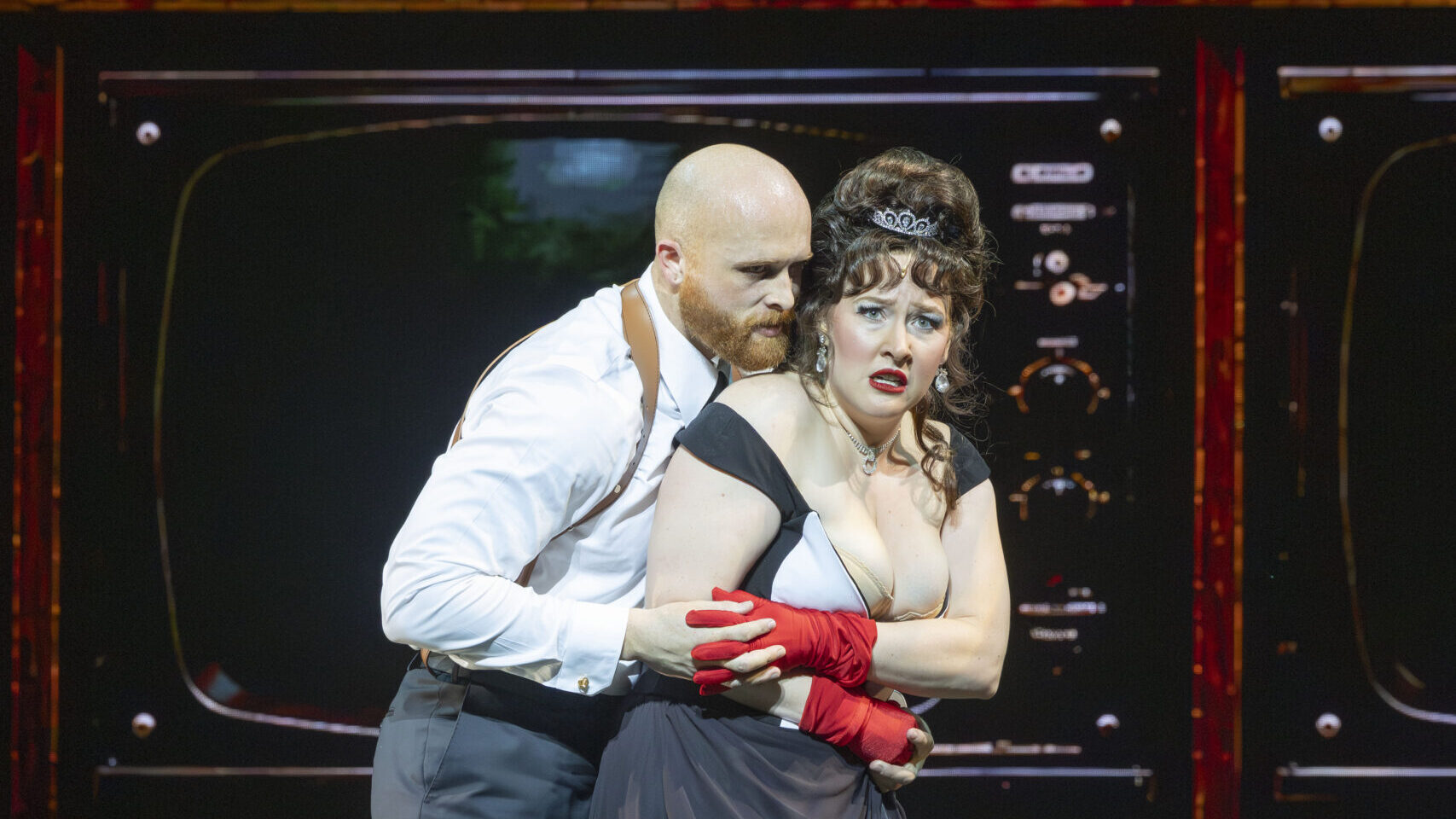
Photo: Cory Weaver
Wolf Trap Opera serves as a talent incubator for young artists, and the leading roles of this season’s Tosca were no exception. Soprano Tessa McQueen, a 2023 Wolf Trap Studio Artist, made an accomplished return to the program in the opera’s titular role. McQueen’s performance showcased strong command of her range and floating high notes, though her instrument lost some of its sheen in the character’s more exuberant exclamations. Her clear, crystalline soprano and smooth vocal transitions made her rendition of “Vissi d’arte” a moving emotional climax.
Also making a welcome return to Wolf Trap Opera, Demetrius Sampson Jr., a 2024 Filene Artist, brought a nicely limber lyric tenor to the role of Mario Cavaradossi. His “E lucevan le stelle” revealed tightly coiled pain that grew in intensity in bitter acceptance of his fate. As Scarpia, baritone Jonathan Patton clearly relished the opportunity to sing this iconic baritone role, and his enthusiasm endeared him to the audience. Patton played the part with a menacing sneer and a sinuously creepy bearing towards Tosca. Cumhur Görgün brought a stately bass to the role of Angelotti while bass Sergio Martinez sang the Sacristan with warmth and a good-natured demeanor.
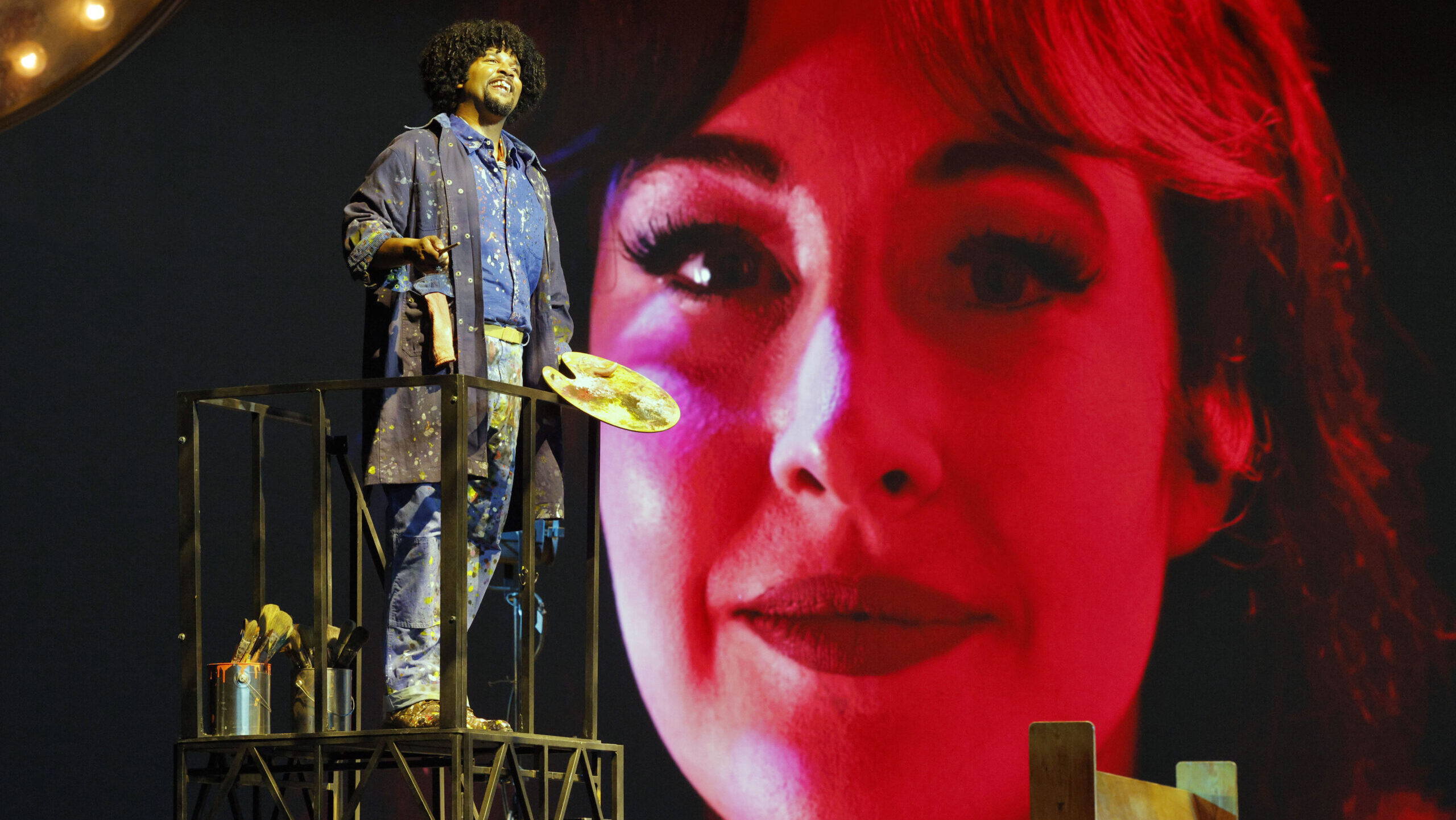
Photo: Cory Weaver
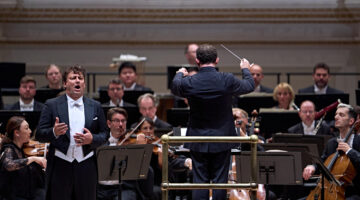
José Luis Gómez’s brisk conducting of the Washington National Opera Orchestra effectively built the tension in Puccini’s score. The tempo felt a bit fast at times in Act I but perfectly suited the melodrama of Act II. The orchestra delivered an ethereal Act III interlude with notable solo playing from the clarinet section. The chorus, led by chorus master William Woodard, and the Children’s Chorus of Washington, led by artistic director Margaret Nomura Clark and executive director Robbie Jacobs, gave strong performances of Tosca’s brief yet important choral scenes, including a chilling Te Deum.
In another joint directing effort following their Wolf Trap Opera production of Kevin Puts’s Silent Night in 2024, the husband-and-wife team Ryan and Tonya McKinny set Tosca in early 1970s Italy, transforming Floria Tosca from opera singer to movie star. A bass-baritone who appeared in the DMV region most recently as John Proctor in Washington National Opera’s production of The Crucible, Ryan McKinny (a Wolf Trap Opera alum) has recently begun directing opera in addition to singing.
Tosca is the rare opera that has a strictly defined time and place: Rome in June 1800. Victorien Sardou’s play La Tosca, on which Puccini’s opera is based, is even more precise: June 17-18, 1800. Restaging such a familiar and context-rich story in a new setting is something of a creative risk and it can be interesting to see enterprising directors tackle such a challenge. The McKinnys swapped the political turbulence of the Napoleonic Wars for that of the Anni di piombo (Years of Lead), an era marked by far-right and far-left extremist violence in Italy.
Tosca’s new role as a movie star and her confrontation with Scarpia raised thought-provoking questions about the experiences of women in the film industry and sexual violence nearly a decade after the #MeToo movement began, but other aspects of the production felt underdeveloped. The staging’s treatment of the complex politics of the Years of Lead was a bit hard for me to understand. The choristers who enter the church near the end of Act I were presented as protesters with vague left-leaning signs, but this portrayal and the blocking didn’t seem to neatly align with the text they were singing, which celebrates the premature news of victory over Napoleon (in this version, undefined rebels). The production’s decision to have Tosca douse Scarpia’s body with alcohol and immolate him along with the (likely flammable) film from the camera in his office was cathartic but perplexing. If Tosca set part of the Palazzo Farnese ablaze, her murder of Scarpia would have presumably been discovered much earlier and she would not have been able to make it to Cavaradossi’s side early the next morning before his execution.
Lawrence E. Moten III’s scenic design was a tribute to the golden age of cinema with bright lights, movie cameras, and a classic movie screen. He fitted out the church with the requisite scaffolding, pews, and statue of the Virgin Mary and gave Scarpia a sleek midcentury office fit for Don Draper. Projections by Adam Larsen effectively set the scene with views of the Roman cityscape. Vivid costumes by Molly Irelan, particularly Cavaradossi’s paint-splattered denim, the Sacristan’s disheveled janitorial uniform, and Tosca’s glamorous sunglasses and fur coat, brought the characters to life. Anne Nesmith’s hair and makeup design completed Tosca’s immaculate diva look. Lighting by Chad R. Jung heightened the drama, especially his use of the color red in the conclusion to Act I. Thunder and lightning from a serendipitously timed evening thunderstorm provided additional drama to Act III.
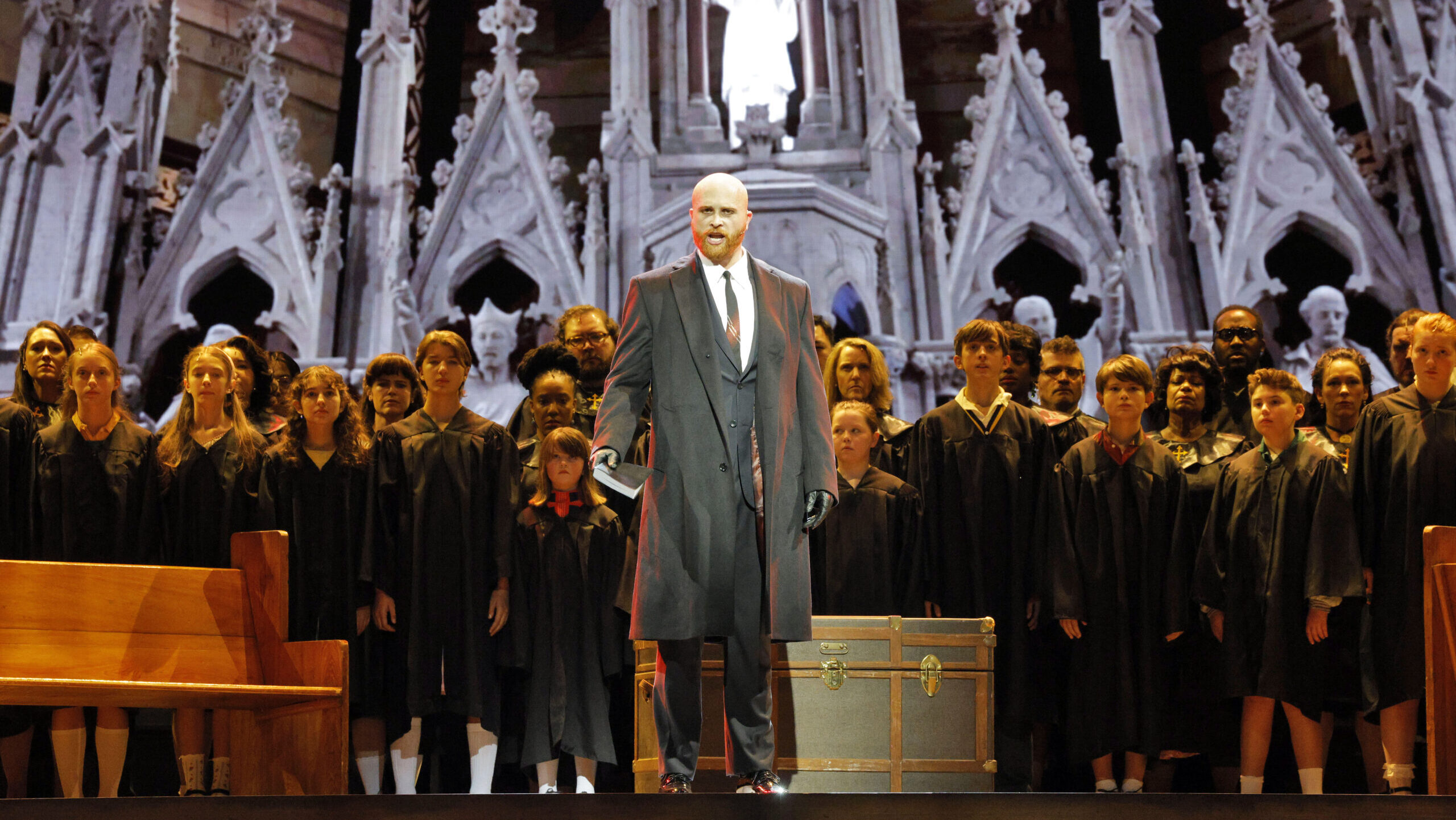
Photo: Cory Weaver
The set ultimately played second fiddle to a continuous video displayed on the movie screen. This film would perhaps make for an interesting standalone adaptation of Tosca; as the backdrop to a live stage drama, it largely proved distracting. The video’s frequent changes in subject and perspective were overstimulating and drew the audience’s attention away from the singers. Some filmed vignettes were more effective than others, such as Angelotti’s escape from prison, the Act I church background, and Cavaradossi’s portrait of Mary Magdalene (represented by a 1965 self-portrait by Faith Ringgold), which faded into Tosca’s face during “Recondita armonia.” Certain parts of the video felt superfluous, however, such as footage of Cavaradossi and Tosca embracing during the Act I love duet as Sampson Jr. and McQueen embraced in real life below the screen. And at some pivotal moments of the story, the production’s overbearing focus on the video detracted from the live action on stage.
In Act II, stomach-churning footage of a bloodied Sampson Jr. undergoing torture eroded some of the opera’s melodramatic tension. Key to Scarpia’s psychological torture of Tosca is the fact that she can hear her lover scream offstage but can’t see him and doesn’t know what’s happening. It’s the fear of the unknown and unseen that leads her to break down. In Act III, Cavaradossi’s execution was depicted solely on the screen, leaving Tosca awkwardly alone on stage to grieve her dead lover with no body in front of her. Tosca’s ensuing death by self-inflicted gunshot wound felt anticlimactic relative to her traditional leap off the Castel Sant’Angelo roof and its poetic symmetry with the night sky as evoked by Cavaradossi in “E lucevan le stelle.”
Andrew Lokay
Andrew Lokay began his career as an opera fan at the San Francisco Opera, where the first performance he saw was Madama Butterfly. He graduated Phi Beta Kappa from Stanford University with a Bachelor of Arts in international relations and French with honors in international security studies. He now lives in Washington, DC and is a frequent audience member for opera and theatre in the nation’s capital.
-
People: Adam Larsen, Anne Nesmith, Chad R. Jung, Cory Weaver, Cumhur Görgün, Demetrius Sampson Jr., Faith Ringgold, Gioachino Puccini, Jonathan Patton, José Luis Gómez, Lawrence E. Moten III, Margaret Nomura Clark, Molly Irelan, Robbie Jacobs, Ryan McKinny, Sergio Martinez, Tessa McQueen, Tonya McKinny, Victorien Sardou, William Woodard
-
Works: Silent Night, The Crucible, Tosca
-
Places & Organizations: Children's Chorus of Washington, Washington National Opera, Washington National Opera Orchestra, Wolf Trap Opera