Aryeh ready for a miracle?
Aryeh Nussbaum Cohen shows that he’s at the top of a crowded pack of countertenors in two recent New York performances with Philharmonia Baroque.
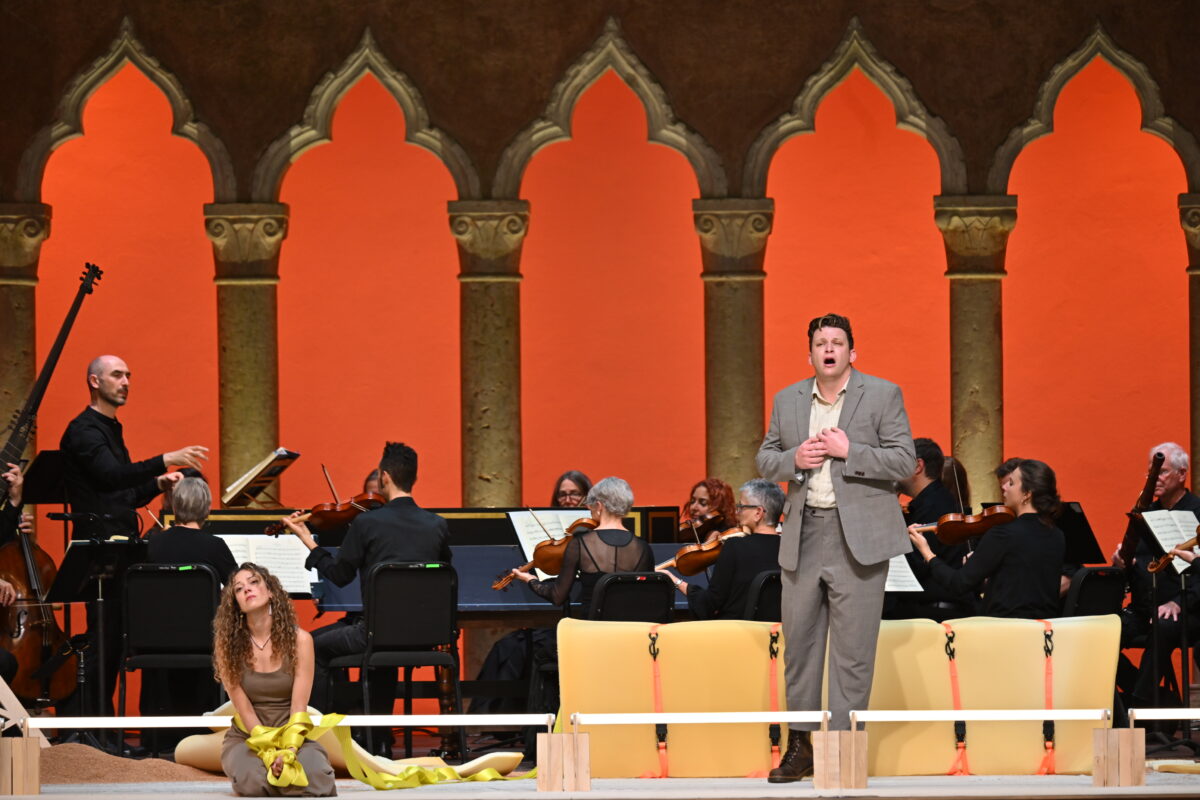
Photo: Gabe Palacio
San Francisco’s Philharmonia Baroque twice visited the New York area to serve up two generous helpings of Handel and to introduce its newest Music Director. First, on the final Sunday in July, conductor Peter Whelan led his polished period-instrument orchestra and five singers in a semi-staged performance of the rarely-heard opera Tolomeo at the Caramoor Center for Music and the Arts in Westchester County. Then last week the conductor, orchestra, and a trio of his Tolomeo singers brought to Lincoln Center’s Summer for the City “Of Rivers and Roses,” a curated program juxtaposing a mix of Handel with three songs by contemporary American composer Caroline Shaw.
1728’s Tolomeo is the fifth and final opera that Handel wrote during the two-year period when he invited the celebrated Faustina Bordoni to join his star-combo of Francesca Cuzzoni and the castrato Senesino. Having both Bordoni and Cuzzoni in the same opera presented a unique challenge as the composer needed to supply each with an equal number of crowd-pleasing arias to display their much-admired talents. None of the previous four pairings—Alessandro, Admeto, Riccardo Primo and Siroe—can be counted among Handel’s strongest operas, yet they all contain some fine music. However, Tolomeo finds the composer at his least inspired, responding to Nicola Francesco Haym’s unusually dense libretto with a string of smoothly accomplished but rarely memorable arias.
Featuring an unusually small cast of just five, Tolomeo offers its audience a tale of two exiled brothers, sons of scheming Cleopatra III, who tangle on the island of Cyprus in matters of love and kingship. Fleeing King Tolomeo, disguised as a shepherd, has been displaced by his brother Alessandro and lost his wife Seleuce in a boating accident. She, still alive but disguised as a shepherdess (naturally!), has to fend off the advances of Araspe, the king of Cyprus. His sister Elisa, pursued by Alessandro, of course, falls in love with Tolomeo. Reversals and recognitions abound until the title character and his queen are reunited and restored, Elisa and Alessandro conveniently find each other, and Araspe is left alone to rule his kingdom.
Performed in front of Whelan’s orchestra in contemporary dress, James Darrah Black’s mostly apt production nimbly delineated the complex plot for the first two acts. However, for the final untangling, Black introduced a set of large mirrored cubes into which his eager cast gazed intently while performing their arias and presumably gained insight into their fraught actions. Thus, the inevitably “happy” denouement proved puzzling if not downright silly.
For the Cuzzoni-Bordoni roles, Black exaggerated their contrasting characters: Nicole Heaston embraced the intensely horny Elisa with energetic verve, while Lauren Snouffer suffered Seleuce’s travails with blandly resigned acceptance. Heaston may sometimes have attacked her sparkling music with less-than-ideal baroque élan, but both sopranos did their best to enliven their warring prima donna arias, despite lacking the finer material with which Handel endowed Alessandro’s Lisaura and Rossane or Admeto’s Alceste and Antigona.
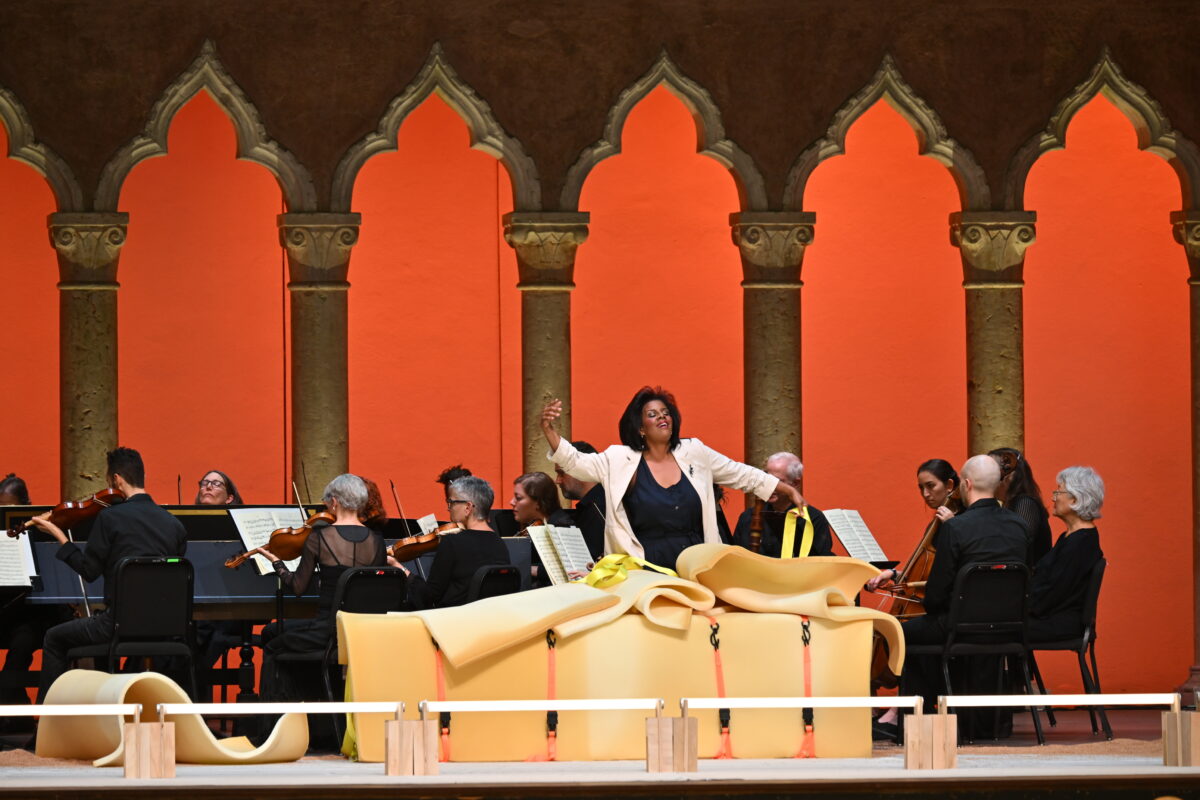
Photo: by Gabe Palacio
Dashon Burton brought a brusque but agile bass-baritone to Araspe’s cardboard villainy, while Kangmin Justin Kim’s countertenor sounded old and wobbly in the recitatives but pleasantly firmer in his arias, though he sometimes struggled with Alessandro’s unrewarding low tessitura.
But the opera lately appears to be all about its title character: popular countertenors Jakub Józef Orliński and Franco Fagioli both recently toured Europe with concert versions. At Caramoor, Aryeh Nussbaum Cohen as Tolomeo finally got his chance to demonstrate to New York audiences that he’s fully arrived as one of the world’s finest countertenors. In 2017, Cohen was a Grand Prize winner of the Metropolitan Opera’s National Council Auditions, and five years later, he made a briefish company debut as Rosenkrantz in the North American premiere of Brett Dean’s Hamlet. While he sang the secondary role of Unulfo in the English Concert’s Rodelinda at Carnegie Hall in 2023, the Brooklyn native has, until now, gathered enthusiastic responses mostly outside the New York area.
In superb voice as both Tolomeo and in his contributions to the “Of Rivers and Roses” concert, Cohen strongly showed off his bronzed, securely seamless countertenor with never a hollow hoot to be heard. Some listeners routinely swear off the entire species for sounding vaguely artificial, but Cohen proves to be that rare creature: a countertenor for people who hate countertenors! Like Anthony Roth Costanzo, another American countertenor, Cohen long embraced Tolomeo’s final scena “Stille amare” (the score’s brightest gem) as his surefire audition numbers, and in Caramoor’s superbly nuanced rendition one definitely heard why. But Cohen and Whelan admirably eschewed the opportunity for a long ovation by instead pushing forward as the character succumbed to the (fake) poison he ingested.
Handel’s duets for high voices are nearly always highlights, and the two for Seleuce and Tolomeo proved to be ideal vehicles for Snouffer and Cohen, who gloriously bemoaned their doomed fate at the end of the second act and then ecstatically celebrated their happy reunion at the opera’s conclusion. “Of Rivers and Roses” offered three further opportunities for the pair to demonstrate their heavenly blend and secure stylistic command. Both the haunting “Who calls my parting soul” from Esther and the wrenching “To thee thou glorious son of worth” from Theodora ravished the ear, but best of all was one of my favorites: Radamisto’s rarely performed but deliciously entrancing “Se teco vive il cor” enhanced by Whelan’s perfect tempi. Snouffer and Cohen had previously collaborated on Music of the Baroque’s Jephtha, again demonstrating that a Philharmonia Baroque Handel duet CD with these forces is a no-brainer!
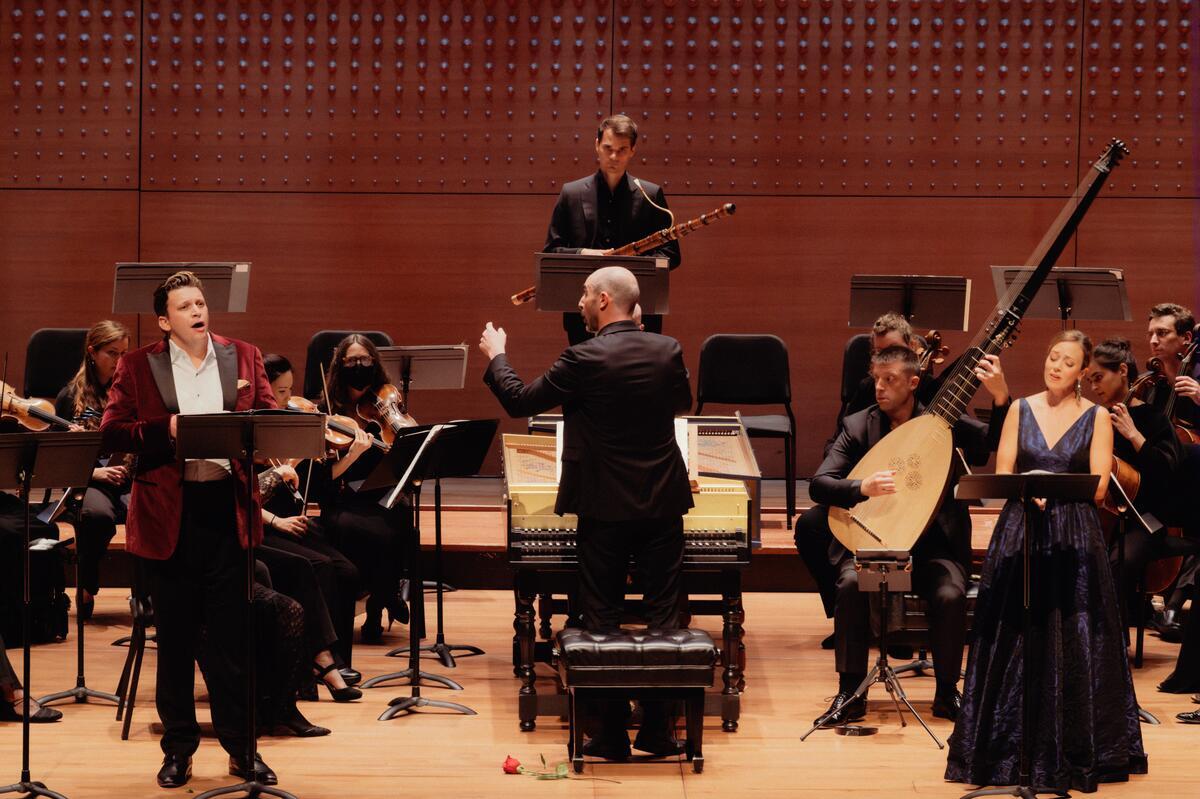
Photo: Lawrence Sumulong
The combination of Handel and Shaw got off to a rocky start when Burton, after a rollicking clash with Snouffer in excerpts from Handel’s secular cantata Apollo e Dafne, transitioned to Shaw’s “The Edge” to a text by Jacob Polley. After securely voicing Apollo’s romantic harassment of Dafne, Burton lost his bearings, his intonation erratic in a piece originally commissioned by Philhamonia Baroque for Anne-Sofie von Otter. Things changed markedly in the second half which Cohen opened spectacularly with “And so,” Shaw’s lushly soaring song to her own text offering a spin on Shakespeare’s “A rose by any other name would smell as sweet.” Snouffer ended the program with Shaw’s affecting “Red, red Rose” to Robert Burns’s famous poem after which the soprano delicately transitioned to Bellezza’s rueful final aria from Il Trionfo del Tempe e del Disinganno. Not to end on such a quiet note, the three singers reappeared for an unexpected encore: “The flocks shall leave the mountain,” the dazzling trio in which the furious Polyphemus threatens the fearful Acis and Galatea.
After thirty-four years as its leader. Nicholas McGegan left Philharmonia Baroque in 2020. Richard Egarr too departed after an embarrassingly brief tenure as his successor. Based on its pair of local appearances. Whelan and PB are off to a splendid start. His orchestra (for his Lincoln Center appearance, the group was dotted with familiar New York faces like Gonzalo X. Ruiz, whose superb oboe shone throughout) played with invigorating energy and stylish vigor. Scattered throughout “Of Rivers and Roses” were movements from the first Water Music suite that danced with unforced brio and featured the bravely forthright horns of Sara Cyrus and Alexandra Cook. Although Tolomeo wasn’t the undiscovered gem that Teseo and Atalanta proved to be when in the recent past McGegan and PB brought them to the area, one hopes that Whelan and his plucky band will visit again—soon!
Cohen’s next big U.S. project will again bring him in striking distance of NYC when in April he’s Ulisse in Deidamia, part of R.B. Schlather’s Hudson Hall series. Handel’s final opera is recommended as a chance to catch yet another episode that Christopher Nolan omitted from his startlingly sexless Odyssey film.

Christopher Corwin
Christopher Corwin began writing for parterre box in 2011 under the pen name “DeCaffarrelli.” His work has also appeared in , The New York Times, Musical America, The Observer, San Francisco Classical Voice and BAMNotes. Like many, he came to opera via the Saturday Met Opera broadcasts which he began listening to at age 11. His particular enthusiasm is 17th and 18th century opera. Since 2015 he has curated the weekly podcast Trove Thursday on parterre box presenting live recordings.
-
People: Alexandra Cook, Anne Sofie von Otter, Anthony Roth Costanzo, Aryeh Nussbaum Cohen, Brett Dean, Caroline Shaw, Christopher Nolan, Dashon Burton, Faustina Bordoni, Francesca Cuzzoni, Franco Fagioli, Gonzalo X. Ruiz, Jacob Polley, Jakub Józef Orli?ski, James Darrah Black, Kangmin Justin Kim, Lauren Snouffer, Nicholas McGegan, Nicola Francesco Haym, Nicole Heaston, Peter Whelan, R.B. Schlather, Richard Egarr, Sara Cyrus, Senesino
-
Works: Acis and Galatea, Admeto, Alessandro, Apollo e Dafne, Atalanta, Deidamia, Esther, Hamlet, Il Trionfo del Tempe e del Disinganno, Jephtha, Radamisto, Riccardo Primo, Rodelinda, Siroe, Teseo, Theodora, Tolomeo, Water Music
-
Places & Organizations: Caramoor Center for Music and the Arts, Carnegie Hall, English Concert, Hudson Hall, Lincoln Center, Metropolitan Opera, Music of the Baroque, San Francisco's Philharmonia Baroque