Wedding from hell
Les Arts Florissants (lightly) stages two Charpentier rarities as a summer wedding gone wrong.
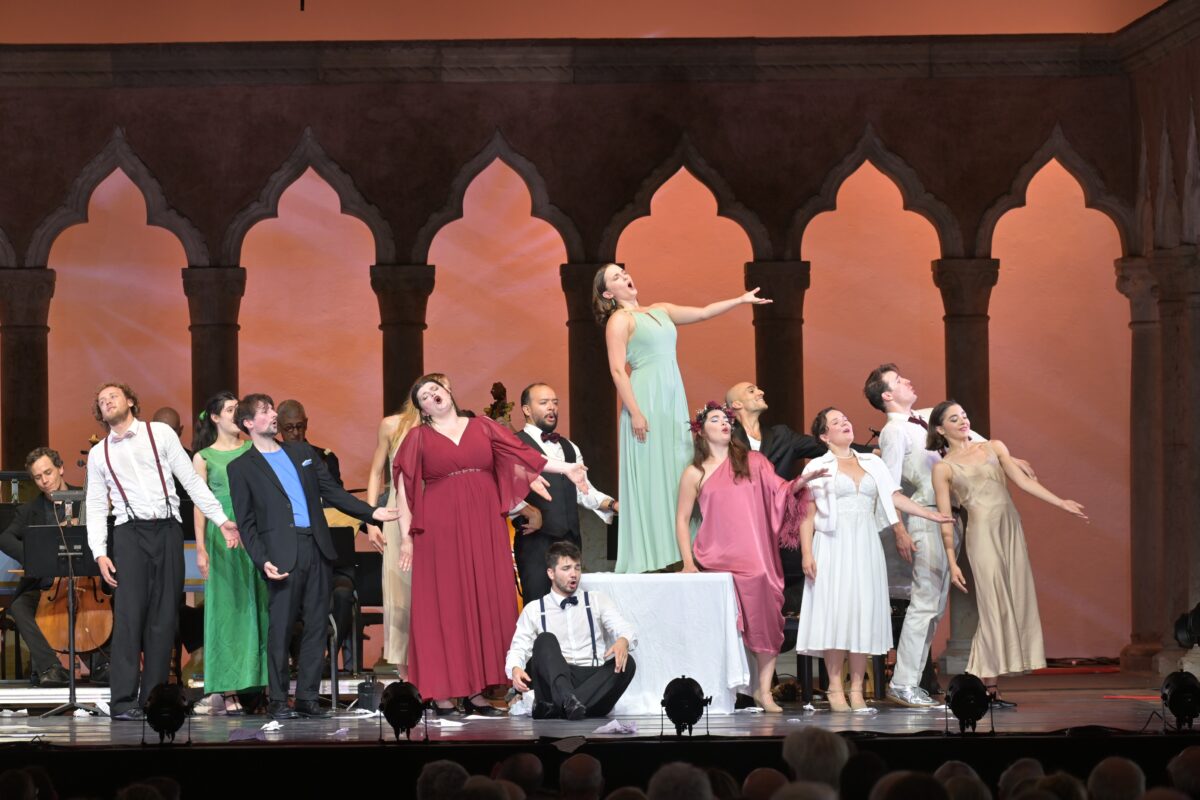
Photo: Gabe Palacio
Following Teatro Nuovo’s Don Giovanni, the other hellbound hero of the summer season was another familiar gent in an unfamiliar operatic work: Orpheus, aka Orphée, as depicted by Marc-Antoine Charpentier in La Descente de l’Orphée aux Enfers, a tragédie lyrique composed in 1686 as presented by Les Arts Florissants. The one-act Charpentier work that gave the company their name, the allegorical Les Arts Florissants (The Flourishing Arts), provided the first-half curtain raiser for the more dramatic, if incomplete, Orpheus drama that followed. It was presented for one night only on July 17 by the Caramoor Festival in Katonah at their Venetian Theater.
Here is a one-way ticket to Hell: For whereas, in most versions, Orpheus goes to the underworld and comes back with Euridice leading to the tragic finale, here it ends with the judgment of Pluto/Hades on the return of Euridice and a celebratory chorus of shades. Either this is all that Charpentier composed, or there was a third act that is lost to time.
These are both chamber or salon operas that were probably originally performed by the household musicians of Charpentier’s employer and patroness, the Mademoiselle de Guise, either at her chateau or that of the Dauphin in 1686 or 1687. It uses a small consort of instrumentalists with about a dozen singing roles (several doubled). I have seen La Descente de l’ Orphée aux Enfers previously, as it was done by the defunct Gotham Chamber Opera under Neal Goren at St. Paul’s Chapel in January 2014. I found the work pastoral and charming but dramatically inert. Les Arts Florissants found more dramatic and musical intensity in the work, locating a searing core of pain while celebrating the redemptive power of music.
Les Arts Florissants presented both works with the same ensemble of ten young singers, recent laureates of the Jardin des Voix training academy. They have been touring this program around the world, often in outdoor venues. As is typical of French opera, baroque or beyond, there is a strong dance element. Choreography by Martin Chaix was performed by four modern dancers utilizing casual contemporary movement that was simple enough that the youthful singers occasionally joined in. The simple semi-staged direction by Marie Lambert-Le Bilhan and Stéphane Facco was fairly basic, featuring no scenery, few props, and modern, boho-type wedding attire, suggested a university opera program performance on a limited budget—very different from the company’s elaborate stagings of Lully’s Atys or Charpentier’s Medée we saw at the Brooklyn Academy of Music back in the nineties. Frankly, a fuller staging with elaborate sets and costumes might have overwhelmed these intimate, modest “pocket operas”, as company founder and conductor William Christie has dubbed them. Christie himself presided over a ten-musician chamber ensemble from the harpsichord.
Les Arts Florissants is a 45-minute allegorical celebration of the power of the arts with individual singers representing painting, architecture, poetry, and, of course, music (who gets more to do) in conflict with War and Discord, who threaten their existence. After the intrusion of War and Discord, Peace enters and prevails, and everyone joins in the song and dance. There is a celebratory tribute to the Roi Soleil, King Louis XIV, who had recently prevailed in a conflict against Spain and the Holy Roman Empire, restoring peace to France. The work was presented as being performed as an entertainment at a wedding—presumably that of Orpheus and Euridice by them and their guests—, serving as a prelude to the tragic work that followed.
The direction and tone changed in La Descente de l’Orphée aux Enfers, which emerged as the more striking and effective work. The singers and the dancers writhed around in black, entwined in black ropes as tormented spirits in hell under red lights. The tone and the colors were darker, both musically and dramatically.
There were standouts among the ensemble. American lyric tenor Richard Pittsinger, tall and handsome (with his bass-baritone father David Pittsinger’s chin, profile and jawline), was a heart-rending Orphée. The theme of the piece is very much the persuasive and redemptive power of music as embodied by Orphée, whose singing soothes the torments of damned souls in hell and moves the hearts of Proserpina and even the fearsome Pluto to mercy. Pittsinger’s plangent tenor was combined with great fervency of delivery that embodied the hero’s pain but also his power over the hearts of others.
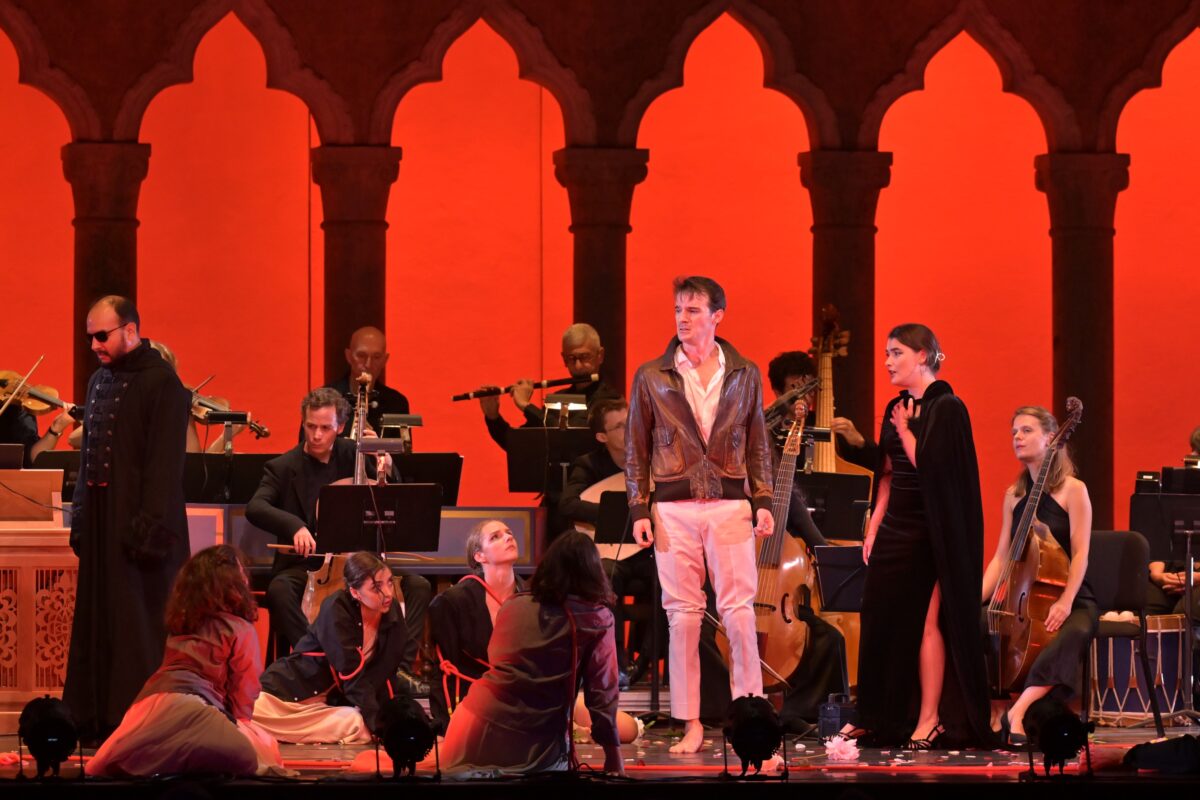
Photo: Gabe Palacio
Other standouts in both operas were American soprano Sarah Fleiss as Proserpina but also Poetry, whose rich tone was more filled out and projected more confidently than the other soprano soloists. Camille Chopin radiated charm as Euridice and La Musique with a confident, animated stage presence and a pointed, piquant soprano. French haut-contre Bastien Rimondi draw attention with his focused tone and precise musicianship in his very small roles while Canadian contralto Sydney Frodsham revealed a strikingly large, voluminous deeper tone underpinning her brief solos and choral contributions. There were a few lower male voices who struggled to match the proper pitches and some undernourished tones from the women but none of this did any real harm to the ensemble. They were all meticulously coached.
It was a perfect entertainment for a pleasant summer night surrounded by trees and statues in the gardens of a country house. The music of Charpentier and the artistry of Les Arts Florissants were eloquent advocates for the power and importance of music and the arts in troubled times of fear and discord.
-
People: Bastien Rimondi, Camille Chopin, Caramoor Festival, David Pittsinger, Les Arts Florissants, Marc-Antoine Charpentier, Neal Goren, Richard Pittsinger, Sarah Fleiss, William Christie
-
Works: Atys, Don Giovanni, La Descente de l’Orphée aux Enfers, Medea
-
Places & Organizations: Brooklyn Academy of Music, Gotham Chamber Opera, Les Arts Florissants, Teatro Nuovo