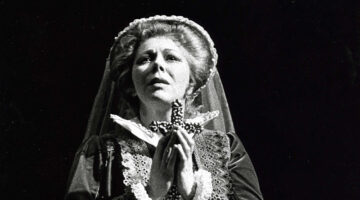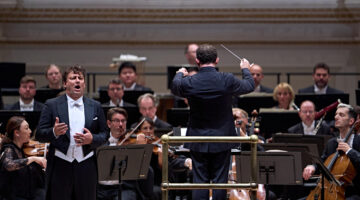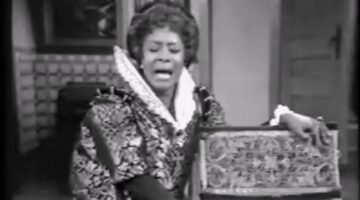
John Barbirolli was a great opera conductor
Fifty some years ago I stumbled on to John Barbirolli‘s recording of matchless Elgar & V-Williams music for strings and discovered my go-to conductor for life.
 By
TC
By
TC
I instantly succumbed to his warmth, the emotional expansiveness and sense of spontaneous drama, the songful/soulful utterance–which is pretty much the mark of all his recorded repertoire. But in Romantic music, in particular (Mahler, Elgar, Strauss, Bruckner, Puccini, Verdi, early Sibelius), I find his con amore music-making supreme. And that’s nowhere more evident than in his classic Madama Butterfly with Scotto & Bergonzi.
As a young man he conducted a lot of opera, both at Covent Garden and as director of the Royal Opera’s touring company, making records with Turner, Favero, Pertile, Melchior, Gigli, Leider, and others. He returned to Covent Garden in the ’50s for productions of Wagner, Gluck, Puccini, Verdi (Callas’s Aida), and was even offered the position of Musical Director, which he turned down to devote himself to the Halle band. Only in the last years of his life did he begin to record operas: Butterfly, Otello, Dido & Aeneas, though at the time of his death there were recordings planned of Manon Lescaut with Caballe and Falstaff.
The Butterfly is a familiar performance, and his shaping hand is all over it so there are any number of famous orchestral passages to choose from as examples here; but maybe better is just this short bit in which his characteristic way with the score supports to the scene–the phrasing, the tempo, the dynamics, the whole charm of the accompaniment being very Barbirolli. Small touches like this throughout the piece still get me every time. And the old hands in the Rome Opera Orchestra, reportedly delighted by the way he caressed such small details of the score, went to management and asked that he be engaged for the next season–an invitation he accepted, returning a few years later to conduct an Aida with them.
-
People: Carlo Bergonzi, John Barbirolli, Maria Callas, Montserrat Caballé, Renata Scotto
-
Works: Aïda, Dido and Aeneas, Falstaff, Madama Butterfly, Manon Lescaut, Otello
-
Places & Organizations: Rome Opera