Tsar power
Zany gags keep Zar und Zimmermann zipping along at the Deutsche Oper Berlin.
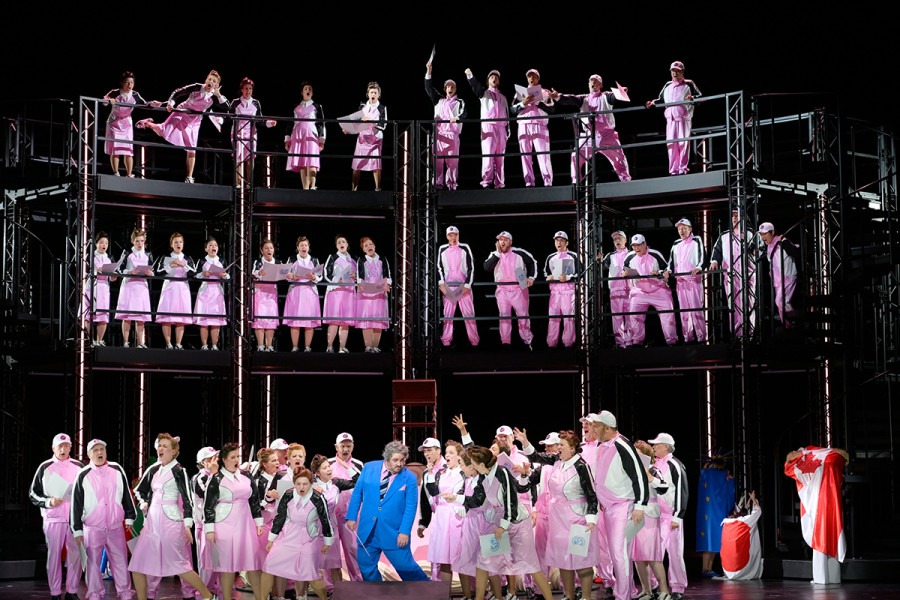
Photo: Thomas Aurin
“Don’t be a tsar, be a carpenter,” proclaimed the Deutsche Oper Berlin Ensemble as the curtain fell on Albert Lortzing’s Zar und Zimmermann. The age-old urge to topple regimes resonated throughout the spieloper, ultimately concluding on a positive note in a Mozartian, “Ah, Tutti Contenti” fashion.
An operatic “deep cut”, Lortzing’s Zar und Zimmermann premiered in December 1837 in Leipzig, and there had not been a new production in Berlin since that by Winfried Bauernfeind in the 1980s. The long-awaited production opened last month at the Deutsche Oper Berlin, succeeding an entire festival of Lortzing’s works in Leipzig this past spring. The Deutsche Oper production directed by Martin G. Berger and conducted by Antonello Manacorda, received quite a few negative reviews, so I obviously had to go see the “bonbonfarbenen Show” for myself.
The gist of the piece is as follows: Tsar Peter I of Russia travels to the Netherlands to commit industrial espionage. In Saardam, Peter befriends a defector also named Peter (Ivanov), and while one Peter struggles to contain his jealousy over his girlfriend, Marie, Tsar Peter faces a political uprising back home. When Saardam’s mayor, van Bett, attempts to locate the undercover Tsar, what follows is a comedic case of mistaken identity.
Potentially to avoid Russian geopolitics, Berger invented a small “operetta state” that Tsar Peter presides over, Volkszarentums Tschirikistan. Berger also updated the dialogue throughout the spieloper, allowing for details such as wiretapping and election rigging to heighten the drama. The updated dialogue and modern production upset critics, and while some of their criticism was warranted, I quite enjoyed Berger’s production.
The opera opened with a seemingly AI-generated propaganda film. Generally, the use of anything remotely AI-generated is an immediate turn-off for me, as I believe that cultural institutions should prioritize the artistic output of human beings over that of machines. However, the propaganda film was most likely meant to paint the uncanny farce of the tsarist “utopia” of Volkszarentums Tschirikistan. The absurdity of Tschirikistan was clearly tongue-in-cheek, from their economy based on canoe carpentry to their national animal, the unicorn, centered on the nation’s flag. The costuming by Esther Bialas, too, reflected a step away from reality as the ensemble wore Eastern-European-coded pink tracksuits.
While Berger’s added dialogue may have introduced unnecessary characters and plot lines, it provided many opportunities for genuine laughter: for example, a consistent gag that everyone was named Peter. An especially hysterical moment followed the introduction of a new character, and the reasoning for doing so was “[because] the composer wrote a sextet.” The beloved “dance of the clogs” earned many smiles, having been transformed into a razzle dazzle, Broadway-style tap number.
As for the vocal performances, Artur Garbas (Tsar Peter) and Patrick Zielke (van Bett) were the clear standouts. Garbas, a young baritone, has an old-school, blooming Baritone sound and a charismatic presence to go along with it. Zielke was perfectly cast as the comedic van Bett, running to and fro without missing a measure of patter. Unfortunately, the central soprano role (Marie), sung by Nadja Mchantaf, disappointed, for while her voice is lovely, it came across as labored, swallowed, and over-covered.

Madison Schindele
Maddie Schindele is based between NYC and Berlin and is a Ph.D. candidate in musicology. She enjoys writing about modernist German opera, disability, and feminist musings!
-
People: Albert Lortzing, Antonello Manacorda, Artur Garbas, Esther Bialas, Martin G. Berger, Nadja Mchantaf, Patrick Zielke
-
Works: Zar und Zimmermann
-
Places & Organizations: Deutsche Oper Berlin