Super rich kids
Wolf Trap Opera triumphs in a fizzy, fun Cenerentola.
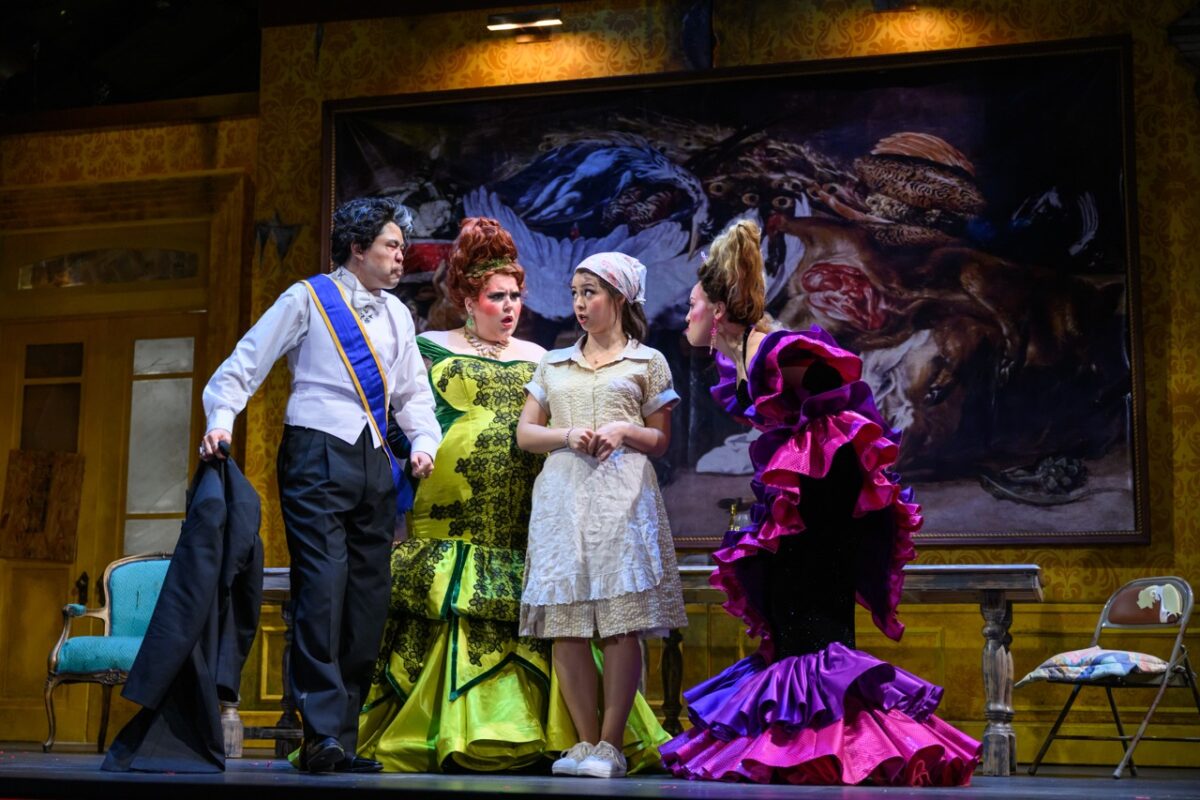
Ziniu Zhao, Emily Treigle, Sophia Maekawa, and Angela Yam. Photo: Rich Kessler
The highest compliment I can give to Wolf Trap Opera’s production of La Cenerentola is that everyone seemed to be having fun. The evening, opening night for the show’s run, which concludes on June 27, fizzed with unselfconscious silliness and, at times, truly remarkable bel canto virtuosity. “You can tell that these people were the cool theater kids,” my companion said of the performers. Like watching a scrappy college football game, there was a rough quality, too, which only made the proceedings more compelling. Somewhere, Rossini is toasting this group —and for good reason.
We began with a staged overture. Normally I think this dilutes the power of the music, which is, in itself, a powerful sonic primer. Yet in this production, it worked. The prince and his valets walk on stage and perform the identity swap in front of the audience; afterwards, the “curtain” (here, a sliding door) rolls aside to reveal a messy den populated with spoiled rich girls reading magazines. The director, Joel Ivany, also wisely introduces Don Magnifico’s character (the father of Cinderella and the two evil stepsisters) as an old, drunken wastrel – he clomps down the stairs, sells a painting, swigs from a bottle.
The opera proper begins with a melancholy daydream from Cinderella (whose actual name is Angelina), sung with dusky soulfulness by the mezzo-soprano Sophia Maekawa. Angelina is taunted by her sisters, Clorinda (Angela Yam) and Tisbe (Emily Treigle). Both sisters were comedic revelations, wrapped in the most delicious camp, especially Yam, who plays the older sister with a tart, over-the-top narcissism, and has a light, clear soprano to boot. The rest of the story is familiar to us: Don Ramiro, the prince, disguises himself as his valet, while pressing the poor driver into his service to discern the true nature of the sisters. Maekawa deserves plaudits, too, for her acting. When that melancholy tune comes back in the final act, this time she luxuriates in the melody, wine glass in hand, content in the knowledge that she had won.
It was around this time that I heard perhaps the most spectacular individual performance of the year. While Maekawa was the most consistent singer of the evening, the most spectacular was Angel Raii Gomez, playing Don Ramiro, who stunned with a sustained, breathtaking high F in “Sì, ritrovarla io giuro”, which, in the words of another one of my companions, made his “balls go up into [his] stomach.” My heart, at least, was in my throat. In their Act I duet, “Un soave non so che,” in which Don Ramiro and Angelina fall in love at first sight, Gomez and Maekawa nailed every note and arpeggio with almost mechanical precision. Such was their vocal chemistry, I found myself wanting a separate recital, a la Lawrence Brownlee and Erin Morely’s recent Golden Age collaboration.
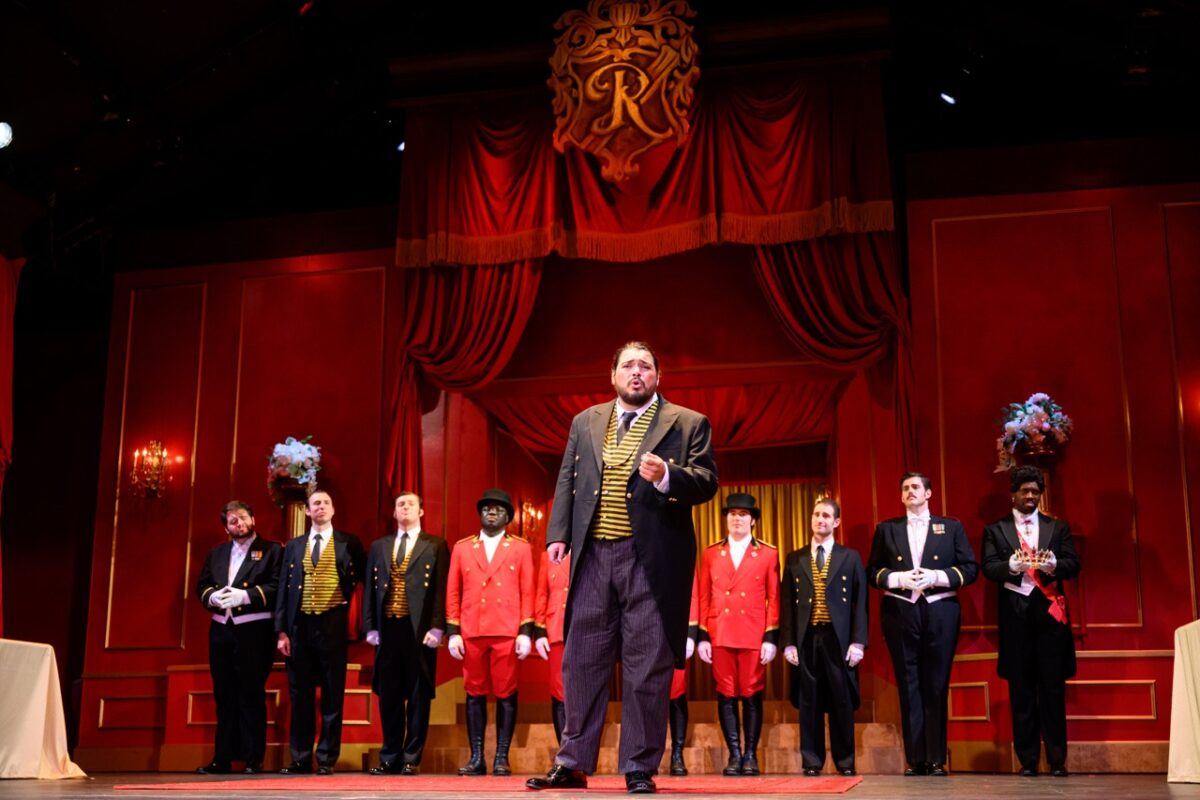
Angel Raii Gomez and Members of the Wolf Trap Opera Studio, Photo: Rich Kessler
The basso cantante contingent distinguished themselves primarily for their comedic chops. Ziniu Zhao, playing Don Magnifico, showed himself to be a master of Rossinian patter, pulling off the verbal-vocal acrobatics of “Sia qualunque delle figlie” while waving a wine bottle and chasing the valets around the stage. Alidoro, the fairy godmother-type figure, played by Cumhur Görgün, was sufficiently mischievous in a curiously restrained, dignified way throughout the night, drawing laughs as he bent the limbs of the frozen singers in the Act II sextet. Korin Thomas-Smith, playing the driver Dandini, had a more muscular voice, even if he didn’t quite pull off Mr. Zhao’s rapid-fire pyrotechnics. His acting, however, was perhaps the most subtle of all the male roles, striding with self-contained ease across the stage as the fatefully elevated valet. He was able to draw laughs with popping eyeballs, arched brows, exaggerated exasperation, and comic seduction.
All this froth was complemented by the human scale of the space. Scattered laughter in a huge theater can sometimes feel pathetic. The Barns at Wolf Trap is, as the name suggests, a restored 18th-century barn, and—at just 382 seats—not a huge one. Nestled in the woods of Wolf Trap National Park, the venue’s wood-paneled, low-lit interior glows with cozy familiarity. Compare this to the Metropolitan Opera, for example, whose cavernous environs can feel remote, cold, almost sepulchral. That was never a problem here. Laughter ripped through the modest crowd like wildfire – a reminder that this repertoire was built for a place like the Barns. Similarly, the orchestra, led with lapidary sheen by maestro Louis Lohraseb, fed the farce with rumbling, chirping panache, falling down only occasionally where the singers could have used better pacing. In Angelina’s final aria, “Non più mesta”, for example, I wished that Mr. Lohreb would give Maekawa a chance to keep up. The soprano, for her part, drilled the coloratura runs with confidence, demonstrating healthy agility in the voice.
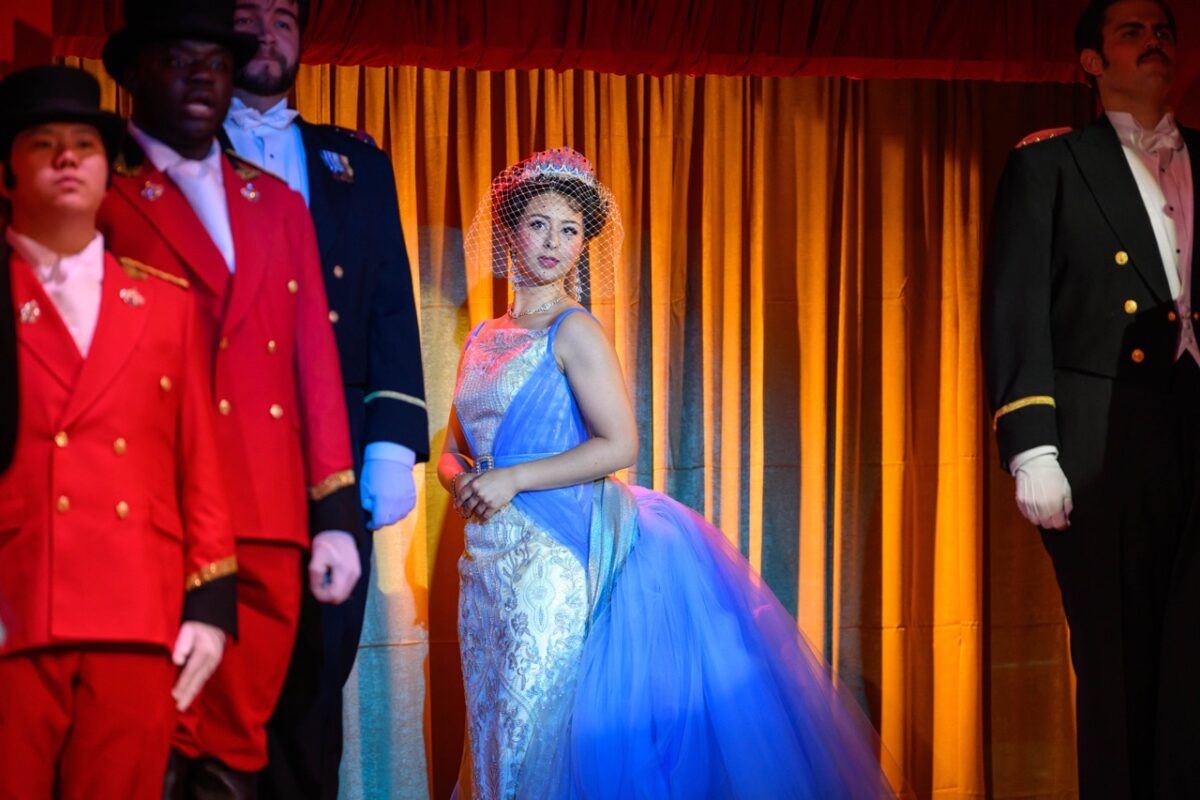
Sophia Maekawa. Photo: Rich Kessler
Like operatic smelling salts, Wolf Trap’s production will wake you up to the comedic possibilities of the form. And, somehow, there are still tickets remaining in the run. Given the magic happening in the woods of northern Virginia, that shouldn’t last for long.
La Cenerentola’s run continues through June 27.

Brendan Latimer
Brendan Latimer is a writer and urban planner based in Baltimore, MD. He invented the dark chocolate with orange juice combo. You can find him on Instagram at @b_lat_ and @operanoises.
-
Topics: "reviews"
-
People: Angel Raii Gomez, Angela Yam, Cumhur Görgün, Emily Treigle, Erin Morely, Gioachino Rossini, Joel Ivany, Korin Thomas-Smith, Lawrence Brownlee, Louis Lohraseb, Sophia Maekawa, Wolf Trap Opera, Ziniu Zhao
-
Works: La cenerentola
-
Places & Organizations: Metropolitan Opera, Wolf Trap Opera