Lise with an “S”
Emma Hoffman reports on the glimmers of ecstatic artistry in Lise Davidsen‘s all-Schubert recital at Carnegie Hall with James Baillieu.
 By
Emma Hoffman
By
Emma Hoffman
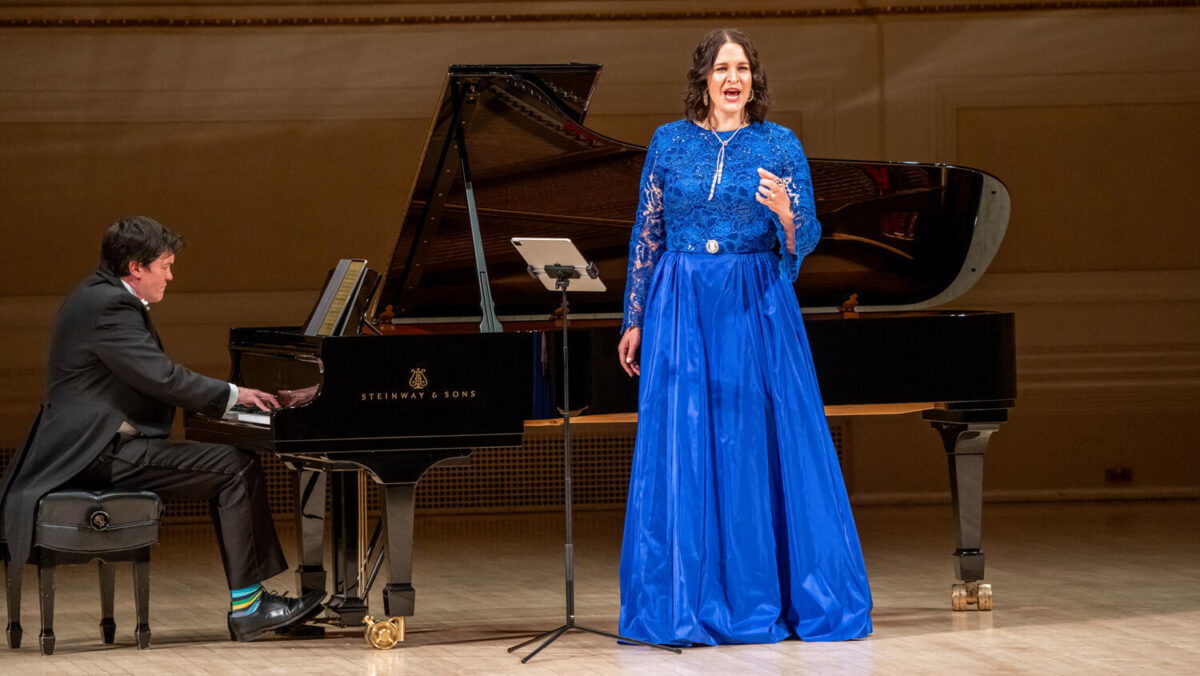
Photo: Stephanie Berger, c/o Carnegie Hall
There are voices, and then there is Lise Davidsen.
In the critical toolbox, voices are likened to all manner of things: threads and fabrics, other instruments, even certain tastes and scents. Davidsen’s soprano, on the other hand, cannot be likened to something you take in-hand. Yes, her soprano could be evoked by a pipe organ or some grand tapestry, but it is, perhaps, more apt to describe it in terms of spaces, of places to inhabit, if only briefly. As her all-Schubert program with James Baillieu at Carnegie Hall last Friday evening proved, her sound is not something a listener can imbibe; rather, it engulfs the listener through its sheer power.
In the first half of the program, that power could prove problematic. Her vibrato weighed down upon “Am Bach im Frühlinge” and “Ganymed,” casting a wake behind Baillieu’s sprightly and characterful accompaniment. (It should be noted that the piano had to be re-tuned at intermission.) And while her voice broke through the gothic fogs of “Der Zwerg” with the intensity of a Fresnel lens, some untextured phrasing and imprecise diction (she referenced an iPad intermittently throughout the program) left the narrative unmoored. This initial unwieldiness lent “Grethchen am Spinnrade” a frantic quality, though she smartly attenuated her sound before a spine-tingling cry up the piece’s climactic B flat.
In the selections from Gesänge aus Wilhelm Meister, however, things clicked into place. Her dynamics were more controlled in “Kennst du das Land”; the delicacy with which she painted the groves of Italy broke into ecstasy as she imagined returning to her homeland, a warmth suffusing the steeliness of her soprano. The long phrases of “Heiß mich nicht reden” unfurled with gorgeous gloom, and she sang the last verses in near-straight tone, gradually fading away—if only the audience’s enthusiasm could have waited, and we could have lingered in that silence for a moment longer. “So laßt mich scheinen” revealed a luminosity to her middle voice that can sometimes dim in halls like the Met, while “Nur wer die Sehnsucht kennt” emerged as one sweeping, heart-rending sigh, supported by Baillieu’s dusky tones. Those tones grew into the dirge of “Der Tod und das Mädchen.” Davidsen seemed transfixed before panic flashed across her face; she launched into the maiden’s pleas. She invoked death in the second verse with a plainspokenness, ending the first half of the program on a note of calm resolve.
After a brief intermission and outfit change for the soprano from royal blue to brown (she deserved better than what she wore—let’s get this diva some couture!), Davidsen and Balilieu returned for brighter fare: “Der Musensohn” and “Lachen und Weinen,” both winsomely performed. Their communication throughout “Suleika I” was ideal, as they applied careful rubato to coax out the feelings of longing and winds evoked in the text. Before a lovely “Auf dem See”, she addressed the audience with her characteristic modesty, likening the narrator of the song’s gratitude for the natural world to her gratitude for being able to perform in New York: “I wake up here, and I’m like, ‘oh my god!’” If that did not capture the audience’s heart, the radiance of the succeeding “Der blinde Knabe” certainly did.
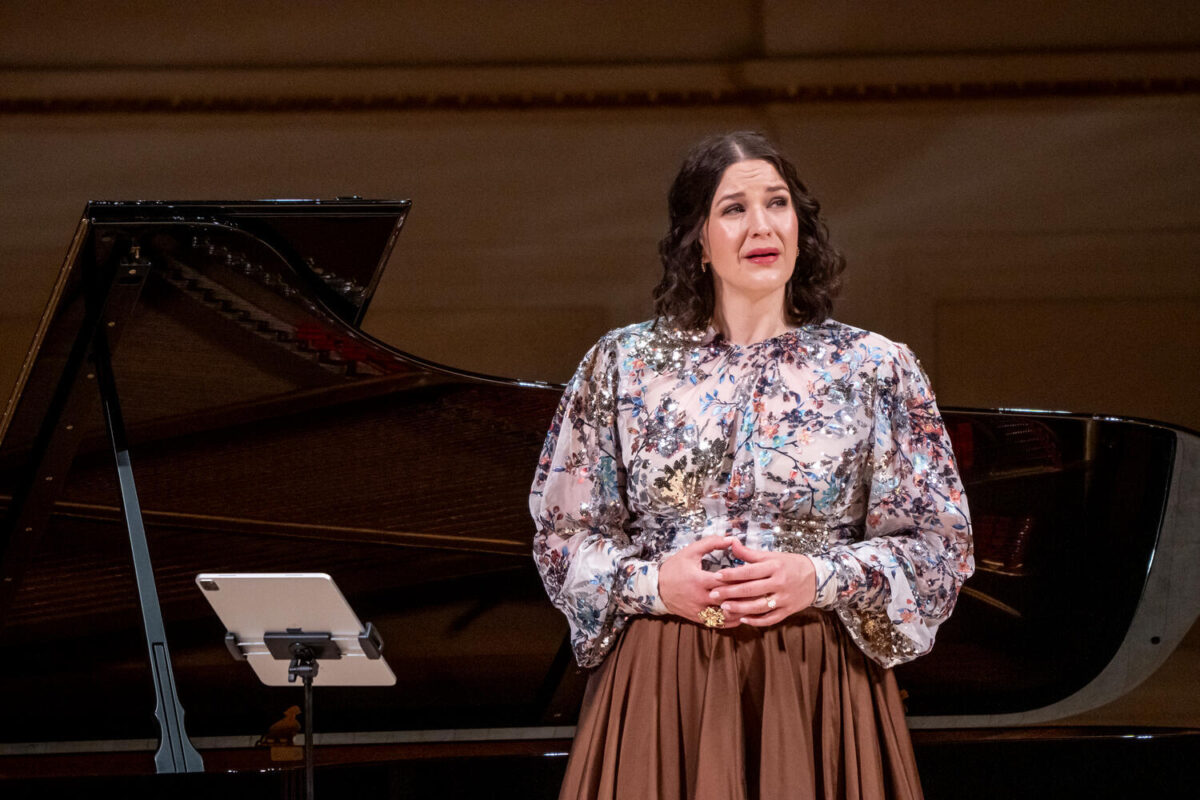
Photo: Stephanie Berger, c/o Carnegie Hall
A stunning juxtaposition followed. “Du bist die Ruh” unfurled as Baillieu’s playing dappled the warmth of dawn. The color of Davidsen’s voice seemed only to become more vivid in its sotto voce intimacy, gliding slowly towards a crescendo in the final verse, then floating back to a pianissimo. In this sublime stillness, the red velvet and gild of the hall faded, and I felt as though I was staring down into sky reflected in the blue-green expanse of a pool, disturbed only by the glimmer of sunlight on its surface. Then in the sumptuous grandeur of “Die Allmacht”, her voice seemed to pierce that same sky as would a cathedral spire, her hands, which she had largely restrained to subtle, small gestures, were raised upright.
“Die junge Nonne” returned the program to narrative ballads, with Davidsen layering an eerie cast over the opening invocations of the storm. The concluding “alleluias” shimmered. Soprano and accompanist matched each other in ferocity in “Erlkönig”, with Balilieu hunching over the keyboard like the titular demon and Davidsen adopting a nasal tone to conjure the seductive, sinister fairy world. She delivered the denouement (“In seninen Armen das Kind war tot”) with an angry glare, as if outraged at the father’s neglect of his child, a level of dramatic insight I do not recall from her performance of the same lied at her Met recital. “Litanei auf das Fest aller Seelen” returned us to stillness and crisp, cool-toned depths. The audience’s reception was ecstatic, and they returned for two encores: “An die Musik” and “An der Natur”.
If the opera house is the natural fit for Davidsen the voice, the recital may be the natural format for the Davidsen the artist: straightforward and seemingly humble, but allowing for myriad textures, colors, and dimensions of sound to emerge and immerse.
Emma Hoffman
Emma Hoffman is a graduate of Barnard College. In 20 years she’ll be a crusty Upper West Sider in a babushka.
-
People: James Baillieu, Lise Davidsen
-
Places & Organizations: Carnegie Hall, Metropolitan Opera