On the party platform
Don’t expect any sweeping statements from Franz Welser-Möst ‘s polished, if dramatically inert, Fidelio.
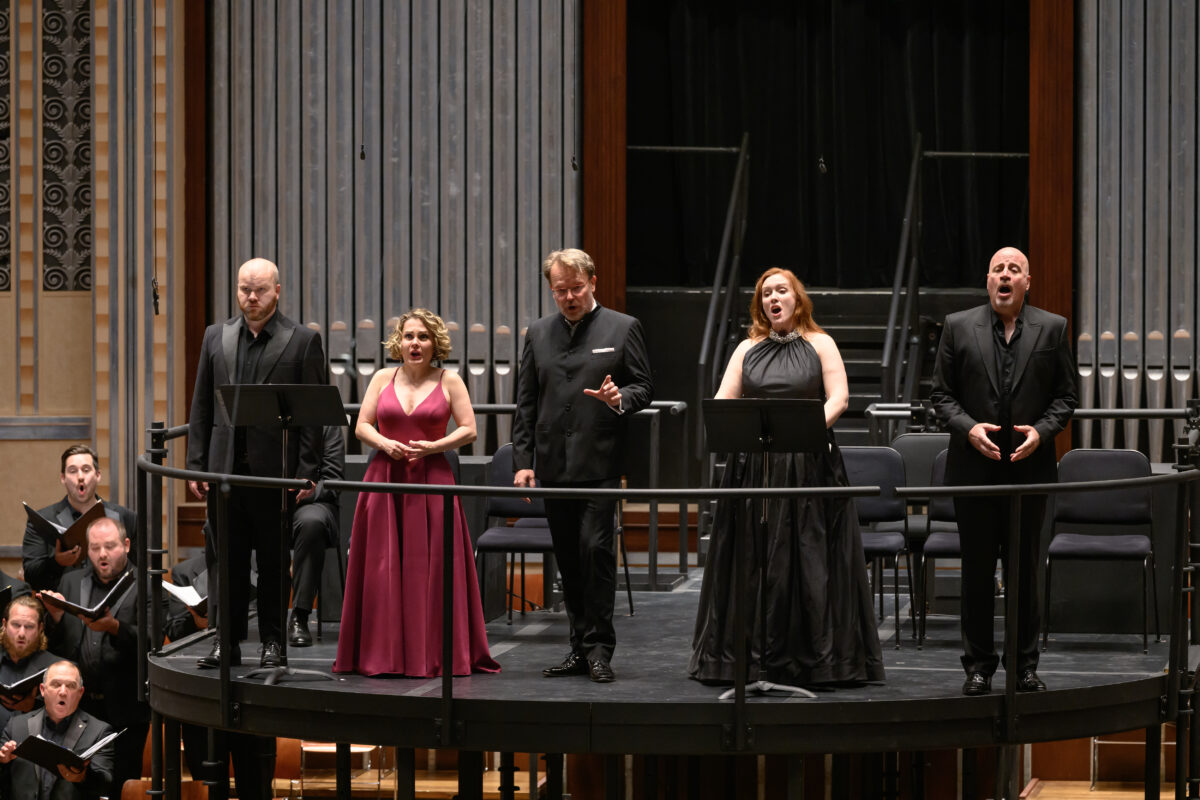
Photo: Yevhen Gulenko, courtesy of The Cleveland Orchestra
In a program note for The Cleveland Orchestra’s concert staging of Fidelio, conductor Franz Welser-Möst contends that any production of Beethoven’s sole opera “joins a long history of political performances.” An audience member needn’t look far to understand how this work, which venerates those willing to put their lives on the line for social justice and critiques the perverted ideals of revolutionary politics, remains relevant in the United States of 2026.
The performance itself even took on an extra-textual layer of meaning last month, when the orchestra announced that Malin Byström, the originally announced Leonore, had withdrawn due to visa processing delays. While it’s hard to imagine immigration and customs enforcement viewing a Swedish spinto soprano as a threat to national security, the absence of a significant international artist underscores the shrinking of America’s cultural world in the current moment.
Artists such as Christian Tetzlaff and András Schiff have already announced they won’t perform in the US during Donald Trump’s presidency, and others are surely hesitant to make the country a regular stop in the ensuing years.
It would be gratifying to say the Cleveland Fidelio offered a searing critique of the national (and international) political climate, but at the final matinee performance on May 24, the results were often musically and dramatically inert. As has become common with the annual opera productions at Severance Hall, Welser-Möst placed the soloists on a raised platform in the center of the stage; this likely helped with projection but often obscured facial expressions and body language, even from prime parquet seats.
With no stage director credited, each singer seemed to be left to their own devices in terms of crafting character. This left several reverting to received wisdom: Ashley Emerson’s hoydenish Marzelline, Owen McCausland’s lovestruck Jaquino, Raymond Aceto’s bumbling Rocco. Tomasz Konieczny, a veteran of the Met’s recent revival, camped it up as Don Pizarro, relishing the boos that greeted his current call. I’d like to make clear that mine were directed at his blunt, legato-less, unmusical singing, not his Sheriff of Nottingham schtick.
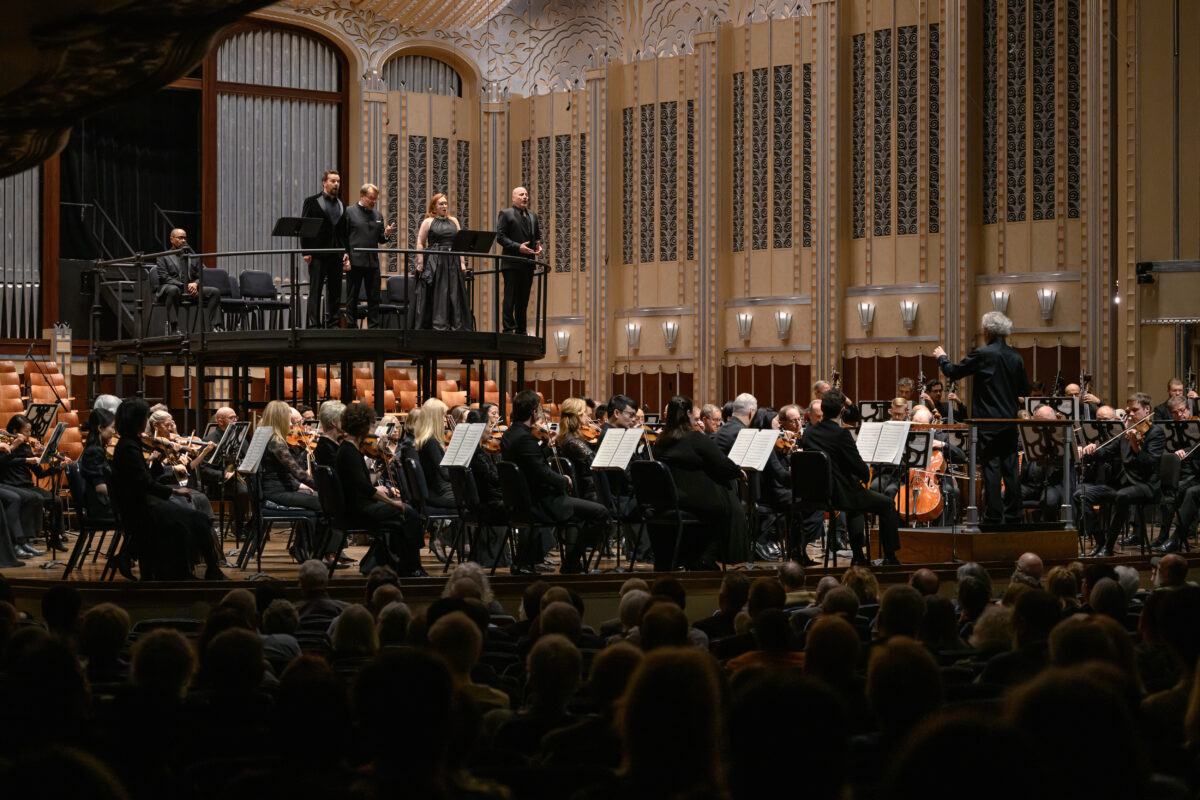
Photo: Yevhen Gulenko, courtesy of The Cleveland Orchestra
In her role debut, Sara Jakubiak replaced Byström and delivered an honorable performance that still felt like a work in progress. She spent much of the afternoon glued to her score — an awkward distinction in a performance where the rest of the company sang from memory — and her focus on getting the music right limited her characterization. There were silent moments where her dramatic artistry shone through, as when Leonore, disguised as Fidelio, first recognized her husband Florestan’s voice in the dungeon.
In “Abscheulicher!,” Jakubiak coped gracefully with glacial tempos from Welser-Möst that pushed the scena to nearly 10 minutes. The conductor favored a relaxed approach to the music throughout the performance, which often turned ponderous. Only in the Prisoners’ Chorus, which featured distinguished singing from Francisco Prado as the Second Prisoner, did this approach make sense. The Cleveland Orchestra Chorus, prepared by Lisa Wong, was up to its usual high standard.
David Butt Phillip, another holdover from last season’s New York staging, brought burnished tone and impressive messa di voce to “Gott! Welch Dunkel hier!” Next season, he and Jakubiak will take on the Emperor and Empress in Die Frau ohne Schatten, Welser-Möst’s valedictory production as he finishes a 25-year run as Cleveland’s music director.
In perhaps the concert’s biggest fumble, the music was punctuated by superfluous narration, which the finely written supertitles rendered totally unnecessary. It was performed by Tony F. Sias, president of Cleveland’s Karamu House, the country’s oldest extant Black theater company. While Sias was clearly game, his halting delivery often zapped the opera’s forward momentum. He also regrettably mispronounced or fumbled many character names, at one point referring to the villain as “Don Piazza.”
Two redeeming qualities arrived near the afternoon’s conclusion. Dashon Burton unleashed a warm and resonant bass-baritone as Don Fernando, complementing his luscious singing with a dignified sense of character. And prior to the final scene, Welser-Möst interpolated the Leonore Overture No. 3, which began stately and elegant before unleashing a musical fury largely absent from the preceding performance. Although these operas-in-concert have brought an international sense of the art form to the city, this addition underscored where The Cleveland Orchestra truly shines.
-
Topics: beethoven, concert performances, Review
-
People: Ashley Emerson, Dashon Burton, David Butt Phillip, Franz Welser-Möst, Lisa Wong, Malin Byström, Owen McCausland, Raymond Aceto, Sara Jakubiak, The Cleveland Orchestra, Tomasz Konieczny
-
Works: Die Frau ohne Schatten, Fidelio
-
Places & Organizations: Metropolitan Opera, Severance Hall, The Cleveland Orchestra