Difficult people
Anna Pirozzi makes a welcome return to the Metropolitan Opera, but Turandot remains as thorny as ever.
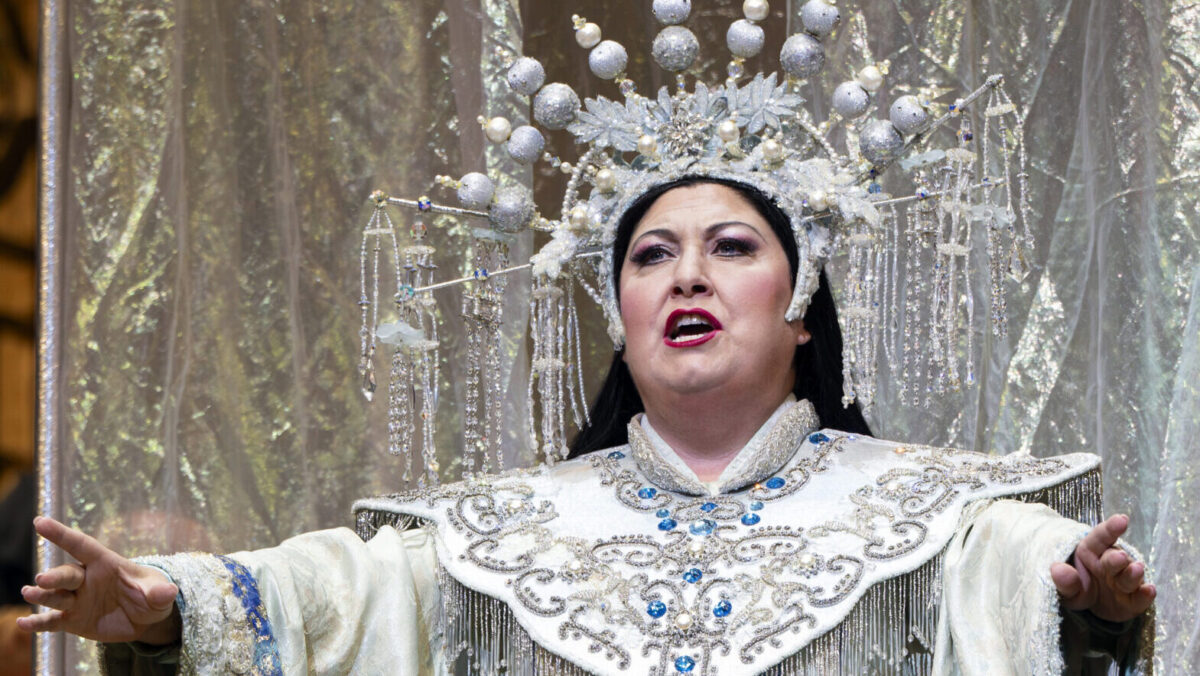
Anna Pirozzi in the title role of Puccini’s “Turandot.” Photo: Jonathan Tichler / Met Opera
Turandot may be an opera for our times because it is about when not very nice people who lack empathy win and maintain power after doing horrible things and treating people badly. It is also about a hero who pins his hopes on such a person and benefits enormously at the expense of his family and loved ones. I am reminded of the retired WQXR announcer Nimet Habachy who declared (in that clipped Anglo-Egyptian accent of hers) after an afternoon radio broadcast of Turandot “Have you ever thought that perhaps Calaf and Turandot deserve each other?”. One of the reasons Puccini got creatively blocked and couldn’t complete the final duet was the problem of two lovers who are more scorpions in a mating dance than transfigured, triumphant lovers. Puccini couldn’t find the humanity in the duo, so the music didn’t come. The death of Liù feels real, but the final love duet registers hollow after it. I think Alfano did a good job, however, and sometimes I’d like to hear the Met do the unedited, complete original Alfano finale.
This May and June, the Metropolitan Opera is presenting rotating back-to-back performances of popular Puccini warhorses with alternate casts. Turandot is very much an opera dependent on casting because it is all about larger-than-life voices and spectacle. The first performance of the second cast on March 19th certainly had voices of some size and command as well as the visual spectacle that Zeffirelli’s 1987 production reliably delivers to audience oohs and aahs. (It’s still happening like clockwork at the reveal of the Act II palace tableau) Our current leader (like this production a product of the go-go materialist 1980’s) would approve of all the gold all over the place.
There were two local role debuts center stage: Brian Jagde as the Unknown Prince Calaf and Neapolitan soprano Anna Pirozzi as the icy Princess Turandot. Both delivered the vocal goods despite neither having the largest voice I have ever heard in their respective parts. Angel Blue returned as Liù much slimmer of frame but struggling with a technically compromised instrument with a wayward upper register. The Ukrainian conductor Oksana Lyniv delivered a crackling, technically assured reading of the score that highlighted its novel harmonics and dissonances but shortchanged somewhat the sustained lyrical melodies. The orchestra volume was too loud in Act I but Acts II and III were more under control and the orchestra played superbly for her. The chorus was in great form.
Pirozzi arrived at the Met seven seasons ago for a one-off Lady Macbeth, covering for Anna Netrebko; it was by no means a failure, but she was overshadowed by the Russian superstar (then in her prime). I think Pirozzi would have outshone Lyudmila Monastyrska as Abigaille in Nabucco and Sonya Yoncheva as Maddalena in Andrea Chénier among other dicey recent castings. She could be a more reliable option for the title role in next season’s Medea revival but probably isn’t available.
Interestingly, Pirozzi didn’t come out blasting the volume in the opening phrases of “In Questa Reggia” but was meditative and introspective and gradually built the aria to ringing high notes. She kept the voice at a medium dynamic and works from there. When blasting high Cs were required, Pirozzi delivered ably and without shrillness or forcing. There were some weaker tones on the bottom, but she is hardly the first Chinese princess to cheat a bit on the lower end to keep the voice focused. Clarity, detail, and musical poise were consistent elements. Her pitch was extremely accurate throughout. She is, to my knowledge, the first Italian ever to sing Turandot at the Met, and this showed in crystalline Italian diction with pure vowels and nuanced use of the text. Let’s not wait another seven years for another listen.
Jagde, a native New Yorker, has a healthy instrument that seemed more spinto than heroic tenor. He sang pretty much mezzo forte throughout and sometimes shortchanged lyricism and legato – the meditative phrases in “Nessun Dorma,” for example. It’s a consistent and well-produced voice, and he added a secure high C on “No, no principessa altera ti voglio tutta ardente d’amor” in the Act II riddle scene. Jagde is tall with broad shoulders and a trim waist and moves well and is alert onstage, not just a semaphoring automaton. All in all, he made a very positive impression but there is more he can do with words, legato, dynamics, phrasing and style. He was by no means clueless up there, but he has farther to go.
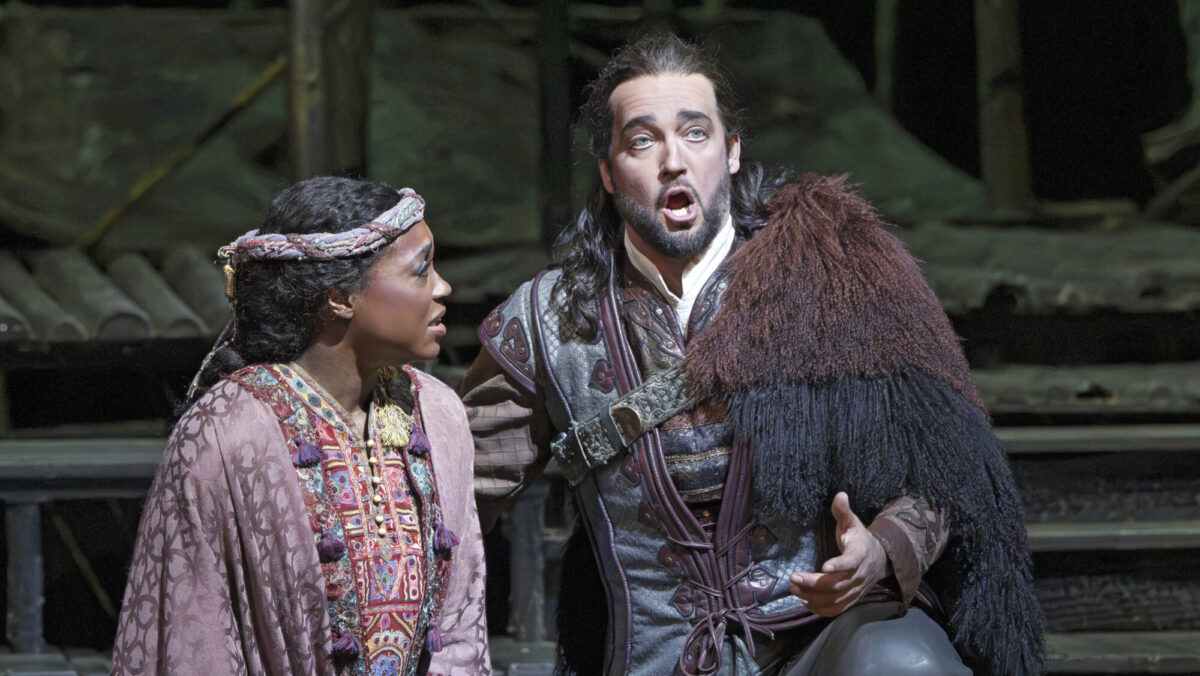
Angel Blue as Liù and Brian Jagde as Calàf in Puccini’s “Turandot.” Photo: Jonathan Tichler / Met Opera
Blue has a rich tone reminiscent of Leontyne Price but without Price’s technical command of an incandescent top register. I think the sudden weight loss has caused some vocal displacement and that she needs to retrain. The Mimì in the recent Bohème revival also showed technical issues in the upper third of the voice in another Puccini role that isn’t particularly high or technically demanding. She attempted a floated piano “pietà” at the end of “Signore, Ascolta” but the note got fixed in the throat and came out flat and fuzzy toned. Also, she lacked pathos and vulnerability in Act I. I couldn’t see the unrequited love for Calaf. Blue warmed up a bit for the two Act III arias but again the high notes sounded disconnected from the core of the tone and needed a lot of pushing to come out. Liù should not be a role that requires effort from her, and I am apprehensive about Blue returning to Aïda next season which is higher and much harder and more exposed technically.
John Relyea was a strongly involved Timur with an imposing tone that overshadowed Blue and Jagde in Act I. He gave a high energy performance even though he was playing a frail old man. Joo Wan Kang, Andrew Stenson, and Tony Stevenson were an assured trio of ministers and Lyniv kept them on their toes. Carlo Bosi was another native Italian bringing authenticity to Emperor Altoum, and Ben Brady made some virile, handsome sounds as the Mandarin.
As for Zeffirelli’s production – it was vividly recreated by revival director J. Knighten Smit. Turandot is a fairy tale without a moral message underlying it. The spectacle, glitter and constant crowd movement of this classic production keeps you from thinking too deeply about the story or the characters. Maybe that is how it should be?
-
Topics: Helpful casting suggestions, Review
-
People: Andrew Stenson, Angel Blue, Anna Netrebko, Anna Pirozzi, Ben Brady, Brian Jagde, Carlo Bosi, Franco Alfano, Franco Zeffirelli, Giacomo Puccini, J. Knighten Smit, John Relyea, Joo Wan Kang, Leontyne Price, Oksana Lyniv, Sonya Yoncheva, Tony Stevenson
-
Works: Aïda, Andrea Chénier, La bohème, Macbeth, Medea, Nabucco, Turandot
-
Places & Organizations: Metropolitan Opera