Which side story?
Vivacious performances outweigh a host of odd directorial choices in the Washington National Opera‘s West Side Story
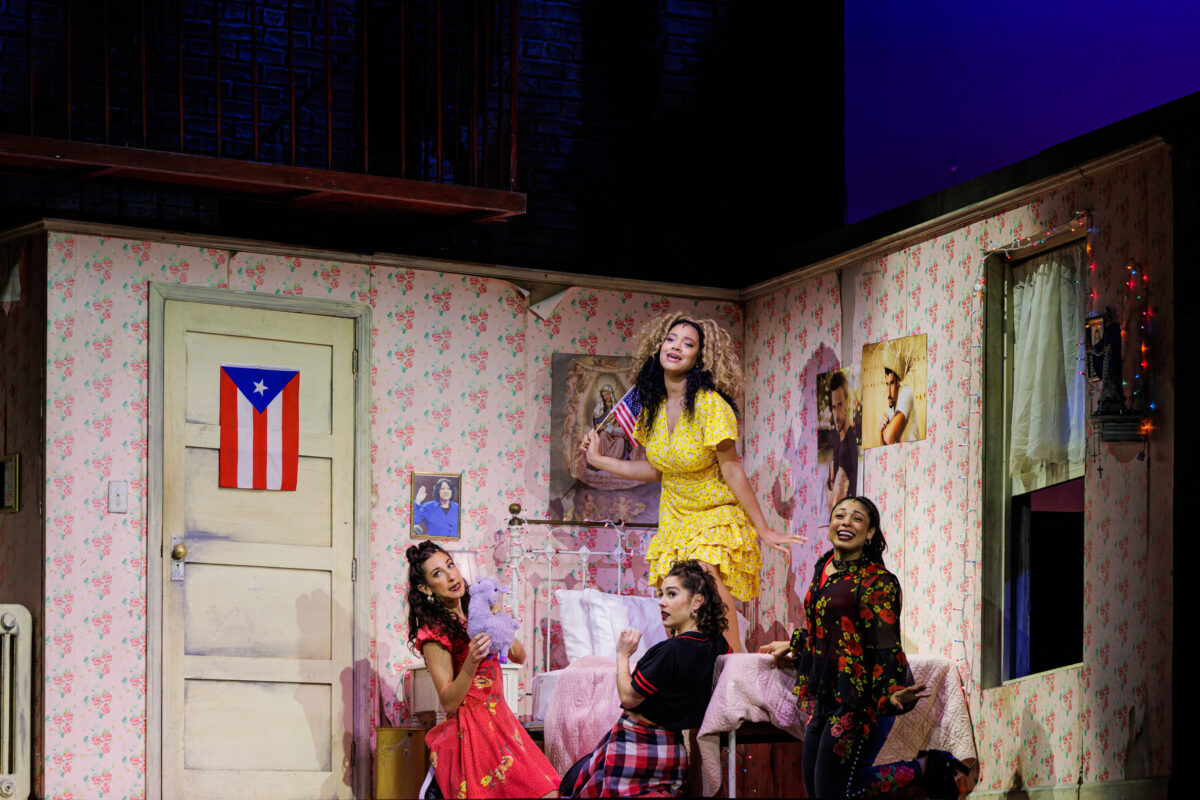
Maria (Shereen Pimentel) and Sharks ladies. Photo: Elman Studio
Two warring clans. Forbidden love. We know the story. Adapted from Shakespeare’s Romeo and Juliette, West Side Story – the product of a quartet of genius in Leonard Bernstein (music), Stephen Sondheim (lyrics), Arthur Laurents (book), and Jerome Robbins (conception and original choreography) – is a classic of American theater. If you went to high school in America, as I did, it’s practically required listening (or playing, if, also like me, you were in the school band). I like to think I know this piece well. That’s why, despite nimble conducting by Baltimore legend Marin Alsop, extraordinary choreography from Joshua Bergasse (following the original), and breathtaking lighting design led by A.J. Guban (original design by Mark McCullough), I was miffed by the directorial choices of the director (and artistic director of the Washington National Opera), Francesca Zambello. Disappointing, too, were the ultimately unconvincing portrayals of the romantic leads. It’s therefore a testament to the physicality and charisma of the supporting players that I wholeheartedly, if not unreservedly, recommend WNO’s production of this beloved musical.
First, I want to comment on what seems to be a common feature of a Francesca Zambello joint. When Bernstein and company wisely pivoted away from their original concept of warring Jewish and Irish gangs, they lit upon the universal by way of the particular – and topical. Throughout West Side Story, characters listen to mambo, play with switchblades, and chitter amongst themselves in mid-century pseudo-slang. As one of my companions noted, the music and text “wants to be itself.” But Zambello doesn’t want it to be itself. In her quasi-contemporary staging, Zambello attempts to shoehorn contemporary elements – most jarringly in costuming like skinny jeans and track pants (led by costume designer Jessica Jahn) – to little effect. Does one character wearing skinny jeans calling another wearing a Patrick Ewing jersey “Daddy-O” bring anything new or fresh to the production? At other points, as in the Jets’ midcentury diner-lair, the production leans into the original setting. This vacillation felt distracting and without a purpose. As in Zambello’s production of Aida, these “no-place any-place” choices strive for universalism and land instead in a strained attempt at politically-neutral relevance.
Let’s dig into this a little more. What’s the problem here, really? After all, no one blinks an eye at Baz Luhrmann’s Romeo + Juliette set in Venice, California in the 1990s. Indeed, walking out of the show, an older woman overheard our conversation and asserted, obtusely, that “gang wars happen everywhere and any time” (or some such thing). We turn again to specificity. It feels credible for Luhrmann to interpret Shakespeare’s clan rivalry as a race-based drama in LA in that period. Does it feel right to situate Tony and Maria – as figureheads of White and Latino ethnic clans, respectively – in “anytime” New York? Part of the reason West Side Story came to life is that its creators were inspired by the animosities of the time. In her program note, Jamie Bernstein describes how Laurents et. al. committed to the idea of Puerto Ricans versus ethnic Whites: “[Suddenly] everything came together…the Jets would move to the cool American sounds of bebop jazz, while the Sharks would dance to the restless, syncopated Latin rhythms of the mambo. There it was: the Jets were cool; the Sharks were hot. Music, dancing, costumes – everything fell into place.” There is an intentionality of form, content, and moment, to both the original setting of West Side Story and Luhrmann’s take on Shakespeare. There is none of that in this production.
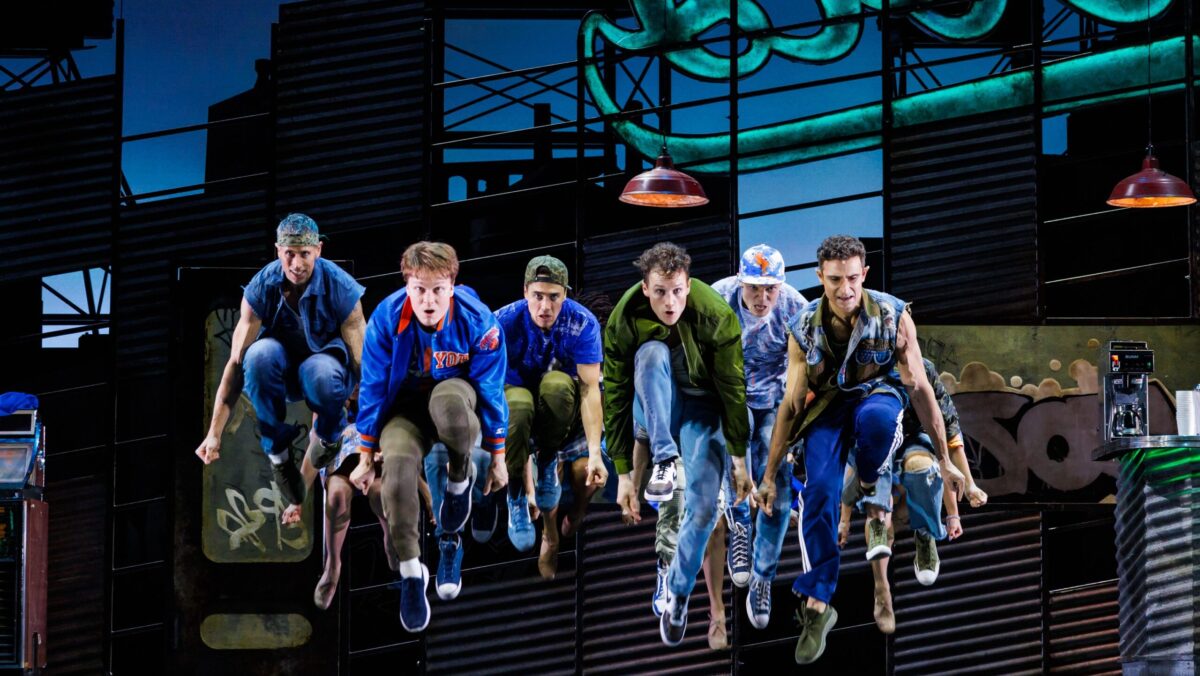
Jets dance scene. Photo: Elman Studio
Luckily, the production preserves Robbins’s groundbreaking choreography, dashed off with brio by a youthful cast and cadre of whirling, gliding dancers, like birds in a flock, swooping in formation. From the beginning, Alsop kept vivid control of the 50-piece WNO orchestra – “When You’re a Jet” sets off in a lurching syncopation dripping with cool, and we know immediately that the evening will not disappoint from the pit. Taylor Harley plays Riff, brash leader of the Jets, believably goading if a bit light on the vocals. Likewise, his rival and counterpart in the Sharks is Bernardo, played with swaggering gusto by Yirel Echezarreta. Both execute the stylized fight-dance scenes with spectacular bravado, maintaining the tension throughout such set pieces. I found myself practically holding my breath as they circle each other during their knife duel, Jets and Sharks banging on the chainlink fences.
The evening’s leading roles, like several of the production choices, left an equivocal impression. Shereen Pimentel as Maria spent most of the evening as a cipher. Pimentel has a wide vibrato which, while not to my taste, sufficiently cut above the din of the orchestra and ensemble pieces. Only toward the end, when she asks Chino how many bullets are left in his gun, and if one is left for her, did she raise goosebumps, delivering the line with devastating conviction. Ryan McCartan as Tony led the way vocally with a golden, honeyed tone, but his gesticulations during “Maria” were distracting – a choice I hope was another directorial error and not his own. Speaking of directorial errors, the creative team somehow managed to ruin the most poignant number of the night, Maria and Tony’s duet, “Tonight”, with a haphazard dance number playing below the balcony on which they sang. This was the only misstep in choreography, one that, again, distracted from the gorgeous music. The evening’s standout, it must be said, was Amanda Castro’s Anita. Brimming with sexy charisma, Castro exuded a triple-threat of superb dancing, vivacious acting, and competent singing that I desperately wished from the two leads.
Sometimes there are supporting elements which elevate a mediocre production, and such was the case that night. The lighting design, led by the aforementioned Guban, was a revelation: a glowing blue-orange gradient bathes the action in a mythic New York skyline silhouetted by rooftop watertowers; during the school scene, the stage is alternately lit red and blue as Jets and Sharks do battle with dance. Zambello’s strengths shine most in her masterful maneuvering of modular set pieces. The production’s central mis-en-scene – chain-link fences and overhanging street lamps, Doc’s diner, and the dress shop where Anita and Maria work – are all shuttled to and fro in barely the blink of an eye, the transitions shrouded only in darkness (credit to scenic designer Peter J. Davidson). In a move that drew applause from the crowd, Maria’s bedroom pops out of her apartment building on a swing, revealing the girlish trappings within. That all of this machinery was cut to size from the huge Kennedy Center stage to the more modest Baltimore lyric in such a short time is nothing short of an achievement.
At this point, I doubt there are many close to Francesca Zambello who directly criticize her directorial decisions. Her oeuvre contains so many gems – for example, her breathtaking Les Troyens at the Met in 2013 – that it’s dismaying to see such peculiar artistic indecisiveness as outlined above. Nevertheless, in an era of American music theater defined, in part, by a collision of art and politics, WNO continues to blaze a defiant path forward. One hopes they continue the momentum with productions that chart a similarly innovative trajectory. American theater depends on it.
West Side Story continues at Music Center at Strathmore from May 14-15.

Brendan Latimer
Brendan Latimer is a writer and urban planner based in Baltimore, MD. He invented the dark chocolate with orange juice combo. You can find him on Instagram at @b_lat_ and @operanoises.
-
People: A.J. Guban, Amanda Castro, Arthur Laurents, Francesca Zambello, Jerome Robbins, Jessica Jahn, Joshua Bergasse, Leonard Bernstein, Marin Alsop, Mark McCullough, Peter J. Davidson, Ryan McCartan, Shereen Pimentel, Stephen Sondheim, Taylor Harley, Yirel Echezarreta
-
Works: Aïda, Les Troyens, West Side Story
-
Places & Organizations: Metropolitan Opera, Washington National Opera