They don’t stoop to conquer
The countertenors conquer the day in Handel‘s Giulio Cesare in Egitto at the Deutsche Oper Berlin.
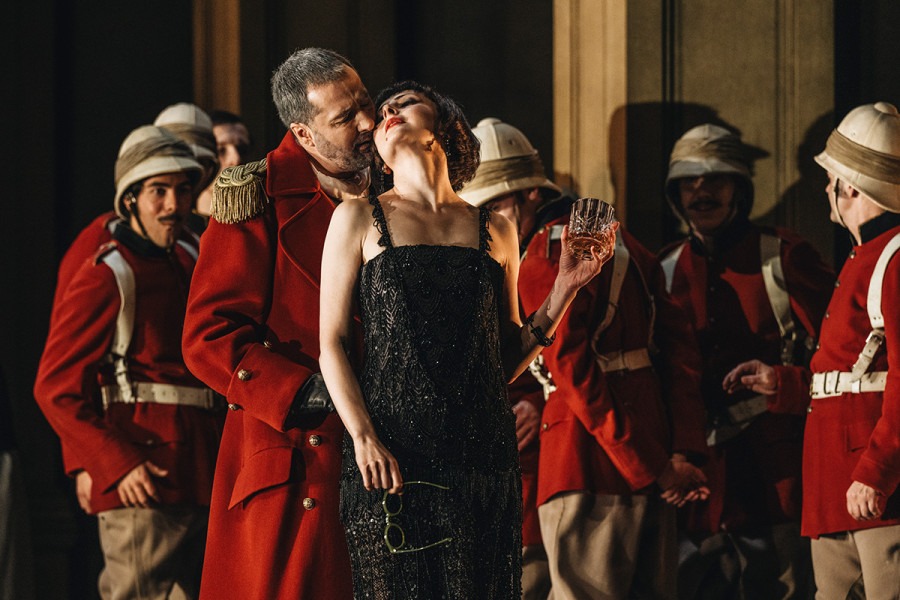
Photo by Nancy Jesse
Julius Cesar has arrived on the shores of the Spree! Almost twenty years after its premiere at the Glyndebourne Festival, David McVicar’s beloved production of Giulio Cesare in Egitto has finally arrived at the Deutsche Oper Berlin.
Set in the Roman civil war of 48–47 BC, Giulio Cesare in Egitto follows Giulio’s arrival in Egypt and the ensuing power struggle with the region’s tyrannical ruler, Tolomeo. After being presented with the head of his formal rival, Pompey, on a silver platter, Giulio, along with Pompey’s wife and son, Cornelia and Sesto, vow to avenge Pompey’s death by defeating Tolomeo. All the while, Tolomeo’s sister, Cleopatra, devises a plot to usurp her brother’s rule. After four hours of seduction, disguises, and deception, Sesto ultimately kills Tolomeo; Cleopatra reigns as the Queen of Egypt; she pledges loyalty to Giulio and the Roman Empire; and they all live happily ever after. While Handel’s Giulio Cesare first premiered in London in 1724, the impetus to defeat tyranny remains timeless.
McVicar’s production is treasured; Baritenor wrote for Parterre in November that they are “still thinking about” the production two decades later! While committing to nearly five hours of Baroque opera on a sunny Friday in May may seem like a heavy lift, McVicar’s production is worth every minute of missed sunshine. This production has everything: fabulous curtain work, tongue-in-cheek orientalism right out of One Thousand and One Nights, and costumes that give “British looting expedition.” The Deutsche Oper’s production runs until July 8, but if you can’t make it to Berlin, recordings of McVicar’s production (both from Glyndebourne and the Met), are accessible online.
Giulio Cesare is a love letter to countertenors, with three of the principal roles originally performed by castrati. Giulio was sung by the commanding and comedic Christophe Dumaux, who gave a masterclass in stamina Friday night. Throughout the torrents of vocal runs, Dumaux did not tire, and by the time he sang “Quel torrente che cade dal monte” towards the end of the night, I was in disbelief at his continued vocal diligence. The other two countertenors, Cameron Shahbazi (Tolomeo) and Edu Rojas (Nireno), were wonderful, but stood out for their comedic prowess rather than their vocal pomp. The vocal standout of the evening was undoubtedly Martina Baroni as Sesto. Baroni made “Svegliatevi nel core” sound easy. Even after rolling around on the floor, she was able to sing long phrases with ease while making beautiful dynamic choices. Her second aria, “Cara speme questo core,” had the audience mesmerized, transporting us to Sesto’s inner world.
The same, sadly, could not be said for the entire cast. I was unfortunately unimpressed with Elena Tsallagova’s Cleopatra. Tsallagova weighed the orchestra down, each phrase slowing to a noticeable degree, not to mention the many distracting breaths she took in the middle of runs and phrases. Her “Piangerò la sorte mia” was especially disappointing, as you could tell she was tired. Tsallagova offered some solace in “Se pietà di me non senti,” with her bell-like straight tone and delicate high notes showing a softer side of Cleopatra. Despite her vocal fatigue, Tsallagova’s acting was spot on, and throughout the performance I found myself thinking I was watching Natalie Dessay (perhaps because Dessay sang Cleopatra in the Met’s HD broadcast). Another disappointing performance was that by Stephanie Wake-Edwards as Cornelia. Before the performance, it was announced that Wake-Edwards was ill but would perform regardless, a terrible decision for both the audience and Wake-Edwards’ vocal health. This begs the question: why would an opera house allow a singer to risk their vocal health just so the show could go on as planned? Was there no cover on standby? Why not cut Cornelia’s arias or at least cut the “da capo” repeats — the opera is long enough and can do without ill-fated ornamentation.

Madison Schindele
Maddie Schindele is based between NYC and Berlin and is a Ph.D. candidate in musicology. She enjoys writing about modernist German opera, disability, and feminist musings!
-
People: Christophe Dumaux, David McVicar, Elena Tsallagova, Martina Baroni, Natalie Dessay, Stephanie Wake-Edwards
-
Works: Giulio Cesare, Giulio Cesare in Egitto
-
Places & Organizations: Deutsche Oper Berlin, Glyndebourne Festival, Metropolitan Opera