That time of evening
Golda Schultz soldiers through illness at the New York Philharmonic.
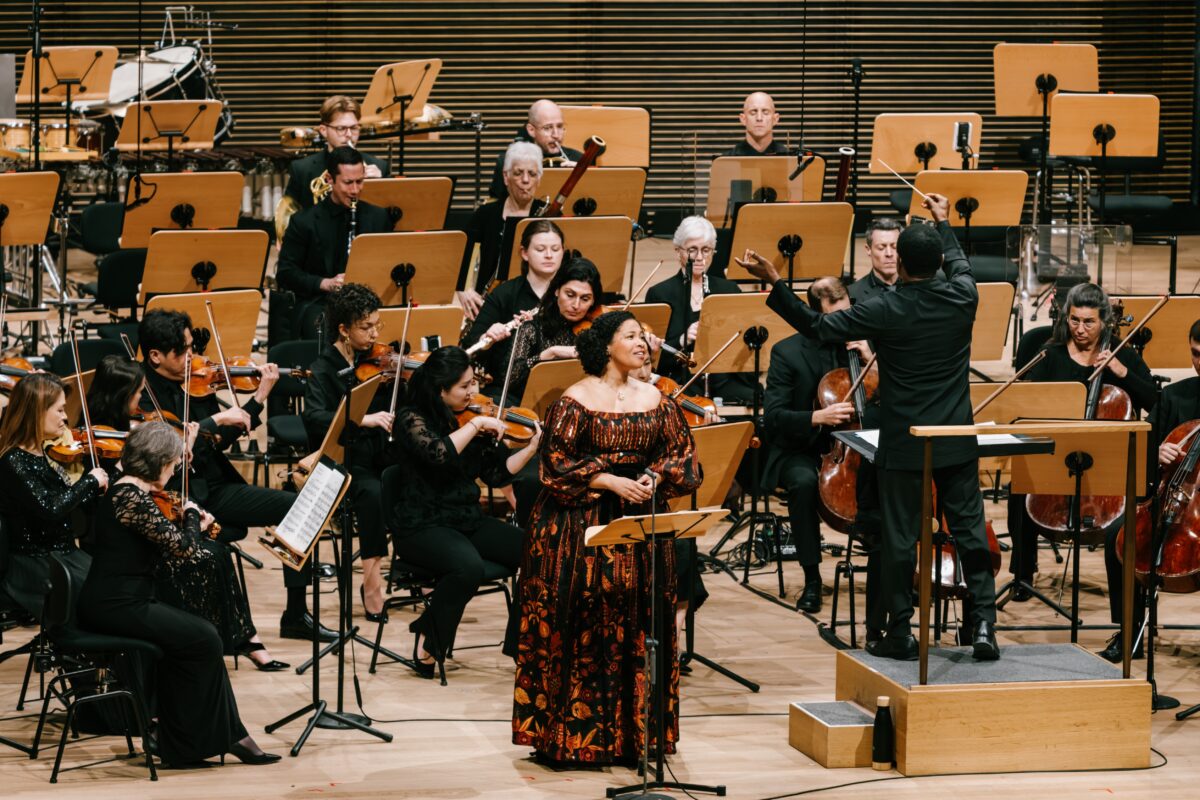
“When your instrument is in your body, it doesn’t always do what you want.”
This what the South African soprano Golda Schultz told the New York Philharmonic audience on Friday night. Due to hay fever and allergies, as well as ongoing recovery from bronchitis, Schultz explained, she would have to reduce the program from three pieces to two.
It felt like déjà vu. On Wednesday night, Schultz, in the same black-and-bronze dress, had made a similar announcement, as I listened from nearly the same seat. Schultz had explained that “The Trees on the Mountain” from Carlisle Floyd’s Susannah required too much vocal “delicacy”; She was unable to do it justice. Schultz remained poised and witty: “I hope you’re here for other reasons.”
Without the Floyd, that left Samuel Barber’s Knoxville: Summer of 1915, as well as “No Word from Tom” from Igor Stravinsky’s The Rake’s Progress, neither exactly easy. Those two pieces together made up about 30 minutes of a two-hour program, which had also included Charles Ives’s The Unanswered Question and a demanding new work by George Lewis with the experimental ensemble Yarn and Wire.
When a singer makes such an announcement, it is hard not to listen, even subconsciously, for signs of illness. On Wednesday night, I noticed something subdued about her sound, particularly in the Barber, like a swimmer hovering just below the water’s surface. Throughout, conductor Kwame Ryan supported her with the orchestra. But Schultz’s portion of the program that night went by all too quickly, and I wasn’t sure if I could trust my impressions.
Reviewing any performance, let alone a vocal performance, is, in some ways, an unfair task. It is a valuation, of sorts, of a singer on a given day, at a singular point in time. Besides, voices are fickle, impacted by health, or by sleep. Our bodies are fragile instruments. I decided to return to the Philharmonic on Friday night and write something more holistic.
I must admit, though, that on Thursday, I could not resist re-listening to Leontyne Price’s recording of Barber’s Knoxville. The piece is a setting of a prose poem by James Agee recalling a summer night from his childhood lying on quilts spread over the dew-damp grass. The poem is in the voice of a five-year-old child: “All my people are larger bodies than mine.” But the speaker has knowledge of mortality beyond his years: “May God bless my people… my mother, my good father… in the hour of their taking away.” Price’s rendition of Knoxville is almost straight-toned; She really sounds like a young boy.
Schultz’s interpretation on Friday night was womanlier, her vibrato like a tightly wound coil. I wondered if there could have been more vocal contrast in the fraught middle section. (Was she worried about imperfections being attributed to allergies?) But her interpretation was otherwise full of word-painting: “people go by, things go by” tossed away; “casually” pronounced in the vernacular. Throughout, Schultz showed plenty of delicacy.
The Stravinsky was, character-wise, an even better fit for Schultz. (You could also tell that she has performed this opera recently, with Paris Opera.) Singing “Quietly, night” above a churning orchestra, Schultz sounded like the perfect Neoclassical, Mozartian tragic heroine. On Friday night, she admirably navigated recitative-like sections and twisting ornaments to a dramatic conclusion. But on Wednesday night, that final note — a high C on “heart” — was like an arrow hitting a bullseye.
-
People: George E. Lewis, Golda Schultz, James Agee, Kwamé Ryan, Leontyne Price
-
Works: Knoxville: Summer of 1915, Susannah, The Rake's Progress, The Unanswered Question
-
Places & Organizations: New York Philharmonic, Paris Opera, The New York Philharmonic