Photo: Daniel Welch
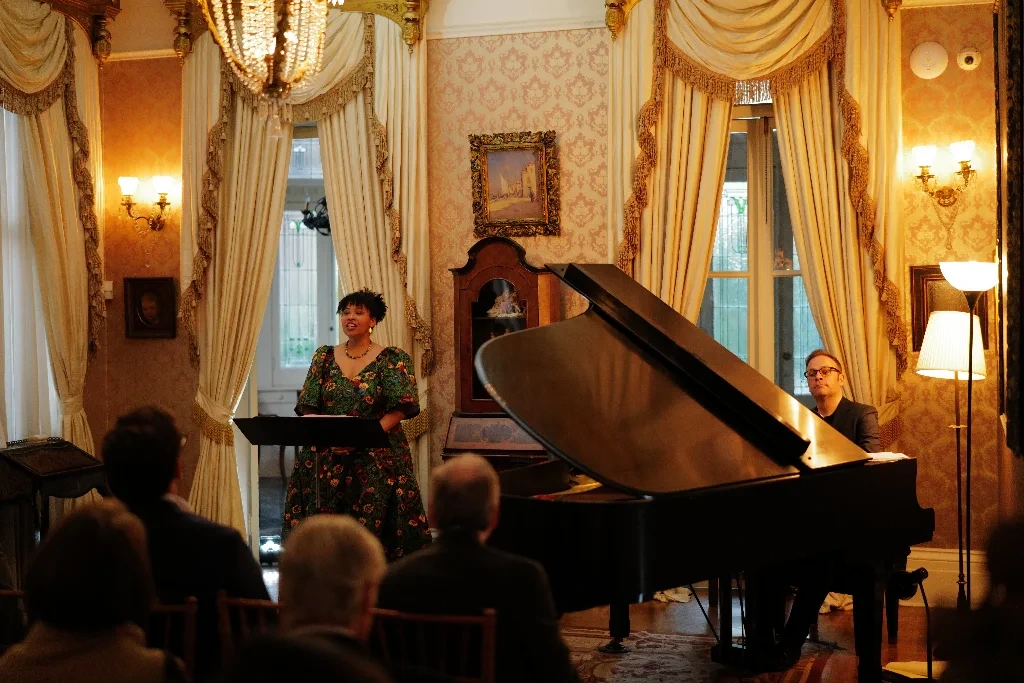
Mahalia Jackson reminds us that the Lord’s “eye is on the sparrow,” the sparrow whose dying fall to ground, Christ says in the Gospel of Matthew, merits the attention of God. Birdsongs and death knells set the tone on Wednesday of the inaugural New Orleans Opera Festival, when South African soprano Golda Schultz performed in the Garden District with an intelligently curated recital on the “Dark Matter(s)” of mortality, with songs drawing from the poetry of Whitman and Shakespeare, Langston Hughes, and Hermann Hesse. In the parlor of the Opera Guild Home, three blocks away from the white-washed tombs of Lafayette Cemetery that draw the necro-tourists to our city, the internationally beloved soprano accustomed to the crowds of La Scala and the Met faced a much smaller, though still appreciative, audience.
She began the evening with George Crumb’s Apparition (1979), a setting of passages from Whitman’s “When Lilacs Last in the Dooryard Bloom’d.” She warned us in advance that what her accompanist, Jonathan Ware, was about to do to the guild’s “historic piano” (which belonged, I believe, to the composer Moses Hogan) was not going to hurt the instrument. Not long into Crumb’s piece, Ware leaned under the lid of the piano like some mystical mechanic working “under the hood,” strumming the strings with his hands and knocking against wood to produce sounds that, while unmistakably modern, also evoked those reconstructions of the music of Greek antiquity.
Underneath the guild home parlor ceiling, featuring a painted sky full of birds in flight, Schultz – with the technical precision that is her hallmark – offered wordless bird calls in “Vocalise I” and “Vocalise III,” pieces reminiscent of Messiaen’s Catalogue d’Oiseaux (if the catalogue had been set for soprano) or of songs like the “Doundou tchil” from Harawi, with its variations between chesty breathiness and sudden springs into crisp high notes.
In a recital dress well-chosen for the Garden District – red, blue, and yellow flowers bursting out of dense greenery – Schultz lived up to her reputation. She brought the composure and confidence of a diva with little of the pretension. When she whispered of death, the Dark Mother, approaching us “with soft feet,” her delivery came with sharp, chilly, snakelike sibilation. Her vocal colors warmed in “Come lovely and soothing death,” where she seemed to be savoring the approach of life’s end – death as part of the tasting menu, death as a dish served warm and appetizing. The speaker in Keats’s “Ode to a Nightingale” is “half in love with easeful Death.” Schultz approached this love for death with no such half measures. As she finished off the Crumb, she moved backward into a curtain-draped doorway separating the parlor from an adjoining room, mouthing wordlessly the final lines that describe the physical body’s desire to nuzzle up to Death, that express the body’s gratitude as it sleeps “nestling close to thee.” Even outside of the dramatic arc of an operatic narrative, one could see Schultz’s acting chops on full display here – the ability to hold a room’s attention, to use silence and facial expression for effect just as skillfully as she used her voice.
The venue served her well, despite the chaos of a last-minute change that moved the recital from The Civic Theater downtown to the Opera Guild Home. Milling around the sandwiches and wine bottles in the dining room before the performance, audience members worried over the change and its reasons and its impacts in whispers. In New Orleans, a city proud of its historic affection for opera, there’s pressure to “get it right” and to launch a successful festival that might demonstrate not just for locals but for performers like Schultz (visiting for the first time) that this is a place that cares about the art form. By intermission, two attendees told me they couldn’t imagine the Clara Schumann pieces (“Es fiel ein Reif,” “Sie liebten sich beide,” and “Ihr Bildnis”) showing off nearly as well in a downtown theater. Schultz’s renditions of the lieder fit in that cluttered parlor of Victorian too-muchness, antique vases and paintings of varying quality, wine glasses perched on fireplace mantles, and nudges from seat neighbors after particularly impressive line deliveries from Schultz.
I know I should be joining the chorus of reviewers praising Schultz’s skills as a singer, but forgive me for being an English professor – I’m drawn to how savvily she selected her pieces to speak to one another, crafting with literary connoisseurship an evening of poetry “readings” from nineteenth-century greats like Heine and Baudelaire. Shakespeare made his appearance in Johannes Brahms’s Ophelia Lieder. Florence Price’s settings of Paul Laurence Dunbar’s works (“Hold Fast to Dreams,” “Because,” “Night”) worked well in the south Louisiana setting, given the Black spiritual tradition that inflects “Because.” The yellowing bones of the child in Rita Stroh’s “La Momie” from Dix Poésies Mises en Musique (1901), a setting of an Achille Segard poem, put me in mind of children dead from yellow fever, buried in the nearby cemetery, and the “Barcarolle” with the exhalations of “Les magnolias” also worked marvelously with the atmosphere in the quickly-dimming New Orleans living room.
Birds flocked back for Schultz’s final piece of the night, Richard Strauss’s Vier Letzte Lieder (done in the Ernst Roth published order). After the clipped directness of Clara Schumann and Brahms, Schlutz blew the walls off the parlor, opened up the vast horizons of Strauss with ecstatic and clean delivery of the piece’s long lines. “Frühling” came with its birdsong, not a charming chirping of garden sparrows but a glorying in the transcendence of boundaries, revealed “von Licht übergossen / Wie ein Wunder vor mir!” The “zwei Lerchen” soar, and Ware at the piano played us out with the final trills of “Im Abendrot” – a last little vogelsang in the darkening parlor. Schultz paused, eyes closed, with composure, calm, and accomplishment. The room was silent, reverent.
Returning for her encore, Schultz offered “Somewhere” from West Side Story, less “Dark Matter” here and more Broadway-shiny optimism. Unlike the lost dead lovers in Clara Schumann’s “Volkslied,” who end up “gestorben, verdorben,” here we had a sunnier, more American perspective on teenage death – life must go on… somewhere. It served as a grace note to an evening that showcased Schultz’s superabundance of talent. New Orleans eagerly awaits her return. Hopefully, on her next visit, we can offer her a larger venue so a larger audience can appreciate her. Those of us in the Opera Guild Home, however, were grateful to be present for this first, intimate welcome.