Youth has no age
Led by Yannick Nézet-Séguin and Yoann Combémorel, the Curtis Symphony Orchestra proves themselves the equal of any major American orchestra in a program of Mahler, Wagner, and Dawson.
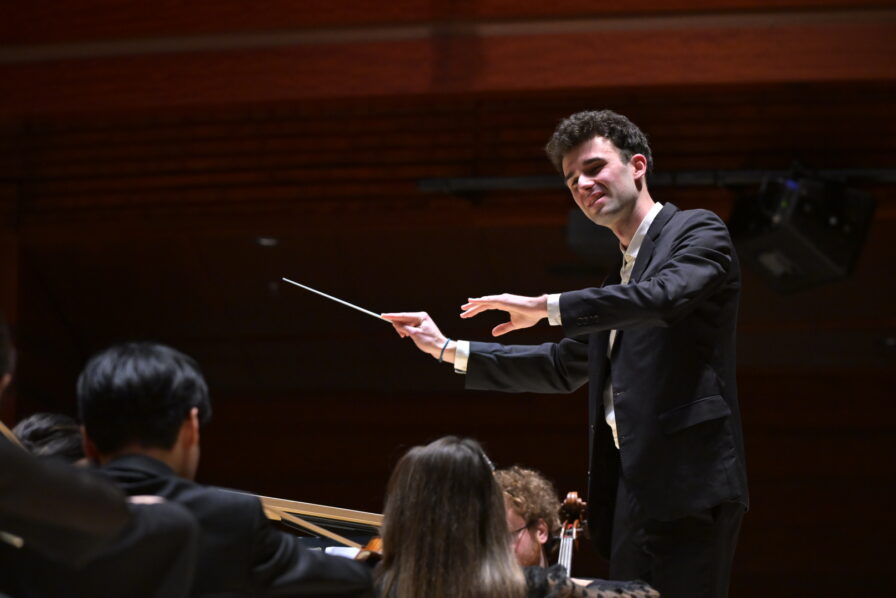
Photo by DeBalko Photo LLC
Even by our indefatigable Maestro Yannick Nézet-Séguin’s standards, March 2026 was quite the endurance test. First came three performances of Mahler’s epic Symphony #2. A day later, he began a run of five Met performance of Tristan und Isolde over the course of a couple of weeks.
With three more Tristan’s still to come on his calendar, one might reasonably expect YNS to have taken a few days off… but ‘twas not to be. On March 26th, he was back on the podium at Philadelphia’s Marian Anderson Hall for a large-scale concert with the Curtis Symphony Orchestra and featured soloists from the Curtis Opera Theatre.
In a sense, this concert served as an extension of the same musical world, including works by Wagner and Mahler (both, Mahlers actually—Gustav and Alma). But the mood here was considerably lighter, and Yannick himself was his usual chatty self. Maybe some of his good cheer was fueled by a sense of giddy relief, but it’s also clear that he draws tremendous satisfaction from his mentoring role at Curtis. That love certainly seems mutual.
The evening started auspiciously, but without Yannick. Under the baton of Curtis Conducting Fellow Yoann Combémorel, the music began with a spirited, distinguished account of the Rienzi overture, which among other virtues showed that this youthful group may be made up of students (albeit at the highest level), but it’s the equal of all but perhaps the top tier of American orchestras. Heard here in Marian Anderson Hall—home to the Philadelphia Orchestra—the Curtis ensemble more than held their own. The brass had a particularly strong sense of cohesion. In a few sections of the Rienzi, the introduction of individual themes felt halting rather than fluid, but this was a distinguished and exciting beginning.
Next, Yannick arrived to conduct what for me was the program’s centerpiece: five Gustav Mahler songs from Des Knaben Wunderhorn. Particularly in American concert halls, these orchestral settings have never quite caught on—they’re done more often in Europe, though not with the regularity of Mahler’s other vocal works. To some extent, it’s understandable—the songs aren’t really codified as a cycle; the order and vocal assignments are flexible. And the poetry is peculiar mix of tones, from darkness to winking farce (if you don’t associate Mahler with humor, this will be surprise).
But that’s what makes the work a wonderful—and such a good choice here, where the Wunderhorn songs gave opportunities to a mixed group of young Curtis Opera Theatre singers a chance to shine both vocally and interpretively.
First up was “Lob des hohen Verstandes,” a delicious take-down of a pompous blowhard. (Dietrich Fischer-Dieskau sometimes sang it. I’ll stop there.) Here, Emilio Vasquez showed off a well-integrated lyric baritone, finely articulated German, and a delightful sense of comic timing. He had a few moments of pitchy-ness—the intervals here are a killer—but he recovered quickly and nailed the tricky trill as well as I’ve heard it done.
“Wo die Schönen Trompeten blasen” followed. This sublime setting—one of the greatest of all Lieder—received a glowing performance by mezzo-soprano Maisy Parker, full of lovely vocal color, and with quiet ascending lines that were particularly ravishing.
“Revelge” has a pulsating, disquieting but riveting militaristic tone (Yannick and the orchestra were thrilling here). Landry Allen’s fresh, forwardly placed tenor is on the lyric side for this music, but it was an impulsive and detailed reading.
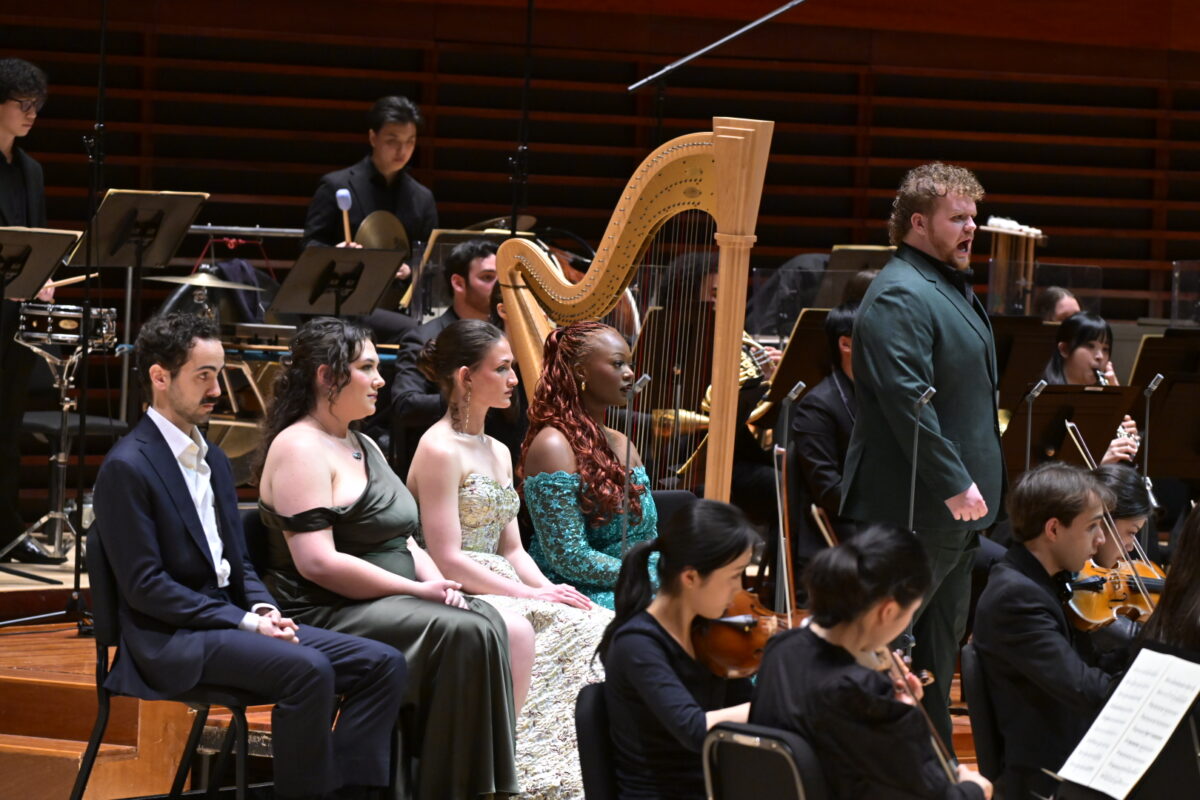
Photo by DeBalko Photo LLC
“Urlicht” is surely the best known from its reappearance in Symphony #2—in both cases, it’s a time-stopping moment, given here to another rising mezzo, Carlyle Quinn. Quinn’s sound makes an immediate impression—the kind of sizable, dark, almost contralto color that sadly has largely disappeared. She gave a focused, highly charged performance—I wonder if the darkness of the tone is the result of too much vocal covering, and that by nature she may be more of a lyric mezzo. But she is a talent to watch.
Parker and Vasquez returned for “Verlorne Muh,” where he confirmed his comic gifts, and she offered a charming sense of flirtation (very different from her previous persona!).
There were also two short songs by Alma Mahler—“Laue Sommernacht,” and “Bei dir is es traut.” To my mind, this was the program’s only mistake. Lasting around two minutes each, they are pleasant but banal… and nothing throws their mediocrity more cruelly into focus than placing them between “Wo die schönen Trompeten blasen” and “Urlicht,” two sublime masterpieces. They were assigned to Nikan Ingabire Kanate, who delivered them with stylishly. Her piquant, vibrant soprano seemed to me well-suited for French art song, and she has a very elegant presence. I look forward to hearing her in something more substantial.
Before leaving the Mahler, I’ll air one more complaint. In Marian Anderson Hall, Yannick has experimented with where to place vocal soloists for orchestral concerts. He seems now to favor what to me is a very awkward configuration—seating them on stage right, essentially between a row or two of the string section and the percussion platform. It can be effective if the goal is a sort of disembodied sound emerging from the orchestral texture. I appreciated it in the Mahler Symphony #3, for example. But it made no sense for Des Knaben Wunderhorn, where the singers should be featured front and center, their facial expressions easily visible for the audience.
The concert ended with a rousing performance of Dawson’s Negro Folk Symphony—very smart programming when put into dialogue with the Knaben Wunderhorn songs, as both are large-scale symphonic works built around folk themes. Yannick has recently made something of specialty of the Dawson, and he remarked that the Curtis forces might be his favorite for it. It certainly brought the highly successful evening to a rousing finish.
-
Topics: mahler, Review, richard wagner
-
People: Alma Mahler, Carlyle Quinn, Curtis Symphony Orchestra, Emilio Vásquez, Landry Allen, Maisy Parker, Nikan Ingabire Kanate, Yannick Nézet-Séguin, Yoann Combémorel
-
Works: Des Knaben Wunderhorn, Rienzi, Symphony No. 9 in E Minor, Tristan und Isolde
-
Places & Organizations: Curtis Institute of Music, Curtis Opera Theatre, Marian Anderson Hall, Metropolitan Opera, Philadelphia Orchestra