Sophocles’ Antigone – a play about defiance, grief, and the limits of authority – might seem far removed from the corridors of an American high school. In Time to Act, however, librettist Crystal Manich and composer Laura Kaminsky bring the ancient tragedy squarely into the present at Pittsburgh Opera, using a high school drama class rehearsing Antigone to explore the psychological aftermath of a school shooting, and how guilt and suspicion can cling even to those whose only tie to the tragedy is blood.
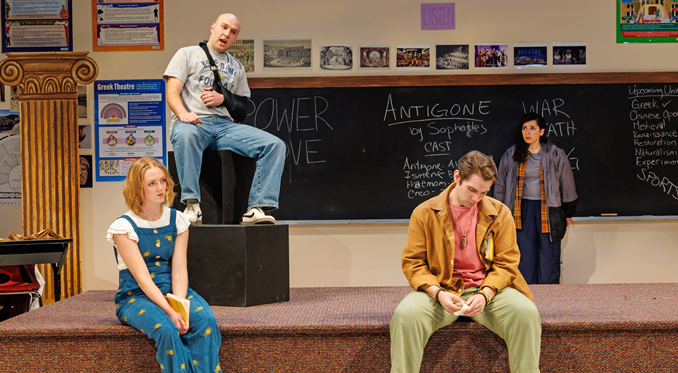
Conceived in 2018 in the aftermath of the Parkland shooting, the opera centers on a high school drama class preparing a production of Antigone. Each student loosely mirrors a figure from Sophocles’ play: Ty, the archetypal football jock, embodies King Creon; José, the earnest drama kid, plays Haemon; and Alona, a quiet new student arriving for her first day, is cast as Antigone. As rehearsals progress, we learn the class is still processing the trauma of a shooting at a nearby school the previous year. The drama culminates when Alona reveals she is the sister of the shooter, a revelation that folds the students’ grief and anger back into the ancient tragedy they are performing.
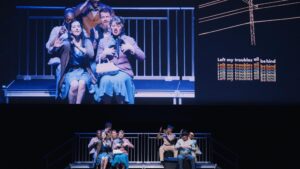
The production took place at the Bitz Opera Factory, Pittsburgh Opera’s headquarters, where a large event space was converted into a 200-seat end-stage theater with the orchestra seated on a balcony behind the stage. Kaminsky’s score is written for eight instruments commonly found in an American school music room including drums, piano, and saxophone. The set resembled a typical high school drama classroom, complete with a small stage, desks, a chalkboard, and posters about Greek theater.
The libretto succeeds in capturing the natural rhythms of student conversation while weaving in lines from Sophocles that feel natural to the drama. The character arcs of Ty and Alona are particularly compelling, and the opera’s three‑scene structure – Loneliness, Truth, and Catharsis – gives the opera a clear emotional progression. Its message ultimately lands on hope: the students rewrite Antigone’s ending so she can “find her light,” and in doing so realize they are not bound by the way the ending of the play is written but are capable of creating change. Though this material could easily have tipped into preachiness or after-school-special sentimentality, it avoids both and instead feels genuinely uplifting and empowering.
Kaminsky’s score blends modern classical writing with a strong jazz component, leaning heavily into syncopated and jazz‑inflected rhythms. The majority of the piece feels anxious, remaining largely in a minor key before transforming at the end into a major-key choral resolution. The performance was led by Michael Sakir (the current artistic director of Opera Montana) who did a superb job maintaining cohesion between the cast and orchestra, as well as balancing the challenging acoustics of the space.
The production benefitted from a cast drawn largely from Pittsburgh Opera’s Resident Artist program, all of whom not only brought sharp acting instincts but had impressive command of a score that eschews familiar harmonic patterns. Erik Nordstrom (Ty/Creon) delivered a convincing football‑jock bravado, his robust baritone cutting cleanly through the texture. Logan Wagner (José/Haemon) supplied a tender, lyric sound that made his compassion for Alona deeply felt. Soprano Shannon Crowley lit up the stage as Bailey, channeling high‑octane energy and a palpable sense of horror as Alona’s story unfolds.
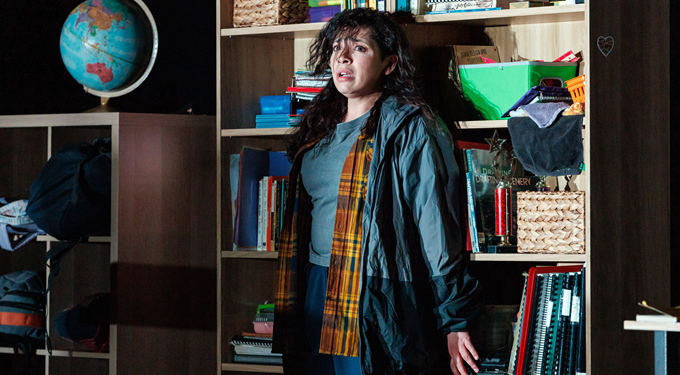
The cast was rounded out with two rising artists. At the center was mezzo-soprano Timothi Williams as Alona, offering a remarkably compelling performance that moved from introverted newcomer to a devastated sister questioning whether her brother might have turned his gun on her had she been discovered laying on an auditorium floor. Baritone Yazid Grey sang the role of the drama teacher, and his early aria “We all have a role to play” was a musical highlight of the show.
While the show was largely effective, a few elements diluted its impact. The opening scene, set before Alona’s arrival, spends too much time establishing secondary characters and could move more swiftly toward the central conflict. Near the end, a new subplot involving Ty discovering a handgun in his father’s desk felt disconnected from the main narrative and interrupted the dramatic momentum. A physical fight scene landed awkwardly, disrupting the flow of the drama and earning an unintended laugh rather than contributing to the emotional stakes. Musically, the orchestration created an atmospheric backdrop but often felt detached from the characters onstage.
Overall, however, I came away impressed, particularly by the cast’s performances and their command of a score that avoids conventional operatic harmony. For her first libretto, Manich draws confidently on her experience as an opera director, shaping a plot that aligns naturally with its classical model and creating characters who feel believable and emotionally accessible. Kaminsky’s jazzy, minimalist style paired well with the reduced orchestration while still providing an effective atmosphere for the drama. The piece will now move to the Boston Conservatory in April, before heading to Opera Montana in the spring of 2027.