
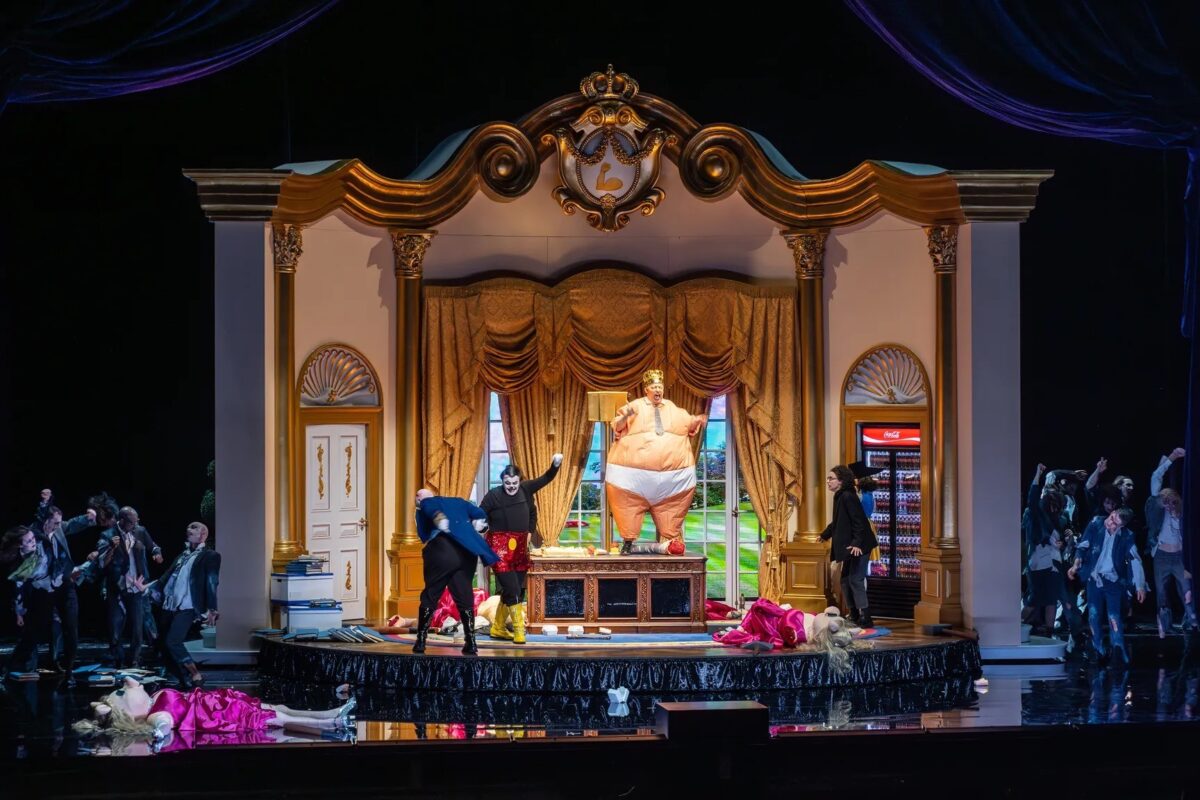
Seeing the words “Trump” and “Opera” in the same sentence is unfortunately becoming a more common occurrence. After last month’s news that the Washington National Opera would part ways with the Kennedy Center, the opera world was bombarded with additional Trump-related headlines following the premiere of Olga Neuwirth’s Monster’s Paradise in Hamburg. Viral headlines, such as that reading “Gorgonzilla beißt dem orangen König den Kopf ab – die Welt geht trotzdem” (“Gorgonzilla bites off the head of the orange king – the world still goes on”), appeared on newsstands and U-Bahn screens across Germany since the production opened. While Trump remains in the Oval Office with his head intact, Neuwirth’s work encourages us to imagine an exaggerated reality: one where Trump’s regime is crushed by a knock-off Godzilla.
Staatsoper Hamburg’s Monster’s Paradise concluded this past Thursday, February 19, but it’s not the last we’ve heard from the King President, as the production makes its way to Opernhaus Zurich. Composed by Neuwirth with a libretto by Elfriede Jelinek, this political satire did not quite know what it wanted to be; was it an opera, music theater piece, science fiction film, Grand Guignol, or a reflection of our current reality?
The production began with a monster’s tail seductively poking out from under the Staatsoper’s purple curtain, as if we were about to see a burlesque performance of Godzilla vs Kong. Instead, two hours later, we were presented with an epic battle of Gorgonzilla vs the King President. As the monster’s tail disappeared, the audience was introduced to two vampires, Vampi and Bampi, who were both the narrators of the work and avatars of Neuwirth and Jelinek. The two vampires were soon doubled, as Vampi and Bampi are performed by two singers and two actresses, meant to represent how women are always “several selves at once.” This, unfortunately, was not effective, as when the four of them sang in harmony, the well-trained voices of soprano Sarah Defrise (Vampi) and mezzo Kristina Stanek (Bampi) were drowned out by their belting other halves (actresses Sylvie Rohrer and Ruth Rosenfeld, respectively). When we could finally hear the singing vampires unaccompanied by their actress doubles, Stanek emerged as the standout vocal performance of the evening.
The curtain then opened to reveal the Oval Office, where we meet the King President (Georg Nigl) sitting at an X-Factor-style judge’s table. Contestant by contestant, the King President rejects performances by Kermit and Miss Piggy, an Elvis Impersonator, a Captain America disguised cowboy, Maria von Trapp, and two men dressed in hotdog costumes. Playing on overused tropes, such as Trump’s weight, orange complexion, and thwarted facial expressions, Nigl’s portrayal of the King President was a political cartoon come to life. Nigl’s vocalisms were spot on and sounded as if he created his own singing style just for the role, colored by exaggerated diction and sprechstimme-like inflection. the King President was assisted by two countertenors, Mickey (Andrew Watts) and Tuckey (Eric Jurenas), modeled after Elon Musk and Zuckerberg. These two roles were both physically and vocally demanding, requiring a slew of coloratura while running to and fro. However, writing these two roles as countertenors felt like a low blow. What good does vocally feminizing Musk and Zuckerberg do? Does Neuwirth not realize that writing Trump’s minions as countertenors is the equivalent of using the comeback, “you throw like a girl?”
It was not long until we met the owner of the tail, Gorgonzilla, a “not-Godzilla-due-to-copyright” monster written as the antagonist to the King President. At the end of the day, the dichotomy between good and evil is not a dichotomy at all, and both the King President and Gorgonzilla are one and the same — monsters. The audience returns from intermission to a world ravaged by wars and natural disasters. Rather than pour water atop the burning city, Gorgonzilla and the King President battle it out. The second half of the opera felt more like a film than a live performance, with projected content prioritized over singing. The opera ended with a cinematic segment where Vampi and Bampi float away from the burning city on a raft large enough to fit a baby grand. As they play four-hand Schubert selections out of tune, the keys began to uncontrollably rattle, as not even the beauty of music can survive the world’s end.
It always strikes me how lazy political representations can be, going after gimmicks rather than addressing real harms that the administration is causing. For one, “Monster’s Paradise” really leaned into the division of American politics, with zombies storming the capital and vampires protesting for environmental protections, further feeding the division that is tearing the nation apart. Plus, the ongoing obsession with Trump’s appearance, rather than focusing on the actual harms he is causing, is lazy activism at its finest. As the audience laughed as his blow-up body suit inflated, I sat there remembering that millions of Americans face losing healthcare due to the passing of the Big Beautiful Bill.
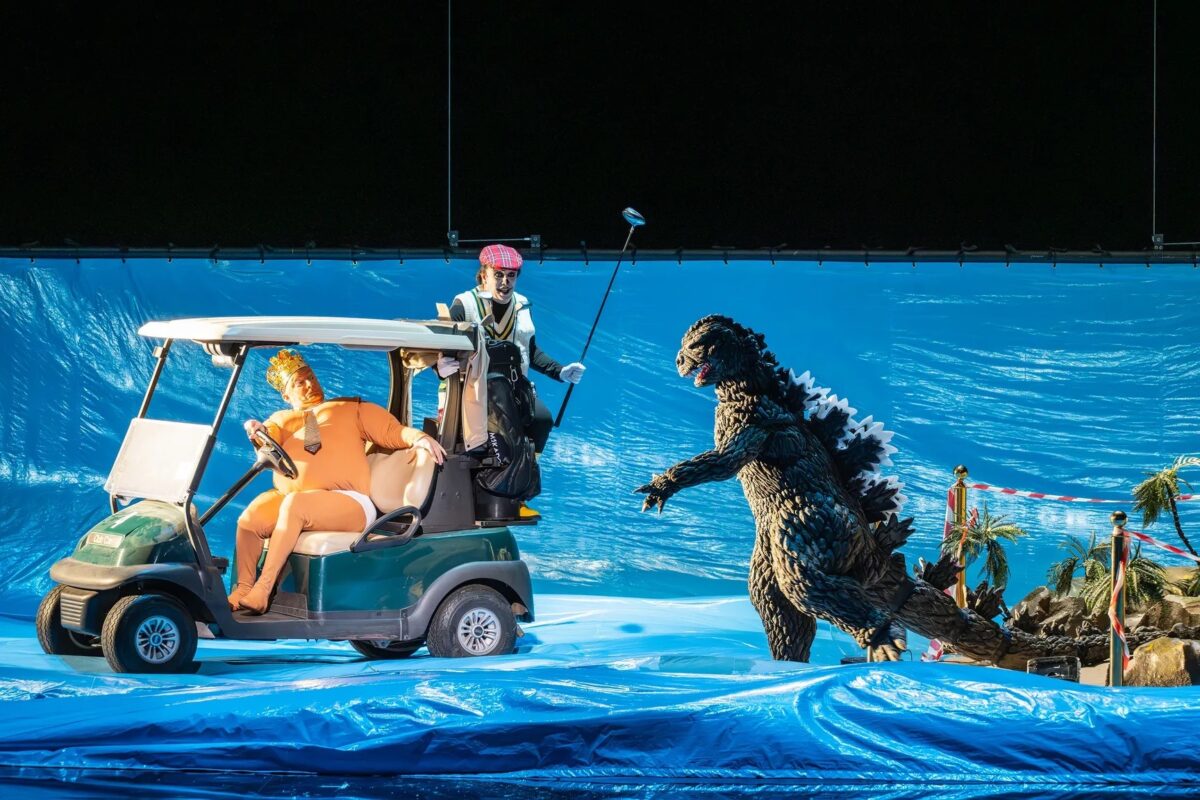
Photo by Tanka Dorendorf
The creative team, namely director Tobias Kratzer, relied on humor to face the horrors of the present day. In an interview, librettist Jelinek shared that “if [Trump] weren’t so appalling and brutal towards minorities, immigrants, women, intellectuals, artists, etc., [he] would be so laughable that one could roll around on the floor laughing every day.” Yet, the work was staged as if laughter was the ultimate goal. In his New York Times review of the work, Joshua Barone said it best when writing that “mocking humor isn’t much of a weapon against an administration whose vice president dressed as a meme of himself for Halloween.”
“Ultimately, someone is making money,” sang Vampi and Bampi in the opening scene. As I left the theater and saw merch for sale, I wondered who in Hamburg was profiting from the suffering caused by the King President.