Photo by Suzanne Karp
Peanut butter and jelly. Chocolate and raspberries. Tristan and Isolde. Some things are just meant to be together.
A perfect example is the San Francisco-based period instrument ensemble Philharmonia Baroque Orchestra & Chorale and the works of Jean-Philippe Rameau. Every time I’ve heard this ensemble take on the works of the French Baroque master, the results are magic. And last week’s concert, dubbed “Baroque Garlands” at Stanford University’s Bing Concert Hall was, again, magic.
For a city of merely 800,000 people, we in San Francisco punch way above our weight class when it comes to early music ensembles, whether professional, semi-professional, or community-based. We are home to at least a dozen such ensembles, among them some of the premier period instrument groups in the United States. One of those is the Philharmonia Baroque Orchestra & Chorale.
Bay Area early music ensembles are also among the most prolific producers of Baroque opera. The juggernaut that is San Francisco Opera has certainly produced its share of Handel and Monteverdi. However, over the last 20 years, the company has retrenched from producing operas written before Mozart. This is not necessarily a bad thing; the company has programmed Handel’s works with some frequency, but the War Memorial Opera House is just too big for Handel (it’s even a bit too big for Mozart). The company has almost no history with the French Baroque repertoire.
That has left ensembles like the Philharmonia Baroque to fill the gap. Each season, the company programs concerts or semi-stagings of operas chiefly by Georg Friedrich Handel but also by Rameau, Alessandro Scarlatti, Thomas Arne, Henry Purcell, and others. Because PBO&C performs in smaller venues more appropriate to Baroque opera, it allows the audience to appreciate the nuances of Baroque dramatic music without getting lost in the vastness of a standard opera house.
Which brings us back to Rameau. Last Sunday, the ensemble offered a newly edited version of the composer’s late-career opera La guirlande, our Les fleurs enchanteé (“The Garland, or the Enchanted Flowers”), first performed in 1751, revised in 1763. The piece is a charmer. A delightfully mindless romantic morality play set among shepherds and shepherdesses, it is a chance for Rameau to show off his talent for orchestration. No less a master orchestrator than Claude Debussy himself apocryphally exclaimed on hearing La guirlande, “Long live Rameau. “Down with Glück!”
Rameau knew his lane. In La guirlande, we get merry rustic melodies, heart-tugging laments, lush choral writing, and lots of dance. He doesn’t ask a lot of us. He doesn’t want us to have an Aristotelian catharsis at the end. He does not want us to learn anything. He does not want to ennoble us. He wants to charm us. And who doesn’t want to be serenaded with such delightful music?
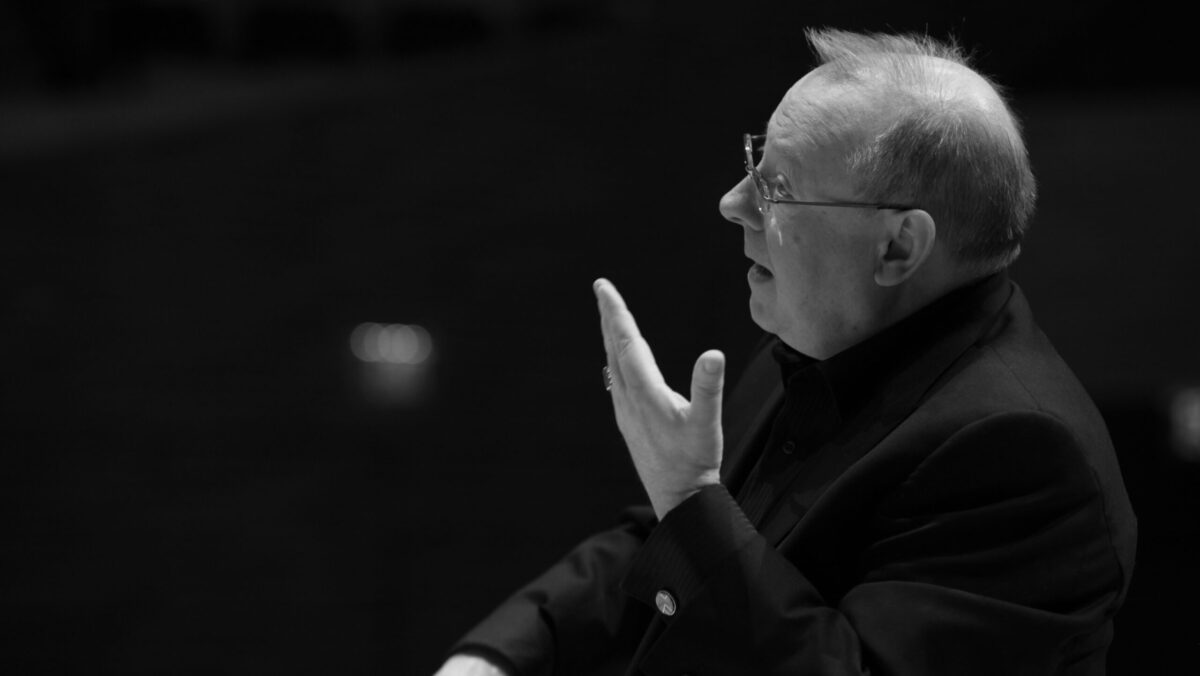
Rameau’s genius for melody and instrumentation is there if we choose to dig into the score. If we don’t want to, we can just enjoy it all. We can enjoy putting our need to be entertained in Rameau’s hands. And in the hands of Philharmonia Baroque’s music director emeritus Nicholas McGegan, the performance was a triumph.
McGegan struck the perfect balance between keeping the pace going and allowing the singers the space to do their work. His touch is light, yet his hand was fully on the tiller, guiding both orchestra and chorus with the understated confidence that has made him rightly a Bay Area favorite. Rameau’s music is not like the music of later composers; the interpretive room is narrower than, say, for Wagner or Verdi. McGegan somehow shaped Rameau’s formulaic series of dances and ensembles in a way that…sparkled. Silly as it may sound, it’s the best word I can use. The resonant acoustics of Bing Concert Hall made it all the better.
The orchestra he helped shape after more than 30 years at the helm continues to shine. Rameau’s rustic score made a standout of oboist Gonzalo Ruiz, in some of the most assured and sonorous wind playing I can recall from any period music concert I have attended. Similarly delightful were flautists Stephen Schultz and Mindy Rosenfeld. Christopher Layer playing musette de cour (a sort of French bagpipe) provided the delightful country ambiance the piece requires.
La guirlande is an efficient little opera, calling for only two soloists. Keeping with the ethos of the entire concert, soprano Nola Richardson, a specialist in music of the Baroque and Classical eras, managed to be solidly expert yet dispatch her role with ease. Her shepherdess Zélide was both a wronged innocent and a sassy pugilist. The voice is focused and laser-accurate, never pushed too hard, with gorgeous legato entries into the top notes—no vaulting or grasping to ruin the French style. A frequent collaborator with Philharmonia Baroque, Richardson made it sound easy, which is exactly what the piece needs.
Tenor Aaron Sheehan is also a familiar Bay Area presence, having appeared previously with Philharmonia Baroque and the San Francisco Symphony. His shepherd Myrtil was earnest and affable, beginning the opera already regretting an infidelity that kickstarts a plot that needs no explanation here. Like Richardson’s, the voice is dead-on accurate if slightly narrow at the top (there was some tippy-toe urging of the voice to ascend Rameau’s ascending vocal lines). Sheehan’s handling of the passaggio between chest and head voice merits particular mention. It was exquisite.
The Philharmonia Chorale, directed by Valérie Sainte-Agathe, provided lush support as a band of particularly tuneful shepherds who embodied Rameau’s gift for choral writing. Though just shy of 25 singers, they sounded like a chorus of 50. There is a richness to the sound of the Philharmonia Chorale that makes you realize that Rameau walked so that Debussy could run.
The Chorale featured prominently in the curtain-raiser, a solid performance of Handel’s Dixit Dominus, a sacred choral piece written in 1707 during Rome’s prohibition on opera when the composer was just 22 years old. Handel’s Italian education would culminate in a string of operas that would make him one of the most successful impresarios of the early 18th century. At first, however, he had to stick to sacred choral music. In Rome, Handel had some of the best choirs in Europe at his disposal, and the Dixit Dominus exemplifies it.
As a dramatic replacement for opera, Handel makes the chorus itself a monologist, first being the Lord and then evangelizing for the Lord. As with the Rameau, McGegan paced the cantata briskly, giving Handel’s highly accented and propulsive rhythms the bite they needed to call the audience together to hear the word of God.
Handel scored the work for string orchestra and continuo, with David Skeen’s work on the cello providing both a steady and sonorous accompaniment to the soloists. In the sections for the full contingent, the Philharmonia Baroque strings were up to the job, offering clearly precise arpeggios in some sections and more limpid accompaniment in others. As the most minor of gripes, I can say that the orchestra was almost a little too put together for Handel’s more theatrical tendencies.
Soloists drawn from the ranks of the Philharmonia Chorale were top-notch. Kyle Sanchez Tingzon’s big-voiced countertenor rang throughout Bing Concert Hall in the “Virgam virtutis tue,” believably speaking to God’s power. Tonia D’Amelio’s burnished soprano in “De torrente in via bibet” was another highlight, a truly operatic voice with a rich middle register and silvery edge to it that definitely needs to be booked for more Handel and especially for more Mozart, rapidamente. Bass-baritone Chung-Wat Soong and soprano Victoria Fraser, also drawn from the Philharmonia Chorale, similarly gave passionate voice to Handel’s music.
If anything, it’s an indication of just how deep the bench is in the Philharmonia Chorale that the company can pull from its ranks for such accomplished solo work. It’s also a testament to Nicholas McGegan that he can return to an ensemble he helped shape and pick up the baton right where he left it. Both the ensemble and its former music director earned their garlands.