Photo by Erich Schlegel
In Anatevka, tradition bends but does not break. In Austin, the same may be true.
“A fiddler on the roof. Sounds crazy, no?” The opening line of Jerry Bock and Sheldon Harnick’s Fiddler on the Roof (hereafter Fiddler) belongs to Tevye, the poor milkman of Anatevka, a small (fictional) Jewish village in Russia. Gazing at the precariously perched violinist, he likens life to something “as shaky as a fiddler on the roof.” What keeps one upright, he insists, is tradition. And yet, as Austin Opera’s production—created in partnership with Cincinnati Opera—makes beautifully clear, tradition survives not by remaining static, but by enduring change.
This Fiddler arrives with institutional resonance. In the company’s forty-year history, it is only the second work of American musical theater to be mounted on its stage, following Sweeney Todd during the 2022–23 season. Produced on an operatic scale, the production is far more than a crossover experiment. Instead, it deeply involved Austin’s Jewish community. The run was accompanied by a photographic exhibition by Betsy Woldman celebrating contemporary Jewish life in Austin, and rehearsals were held on the campus of the Dell Jewish Community Center (JCC). Rabbi Neil Blumofe participated both as a cultural consultant and as the onstage Rabbi, grounding the production in lived tradition rather than nostalgic abstraction. In this context, Fiddler was not simply revived; it was activated.
Fiddler portrays Tevye, a man deeply committed to tradition, as he confronts change through the marriages of his three daughters—Tzeitel, Hodel, and Chava—while exploring the tension between honoring tradition and acknowledging evolution, vividly depicting Jewish communal practices such as Shabbat and the wedding ceremony. It ultimately concludes with the villagers’ expulsion from Anatevka—a scene in which the community is scattered, yet the continuity of tradition is quietly affirmed.
Crystal Manich’s staging effectively foregrounded tradition as both inheritance and burden. Furniture served as the central visual metaphor: tables and chairs—material objects passed down through generations—gradually accumulated onstage as the villagers were forced from their homes. During “Sabbath Prayer,” the family gathers around the table to pray and offer blessings; here, not only Tevye’s household but several additional tables were placed upstage, suggesting that this ritual was observed by the entire village. What once symbolized continuity became, chillingly, firewood. By the final scene, the growing piles read as remnants of a culture under siege. Objects may burn. People and culture endure.
This tradition is repeatedly challenged alongside the musical motif that bears its name. The opening “Tradition,” taken at a brisk tempo, unfolded with unusual harmonic weight and sharply etched choral textures under Timothy Myers’s precise conducting. Importantly, the “Tradition” theme functions not merely as an opening number but as a recurring structural motif throughout the work.
When Tzeitel and Motel plead for Tevye’s permission to marry, the theme hovers subtly in the background, prompting Tevye to weigh tradition against his love for his daughter. The rupture becomes more pronounced when Hodel and Perchik declare, “We are not asking for your permission, only for your blessing.” Unlike Tzeitel and Motel, they refuse to seek authorization within the traditional structure, marking a more radical departure. Here, the music signals that tradition is no longer a source of comfort but of confrontation. The motif returns once more when Chava announces her intention to marry Fyedka, a non-Jew. Faced with this final and most devastating challenge, Tevye ultimately sides with tradition, declaring that he cannot accept her decision. The reappearance of the theme underscores the weight of that choice, reinforcing how tradition—once stabilizing—has become the measure of loss.
The casting smartly embraced a spectrum of vocal styles. Steven Skybell as Tevye, Sharon Robinson as Tzeitel, and Ryan Everett Wood as Motel employed a predominantly musical-theater vocal approach. Given the dialogue-heavy nature of the work, their performances emphasized expressive, speech-inflected delivery.
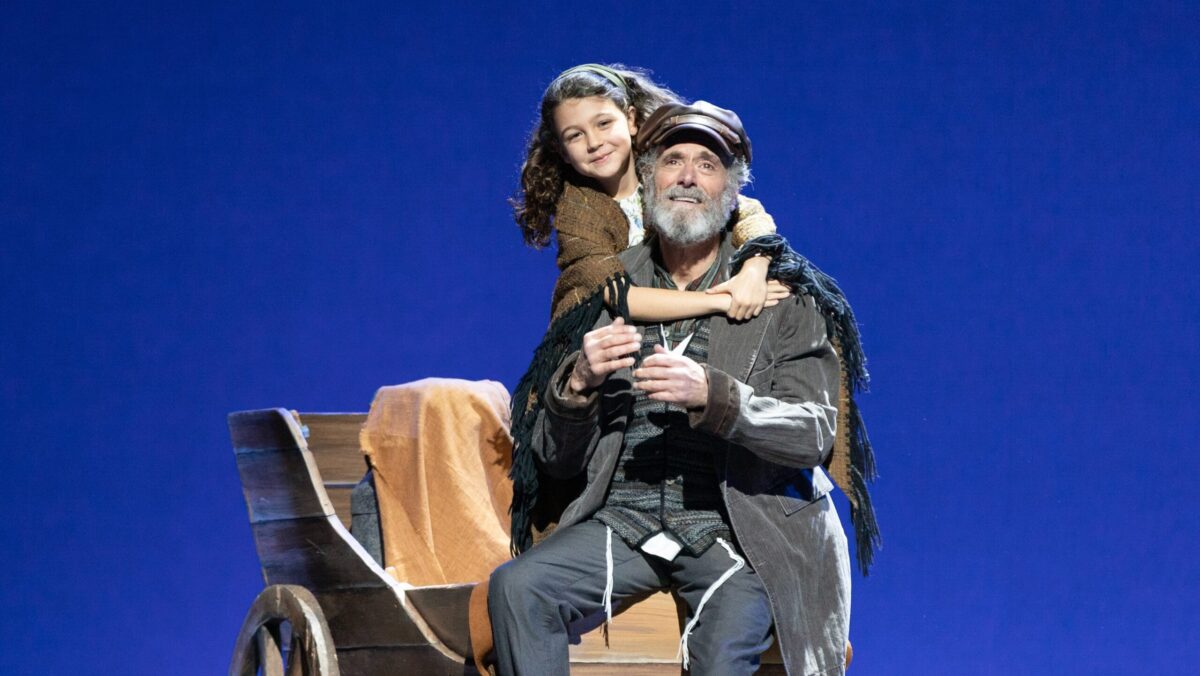
Skybell, in particular, demonstrated an impressive emotional range. In Tevye’s first solo number, “If I Were a Rich Man,” he sings of his poverty—pulling his milk cart without even a horse—while imagining what life might be like if he were wealthy. Reclining casually against the cart and delivering the number with a touch of swagger and humor, he initially seemed somewhat detached from the harsh physical reality of a poor patriarch forced to pull his own wagon. Yet as the evening unfolded, his interpretation proved persuasive. The same man who comically laments his fate later bids farewell to Hodel at the train station as she departs for Siberia to join the arrested Perchik. There, Skybell shed the humor entirely, delivering Tevye’s paternal love in a subdued, unsmiling tone—restrained, sorrowful, yet dignified. Through these contrasts, Skybell offered a layered and compelling portrayal, revealing the character’s complexity across sharply differentiated emotional registers.
Robinson displayed solid vocal production and precise delivery. In “Matchmaker, Matchmaker,” she moved fluidly between sung and spoken passages, crafting facial expressions that might have seemed exaggerated in another context but suited the heightened theatricality of the number perfectly. Wood, in “Miracle of Miracles,” captured Motel’s barely contained joy after receiving permission to marry, striking an effective balance between youthful exuberance and vocal control.
This production also featured opera singers, including Mela Dailey as Golde, Rachel Blaustein as Hodel, and Michael Pandolfo as Perchik. Dailey’s spoken dialogue was solid, but it was her singing that left the stronger impression—lyrical, warm, and lingering in effect. In “Sunrise, Sunset,” as the parents reflect in disbelief on how their daughter and her groom have grown up, Dailey conveyed both a swell of nostalgia and a quiet hope that the newlyweds will weather life’s inevitable hardships. In “Do You Love Me?” Dailey delivered Golde’s response to Tevye’s question with understated warmth. She gently traced the shared years of their life together before finally admitting, with moving simplicity, that love has indeed grown between them. In both numbers, her duets with Skybell were especially effective, as operatic resonance and musical-theater directness remained distinct yet harmonized beautifully, creating moments of genuine intimacy.
Blaustein—who made a memorable impression in Austin Opera’s 2024–25 season as Jocelyn in The Manchurian Candidate—again demonstrated the clarity of her voice. Her declarations of love for Perchik rang with confidence and warmth, while her parting from her father was colored by controlled, unembellished sorrow. She navigated the emotional contrast with notable poise. Pandolfo’s delivery—clear, ringing, and immediately arresting—suited Perchik’s character particularly well, especially given his role as a principled challenger of tradition. His vocal presence matched the character’s conviction, and he handled the spoken dialogue with natural ease. Their duet, “Now I Have Everything,” though a musical-theater number, took on a fresh dimension when sung by two operatic voices. For an audience accustomed to opera, the blend of fuller vocal production with Broadway lyricism was especially appealing, creating one of the evening’s most striking moments.
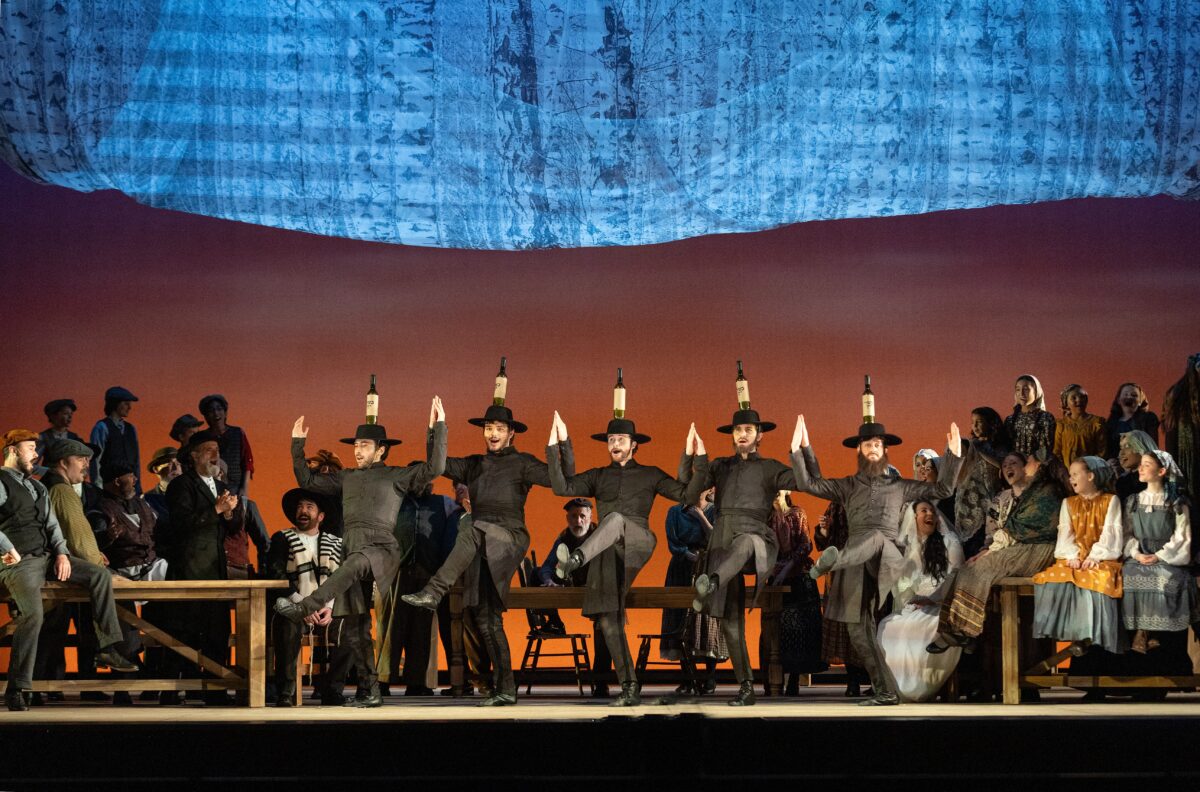
Photo by Erich Schlegel
In “To Life”—when Tevye meets Lazar Wolf to discuss granting permission for his daughter Tzeitel’s marriage and the match is celebrated—Michael Pappalardo’s choreography proved especially striking. By incorporating ballet-inflected movement into the celebratory dance, he expanded the musical number into something that evoked the spirit of operetta. In translating the musical to the operatic stage, this choice not only heightened the theatrical scale but also lent the scene an operetta-like quality, suggesting a deliberate effort to bring the musical seamlessly into the operatic world rather than merely reproducing it.
Throughout the evening, Patrice Calixte, as the fiddler, appeared intermittently onstage, drawing out haunting lines that lingered in the ear. He functioned as a symbolic reminder of Tevye’s insistence on the necessity of tradition—a quiet but persistent presence amid the drama. As Tevye prepares to leave the village, he lifts the fiddler onto his cart before departing. This gesture recalls his opening meditation that life is “as shaky as a fiddler on the roof,” and that tradition provides balance in the midst of uncertainty. By returning to this central metaphor, the production underscores that even as the physical village vanishes, tradition itself endures and moves forward.
For a company long identified with canonical operatic repertoire, this historically and locally contextualized staging—developed in partnership with Austin’s Jewish community—suggests that Austin Opera was not only presenting Fiddler but also enacting its own institutional transformation.