
Photo by Marcus Lieberenz
What performances or works come to mind when hearing the name Erich Korngold? Perhaps his film score for The Sea Hawk comes to mind, or maybe this timeless performance of Renée Fleming singing “Mariettalied” from his opera Die Tote Stadt. While I previously had a difficult time naming any other beloved works by Korngold, this changed after seeing the Deutsche Oper’s production of Violanta.
Violanta was written when Korngold was just 18 years old, leaving me to wonder what an 18-year-old knows about grief, passion, and sin. A lot, apparently! Violanta originally premiered on March 28, 1916, at the Munich Court Theatre under Bruno Walter. With libretto by Hans Müller, Violanta’s plot took inspiration from a portrait in the Vienna Kunsthistorisches Museum. The anonymous woman in Tiziano Vecellio’s oil painting from 1515 casts a gentle side-eye but offers not much else, allowing Müller to paint his own characterization.
The plot follows the melancholy Violanta as she seeks revenge for her sister’s heartbreak and subsequent suicide. The action opens on a silent, chaste Violanta uncharacteristically attending the Venetian Carnival outside her door. At the Carnaval, she encounters her sister’s seducer, Prince Alfonso, and commences her revenge scheme. Violanta lures Alfonso to her home, planning to have her husband, Captain Simone Trovai, murder him. This does not go as planned, however, for when Alfonso arrives and begins to sing, Violanta becomes intoxicated with passion and declares her love for him (not even she can resist a tall tenor). She declares, “hatred and love are brothers,” and realizes that rather than driven by revenge, she is driven by her own erotic desire for Alfonso.
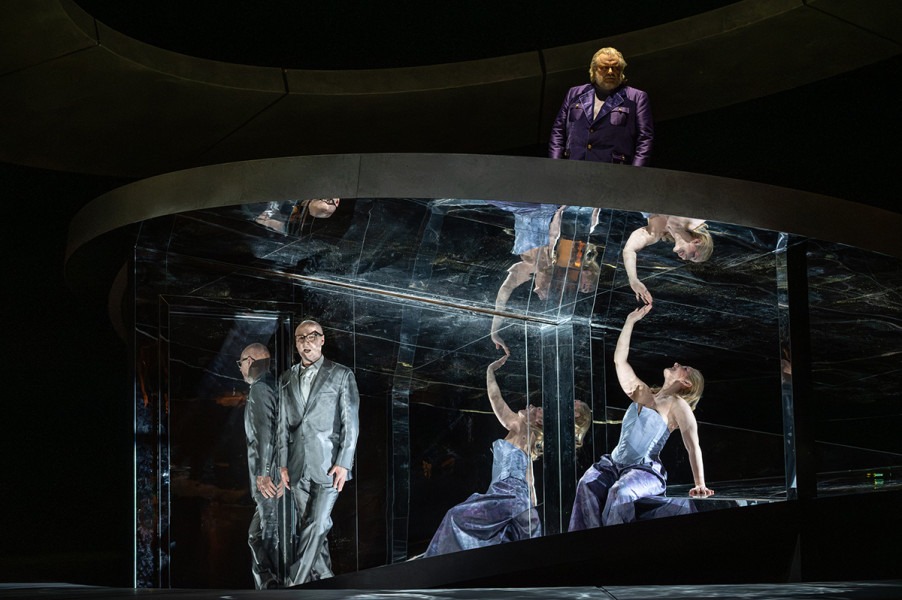
While the libretto maintains that Violanta’s erotic passion is directed at Alfonso, the stage direction suggested an alternative narrative. During the climactic love scene, Violetta ran from room to room, stumbling upon her dead, wet sister, an elderly version of herself, and a realization of the holy mother with six breasts. Busy running, Violanta never actually embraced Alfonso; rather, when they sang of their love for one another, she danced along with carnival guests or looked at herself in the mirror. As director David Hermann made clear in interviews, the interpretation was that Violanta “found herself” in giving into her desires.
To support this interpretation, the ending is left vague. While the plot calls for Violanta’s death by Simone’s knife, in this production, she walked away unscathed by Simone’s bullet. As a feminist attempt to reclaim the common trope of operatic femicide, Hermann asks the audience, “Does she really die the operatic death prescribed in the libretto, or has she found herself?” As the opera ended, the set carrying Violanta and Alfonso descended as if they had a dinner date with Don Giovanni. Before he was out of view, Alfonso made sure to cross off another name in his little black book, driving home the Don Giovanni parallel.
Vocally, Laura Wilde (Violanta) appeared to be holding back during the first half of the performance, perhaps, a conscious choice to mimic Violanta’s modesty and coldness. However, even if it was a choice, it made it difficult to hear Wilde over the orchestra, especially when she sang in her middle voice. When she did cut through, however, her voice was pristine, with not a note awry. She understandably opened up (both emotionally and vocally) when confessing her love for Alfonso, her upper voice seemingly singing “checkmate” to the orchestra. Mihails Culpajevs (Alfonso) sang as if Korngold was a verismo composer, his high notes (of which there are many) eliciting three-tenor power. Alfonso’s aria, “Sterben wollt ich oft,” wherein he sings of his daddy issues, was the highlight of the opera and should be required reading for every tenor.
The costuming was chic, featuring a variety of purple shades and a campy renaissance flare. The exaggerated padding of hips and shoulders was fabulous, mimicking recent styles seen on the runway. The set was minimal, featuring a sole rotating column that revealed facets of Violanta’s subconscious as she sang of her love for Alfonso. Alfonso, all the while, psychoanalyzed her from a far, wearing a grey suit and glasses as if he studied with Freud.
As an appetizer, the Deutche Oper’s production opens with two instrumental works: the first a Dowland lute piece and the second, the first movement from the Prelude of Berg’s Three Orchestral Pieces. The opening lute solo is presented as a gift to the melancholy Violanta, her husband Simone trying anything to lift her spirits. However, as Simone (Ólafur Sigurdarson) danced to the lute solo, I could not unsee his likeness to famous lutenist, Paul O’Dette. As the lute solo continued the misguided choice of repertoire became obvious —we are at a Venetian Carnival, not in Renaissance England! Why not play a piece by Francesco da Milano instead?


#/media/File:Tiziano_Vecellio,_gen._Tizian,_Kunsthistorisches_Museum_Wien_-_Violante_-_GG_65_-_Kunsthistorisches_Museum.jpg)